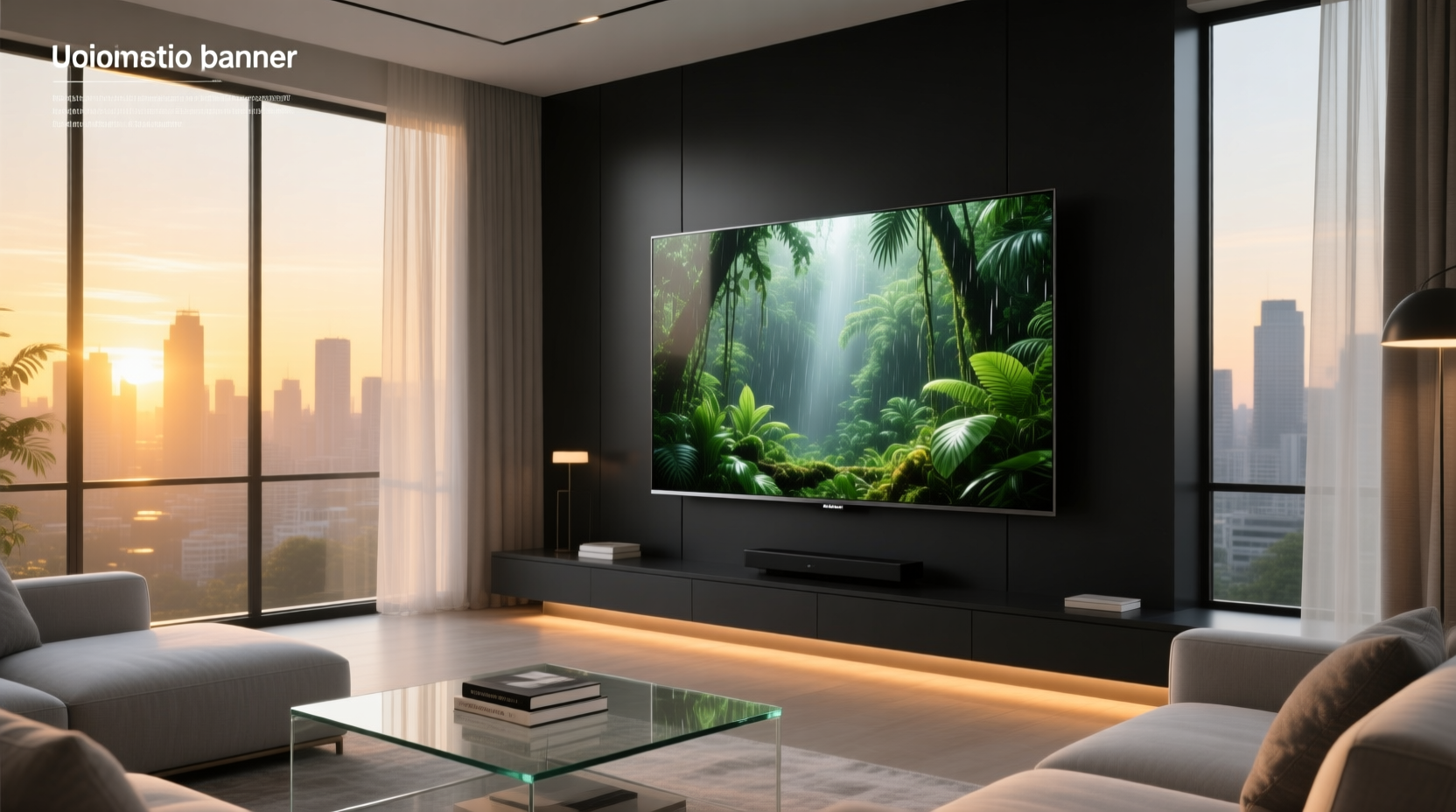
Buying a 90-inch LED TV isn’t like upgrading from 55″ to 65″ — it’s a structural, spatial, and technical leap. Most consumers searching for led 90 inch tv assume such sets are widely available, mainstream, and plug-and-play. In reality, true 90″ consumer-grade LED TVs are extremely rare in North America and Europe; nearly all current ‘90-inch’ listings on major retail platforms refer to commercial displays, legacy models (e.g., Sharp LC-90LE745), or oversized panels sold via B2B channels 1. This guide cuts through the confusion: we explain actual physical size, realistic resolution expectations (4K vs. 1080p), power and mounting requirements, viewing distance math, and — critically — why 85″ or 86″ is often the largest *practical* choice for home living rooms. You’ll learn exactly what to verify before committing — and how to spot misleading specs.
What’s Actually Available in the 90-Inch LED TV Category?
Major consumer electronics brands focus their 2024–2025 product roadmaps on sizes with broad residential adoption and engineering maturity. As a result, Samsung, LG, TCL, Hisense, and Sony do not currently list 90″ models in their official consumer lineups for the U.S., Canada, or EU markets. Instead, listings labeled “90-inch” typically fall into three categories:
- Legacy commercial displays: Like the Sharp LC-90LE745 (2012), a 1080p, 120Hz, 3D-capable LED-LCD panel originally designed for digital signage or trade shows. These units offer robust build quality and long operational life but differ from modern home TVs in interface design, connectivity, and smart functionality 2.
- B2B/wholesale units: Large-format Android-based LED TVs sourced through global supply channels, including platforms offering international procurement options. These models often feature customizable firmware, flexible integration options, and scalable deployment features suitable for enterprise or hospitality use 3.
- Misclassified or placeholder listings: Some retailers label 86″ or 98″ models as ‘90″’ in metadata or filters — a common SEO tactic that reflects search volume rather than exact product specification.
This explains why Google returns ~90 million results yet yields zero verified, in-stock, consumer-ready 90″ LED TVs at authorized retailers. Understanding these distinctions helps align expectations with real-world availability and intended use cases.
Physical Dimensions: How Big Is a 90-Inch TV, Really?
‘90 inches’ refers only to diagonal screen measurement — not width, height, or depth. A true 90″ 16:9 display measures:
- Width: ≈ 78.4 inches (199 cm)
- Height: ≈ 44.1 inches (112 cm)
- Depth (without stand): 2.5–4.5 inches (6–11 cm), depending on panel type
- Weight: Typically 110–150 lbs (50–68 kg) — significantly heavier than an 85″ (≈ 85–110 lbs)
That width alone exceeds standard doorways (32″) and many elevator cabs. Delivery requires freight service, stair negotiation planning, and professional unboxing. Wall mounting demands reinforced studs (not drywall anchors), dual-point anchoring, and UL-listed mounts rated for ≥175 lbs. Most residential walls — especially plaster or masonry without proper stud layout — cannot safely support this load without structural assessment.
Resolution Reality Check: What to Expect at 90 Inches
A 90″ screen magnifies pixel structure. At typical living room viewing distances (8–12 ft), even native 4K (3840 × 2160) resolution begins to show visible pixels — unless you sit ≥14 feet away. For reference:
| Viewing Distance | Perceived Resolution Clarity (90″ 4K) | Recommended Minimum Distance |
|---|---|---|
| 8 ft (2.4 m) | Noticeable pixel grid; text and fine detail appear soft | Not recommended |
| 10 ft (3.0 m) | Moderate clarity; HDR highlights hold up, but UI elements lack sharpness | Acceptable for casual viewing |
| 14 ft (4.3 m) | Optimal pixel blending; full benefit of 4K content realized | Ideal minimum |
Many ‘90-inch LED TVs’ found online — especially older or B2B units — are 1080p (1920 × 1080), not 4K. That means pixel density drops to ~24 PPI (pixels per inch), compared to ~49 PPI on a 98″ 4K set. At 10 ft, 1080p appears softer, with less texture fidelity in nature docs or sports. If resolution matters, confirm native panel spec — not just ‘UHD’ or ‘4K-ready’ marketing language.
Brightness, Contrast & Viewing Environment
LED backlighting performance varies with panel size and implementation. Consumer-grade large panels may have different brightness and contrast characteristics than mid-size models. Ambient light (windows, lamps, ceiling fixtures) affects perceived contrast, making dark scenes appear less deep in non-controlled environments. Unlike OLED, LED TVs use backlight systems that cannot turn off individual pixels; blooming around bright objects can occur, particularly with edge-lit designs common in large panels.
For a 90″ LED TV to deliver strong contrast in a typical living room (with natural light or overhead lighting), consider:
- A full-array local dimming (FALD) system with ≥100 zones (most large commercial panels have ≤32)
- Matte or anti-glare coating (less common on commercial-grade panels)
- Room light control — blackout curtains, directional lighting, no rear-wall reflections
These factors influence image quality across lighting conditions and help optimize viewing experience.
Smart Features & Ecosystem Compatibility: Feature Variations by Use Case
Large-format LED TVs often prioritize stability and integration over consumer-facing smart features. Many units ship with streamlined versions of Android TV or proprietary OS platforms optimized for reliability and long-term operation in commercial settings. Common configurations include:
- Core streaming apps (YouTube, Netflix, Prime Video) with stable playback performance
- Basic voice remote functionality for navigation and media control
- Support for HDR10 or HLG formats, with compatibility dependent on source and signal path
- HDMI inputs supporting common resolutions and refresh rates for professional AV workflows
In contrast, current-gen 85″–86″ consumer TVs (e.g., LG QNED82, TCL QM6K) ship with full Google TV or Roku OS, 3+ HDMI 2.1 inputs, and multi-year software support. Size and feature set should be evaluated based on primary usage context — whether residential entertainment or professional deployment.
Power, Heat & Longevity Considerations
A 90″ LED TV draws 250–400W under typical use — comparable to a desktop PC. Sustained HDR playback can spike to 500W+. This requires:
- A dedicated 15-amp circuit (not shared with HVAC or kitchen appliances)
- Adequate ventilation: ≥4 inches clearance on all sides, no enclosed cabinets
- Thermal management: Commercial panels are engineered for continuous operation in controlled environments; ambient temperature and airflow impact thermal performance
Lifespan estimates (60,000–100,000 hours) assume 50% brightness and 8 hrs/day usage 4. Real-world longevity depends on operating conditions, brightness settings, and maintenance practices. Manufacturers typically specify MTBF (mean time between failures) for commercial products under defined environmental parameters.
What Should You Buy Instead? Practical Alternatives Ranked
If your goal is maximum immersive impact without compromising usability, consider these proven alternatives — all widely available, warrantied, and engineered for home use:
- 85″–86″ 4K QLED/LED with FALD: Best balance of size, price, and performance. Models like TCL 85QM6K or LG 86UA7500 deliver near-90″ presence with full smart features, HDMI 2.1, and 1000+ nits peak brightness.
- 98″ Mini-LED (e.g., TCL 98QM6K): True consumer model, 4K, 144Hz, Google TV, and 1000+ nits — but costs 2–3× more and still demands 16+ ft viewing distance.
- Projection + ALR Screen (100″–120″): Far lower cost per inch, superior contrast, and no wall stress. Requires light-controlled room but delivers cinema-grade immersion.
When evaluating any large-format LED TV, confirm key specifications aligned with your use case: native resolution, local dimming capability, input compatibility, warranty terms, and service availability. Matching product features to environment and usage goals supports long-term satisfaction.
Frequently Asked Questions
- How much space do I need for a 90-inch TV? Minimum wall width: 84 inches (to accommodate bezel + mount). Recommended viewing distance: 14–18 feet. Ceiling height must be ≥9 feet to avoid top bezel obstruction.
- Is there a true 90-inch 4K LED TV sold at retail in the U.S.? No. As of mid-2024, no major brand offers a certified, FCC-compliant, consumer-warrantied 90″ 4K LED TV. All verified 90″ units are commercial or legacy stock.
- Can I mount a 90-inch LED TV on drywall? Absolutely not. You must locate and anchor into at least two solid wood or metal studs, spaced to match the VESA pattern (typically 800 × 400 mm or larger). Use lag bolts ≥1/4″ × 3″, not screws.
- Do 90-inch TVs support Dolby Vision? Almost none do. Dolby Vision certification requires precise dynamic metadata handling and hardware decoding — absent in commercial-grade 90″ panels. Only select 98″ consumer models (e.g., TCL 98QM6K) include it.
- Why are 90-inch TVs so expensive when listed? Pricing reflects low-volume manufacturing, freight logistics, and commercial-grade components — not consumer value. A $27,000 ‘90-inch LED TV’ typically costs 3× more than an equivalent-performing 86″ model due to scarcity, not superiority.
