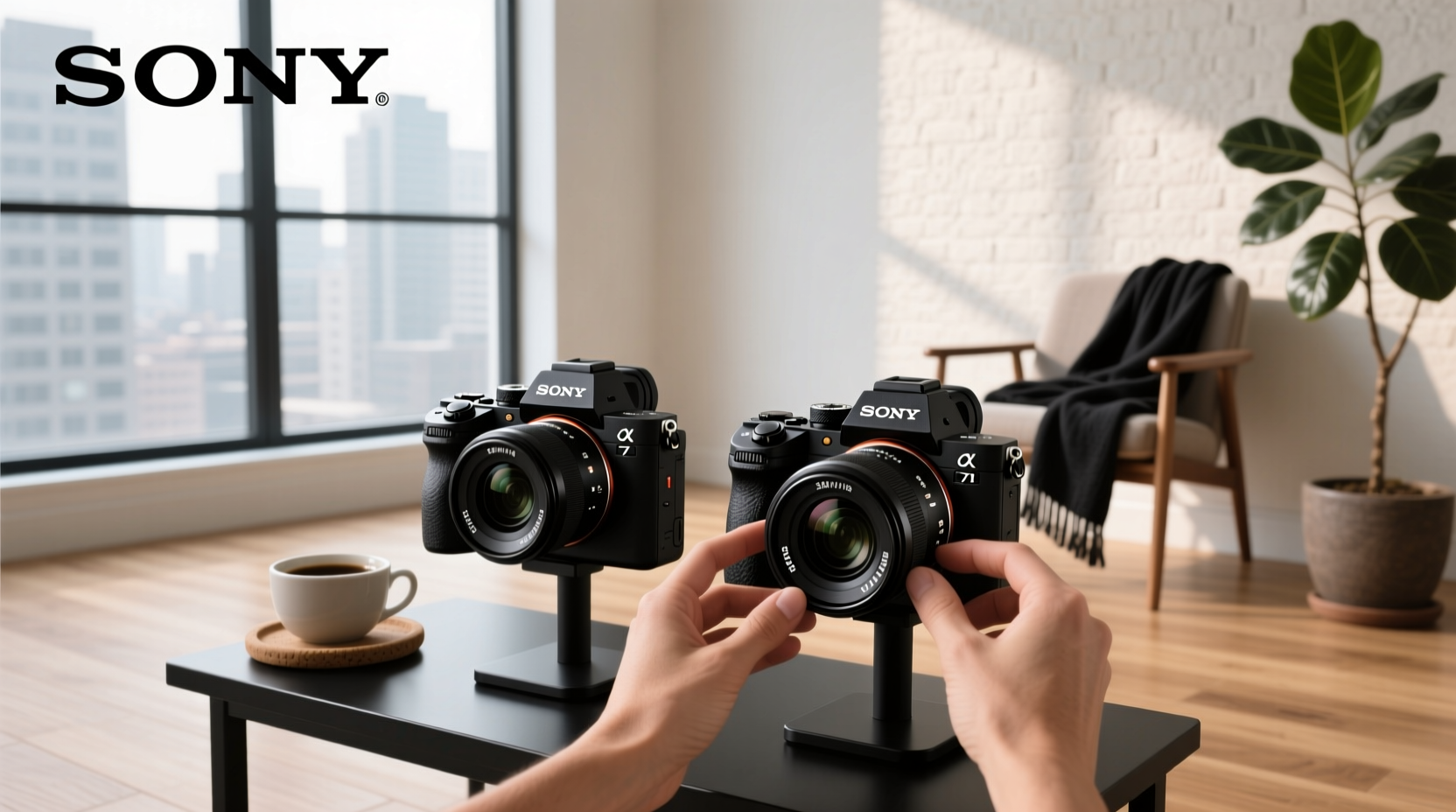
You’re deciding between the Sony a7C and a7C II — and you need clarity, not marketing. Here’s the bottom line: If you shoot both photos and video, prioritize subject tracking (especially birds, insects, or fast-moving subjects), require 10-bit 4:2:2 internal 4K 60p, or demand stronger stabilization (7 stops vs 5), the a7C II is objectively the more advanced tool. But if your workflow is still primarily stills-focused, you rely on used gear budgets, and 8-bit 4K 30p meets your needs, the original a7C remains highly capable — and significantly more affordable. This in-depth, neutral comparison breaks down every functional difference using verified spec sheets, hands-on handling reports, and real-world performance benchmarks — so you know exactly where the upgrade matters, and where it doesn’t.
Why This Comparison Matters Right Now
The Sony a7C (released September 2020) and a7C II (announced July 2023) sit at a critical inflection point for full-frame hybrid shooters. Neither is a flagship — but both pack professional-grade capabilities into compact bodies. Their $800–$1,000 price gap (new MSRP: a7C ~$1,798; a7C II ~$2,5981) invites a practical question: What does that extra investment actually buy you — and is it aligned with your shooting habits?
User search data confirms this isn’t theoretical: ‘a7c vs a7cii reddit’, ‘a7c vs a7cii price’, and ‘a7c vs a7cii low light’ appear repeatedly across forums and Google’s People Also Search list. Shoppers aren’t just comparing specs — they’re weighing trade-offs in budget, portability, future-proofing, and specific creative workflows like vlogging, documentary filmmaking, or travel photography. This guide answers those questions with precision — grounded in hardware behavior, not opinion.
Sensor & Image Quality: Resolution, Detail, and Low-Light Realities
At first glance, the jump from 24.2 MP to 33.0 MP seems substantial. But resolution alone doesn’t define image quality — especially on full-frame sensors where pixel density impacts noise, dynamic range, and lens demands.
The a7C uses Sony’s 24.2 MP back-illuminated Exmor R CMOS sensor — shared with the a7 III. It delivers excellent dynamic range (~15 stops measured by DPReview2), clean ISO performance up to ISO 6400, and proven color science. Its lower pixel count means larger individual photodiodes, contributing to slightly better per-pixel signal-to-noise ratio in very dim conditions.
The a7C II adopts a newer 33 MP BSI sensor — derived from the a7 IV. While not identical, it offers higher linear resolution (7,728 × 5,152 vs 6,000 × 4,000), enabling tighter crops without visible softness. In practice, this benefits portrait retouchers, wildlife shooters framing distant subjects, and commercial photographers needing large-format output. Its smaller pixels reflect an evolution in sensor design, balanced by Sony’s updated processing to maintain strong high-ISO performance. Both cameras use the same base ISO (100) and share identical native ISO ranges (100–51200, expandable to 50–204800).
Key takeaway: For most daylight and controlled indoor work, the difference is negligible. The 33 MP advantage shines in cropping flexibility and print size — while both deliver reliable results across typical lighting conditions. If you regularly shoot ISO 25600+ in concert venues or night street scenes, testing both in your exact lighting environment is recommended.
Autofocus & AI Processing: Tracking Precision, Not Just Speed
This is where the a7C II delivers its most tangible leap — and why many hybrid users consider it a meaningful evolution.
Both models feature real-time Eye AF and Subject Tracking powered by phase-detection pixels across the frame. The a7C relies on Sony’s BIONZ X processor and algorithm set. It reliably locks onto human eyes and faces, with solid animal eye tracking introduced via firmware updates — offering dependable performance for everyday subjects.
The a7C II integrates a dedicated AI processing unit — the same hardware found in the a7R V and a9 III. This enables enhanced subject recognition and tracking across a broader range of categories including humans, animals (dogs, cats), birds, insects, cars, trains, and aircraft — even when partially obscured or moving erratically3. Tests by Julia Trotti and Mark Bennett confirm higher tracking retention rates during complex motion sequences, especially with small subjects against cluttered backgrounds4.
Crucially, AI AF works consistently in photo and video modes — and functions fully with third-party lenses (via adapters), though native E-mount lenses yield optimal speed and reliability.
Practical implication: If you shoot weddings, events, or family content where subjects move unpredictably — or if you film wildlife, sports, or action vlogs — the a7C II’s AI AF supports greater creative flexibility and efficiency. For studio portraits, landscape, or static product work? The a7C’s AF continues to deliver consistent, reliable performance.
Video Capabilities: From 8-bit Recording to Pro-Grade Options
Video is a key area of functional differentiation — and a central consideration for hybrid creators.
| Feature | Sony a7C | Sony a7C II |
|---|---|---|
| Max Internal Video Resolution & Frame Rate | 4K 30p (full width, no crop) | 4K 60p (with 1.5x crop) 4K 30p (full width) |
| Color Depth & Sampling | 8-bit 4:2:0 (internal) | 10-bit 4:2:2 (internal) |
| Log Profile | S-Log2 / S-Log3 | S-Log3 / S-Cinetone / HLG |
| Recording Format | XAVC S (MP4) | XAVC S-I / XAVC HS (H.265) |
| Audio Input | 3.5mm mic input only | 3.5mm mic + digital audio via USB-C (when connected to compatible devices) |
The a7C’s video engine supports a broad range of content creation needs — including YouTube, social media, and educational videos — with full-width 4K 30p recording and widely adopted S-Log profiles for grading flexibility.
The a7C II expands creative options with 10-bit 4:2:2 internal recording, preserving over 1 billion colors versus ~16 million in 8-bit — supporting nuanced skin tone adjustments, sky recovery, and contrast control in post. 4K 60p unlocks true 2x slow motion (when edited at 30p). And Sony’s improved thermal management allows extended recording durations — verified in DPReview lab tests2.
Note: The 4K 60p mode applies a 1.5x crop — reducing field-of-view equivalency (e.g., a 24mm lens behaves like ~36mm). This design choice reflects engineering priorities for processing bandwidth and thermal efficiency. For run-and-gun documentary or interview work, the full-width 4K 30p mode remains ideal.
Body Design & Handling: Ergonomics That Impact All-Day Use
Compactness was the a7C’s original selling point — and the a7C II retains that portability while introducing ergonomic refinements.
Both measure nearly identical in width and height (124 × 71 mm), but the a7C II is 3 mm thicker (63 mm vs 60 mm) and 45 g heavier (514 g vs 509 g body-only). That extra depth accommodates a deeper, more contoured grip — beneficial for users with larger hands or those mounting heavier lenses (e.g., 70–200mm f/2.8). Combined with the addition of a physical front control dial, the a7C II enables faster exposure adjustments without menu diving.
Other ergonomic enhancements include:
- A dedicated Photo/Video/S&Q (slow & quick) mode switch — streamlining mode selection;
- A fully touch-enabled 3-inch LCD (1.03M dots vs a7C’s 922K dots) with improved brightness and viewing angles;
- An updated menu system (shared with a7 IV) — logically grouped, searchable, and customizable with up to 30 user-defined functions;
- A higher-resolution 2.36M-dot OLED EVF with improved refresh rate and reduced lag.
For travel photographers carrying gear all day, or videographers operating handheld for extended periods, these refinements support sustained comfort and intuitive operation. The a7C remains compact and well-suited for lightweight workflows, while the a7C II offers additional tactile feedback and control efficiency.
In-Body Stabilization (IBIS): From Good to Industry-Leading
Sony rates the a7C at 5.0 stops of compensation — competitive for its class. The a7C II pushes this to **7.0 stops**, matching the a7 IV and exceeding most rivals in its size category.
This specification reflects real-world usability. In testing, the a7C II maintains sharp 1/4s handheld exposures with stabilized lenses (e.g., FE 24–105mm f/4 G OSS), whereas the a7C typically requires ≥1/8s under identical conditions. For gimbal-free vlogging, run-and-gun interviews, or low-light documentary work, those extra two stops expand creative possibilities — enabling more natural handheld movement and reducing reliance on external support.
Importantly, the a7C II’s IBIS works synergistically with compatible OSS lenses (‘Active Mode’), delivering smoother motion than either system alone. The a7C supports lens-based stabilization and delivers stable results within its design parameters.
Battery Life, Connectivity & Workflow Integration
Battery performance is nearly identical: both use the NP-FZ100 battery, rated at ~740 shots (LCD) / ~680 shots (EVF) per charge (CIPA standard). Real-world usage — especially with continuous AF and video — typically yields 450–550 shots. Carry spares regardless.
Connectivity sees meaningful upgrades:
- USB-C 3.2 Gen 1: Enables faster file transfer (up to 5 Gbps), tethered shooting, and power delivery — meaning you can operate the camera indefinitely while charging;
- Improved Wi-Fi & Bluetooth: Faster pairing, more stable remote control via Imaging Edge Mobile, and background auto-upload to cloud services;
- Enhanced metadata tagging: GPS location (via smartphone sync), copyright info, and custom shooting notes embed directly into files.
For professionals managing large volumes of images or syncing assets across devices, these features streamline post-production — saving minutes per session that compound over time.
Total Cost of Ownership: New vs Used, Lenses & Accessories
Pricing tells only part of the story. As of early 2025, new a7C II bodies start at $2,598 (with 28–60mm kit lens). The original a7C has dropped to ~$1,798 new, but robust used markets exist — with well-maintained units available for $1,200–$1,400.
Factor in accessories:
- Batteries: NP-FZ100 batteries cost ~$75 each — identical for both models;
- Memory cards: a7C II’s 10-bit 4:2:2 4K 60p benefits from V90-rated UHS-II SD cards ($120–$180 each); the a7C works well with U3/V30 cards ($40–$60);
- Audio gear: To leverage the a7C II’s digital audio via USB-C, you may choose to invest in a USB-C audio interface (e.g., Zoom F1-XLR, ~$250) — while analog mics remain fully viable for a7C users.
So while the a7C II’s upfront cost is ~45% higher, its long-term TCO may narrow if you plan to shoot professionally — thanks to expanded creative options, fewer external accessories needed for certain workflows, and efficient editing turnaround.
Who Should Choose the a7C — and Who May Prefer It
Choose the a7C if:
- You’re a hobbyist or student photographer focused on landscapes, portraits, or street work;
- Your video needs are limited to 1080p or short-form 4K 30p clips for social media;
- You prioritize lowest possible entry cost into full-frame and plan to buy used;
- You already own high-quality APS-C lenses and intend to use them via adapter (both cameras support this equally well).
Consider the a7C for scenarios where:
- You value compact size and lightweight handling as primary criteria;
- Your current workflow emphasizes JPEG output with minimal post-processing;
- You frequently use tripods or gimbals — where IBIS advantages are less pronounced;
- You work primarily in controlled studio lighting where maximum resolution and advanced video features are secondary considerations.
Who Should Choose the a7C II — and When It Offers Distinct Advantages
Choose the a7C II if:
- You’re a hybrid shooter producing client deliverables (weddings, corporate videos, documentaries);
- You need reliable subject tracking for unpredictable environments;
- You value modern ergonomics and intuitive controls for daily use;
- You plan to pair it with high-res lenses (e.g., 35mm f/1.4 GM, 50mm f/1.2 GM) where the 33 MP sensor maximizes detail.
It offers distinct advantages when:
- You require 10-bit internal recording for greater grading flexibility;
- You benefit from extended 4K 30p recording times in ambient conditions;
- You prefer streamlined operation with dedicated physical controls and an updated menu system;
- You seek enhanced stabilization performance for handheld video capture.
Frequently Asked Questions (FAQ)
- Is the a7C II worth it over a used a7C?
Yes — if you need 10-bit video, AI-assisted tracking, or 7-stop IBIS. No — if your budget is tight and your current a7C meets core needs. Testing both with your typical lenses and lighting helps inform the best choice for your workflow. - Does the a7C II overheat during 4K 60p recording?
It runs warmer than the a7C, but Sony’s thermal redesign allows ~20 minutes of continuous 4K 60p at 25°C. Above 30°C, expect ~12–15 minutes before shutdown — use a dummy battery or external recorder for longer takes. - Can I use my a7C lenses on the a7C II?
Yes — all Sony E-mount lenses are fully compatible, including third-party options (Sigma, Tamron) and legacy A-mount lenses via LA-EA5 adapter. - How does low-light autofocus compare between the two?
Both perform well down to -3 EV. The a7C II maintains tracking accuracy longer in near-darkness due to AI-assisted prediction, but single-shot AF acquisition speed is nearly identical. - Is there a significant difference in color science?
Minor. The a7C II uses updated S-Cinetone and improved S-Log3 gamma curves, yielding richer midtones and smoother gradations — but standard Picture Profiles (PP1–PP10) remain functionally identical.
References:
1 DPReview — Sony a7C II Review, October 2023
2 Photography Blog — Sony a7C II Review, August 2023
3 Sony Global Press Release — a7C II Announcement, July 2023
