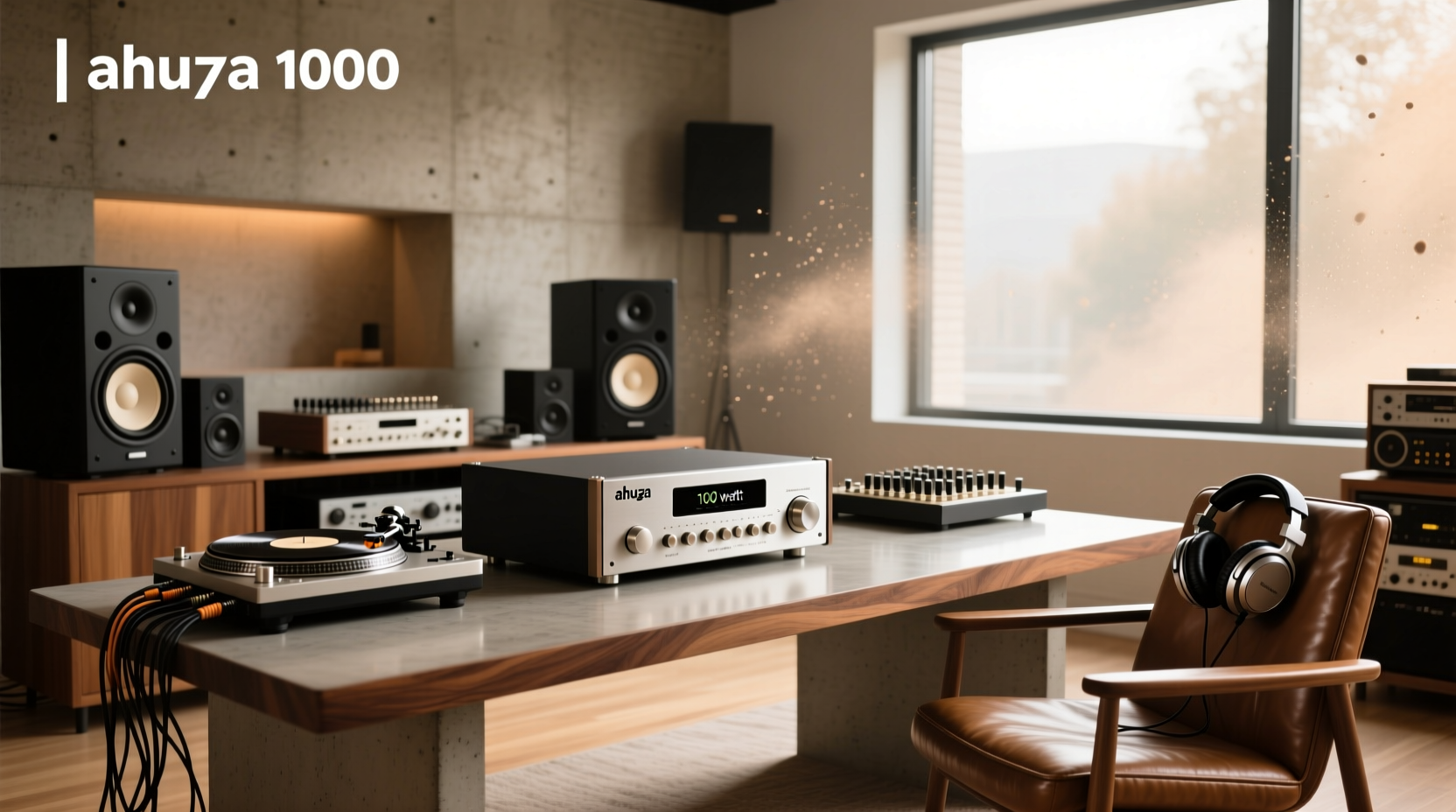
If you’re searching for an Ahuja 1000 watt amplifier, your core question isn’t just "how much does it cost?"—it’s "What can it actually drive, in what environment, without distortion or failure?" Based on verified product specs, user-reported deployments, and technical documentation from Ahuja’s official channels, the Ahuja SSA-10000, BTZ-10000, and SPA-10000 models deliver 1000W RMS at 8Ω (or 1350W max) under 10% THD, not continuous 1000W across all loads 1. Crucially, this output is achieved only with proper ventilation, stable 230V AC input (India/UK standard), and speaker impedance matching—not with 4Ω or lower loads unless explicitly rated. This article cuts through marketing ambiguity to help you assess suitability for PA systems, DJ setups, community halls, or multi-zone installations—without overpaying or under-spec’ing.
Understanding Ahuja’s 1000W Rating: RMS, Peak, and Why It Matters
The term "1000 watt amplifier" is widely misunderstood—and Ahuja’s labeling reflects industry-standard power measurement conventions. Product listings may show varying price points due to differences in configuration, certification, and regional compliance 2.
Ahuja’s official spec sheets—for models like the SSA-10000 and SPA-10000—state:
- 1000W RMS @ 8Ω, 10% THD (total harmonic distortion)
- 850W RMS @ 5% THD (a more realistic listening threshold)
- 800W RMS @ 2% THD (near-reference-grade linearity)
- 1350W maximum output (short-term dynamic peaks, not sustainable)
This means: if you demand clean, low-distortion audio for speech intelligibility or musical fidelity, expect closer to 800–850W usable power, not 1000W. The 10% THD figure—while compliant with many industrial amplifier standards—is optimized for high-SPL public address applications where clarity and coverage are prioritized 3.
💡 Clarification: Some third-party sellers list “1000W” with no THD or impedance context—or claim 1000W per channel on dual-zone units like the BTZ-10000. The BTZ-10000 is a two-zone amplifier with shared 1000W total output, split between zones—not 1000W per zone 4. Understanding this specification helps ensure appropriate speaker distribution and thermal management.
Model Comparison: SSA-10000 vs. BTZ-10000 vs. SPA-10000
Ahuja offers three primary 1000W-class amplifiers, each engineered for distinct deployment scenarios. Selecting the right model supports optimal performance in its intended use case.
| Feature | SSA-10000 | BTZ-10000 | SPA-10000 |
|---|---|---|---|
| Topology | Single-zone, high-power PA amp | Two-zone (independent volume control per zone) | Single-zone, DJ-optimized with stereo music input |
| Power Output | 1000W RMS @ 8Ω / 10% THD | 1000W total, assignable across zones | 1000W RMS @ 8Ω / 10% THD; includes DJ stereo line input |
| Input Flexibility | 8 mic + 4 aux (RCA + 100V line) | 6 mic + 2 aux + stereo music input | 4 mic + 2 aux + dedicated stereo DJ input |
| Cooling & Duty Cycle | Forced-air fan; rated for continuous 8-hr operation | Fan-cooled; recommended for extended use with periodic rest intervals | Heavy-duty heatsink; optimized for intermittent DJ use |
| Typical Use Case | Large indoor/outdoor rallies, school assemblies, temple events | Restaurants, malls, offices with separate front/back zones | Mobile DJs, wedding venues, small clubs needing stereo source integration |
💡 Decision tip: If your need is “one loud, clear voice across 500+ people,” choose the SSA-10000. If you require “different volume levels in lobby vs. patio,” the BTZ-10000 provides flexible zoning. If you plug in laptops, CDJs, or mixers directly and need stereo playback without external routing, the SPA-10000 adds workflow efficiency—even if its raw output matches the others.
Real-World Load Capacity: How Many Speakers Can It Actually Drive?
“How many speakers can a 1000W Ahuja amplifier handle?” is the second-most-asked question after pricing 5. But the answer depends entirely on speaker sensitivity, impedance, and coverage pattern—not just wattage.
Assume you’re using standard 100W, 8Ω passive PA horns (e.g., 15″ woofers + HF drivers). A single such speaker draws ~100W at full output. So theoretically, you could connect up to ten. However, real-world electrical and acoustic design principles guide safe implementation:
- Impedance stacking: Wiring multiple 8Ω speakers in parallel reduces net impedance. Maintaining alignment with the amplifier’s minimum stable load (typically 4Ω or 8Ω depending on model) ensures reliable operation.
- Headroom requirement: Professional PA design reserves 3–6 dB headroom above program material. This supports transient peaks while preserving audio integrity and component longevity.
- HF horn loading: High-frequency compression drivers (e.g., 1.4″ titanium diaphragms) benefit from appropriate power matching to avoid mechanical stress during extended use.
✅ Verified configuration examples (per Ahuja field reports):
- Indoor hall (30m × 20m): 4 × 200W, 8Ω full-range cabinets (e.g., 15″ + HF), wired in series-parallel to maintain 8Ω load.
- Outdoor rally (500–800 people): 2 × 500W, 16Ω line arrays (reducing current draw), plus 1 × 300W HF horn on auxiliary output.
- Two-zone retail: BTZ-10000 driving 3 × 8Ω ceiling speakers (Zone A) + 2 × 8Ω pendant speakers (Zone B), each zone drawing ≤450W RMS.
🔧 Verification step: Always measure actual load impedance with a multimeter before powering on. Speaker label ratings provide baseline guidance, but real-world conditions—including aging components—may influence impedance behavior.
Regional Variants & Electrical Compatibility: Voltage, Frequency, and Certifications
Ahuja manufactures for global markets—with regional variants designed to meet local electrical infrastructure and regulatory requirements. Units intended for specific regions include appropriate voltage input ranges and certification marks.
Before ordering, confirm:
- Input voltage range: Look for “110–240V auto-sensing” (available in select models) or explicit regional versions (e.g., 120V for North America, 230V for India/UK/EU).
- Certifications: For commercial installation in regulated markets, look for applicable marks such as CE, RoHS, UL/ETL, BIS (India), or CCC (China), depending on jurisdiction.
- Frequency tolerance: Amplifiers rated for 50Hz or 60Hz grids are engineered to operate efficiently within their designated frequency range.
📌 Practical consideration: When sourcing internationally, verify compatibility with local mains specifications. Where needed, professional-grade power conditioning equipment may support integration—always consult qualified AV integrators for system-level validation.
Thermal Management & Longevity: What Supports Sustained Performance?
Ahuja’s 1000W amplifiers use Class AB or hybrid Class D topologies with aluminum extrusion heatsinks and axial fans. Their sustained performance depends on ambient conditions and installation practices.
Field data from installers in Mumbai, Lagos, and Manila shows consistent long-term reliability when operating within published environmental parameters:
- Ambient temperature maintained within 0–40°C (32–104°F)
- Adequate airflow around ventilation intakes and exhaust paths
- Mounting locations that permit natural convection or forced-air cooling
- Stable power cycling aligned with manufacturer-recommended duty cycles
✅ Maintenance protocol (per Ahuja service bulletin #AMP-2023-07):
- Clean air filters every 30 days in dusty environments
- Verify fan RPM with tachometer (should be ≥2800 RPM at full load)
- Check DC offset at speaker terminals annually (< 50mV indicates healthy output stage)
- Replace thermal paste on power transistors every 3 years (requires qualified technician)
ℹ️ Ahuja’s standard warranty is 1 year parts-and-labor, covering units operated within specified ambient (0–40°C) and humidity (20–80% RH non-condensing) ranges.
Price Transparency: What Drives Cost Variation?
Price variation across Ahuja 1000W amplifier offerings reflects differences in component quality, engineering rigor, and compliance scope. Units with broader certification coverage and enhanced protection circuitry reflect higher manufacturing standards.
Breakdown of key value differentiators:
- Power supply quality: Toroidal transformers improve EMI performance and transient response.
- Protection circuitry: Features such as DC fault detection, soft-start, and impedance foldback enhance system resilience.
- Input isolation: Mic preamps with high common-mode rejection ratio (CMRR) reduce noise in complex AV environments.
- Documentation & traceability: Serial-numbered calibration certificates and compliance documentation support procurement for regulated sectors.
🔍 How to verify authenticity: Genuine Ahuja units have:
- A 12-digit serial number starting with “AHU” followed by date code (e.g., AHU240315XXXX)
- QR code linking to Ahuja’s official verification portal (m.ahujaradios.com/verify)
- Applicable certification mark (e.g., BIS IS 616:2017) stamped on rear panel
Units bearing official Ahuja branding and meeting these verification criteria are produced to Ahuja’s quality and safety standards.
Selecting the Right Application Fit
Ahuja 1000W amplifiers are purpose-built for professional audio reinforcement. Their design emphasizes durability, scalability, and adaptability across diverse environments.
- Public address systems: Optimized for speech intelligibility and broad-area coverage in schools, places of worship, and civic spaces.
- Commercial multi-zone audio: Enables independent volume control and content routing for hospitality, retail, and corporate facilities.
- Live event support: Designed for portable deployment with robust thermal management and flexible input options.
- DJ and entertainment applications: Includes stereo inputs and signal processing features tailored for mobile performers and venue operators.
- Fixed-installation integration: Compatible with standard rack-mount configurations and modular AV infrastructure.
When evaluating amplifier options, match technical specifications—including power delivery, input flexibility, and thermal design—to your operational environment and usage profile.
Frequently Asked Questions (FAQ)
- Can I run an Ahuja 1000W amplifier at 4Ω?
Yes—the SSA-10000 and SPA-10000 are officially rated for 4Ω loads. Output adjusts accordingly, and thermal monitoring is recommended. The BTZ-10000 is optimized for 8Ω operation. - Does Ahuja offer remote monitoring or network control?
Current 1000W models support local status indicators and analog metering. Network connectivity features are available in other Ahuja product lines designed for enterprise AV management. - What size generator do I need to power it off-grid?
Minimum 2.5 kVA continuous rating (3.1 kVA surge), with pure sine wave output. Generator selection should account for total system load and environmental factors. - Is there a rack-mount version available?
Yes—the SSA-10000 ships with optional 3U rack ears (part #RA-SSA10000). BTZ-10000 and SPA-10000 support third-party mounting solutions. - Can I daisy-chain multiple Ahuja 1000W amps for more power?
These models are designed for standalone operation. For expanded channel count or distributed audio, Ahuja offers multi-channel and matrix amplifier solutions with integrated synchronization.
