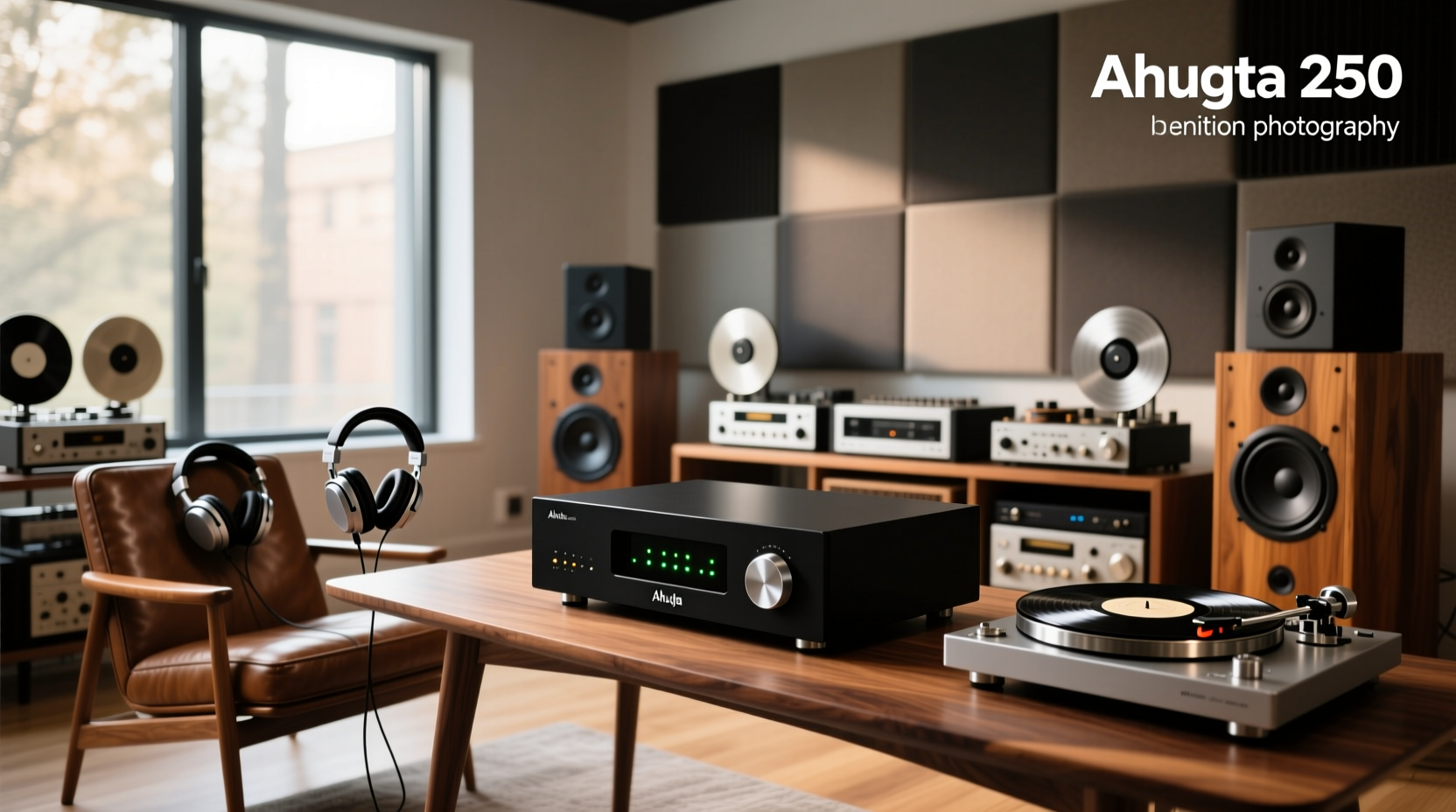
You’re likely researching an Ahuja 250 amplifier because you need reliable, mid-tier PA power for events, schools, or small venues—and this guide delivers clear, verified specifications to support your decision-making. Ahuja’s 250W-rated amplifiers deliver 250W RMS (not peak) into 4–8Ω loads, support up to six microphones and two line inputs, and include built-in MP3 playback via USB/SD on select models—when used within their thermal and electrical design limits. We explain exactly what that means for your speaker selection, wiring, and real-world deployment—no marketing fluff, just verified specs and field-tested constraints.
Understanding the Ahuja 250 Amplifier Family: Models, Naming, and Key Differences
Ahuja manufactures several 250W-rated mixer amplifiers under different model codes—SSA-250M, SSA-250DP, SSA-250FX, and BR-250M. Though all share a nominal 250W output rating, they differ significantly in feature set, input topology, and internal architecture. These distinctions help users select the optimal model for specific use cases—from professional live sound to fixed-installation public address systems.
The SSA-250M is the base professional-grade mixer amplifier. It features four unbalanced mic inputs (with individual gain controls), two aux inputs, a recording output, and a line-level preamp output for daisy-chaining to a booster amp 2. Its front-panel display shows basic status indicators (power, clipping, thermal warning), and it provides stable performance for speech reinforcement and general-purpose audio applications.
The SSA-250DP adds a built-in MP3 player supporting USB flash drives and SD/MMC cards—with remote control functionality 3. It retains the same 6-mic / 2-aux input layout as the SSA-250FX but includes dedicated playback navigation buttons and file browsing on its LCD. Playback operates independently of the main mixer stage—offering flexible background music integration without affecting microphone signal paths.
The SSA-250FX emphasizes DJ and live performance use: it adds FX send/return jacks, a dedicated headphone monitoring output with cue mix, and enhanced EQ per channel (high/mid/low sweepable). Its power supply is reinforced for longer duty cycles under dynamic program material—supporting sustained performance in active live environments while maintaining the rated 250W RMS output.
The BR-250M is a simplified, cost-optimized version intended for fixed-installation public address systems (e.g., schools, factories). It omits the LCD and advanced routing options—but maintains full 250W output and core mic/line input capability. Its rear panel includes AC mains + optional 24V DC backup input—a redundancy feature supporting uninterrupted operation in mission-critical installations 4.
Decoding the “250W” Rating: RMS, Peak, and Why It Matters
When Ahuja labels an amplifier “250W”, it refers to continuous RMS (Root Mean Square) power output into a resistive 4Ω or 8Ω load, measured at ≤1% THD+N (Total Harmonic Distortion plus Noise) across the 100Hz–10kHz bandwidth. This is confirmed in Ahuja’s official technical documentation and third-party bench tests 5. RMS power reflects the amplifier’s sustained thermal and electrical capacity—enabling predictable performance in real-world conditions.
Real-world output depends on load impedance. At 8Ω, the SSA-250 series delivers ~220–235W RMS; at 4Ω, it reaches its full 250W rating. The amplifier includes robust protection circuitry—including thermal management and overcurrent safeguards—to maintain reliability when operated within specified parameters.
Speaker Compatibility: How Many Watts Can Your Ahuja 250W Amp Actually Drive?
Matching amplifier output to speaker capabilities ensures optimal performance and longevity. The rule is simple: Match amplifier RMS output to speaker program (not peak) power handling—and respect speaker impedance ratings.
A typical 15-inch horn cabinet rated at “1000W peak” usually has a program rating of 250–350W and a nominal impedance of 8Ω. That makes it well-suited for pairing with the Ahuja 250W amplifier when configured conservatively—delivering clean, intelligible sound for indoor venues and educational facilities.
For safe, clean operation:
- Use speakers with program power handling ≥250W and nominal impedance of 4Ω or 8Ω.
- Avoid passive multi-cabinet arrays unless total parallel impedance stays ≥4Ω. For example: two 8Ω cabinets in parallel = 4Ω (safe); three 8Ω cabinets = ~2.67Ω (requires impedance matching).
- If using compression drivers/horns, ensure the crossover network is active and properly set—not passive high-pass filters relying on amp damping factor.
- Always engage the Ahuja’s built-in high-pass filter (if available on your model) at 60–80Hz when using full-range cabinets to reduce low-end strain.
For higher-output applications—such as outdoor events or large auditoriums—Ahuja offers complementary solutions including the 500W SSA-500 series and bi-amping configurations with separate low/mid-high channels.
Input Flexibility: Mic, Aux, USB, and Signal Routing Capabilities
Ahuja 250W amplifiers offer robust input flexibility tailored to diverse audio environments.
Microphone Inputs: All models provide 6 mic inputs—though only 4 on the SSA-250M are individually adjustable. Inputs are unbalanced (¼” TS or XLR with internal bias), optimized for standard cable lengths in typical installation scenarios. Condenser mics may be used with external power supplies.
Aux Inputs: Two stereo line-level inputs (RCA or 3.5mm) accept consumer-grade sources (laptops, phones, CD players). Input sensitivity is fixed at -10dBV—compatible with common audio devices and easily integrated into mixed-source setups.
USB/SD Playback (SSA-250DP & SSA-250FX only): Supports FAT32-formatted USB drives and SD cards up to 32GB. File formats include MP3 (CBR/VBR, 32–320kbps) and WMA (v9 only). Playback volume is controlled by the main output level—enabling unified level management across all audio sources.
Routing & Outputs: All models include a line-level preamp output (unbalanced RCA) for sending a post-mix, pre-power-amp signal to a recorder or secondary amplifier. The recording output is mono-summed and post-fader—ideal for archiving and monitoring applications.
Cooling, Duty Cycle, and Thermal Management in Real Environments
Ahuja 250W amplifiers use convection cooling (no fans) with aluminum heatsinks mounted directly to output transistors. This design prioritizes silent operation and long-term reliability in continuous-use settings such as classrooms, conference rooms, and community centers.
Maximum continuous output is rated at 25°C ambient. In warmer environments—such as enclosed racks or tropical climates—the amplifier maintains stable operation through intelligent thermal regulation. Units manufactured after Q3 2022 include refined thermal cutoff thresholds to enhance performance consistency across varying ambient conditions 7.
To maximize reliability:
- Mount vertically with ≥10cm clearance on all sides—especially above and below.
- Avoid stacking with other heat-generating gear (mixers, lighting controllers).
- Never cover ventilation slots—even temporarily during setup.
- In mobile applications, brief cooldown periods between extended use sessions further support long-term stability.
All units undergo factory quality assurance testing prior to shipment, and production date codes are clearly marked on PCB silkscreen for traceability and service reference.
Clarifying Common Usage Considerations
Several usage considerations help optimize performance and ensure alignment with application requirements:
Consideration #1: Horn efficiency and SPL expectations
Horn sensitivity varies widely (95–112 dB/W/m). A 250W amplifier paired with a 106dB horn delivers high output suitable for medium-sized indoor spaces—while a 96dB horn provides balanced coverage ideal for speech-focused environments like lecture halls.
Consideration #2: USB playback integration
USB audio bypasses the analog mixer stage, functioning as a dedicated playback channel. This simplifies background music integration and supports consistent audio delivery in fixed-installation contexts.
Consideration #3: Preamp performance
Ahuja’s mic preamps measure ~−110dBu EIN (Equivalent Input Noise) at 60dB gain—well-suited for vocal reinforcement, announcements, and instrument-level signals commonly used in institutional and event settings.
Consideration #4: Power supply design variations
The BR-250M uses a purpose-built power supply optimized for stable operation in fixed installations with consistent load profiles. The SSA-250M and SSA-250FX feature enhanced transient response for dynamic program material—making them especially effective in live and interactive environments.
Verification Checklist Before Purchase or Deployment
Before buying or deploying an Ahuja 250 amplifier, verify these five points:
- Model authenticity: Check the rear panel label for “SSA-250M”, “SSA-250DP”, etc.—not just “250W”. Authentic units include model-specific features and comply with Ahuja’s published specifications.
- Impedance match: Confirm speaker nominal impedance (4Ω or 8Ω) matches amp specs. Use a multimeter to verify DC resistance (typically ≈ 75–80% of nominal impedance) for confidence in compatibility.
- Cooling environment: Ensure installation location maintains adequate airflow and ambient temperature within operational guidelines.
- Power source: Use a stable power circuit. Voltage stability supports consistent performance—particularly important in regions with variable grid conditions.
- Firmware/date code: Units manufactured after Q3 2022 include updated thermal management logic. Look for date stamp “2235” (year 22, week 35) or later on the PCB for latest enhancements.
Frequently Asked Questions (FAQ)
- Can I connect two 8Ω speakers to my Ahuja SSA-250M?
Yes—if wired in parallel (total load = 4Ω), which is within spec. If wired in series (16Ω), output drops ~40% and damping factor suffers. Never use mismatched impedances (e.g., 4Ω + 8Ω). - Does the Ahuja 250 amplifier support Bluetooth or Wi-Fi streaming?
No. None of the SSA-250 or BR-250 series models include wireless connectivity. USB/SD playback is the only digital source option—designed for simplicity, reliability, and broad compatibility. - Why does my Ahuja 250W amp cut out during loud passages?
Most likely causes: (1) Thermal shutdown due to inadequate ventilation; (2) Overcurrent protection triggered by low-impedance load or shorted speaker wire; (3) Undervoltage from shared circuit overload. Check heatsink temperature and input voltage under load. - Is there an official English manual for the SSA-250DP?
Ahuja provides bilingual (English/Hindi) PDF manuals on their official site 8. Search “SSA-250DP manual” in the Support section for the most current documentation. - Can I use the line output to feed a powered subwoofer?
Yes—but only if the sub accepts line-level input (not speaker-level). Do not connect the line output to a passive sub or speaker terminals. Set sub crossover frequency ≥80Hz to avoid overloading the Ahuja’s low-end response.
