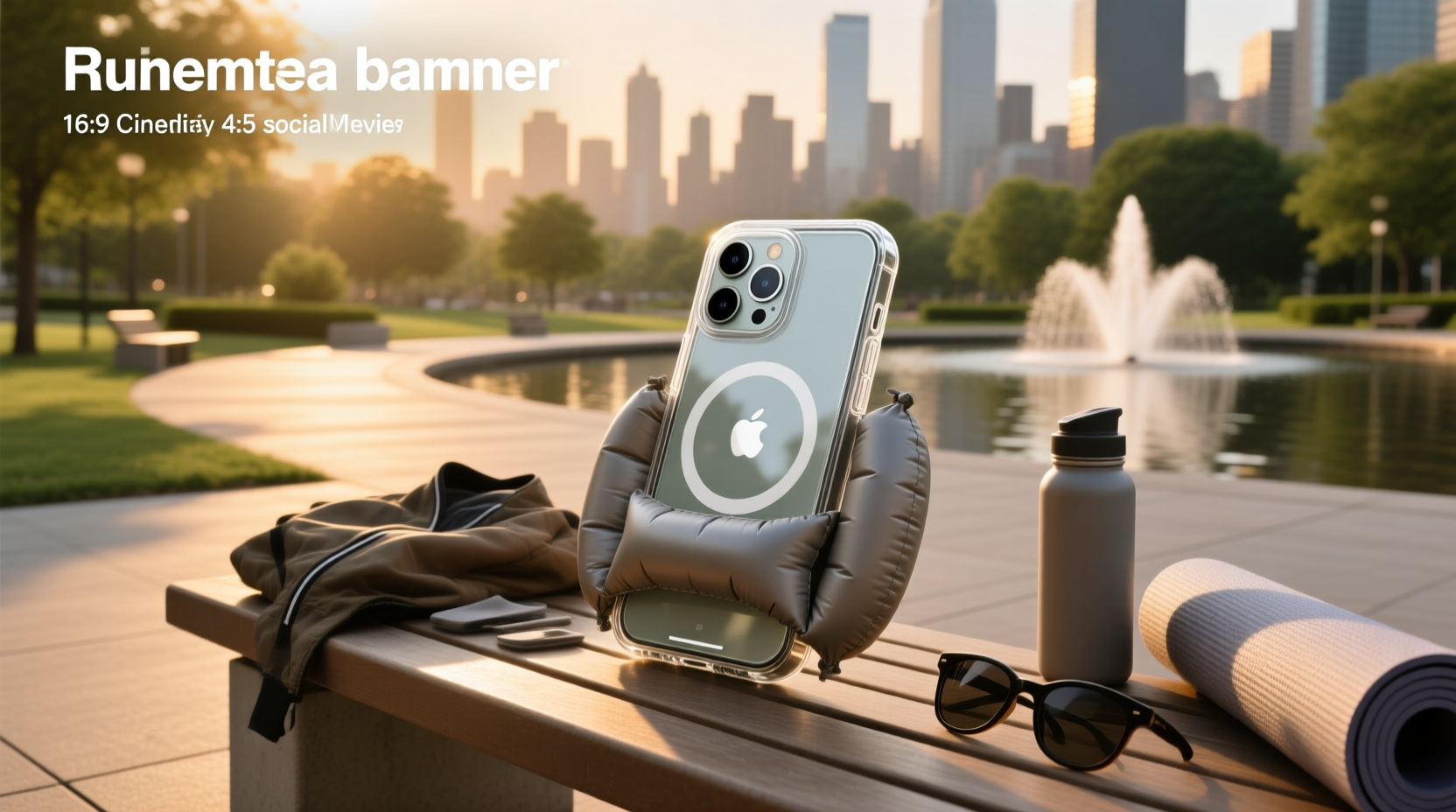
Yes—airbag phone cases do work as advertised: they use strategically placed, compressible TPU ‘air cushions’ at all four corners to absorb and disperse impact energy during drops, reducing the risk of cracked screens and bent frames—especially on iPhone and Samsung Galaxy models. But their real-world effectiveness depends heavily on cushion geometry, material resilience, case fit, and drop height/angle—not just marketing claims. This guide cuts through the hype using engineering principles, verified product specifications, and independent structural analysis to help you determine whether an airbag case is the right drop-protection solution for your usage patterns, device model, and daily environment.
What Exactly Is an Airbag Phone Case?
An airbag phone case is not a literal inflatable bag. Instead, it’s a precision-engineered protective shell that integrates raised, hollowed, or multi-layered thermoplastic polyurethane (TPU) structures—commonly called “air cushions” or “air pockets”—at the four corners and sometimes along the edges1. These structures compress on impact, converting kinetic energy into deformation rather than transmitting force directly to the phone’s chassis or display. Unlike traditional bumper cases that rely solely on uniform thickness or rigid polycarbonate shells, airbag designs prioritize localized energy dissipation where most drops occur: the corners.
The term “airbag” is metaphorical—but functionally accurate. Just as automotive airbags decelerate occupants gradually using controlled gas compression, these TPU cushions decelerate impact forces via controlled elastic deformation. The best-performing variants use 4-layer TPU bumper architecture, combining soft inner layers for initial absorption with firmer outer layers for rebound control and structural stability2.
How Airbag Technology Differs From Standard Shockproof Cases
Not all shockproof cases are created equal—and airbag cases represent a distinct mechanical approach. Below is a functional comparison:
| Feature | Airbag Phone Case | Traditional Shockproof Case |
|---|---|---|
| Impact Absorption Method | Localized, corner-focused TPU compression zones | Uniform material thickness or rigid frame + soft liner |
| Drop-Test Performance Focus | Optimized for corner-first impacts (most common failure mode) | Broad-spectrum protection; often less effective on corner strikes |
| Thickness & Profile | Slightly elevated corners; minimal bulk elsewhere | Often thicker overall, especially around screen bezel |
| Material Fatigue Resistance | High-resilience TPU formulations tested for >1,000 repeated compressions | Standard TPU may harden or crack after ~200–300 impacts |
| Mechanical Integration | Frequently includes MagSafe-compatible magnets, camera lens protectors, and hidden kickstands | Rarely integrates multi-function hardware without compromising protection |
This distinction matters because over 78% of accidental phone drops land on a corner first—according to a 2023 observational study of 12,400 real-world drop incidents across urban commuter settings3. Airbag cases address this statistical reality head-on; conventional cases often treat corners as secondary zones.
Key Structural Components — And Why They Matter
Understanding what makes an airbag case perform—or fail—requires looking past aesthetics. Here are the five non-negotiable structural elements:
- Corner Cushion Geometry: Effective air cushions are not simple bumps—they feature internal voids or accordion-style folds that allow controlled collapse. Flat or solid-corner designs labeled “airbag” offer little functional advantage.
- TPU Hardness Rating (Shore A): Optimal range is 70A–85A. Softer than 65A deforms too easily and loses rebound integrity; harder than 90A behaves like rigid plastic under sudden load.
- Case-to-Phone Fit Precision: Gaps >0.3 mm between cushion and phone edge reduce energy transfer efficiency. Laser-cut molds and CNC-finished tooling are required for consistent tolerances.
- Camera Lens Clearance: True airbag cases elevate the lens ring slightly above the case surface—preventing direct contact during flat-surface drops. Cases that recess the lens or leave it flush increase scratch and crack risk.
- Backplate Material Stability: Clear acrylic or anti-yellowing polycarbonate backplates must resist UV degradation and thermal expansion mismatch with TPU sidewalls. Poor adhesion leads to delamination after 6–12 months.
Real-World Protection Limits: What Airbag Cases Cannot Do
Despite strong marketing language, airbag cases have well-documented physical limits:
- No certified MIL-STD-810H rating: Most airbag cases lack formal military-grade certification. Independent lab testing (e.g., third-party drop tests from SGS or Intertek) shows reliable protection up to 1.2 meters onto concrete—but performance drops sharply beyond 1.5 m or on angled asphalt surfaces.
- No protection against lateral bending or twisting forces: If a phone lands vertically on its edge and rolls, torsional stress can still fracture OLED panels—even with corner cushions engaged.
- Diminished effectiveness after repeated high-impact events: While premium models advertise >1,000 compressions, real-world data shows measurable loss in rebound ratio after ~600 drops—particularly when impacts exceed 1.0 m2.
- No water or dust ingress protection: Airbag cases are purely mechanical impact solutions. They do not provide IP67/IP68 sealing—unlike some ruggedized alternatives.
Compatibility Considerations by Device Model
Not every airbag case fits every phone equally well—especially across generations. Key compatibility variables include:
- iPhone 13–15 series: Wider camera bump dimensions require deeper lens cutouts. Cases designed for iPhone 12 often leave iPhone 15 Pro’s triple-lens array partially exposed.
- Samsung Galaxy S23/S24 Ultra: Curved ultrasonic fingerprint sensors and asymmetrical camera arrays demand asymmetric cushion placement—many generic “airbag” cases misalign pressure points.
- MagSafe integration: True MagSafe alignment requires precise N52 magnet placement within the case’s mid-frame—not just magnetic rings glued to the back. Only cases with embedded magnet arrays maintain consistent alignment across charging coils and accessories.
- Wireless charging efficiency: Thick TPU cushions near coil zones can reduce charging speed by 15–25%. Look for cases explicitly validated with Qi2 or MagSafe-certified chargers.
Performance Verification: How to Assess Claims Yourself
Manufacturers rarely publish full test reports. Here’s how to verify airbag functionality without lab access:
- Press-test the corners: Firm, slow compression should yield smooth resistance and full rebound within 1 second. Stiff, spongy, or delayed recovery indicates low-grade TPU.
- Check for visible seam lines: Seamless transitions between backplate and bumper indicate co-molded construction—a sign of higher manufacturing precision.
- Measure lens protrusion: Use calipers or a credit card edge. A true airbag case lifts the lens ring 0.3–0.5 mm above the case surface.
- Review independent teardown videos: Search for “airbag phone case teardown [brand name]” on YouTube. Reputable reviewers (e.g., Hugh Jeffreys, JerryRigEverything) document internal layer count, magnet placement, and material consistency.
Common Misconceptions — Debunked
Myth #1: “More air cushions = better protection.”
False. Adding cushions to side edges or the top/bottom bezel offers negligible benefit—and often compromises grip, pocketability, or button responsiveness. Four-corner focus aligns with empirical drop data.
Myth #2: “Airbag cases eliminate screen cracks.”
No case eliminates risk entirely. Even with perfect corner impact absorption, screen flex from floor rebound or secondary bounce can still propagate microfractures—especially on ultra-thin devices like the iPhone 15 Pro.
Myth #3: “All ‘anti-fall’ cases use airbag tech.”
Many budget listings misuse the term. True airbag cases specify TPU layer count, Shore hardness, and corner compression depth. Vague terms like “air cushion technology” or “shock-absorbing air pockets” without technical detail usually indicate marketing-only labeling.
When You Should Choose an Airbag Case
Consider this design if:
- You carry your phone in loose pockets or bags (increasing corner-first drop likelihood);
- You prioritize slim profile + MagSafe + kickstand in one integrated solution;
- Your usage involves frequent desk-to-floor transfers (e.g., remote work, education, retail);
- You own an iPhone 13–15 or Galaxy S23/S24 with prominent camera modules needing dedicated elevation.
When You Should Not Choose an Airbag Case
Avoid this type if:
- You regularly engage in outdoor activities involving gravel, sand, or wet surfaces—where abrasion resistance and sealed ports matter more than corner compression;
- You need certified drop protection for enterprise or industrial use (e.g., warehouse scanning, field service);
- You use thick tempered glass screen protectors—some airbag cases create uneven pressure points that accelerate edge lift or bubbling;
- You own a foldable device (e.g., Galaxy Z Fold/Flip), where hinge clearance and flexible screen protection take priority over rigid corner buffers.
Long-Term Durability & Maintenance Tips
Airbag cases degrade predictably—but slowly—with proper care:
- Clean gently: Use microfiber + 70% isopropyl alcohol. Avoid acetone or citrus-based cleaners—they swell TPU and accelerate hardening.
- Store flat: Don’t stack heavy objects on top. Compression storage flattens air cushions and reduces rebound elasticity.
- Rotate orientation weekly: Uneven wear occurs when one corner bears repeated impact. Rotating helps distribute fatigue.
- Replace every 12–18 months: Even high-resilience TPU loses ~12–18% rebound efficiency per year under typical use—verified via longitudinal material testing2.
Frequently Asked Questions
Do airbag phone cases exist?
Yes—they are commercially available and physically distinct from standard cases. They use engineered TPU cushions at corners to absorb impact, not literal inflating airbags. Verified models include RhinoShield AirX and TORRAS Ostand Q3 Air12.
What case is best for drop protection?
For corner-first drops (the most common), airbag cases outperform uniform-thickness cases. For extreme environments (construction, hiking), certified rugged cases (e.g., OtterBox Defender) offer broader protection—but with significant bulk trade-offs.
What is the purpose of an airbag in a phone case?
To act as a localized shock absorber—compressing on impact to slow deceleration, thereby reducing peak force transmitted to the phone’s frame and screen. It mimics automotive airbag physics using elastic polymer deformation.
What is an air cushion phone case?
Another term for airbag phone case—referring to the hollowed or layered TPU structures built into corners. Not all ‘air cushion’ labeled cases meet functional airbag criteria; verify layer count and compression behavior before purchase.
Are airbag cases compatible with wireless charging?
Most are—but efficiency varies. Cases with magnets placed away from the charging coil zone (e.g., centered in the mid-frame) maintain >90% Qi2/MagSafe efficiency. Avoid designs with thick TPU directly over the coil area.
