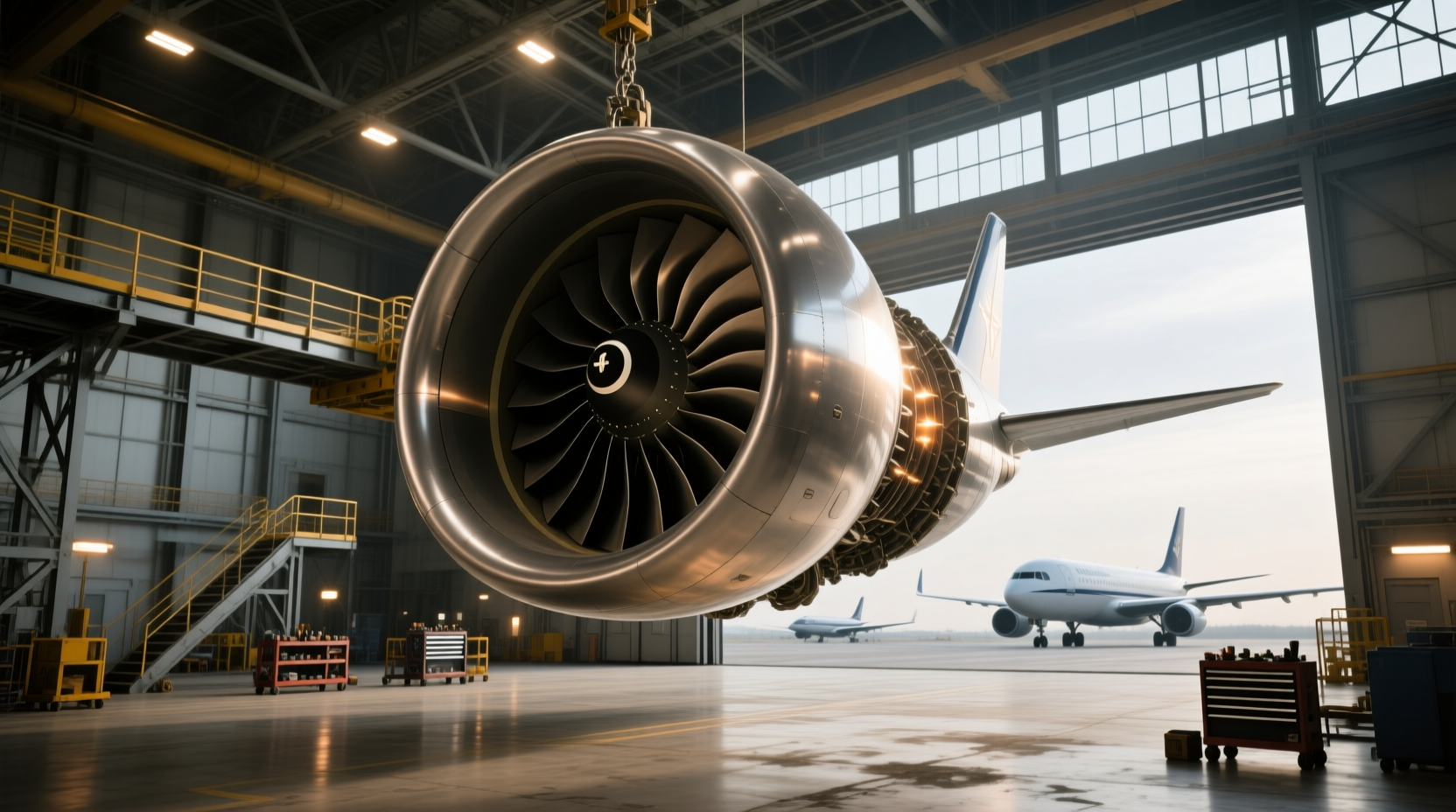
An airplane turbine is not the entire engine — it’s a critical rotating component inside gas turbine engines that converts thermal and kinetic energy from combustion gases into mechanical shaft power. This power drives the compressor and fan, enabling thrust generation in turbofans (most commercial jets) and shaft output in turboprops and turboshafts. Understanding its role — especially how high-pressure (HPT) and low-pressure (LPT) turbines differ in location, temperature exposure, and function — resolves common confusion about jet engine operation, failure modes, and emergency systems like the ram air turbine (RAT)1. This guide breaks down turbine fundamentals using verified aerospace engineering principles — no jargon without explanation.
Why ‘Airplane Turbine’ Is a Misleading Term — And Why It Matters
When users search for “airplane turbine,” many assume they’re looking for the whole engine. But as NASA clarifies: “The turbine is one of three core sections — compressor, combustor, and turbine — working together in a continuous thermodynamic cycle”2. Calling a CFM56 or GE90 engine a “turbine” is like calling a car “a transmission.” This misconception leads to flawed questions — e.g., “Can I replace my airplane turbine?” — when the real issue may involve maintenance intervals, blade inspection criteria, or understanding why turbines don’t melt at 1,700°C exhaust temperatures. Clarifying terminology upfront prevents downstream confusion about certification, safety margins, and system interdependence.
How an Airplane Turbine Actually Works: The Energy Extraction Process
A turbine extracts usable mechanical energy by exploiting pressure and temperature gradients across its blades. Here’s the step-by-step physics — verified across authoritative sources including NASA and Rolls-Royce technical publications:
- Gas entry: After combustion, gases exit the combustor at ~1,500–2,000°C and 30–50 bar pressure, flowing axially into the first-stage HPT nozzle guide vanes.
- Impulse & reaction forces: Hot gas accelerates through converging nozzles, striking turbine blades at precise angles. Modern blades use both impulse (deflection-based force) and reaction (pressure differential across curved surfaces) principles3.
- Shaft rotation: Blade rotation spins the central shaft, which directly connects to the high-pressure compressor ahead — maintaining compression efficiency and sustaining the Brayton cycle.
- Energy transfer cascade: Exhaust from the HPT still contains significant energy; it expands further through the LPT, powering the large front fan (in turbofans) or propeller gearbox (in turboprops).
This staged energy extraction maximizes overall engine efficiency — typically 35–40% thermal-to-thrust conversion in modern high-bypass turbofans4. Without turbines, jet engines would be static combustion chambers — producing heat but no net thrust.
Turbine Types in Aviation: HPT vs. LPT vs. RAT — Key Differences
Not all turbines serve the same purpose. Their design, materials, cooling methods, and placement reflect distinct operational requirements:
| Turbine Type | Primary Function | Location in Engine | Operating Temp Range | Cooling Method |
|---|---|---|---|---|
| High-Pressure Turbine (HPT) | Drives high-pressure compressor; handles highest-energy gas stream | Immediately downstream of combustor | 1,400–1,700°C metal surface temp (gas >2,000°C) | Internal air bleeding + film cooling + thermal barrier coatings (TBCs) |
| Low-Pressure Turbine (LPT) | Drives fan (turbofan) or propeller gearbox (turboprop); recovers residual energy | Downstream of HPT, before exhaust nozzle | 600–900°C | Convection cooling only; simpler blade geometry |
| Ram Air Turbine (RAT) | Emergency power source: generates hydraulic/electrical power after dual-engine failure | Deployed externally from fuselage or wing root | Ambient air temp (−50°C to +40°C) | No active cooling needed; operates at subsonic Mach 0.2–0.5 |
Source: FAA Advisory Circular 33.70, Rolls-Royce “The Jet Engine” textbook (5th ed.), and NASA Glenn Research Center turbine section documentation5. Note: HPT blades are among the most advanced manufactured parts on Earth — single-crystal nickel superalloys with micro-scale internal cooling channels6.
Why Turbine Blades Don’t Melt — Materials Science in Action
A common question — “How do turbine blades survive extreme heat?” — reveals a fundamental misunderstanding: they do get hotter than their melting point. The answer lies in three overlapping protection layers:
- Convective cooling: Compressor bleed air (at ~500°C) is ducted internally through micro-channels in the blade, absorbing heat before exiting through film-cooling holes.
- Thermal barrier coatings (TBCs): A 100–300 µm ceramic layer (yttria-stabilized zirconia) reduces metal surface temperature by 100–300°C.
- Directionally solidified & single-crystal casting: Eliminates grain boundaries — the weak points where creep and oxidation initiate — allowing operation above the alloy’s equilibrium melting point7.
According to Veritasium’s documented visit to Rolls-Royce’s precision casting facility, each HPT blade undergoes 12+ hours of vacuum heat treatment and is inspected via X-ray tomography for internal voids — a process that rejects ~8% of castings8. This explains why turbine maintenance is among the most costly and regulated aspects of aircraft upkeep.
Bird Strike Impact: What Happens When Debris Enters the Turbine?
Bird ingestion remains a leading cause of turbine damage. Certification standards (FAA Part 33, EASA CS-E) require engines to safely shut down after ingesting a 1.8 kg (4 lb) bird at takeoff speed — not to continue operating9. Here’s what occurs:
- Blade impact: At 250+ knots, a 1.5 kg goose delivers ~120 kN impact force — enough to fracture leading edges or induce resonant vibrations.
- Uncontained failure risk: If blade fragments breach the casing, they can puncture fuel lines or hydraulic systems. Modern engines use titanium or steel containment rings rated to absorb 95% of fragment energy.
- Operational response: Pilots follow immediate shutdown + windmill restart procedures. Dual-engine failure triggers RAT deployment within 8 seconds10.
Post-strike inspections focus on borescope examination of HPT/LPT blade tips, disc dovetail slots, and combustion liner integrity — often requiring 4–6 hours of ground time even if no visible damage appears.
Turbine vs. Jet Engine: Clearing Up the Most Common Confusion
“What’s the difference between a jet and a turbine?” is asked frequently — and the answer is foundational: All jet engines are gas turbines, but not all gas turbines are jet engines. Here’s the taxonomy:
- Jet engine: Broad category encompassing any air-breathing engine producing thrust via high-velocity exhaust — includes turbojets, turbofans, ramjets, and scramjets.
- Turbine engine: Any engine using a turbine to extract energy from hot gas — includes turbofans (thrust), turboprops (shaft power + small thrust), turboshafts (helicopter rotors), and APUs (auxiliary power units).
- Key distinction: Turbofans produce ~80% of thrust from bypass air accelerated by the fan (driven by LPT), while only ~20% comes from core exhaust — making them far more efficient than pure turbojets11.
So when someone says “my plane has turbine engines,” they likely mean it uses gas turbine technology — not that it lacks pistons. Precision matters for maintenance logs, regulatory compliance, and pilot training syllabi.
Real-World Turbine Applications Across Aircraft Types
Turbine configuration varies significantly by aircraft mission profile. Understanding these helps contextualize why certain designs dominate specific segments:
- Commercial airliners (e.g., Boeing 787, Airbus A350): Use ultra-high-bypass-ratio turbofans (BPR >9:1) with 2–3 spool turbines (LP, IP, HP). Trent XWB and GEnx engines feature 6–8 stage LPTs to maximize bypass flow efficiency12.
- Regional jets (e.g., Embraer E195-E2): Rely on geared turbofans (P&W PW1900G) where a planetary gear reduces LPT speed — allowing optimal fan and turbine RPM separation.
- Turboprops (e.g., ATR 72, Dash 8): Feature free-power turbines — mechanically decoupled from the gas generator — enabling constant propeller RPM regardless of engine power setting.
- Business jets (e.g., Gulfstream G650): Prioritize rapid throttle response; use smaller-diameter, high-speed turbines with minimal rotational inertia.
These differences affect fuel burn, noise signature, maintenance frequency, and dispatch reliability — factors pilots and operators evaluate rigorously during fleet planning.
Common Misconceptions About Airplane Turbines — And Why They’re Dangerous
Several persistent myths create operational or maintenance risks:
- Misconception #1: “Turbines spin freely once started.” Reality: Turbines require continuous airflow and fuel flow to sustain rotation. Windmilling (unpowered rotation) provides no useful output and increases bearing wear.
- Misconception #2: “More turbine stages always mean better efficiency.” Reality: Each stage adds weight, complexity, and pressure loss. Modern engines optimize for net efficiency — e.g., the LEAP-1A uses fewer LPT stages than older CFM56 but achieves 15% lower SFC via aerodynamic refinement.
- Misconception #3: “RATs can power full flight controls indefinitely.” Reality: RATs generate ~5–7 kW electrical or 3,000–5,000 psi hydraulic pressure — sufficient for basic flight instruments and primary control surfaces, but not for anti-ice, cabin pressurization, or full autopilot functionality.
These errors appear in amateur aviation forums and outdated training materials — reinforcing why referencing current OEM manuals (e.g., Rolls-Royce RB211 Maintenance Manual Section 72-00-00) is non-negotiable for licensed technicians.
How to Verify Turbine Specifications for Your Aircraft or Project
If you’re sourcing data for engineering analysis, maintenance planning, or academic work, avoid generic web summaries. Follow this verification protocol:
- Identify exact engine model: “CFM56” is insufficient — specify CFM56-7B26, -7B27, or -7B27E (each has different turbine vane counts and cooling schemes).
- Consult Type Certificate Data Sheets (TCDS): FAA and EASA publish TCDS documents listing certified turbine dimensions, materials, and operational limits — freely accessible online13.
- Check OEM service bulletins: Rolls-Royce, Pratt & Whitney, and GE Aviation issue mandatory service bulletins (SBs) addressing turbine life limits, inspection intervals, and repair allowances.
- Use borescope measurement protocols: For field inspections, follow ASTM E2581 standards for bore diameter, blade tip clearance, and erosion depth quantification.
Never rely solely on YouTube animations or simplified diagrams — they omit critical tolerances (e.g., HPT blade tip clearance must stay within ±0.005 in across all operating conditions) that define airworthiness.
Frequently Asked Questions (FAQs)
Q1: Can a turbine engine run without a turbine?
No. Removing the turbine breaks the Brayton cycle — the compressor cannot sustain pressure rise without shaft power return. Static ignition would cause immediate stall and potential combustor rupture.
Q2: Do all airplanes have turbines?
No. General aviation aircraft (Cessna 172, Piper Cherokee) use reciprocating piston engines. Only turbine-powered aircraft — jets, turboprops, and turboshafts — contain turbines. Piston engines use crankshafts, not turbines, to convert combustion energy.
Q3: Why do some turbine engines have multiple spools?
Multiple independent shafts (e.g., LP, IP, HP spools) allow each compressor/turbine pair to rotate at its optimal speed — improving engine stability, throttle response, and surge margin across flight envelopes.
Q4: How long do turbine blades last before replacement?
HPT blades are life-limited parts (LLPs) with strict hour/cycle limits — typically 4,000–8,000 flight hours depending on engine model and operating profile. LPT blades last longer (12,000–20,000 hrs) due to lower thermal stress.
Q5: Is turbine efficiency affected by altitude?
Yes — turbine efficiency improves with altitude up to ~35,000 ft due to colder, denser intake air improving compressor pressure ratio and reducing turbine inlet temperature requirements. Above that, diminishing returns set in due to reduced mass flow.
