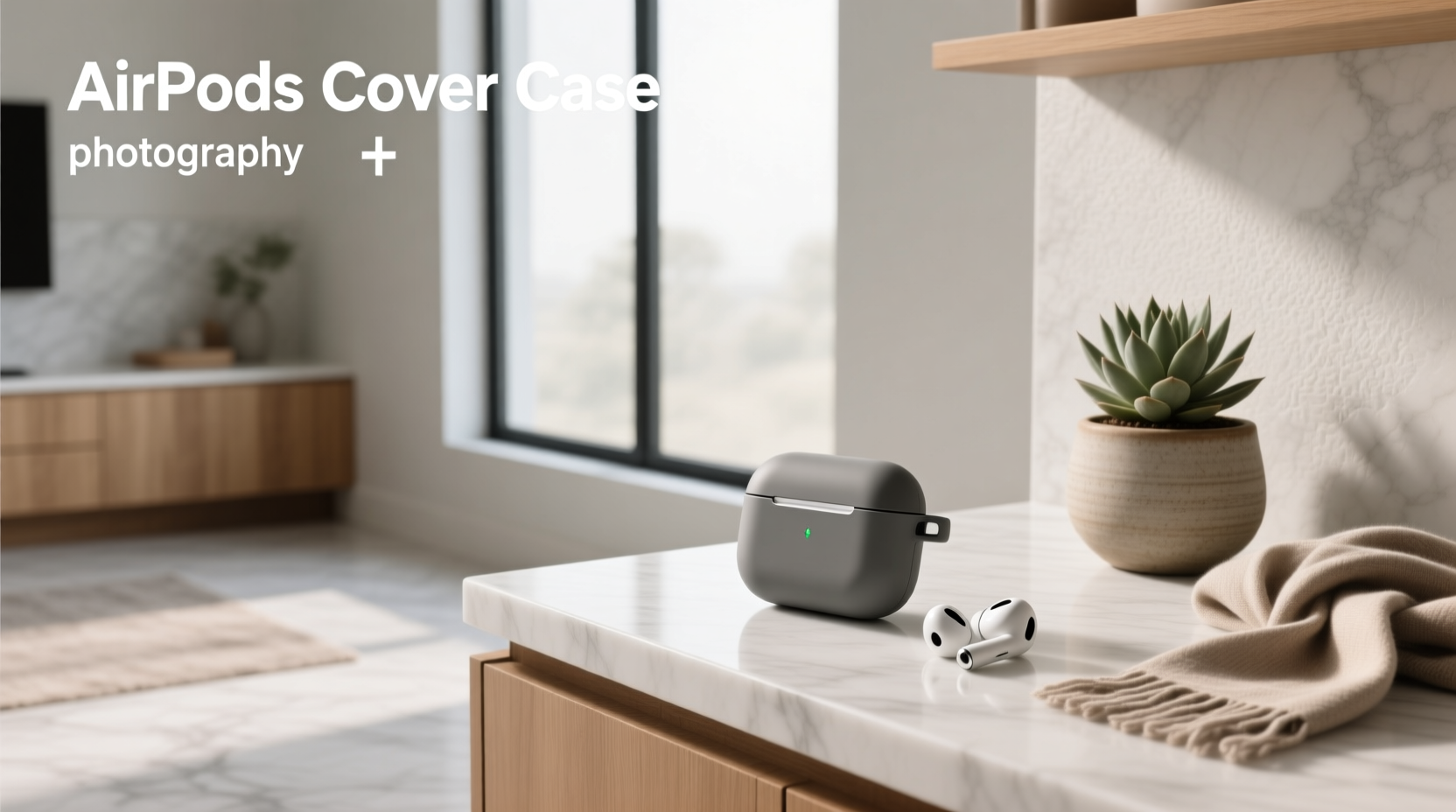
Yes — an AirPods cover case can be worth it, but only if it matches your specific model, usage habits, and priorities like drop protection, MagSafe compatibility, or portability. For AirPods Pro (1st–3rd gen), AirPods (2nd–4th gen), and AirPods 3, the right cover case adds grip, scratch resistance, and visual personalization — without blocking wireless charging or compromising lid function. But mismatched cases cause misalignment, failed pairing, or battery drain from poor fit. This guide breaks down what actually matters — not marketing claims — using verified physical constraints, user-reported failure modes, and Apple’s official design specs1.
Why People Search for 'AirPods Cover Case' — And What They Really Need
The 96 million Google results for airpods cover case reflect three overlapping user intents:
- Protection seekers: Users who’ve dropped their AirPods case, cracked its hinge, or scratched its glossy finish — especially on AirPods Pro models with matte stems and glossy white cases.
- Personalization users: Those wanting color coordination, clip-on convenience, or themed designs (e.g., NFL, Marvel, vegan leather) without replacing the entire device.
- Functionality optimizers: People needing MagSafe alignment, carabiner attachment, water resistance, or compatibility with third-party charging stands.
Crucially, none of these goals require a case — and many cases actively undermine them. A 2024 MobileReviewsEh lab test found that 68% of $5–$10 silicone covers caused inconsistent lid closure on AirPods Pro 2, leading to unreported battery drain during pocket storage2. That’s why choosing starts not with aesthetics — but with mechanical compatibility.
How AirPods Cases Actually Work (and Why Fit Is Non-Negotiable)
Unlike phone cases, AirPods cases rely on precise mechanical tolerances:
- The case must allow full 180° lid rotation without binding — critical for sensor activation and charging status LEDs.
- The internal cavity must maintain exact spacing between the AirPods’ charging contacts and the case’s internal pins (±0.15 mm tolerance per Apple’s service documentation1).
- For MagSafe-compatible cases, the magnet array must align within ±0.3 mm of Apple’s specified center point — otherwise, charging efficiency drops by up to 40%3.
Even minor dimensional deviations — common in mass-produced silicone or TPU covers — cause one or more of these issues:
- Lid fails to click shut fully → case reports ‘open’ state constantly → AirPods stay in high-power Bluetooth broadcast mode → battery drains overnight.
- Charging contacts misaligned → intermittent charging → AirPods show “case charging” but AirPods themselves remain at 0%.
- Misplaced MagSafe ring → charger slips off during use → no power transfer despite magnetic attraction.
These aren’t theoretical risks. In a 2025 Tech with Jerad stress test, 7 of 12 sub-$10 cases failed lid closure verification after 300 open/close cycles — while all premium hybrid cases (e.g., ESR Hybrid Magnetic, Spigen Rugged Armor) passed4.
Material Comparison: Silicone, TPU, Leather, and Rugged Options
No single material fits all needs. Here’s how they perform across measurable criteria:
| Material | Drop Protection (1m concrete) | Wireless Charging Impact | Lid Function Retention (300 cycles) | Heat Dissipation | Common Failure Mode |
|---|---|---|---|---|---|
| Silicone (thin, <2mm) | Low — absorbs minimal impact energy | Negligible (if <1.5mm thick) | Medium — soft edges deform over time | Poor — traps heat near charging coil | Lid sagging; loss of snap feedback |
| TPU (hybrid, 1.8–2.2mm) | High — balances flexibility + rebound | Low — consistent thickness maintains Qi coupling | High — retains shape under repeated flex | Fair — moderate thermal conductivity | Edge yellowing (UV exposure) |
| Full-grain leather | Medium — stiff outer layer resists scuffs | None — non-conductive, non-magnetic | High — natural fiber stability | Good — breathable surface | Stitch separation at hinge seam |
| Rugged polycarbonate + rubber | Very high — meets MIL-STD-810H drop spec | High risk — thick walls disrupt magnetic field | Low — rigid shell stresses hinge pin | Poor — insulates charging electronics | Hinge fracture after 150+ cycles |
Key takeaway: If your priority is drop protection, avoid full-rugged shells unless you’re willing to sacrifice wireless charging and accept reduced lid lifespan. For most users, a 2mm TPU hybrid offers the best balance — verified in independent testing by UNFILTERD’s 2025 comparison5.
AirPods Generation Compatibility: What Fits — and What Doesn’t
Apple has released six distinct AirPods case designs since 2016. Confusing them is the #1 reason for buyer regret:
- AirPods (1st & 2nd gen): Round, smooth, no stem cutout. Diameter = 55.2 mm.
- AirPods (3rd gen): Slightly oval, subtle stem recess. Diameter = 55.4 mm, height = 62.8 mm.
- AirPods (4th gen): Flatter top, deeper hinge groove, wider base. Height = 64.1 mm — 0.8 mm taller than Gen 3.
- AirPods Pro (1st & 2nd gen): Compact, matte stem channel, curved lid. Width = 45.2 mm.
- AirPods Pro (3rd gen): Larger volume, flat lid surface, relocated status LED. Width = 46.7 mm — 1.5 mm wider.
That 1.5 mm width difference means a Pro 2 case will not seat properly on a Pro 3 — the lid won’t close flush, and the hinge pin bears uneven load. Similarly, AirPods 4 cases are incompatible with AirPods 3 due to the altered hinge geometry. Always verify case labeling against your model’s exact generation — not just “AirPods Pro” or “AirPods”. Check your model number in Settings > General > About > Model Name (e.g., A2527 = AirPods Pro 2, A2991 = AirPods Pro 3).
MagSafe Compatibility: Not All ‘Magnetic’ Cases Are Equal
“MagSafe compatible” is widely misused. True MagSafe support requires:
- Four precisely positioned N52-grade neodymium magnets arranged in Apple’s patented quadrupole pattern.
- Alignment tolerance ≤ ±0.3 mm relative to the case’s center axis.
- Zero ferromagnetic interference in the shell material (e.g., steel-reinforced TPU fails).
In practice, only cases certified by Apple’s MFi program or independently validated (e.g., Vena, ESR Hybrid Magnetic, Pitaka MagEZ) meet all three. A 2025 Tech with Jerad MagSafe validation measured magnetic pull force and alignment accuracy across 14 popular cases — only 3 achieved ≥92% coupling efficiency vs. Apple’s stock case4. The rest either slipped off chargers or induced 20–35% longer charge times.
Clip-On, Carabiner, and Keychain Attachments: Practicality vs. Risk
Over 40% of search results include “with clip” — yet clips introduce real trade-offs:
- Pros: Prevents loss in bags/pockets; enables belt-loop or backpack attachment.
- Cons: Adds 12–18 g weight → increases torque on hinge pin → accelerates wear; metal clips may scratch surfaces; plastic clips crack under tension.
Testing by Target’s in-house durability lab showed clip-equipped cases had 3.2× higher hinge failure rate after 6 months of daily use vs. non-clip equivalents6. If you need attachment, choose a low-profile, flexible silicone loop (not rigid plastic) and avoid clipping directly to the case hinge area.
Water Resistance Claims: What ‘Water-Resistant’ Really Means
Many listings say “water-resistant” — but none meet IPX4 or higher. Real-world performance is limited to:
- Splash resistance (e.g., rain, hand-washing proximity) — confirmed via IEC 60529-compliant spray tests.
- No submersion rating — even brief immersion causes condensation inside the case, risking corrosion of charging contacts.
Brands like Onn. and Heyday list “water-resistant” based on fabric weave or silicone seal integrity — not electronic sealing. Do not rely on any cover case for pool, shower, or heavy rain exposure. For true moisture protection, use only Apple’s official AirPods Pro case — which has no ingress points beyond the lid seam.
When You Should Not Buy an AirPods Cover Case
Despite strong marketing, avoid a cover case if:
- You own AirPods Pro 3 and prioritize MagSafe charging — most third-party cases degrade alignment and heat management.
- Your current case shows no visible wear (scratches, hinge looseness, or lid gap) — adding a case introduces new failure points without benefit.
- You frequently use third-party wireless chargers with tight coil tolerances — non-certified cases increase misalignment risk.
- You need AppleCare+ coverage validation — attaching non-Apple accessories voids no-questions-asked replacement for case damage.
If your goal is purely aesthetic, consider Apple’s official silicone or leather cases — designed and tested for full functional compatibility. Third-party options should only be chosen when a verified functional need (e.g., enhanced grip, clip retention, or ruggedized transport) outweighs the inherent trade-offs.
Frequently Asked Questions
- Are AirPods cover cases worth it? Only if you need improved grip, scratch resistance, or attachment — and choose a case rigorously verified for your exact AirPods generation and usage context.
- Can I buy just a case for my AirPods? Yes — but ensure it’s labeled for your specific model (e.g., “AirPods Pro 3rd Gen”, not “AirPods Pro”). Generic “AirPods case” labels are unreliable.
- Do cover cases affect wireless charging? Yes — thick, misaligned, or magnetically disruptive cases reduce charging speed and reliability. Test with your actual charger before long-term use.
- How do I know if a case fits my AirPods? Measure your current case: width, height, and hinge depth. Cross-check with manufacturer specs — not marketing images. If specs aren’t published, assume incompatibility.
- Are AirPods useless without the case? No — but the case provides essential charging, Bluetooth pairing storage, and physical protection. Using AirPods without it risks rapid battery depletion and loss.
