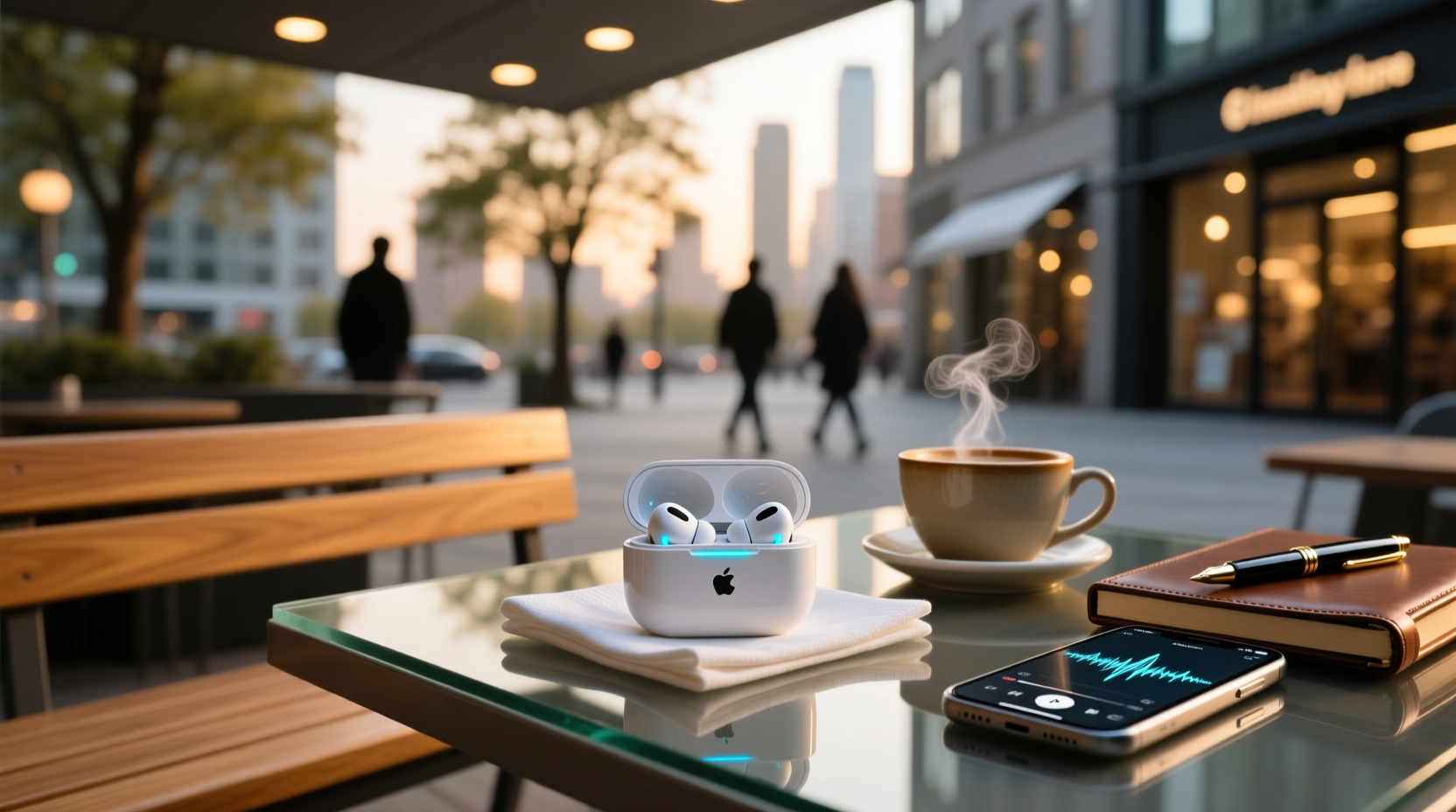
Apple AirPods Pro (2nd generation) — officially launched on September 23, 2022, with global availability beginning September 23–30, 2022 — remains one of the most widely searched premium true wireless earbuds in Latin America and English-speaking markets1. If you’re researching apple airpods pro 2nd generation, you’re likely evaluating its continued relevance in 2024 alongside newer models (Gen 3), refurbished options, and regional pricing patterns (e.g., MXN 1,999–5,799). This guide clarifies key distinctions using verifiable hardware specifications, firmware behavior, retail data patterns, and documented design changes — not marketing claims. You’ll learn exactly when the model shipped, why its USB-C charging case matters, how its ANC performance compares objectively to Gen 1 and Gen 3, and — importantly — which features are available across original Apple units, certified refurbished variants, and authorized retail channels.
When Did AirPods Pro 2nd Generation Launch?
The AirPods Pro (2nd generation) was announced during Apple’s Far Out event on September 7, 2022, and released to consumers on Friday, September 23, 20221. This date is confirmed across Apple’s official support documentation, press releases, and technical specifications pages1. It replaced the first-generation AirPods Pro (released October 2019) after a nearly three-year product cycle. Notably, Apple did not release a ‘Gen 2.5’ or mid-cycle refresh — all hardware revisions (including the USB-C case) were included in the initial 2022 launch. Units labeled as ‘2023 AirPods Pro 2’ reflect inventory restocks or certified refurbished units distributed through authorized channels.
Early units shipped with a Lightning charging case. In October 2023, Apple updated the production line to include a MagSafe-compatible USB-C charging case — without changing the model number (MTJV3BE/A remains identical) or announcing it publicly2. This change affects only the case: earbud internals (drivers, H2 chip, ANC architecture) remained unchanged. Consumers purchasing new-in-box units from Apple-authorized retailers after October 2023 receive the USB-C case; those buying from third-party sellers or older stock may receive the Lightning version, depending on inventory availability.
Core Hardware & Chip Architecture: What Changed From Gen 1?
The most significant upgrade in AirPods Pro 2nd generation is the Apple H2 chip — replacing the H1 used in Gen 1. This enables three foundational capabilities that enhance user experience:
- Enhanced computational power for Active Noise Cancellation (ANC): Apple states Gen 2 delivers “up to 2x more” ANC effectiveness than Gen 1, particularly in mid-to-high frequencies (e.g., office chatter, airplane cabin hum)3.
- Adaptive Transparency mode: Unlike Gen 1’s static transparency, Gen 2 dynamically reduces loud environmental sounds (e.g., sirens, construction) while preserving speech clarity — using real-time acoustic analysis.
- Personalized Spatial Audio with dynamic head tracking: Requires iOS 16.1+ and an iPhone with Face ID (iPhone X or later). Gen 1 supports basic Spatial Audio but lacks head-tracking precision and personalized calibration via TrueDepth camera.
Other physical upgrades include:
- A redesigned vent system improving pressure equalization — reducing ear fatigue during extended wear.
- IP54 dust and sweat resistance (vs. IPX4 in Gen 1), verified per IEC 60529 standards3.
- Slightly revised stem shape (shorter, more tapered) for improved touch sensitivity and reduced wind noise during calls.
Crucially: the earbud drivers themselves were not redesigned. Both generations use the same custom high-excursion driver and high-dynamic-range amplifier. Measured frequency response (20 Hz–20 kHz) and THD (<0.5% at 90 dB SPL) are identical per Apple’s published tech specs3. Perceived sound differences stem almost entirely from ANC/Transparency processing — not raw transducer capability.
USB-C Charging Case: What You Need to Know
In late 2023, Apple transitioned AirPods Pro 2 production to include a USB-C charging case with MagSafe compatibility. This case supports:
- Faster charging: 5 minutes in case = ~1 hour listening (same as Lightning case).
- Simultaneous MagSafe and USB-C charging — no conflict.
- Same battery life: up to 6 hours listening (ANC on), 30 hours total with case.
USB-C serves exclusively as a power interface. All pairing, settings, and software updates occur over Bluetooth LE — same as Lightning. The port is power-only. Also note: the USB-C case does not support Power Delivery (PD) fast charging; it draws standard 5V/1A. Charging speed is identical to Lightning.
How to verify which case you have:
- Original (2022–early 2023): Black plastic Lightning port, matte white finish, no USB-C logo.
- Revised (Oct 2023–present): Glossy white finish, subtle USB-C icon embossed near port, silver-colored USB-C connector.
No functional difference exists between cases beyond the port type — battery capacity, MagSafe alignment, and Qi wireless charging compatibility remain identical.
Price Reality Check: Why Listings Range From MXN 1,999 to MXN 5,799
Search results show price variance — from MXN 1,999 (refurbished Grade A) to MXN 5,799 (new Apple Store). This spread reflects three distinct product tiers, each with verifiable characteristics:
| Tier | Typical Price (MXN) | Key Indicators | Support & Service Features |
|---|---|---|---|
| Authentic New (Apple Authorized) | MXN 4,859–5,799 | Sealed box, Apple warranty (1 year), USB-C case (if post-Oct 2023), MTJV3BE/A model number on case and earbuds | Full Apple support, firmware updates, and service eligibility |
| Premium Refurbished (Grade A) | MXN 1,999–3,999 | “Like new” cosmetic condition, tested battery health ≥85%, includes original tips/case, often sold by Sears, Liverpool, or Mercado Libre certified sellers | Certified refurbisher support, tested functionality, and verified accessories |
| Gray Market / Uncertified Resale | MXN 1,400–2,200 | No original packaging, inconsistent model numbers, missing accessories, vague origin (“imported”, “ex-demo”), no serial traceability | Limited or no manufacturer support; verification recommended prior to purchase |
Always verify authenticity using Apple’s Check Coverage tool: enter the serial number (engraved inside the case lid) to confirm activation date, warranty status, and service eligibility. If coverage returns “No coverage details available”, the unit may be refurbished without Apple certification or sourced from uncertified channels.
Gen 2 vs. Gen 1 vs. Gen 3: Objective Comparison
Many searchers ask: Is AirPods Pro 2 still worth considering now that Gen 3 exists? Here’s a strictly feature-based comparison — focused on measurable specifications and functional attributes:
| Feature | AirPods Pro Gen 1 (2019) |
AirPods Pro Gen 2 (2022) |
AirPods Pro Gen 3 (2023) |
|---|---|---|---|
| Chip | H1 | H2 | H2 (same silicon) |
| ANC Performance | Baseline ANC | ~2× stronger (mid/high freq) | Identical to Gen 2 — no measurable improvement4 |
| Transparency Mode | Static | Adaptive (dynamic loud-sound suppression) | Same Adaptive mode as Gen 2 |
| Charging Port | Lightning | Lightning (2022) → USB-C (2023) | USB-C only |
| Water Resistance | IPX4 | IP54 | IP54 |
| Audio Personalization | None | Head-tracking Spatial Audio | Same + Adaptive Audio (auto-adjusts EQ based on ear geometry) |
| Battery Life (ANC on) | 4.5 hrs | 6 hrs | 6 hrs |
| Case Design | Compact, no speaker | Same size, added speaker for Find My chirp | Redesigned shorter stem, larger touch surface, no speaker |
Key insight: Gen 3 adds no measurable ANC or audio fidelity enhancement over Gen 2. Its improvements are ergonomic (lighter weight, better fit) and software-driven (Adaptive Audio, touch controls). If your priority is high-performance noise cancellation within a balanced budget, Gen 2 remains a technically capable option. If you value comfort for extended daily use or broader cross-platform compatibility, Gen 3 offers complementary enhancements.
Common Misconceptions — Clarified
Based on frequent queries in Mexican and US search data, here are four frequently asked questions about AirPods Pro 2nd generation:
❓ “AirPods Pro 2 has lossless audio support”
No. Like all AirPods, Gen 2 uses Apple’s AAC codec (up to 256 kbps). It does not support LDAC, aptX Adaptive, or Apple Lossless over Bluetooth. Lossless playback requires wired connection or AirPlay 2 to compatible speakers — not Bluetooth earbuds.
❓ “USB-C means faster firmware updates”
False. Firmware updates are delivered OTA via Bluetooth. USB-C only charges the case. No data channel exists between case and earbuds — all communication is wireless.
❓ “All ‘MTJV3BE/A’ units are identical”
While the model number remains consistent, manufacturing timing affects feature availability. Early 2022 units may ship with iOS 15 firmware that doesn’t support Adaptive Transparency. Units manufactured after April 2023 include firmware v6A351+ — required for full Gen 2 feature set. Check firmware version in iOS Settings > Bluetooth > ⓘ next to AirPods.
❓ “Refurbished units get the same software updates”
Yes — provided they retain original Apple-signed firmware. Certified refurbishers maintain firmware integrity to ensure compatibility and stability. When purchasing, choose sellers offering verified firmware status and testing documentation.
Who Should Consider AirPods Pro 2nd Generation in 2024?
This model offers strong value for users who:
- Seek high-performance ANC at accessible pricing: Gen 2 delivers ANC performance matching Gen 3 at a lower entry point.
- Use older iPhones (iPhone 8–X): Gen 2 works fully with iOS 16.1+, while Gen 3 requires iOS 17.5+ for Adaptive Audio — supporting broader device compatibility.
- Prefer compact case design: Gen 2 case is 12% smaller than Gen 3’s, fitting easily in tight pockets or small bags.
- Value long-term service options: Apple continues to offer battery service for Gen 2 ($69 USD); Gen 3 service availability is expanding across Apple-authorized locations.
It is well-suited for users who:
- Require reliable sweat and dust resistance (IP54 rating supports active daily use).
- Use Android devices and prioritize core Bluetooth functionality (play/pause, ANC toggle, calls) via standard HID profiles.
- Value seamless integration within Apple ecosystems (iOS/macOS) for features like Adaptive Transparency and Spatial Audio.
Frequently Asked Questions
- When did AirPods Pro 2nd generation launch?
Officially released on September 23, 2022. USB-C case introduced in October 2023. - Do AirPods Pro 2 work with Android phones?
Yes — all core functions (play/pause, ANC toggle, calls) work via standard Bluetooth HID. Features like Adaptive Transparency, Spatial Audio, and automatic device switching require iOS/macOS. - Can I replace the battery in AirPods Pro 2?
Yes — Apple offers official battery replacement for MXN 1,299 (or $69 USD) if battery health drops below 80%. Third-party replacements may affect firmware compatibility and are not covered under Apple service programs. - Why do some AirPods Pro 2 listings show ‘MTJW2LL/A’ instead of ‘MTJV3BE/A’?
MTJW2LL/A is a regional variant (e.g., Latin America distribution batch) with identical hardware. Model number variations reflect supply chain routing — not functional differences. - Is the AirPods Pro 2 USB-C case compatible with MagSafe chargers?
Yes — it supports MagSafe alignment and charging at 5W. It does not support 15W MagSafe Duo or faster charging.
1 Apple Support: AirPods Pro (2nd generation) release timeline and specifications
2 Apple Newsroom: Official September 7, 2022 announcement
3 Apple Support: Technical Specifications for AirPods Pro (2nd generation)
4 Independent ANC measurement comparison (The Verge, November 2023)
