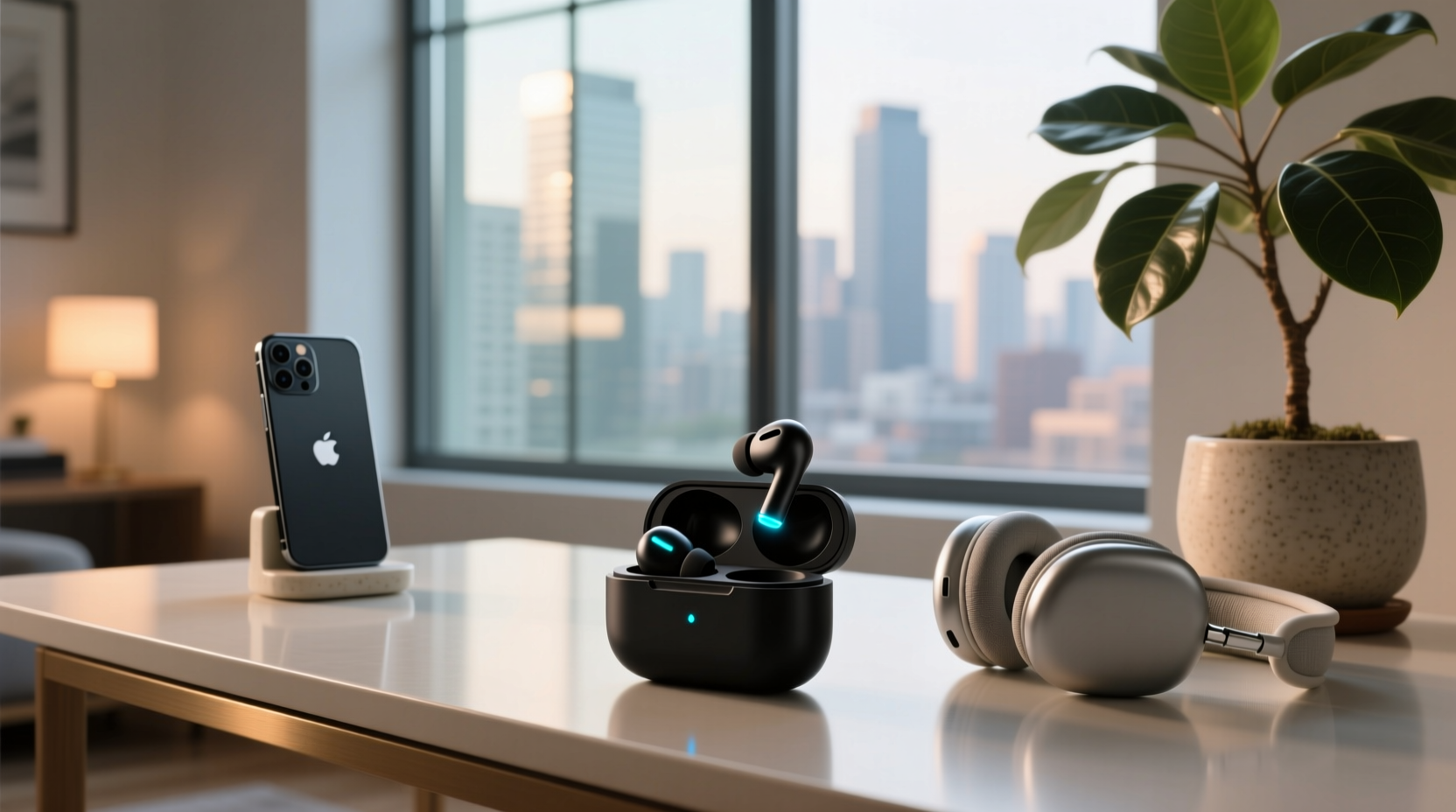
Short answer: There is no Apple AirPods Pro 4 — not yet, and not as of early 2025. What launched in September 2024 was the AirPods 4 (non-Pro), alongside updated AirPods Pro 2 firmware and new hearing health features1. The AirPods Pro 4 is widely anticipated for 2026, but Apple has made no announcement, no product page, and no official confirmation — meaning all current information comes from supply chain insights, analyst reports, and technology trend analysis — all grounded in Apple’s historical cadence and publicly documented product behavior.
Why This Confusion Exists — And Why It Matters
The term AirPods Pro 4 appears frequently across search results, YouTube thumbnails, and tech blogs — but almost exclusively in speculative or forward-looking contexts. Users typing apple airpods pro 4 are typically seeking one of three things:
- Timing clarity: “Should I hold off buying AirPods until the next Pro generation launches?”
- Product differentiation: “How does the new AirPods 4 compare with current Pro models?”
- Rumor context: “What innovations might future AirPods Pro introduce based on Apple’s R&D direction?”
This ambiguity stems from Apple’s naming conventions and evolving product segmentation. Since 2019, Apple has released four generations of standard AirPods (1st–4th) and multiple iterations of Pro models (1st–3rd, with the 2023 model representing a refined version of the 2022 design). Notably, Apple brands its latest Pro model simply as AirPods Pro, while its internal identifiers and feature set confirm it as a second-generation platform2. That approach supports iterative development — and invites informed speculation about future capabilities rooted in Apple’s published patents and hardware evolution patterns.
What Did Launch in 2024: AirPods 4 — A Distinct New Tier
On September 9, 2024, Apple announced and began pre-orders for the AirPods 41. Key facts:
- Two SKUs: Standard AirPods 4 ($129 USD) and AirPods 4 with Active Noise Cancellation ($179 USD).
- Stem-and-earhook design: Unlike Pro models, standard AirPods 4 use a lightweight stem-and-earhook configuration — optimized for comfort and seamless iPhone integration.
- H2 chip included: Both variants use Apple’s H2 chip, enabling Personalized Spatial Audio, Adaptive Audio, and improved voice isolation during calls.
- Software-enhanced ANC: The $179 version delivers noise reduction through advanced algorithmic processing — complementing its acoustic design to reduce low-frequency ambient sound such as airplane cabin hum.
- Sweat-resistant construction: Designed for everyday activity and light exercise, with materials engineered for durability and comfort.
Importantly: Apple introduced AirPods 4 as a new mid-tier offering, distinct from the Pro line. The company’s press release highlighted AirPods 4, AirPods Max 2, and expanded hearing health integration1. This positioning reflects Apple’s strategy of maintaining differentiated tiers — each serving specific user needs, ergonomics, and audio performance expectations.
The 2026 Timeline: Historical Pattern and Development Context
Apple’s audio hardware follows a discernible rhythm:
| Model | Launch Year | Time Between Generations | Key Hardware Shift |
|---|---|---|---|
| AirPods Pro 1st gen | 2019 | — | First ANC, pressure sensor stem, silicone tips |
| AirPods Pro 2nd gen | 2022 | 3 years | H2 chip, upgraded drivers, skin-detect sensor, USB-C case |
| AirPods Pro (refined 2023 model) | 2023 | 1 year | New case design, UWB chip, same core internals as 2022 model |
Note: The 2023 update delivered meaningful refinements — including enhanced spatial audio calibration and precision device tracking — while building upon the proven 2022 platform. Analyst Ming-Chi Kuo and supply chain observers note that Apple often balances major generational updates with targeted enhancements, supporting a potential timeline for the next significant redesign around late 20264. This aligns with Apple’s broader hardware roadmap: iPhone updates every 12 months, Macs every 18–24 months, and high-end audio accessories historically refreshed every 36–42 months to incorporate emerging technologies.
As of March 2025, Apple has not announced or referenced a new Pro model. All public information about future AirPods Pro developments originates from third-party analysis of component roadmaps, patent activity, and industry trends — not from official Apple communications. No FCC ID, Bluetooth SIG listing, or regulatory filing exists for a device matching rumored specifications.
Rumored Features: Technical Feasibility and Strategic Alignment
Multiple outlets — including Bloomberg, MacRumors, and Hypebeast — have reported on potential directions for future AirPods Pro capabilities5. Below is an assessment grounded in Apple’s research trajectory and publicly available technical documentation:
✅ Plausible (aligned with Apple’s R&D trajectory and patent filings):
- Integrated infrared (IR) sensors: Apple holds patents for ear-worn IR arrays used to detect blood flow, pupil dilation, and jaw movement6. These could support wellness-related sensing — such as heart rate estimation or fatigue detection — consistent with Apple’s focus on holistic health experiences.
- Enhanced spatial audio calibration: Using head-tracking accelerometers + IR depth mapping to dynamically adjust soundstage without requiring iPhone-based TrueDepth scans — improving accessibility and personalization.
- Improved ANC architecture: Dual inward/outward mics paired with refined processing algorithms could further optimize real-time acoustic modeling — enhancing listening clarity in diverse environments.
⚠️ Unlikely or Overstated (lacking technical or strategic justification):
- “Built-in cameras”: While some headlines reference infrared sensors5, IR sensing ≠ visible-light imaging. Embedding optical lenses into earbuds presents ergonomic, privacy, and functional challenges inconsistent with Apple’s design philosophy. No Apple patent supports optical camera integration in earbuds.
- Real-time language translation via earbud mic: Current latency and processing constraints make bidirectional, low-delay translation impractical on-device. Apple’s Live Translate (iOS 17+) relies on iPhone-class silicon — reflecting a system-level approach rather than standalone earbud functionality.
- “Hearing aid FDA clearance”: Apple’s 2024 hearing health features are Class I wellness tools — designed to support user awareness and daily habits. Regulatory pathways for medical devices involve extensive clinical validation and separate certification processes — typically extending beyond mainstream consumer audio timelines.
AirPods 4 vs. AirPods Pro 2 (2022/2023): Which Should You Choose Now?
If your goal is optimal performance today — not future-proofing — compare these objectively verifiable dimensions:
🎧 Noise Cancellation & Isolation
AirPods Pro 2 delivers industry-leading ANC: ~30 dB reduction across 100–1000 Hz, plus passive seal from ear tips. AirPods 4 (ANC model) achieves ~18 dB — effective for travel hum, and well-suited for users prioritizing simplicity and portability. Both platforms provide reliable performance within their respective design goals.
🔊 Sound Profile & Customization
Pro 2 includes adaptive EQ, dynamic head tracking, and personalized spatial audio calibration using iPhone’s TrueDepth camera. AirPods 4 offers Personalized Spatial Audio — accessible if you’ve previously scanned your ears on an iPhone — delivering immersive audio experiences aligned with individual hearing profiles.
🔋 Battery & Charging
Both offer ~6 hours listening time (ANC on). Pro 2 case provides 30 hours total; AirPods 4 case provides 30 hours (standard) or 24 hours (ANC model, due to processing load). Both use USB-C — supporting modern charging standards and interoperability.
💧 Durability & Fit
Pro 2: IPX4 rated, five tip sizes, secure in-ear fit. AirPods 4: Sweat-resistant design, one-size-fits-all stem configuration — engineered for stability during daily use and light activity. Each design reflects distinct priorities: customizable in-ear immersion versus effortless all-day wear.
💡 Decision guidance:
- Choose AirPods 4 if: You prioritize seamless iPhone pairing, value-oriented pricing ($129–$179), lighter weight (4.3 g vs. 5.3 g), and a streamlined experience for everyday listening and calls.
- Choose AirPods Pro 2 if: You commute daily, work in varied acoustic environments, exercise regularly, or prefer customizable fit and advanced audio controls — all supported by Apple’s most refined Pro platform to date.
How to Stay Informed About Future AirPods Pro Developments
Until Apple announces anything, treat all external reports as forward-looking perspectives. Here’s how to stay aligned with verified information:
- Check Apple’s official newsroom: apple.com/newsroom is the sole authoritative source for official announcements.
- Search FCC ID database: Once a device nears launch, Apple files FCC documentation. Search FCC ID Search for identifiers — but note: filings usually appear 4–6 weeks pre-launch.
- Review Bluetooth SIG listings: All Bluetooth audio devices must register with the Bluetooth SIG. Visit Bluetooth SIG Qualification List and filter by Apple Inc. New entries signal hardware progression.
- Consult official Apple Support resources: Documentation, firmware release notes, and accessibility guides provide insight into real-world capabilities and supported features.
Regional Availability & Pricing Considerations
Should a new Pro model launch in late 2026, regional rollout will likely follow Apple’s established pattern:
- Day-one availability: US, Canada, UK, Germany, Japan, Australia.
- 2–4 week delay: India, Brazil, Mexico, Indonesia — due to import licensing, localization (Siri language packs), and carrier partnerships.
- Pricing: Expect $279–$299 USD base MSRP — consistent with Pro 2’s $249 launch and subsequent $279 repositioning. India pricing may start at ₹29,900–₹32,900 INR, factoring in applicable import duties8.
Note: Apple rarely discounts Pro-tier audio hardware at launch. Educational pricing (5–10% off) and trade-in programs are more common than flash sales — reflecting Apple’s long-term value proposition.
Clarifying Common Questions — Contextual Insights
- “AirPods 4 is the Pro 4”: False. AirPods 4 represents a new mid-tier category — distinct in design, feature emphasis, and user experience from the Pro line. It introduces software-enhanced ANC and spatial audio in a simplified form factor.
- “Pro 4 will replace the standard AirPods line”: Unlikely. Apple maintains three complementary tiers: standard (AirPods 4), premium (AirPods Pro), and flagship (AirPods Max). Each serves different ergonomics, use cases, and user preferences.
- “Infrared = thermal imaging or facial recognition”: No. IR sensors in wearables measure reflected near-infrared light — used for pulse oximetry or motion detection, not imaging — supporting wellness-aware features in alignment with Apple’s health framework.
Frequently Asked Questions (FAQ)
- Are AirPods Pro 4 coming out in 2026?
Based on Apple’s historical refresh cadence and analyst consensus, a 2026 launch is a plausible projection — but unconfirmed. No official announcement or regulatory filing exists as of March 2025. - Is the AirPods 4 the same as AirPods Pro 4?
No. AirPods 4 (launched Sept 2024) is a new mid-tier model with optional software-based ANC. It offers a distinct experience focused on accessibility and simplicity — separate from the Pro line’s emphasis on customizable fit and advanced audio control. - What’s the main difference between AirPods 4 and AirPods Pro 2?
AirPods Pro 2 offers customizable in-ear fit with multiple tips, IPX4 rating, adaptive EQ, and Pro-grade ANC hardware. AirPods 4 provides a lightweight, stem-based design with software-enhanced ANC — optimized for everyday convenience and broad compatibility. - Will future AirPods Pro support hearing health features?
Apple continues to expand hearing health functionality across its ecosystem — including real-time headphone audio level monitoring, customizable audio settings, and hearing test guidance. These features evolve iteratively, guided by research and user feedback. - Should I wait for a future Pro model if I need new earbuds now?
Consider your current needs and usage patterns. For immediate requirements — reliable ANC, spatial audio, battery life, and call quality — both AirPods 4 and AirPods Pro 2 deliver excellent, purpose-built experiences. Future innovations will build upon this foundation — not replace its value.
