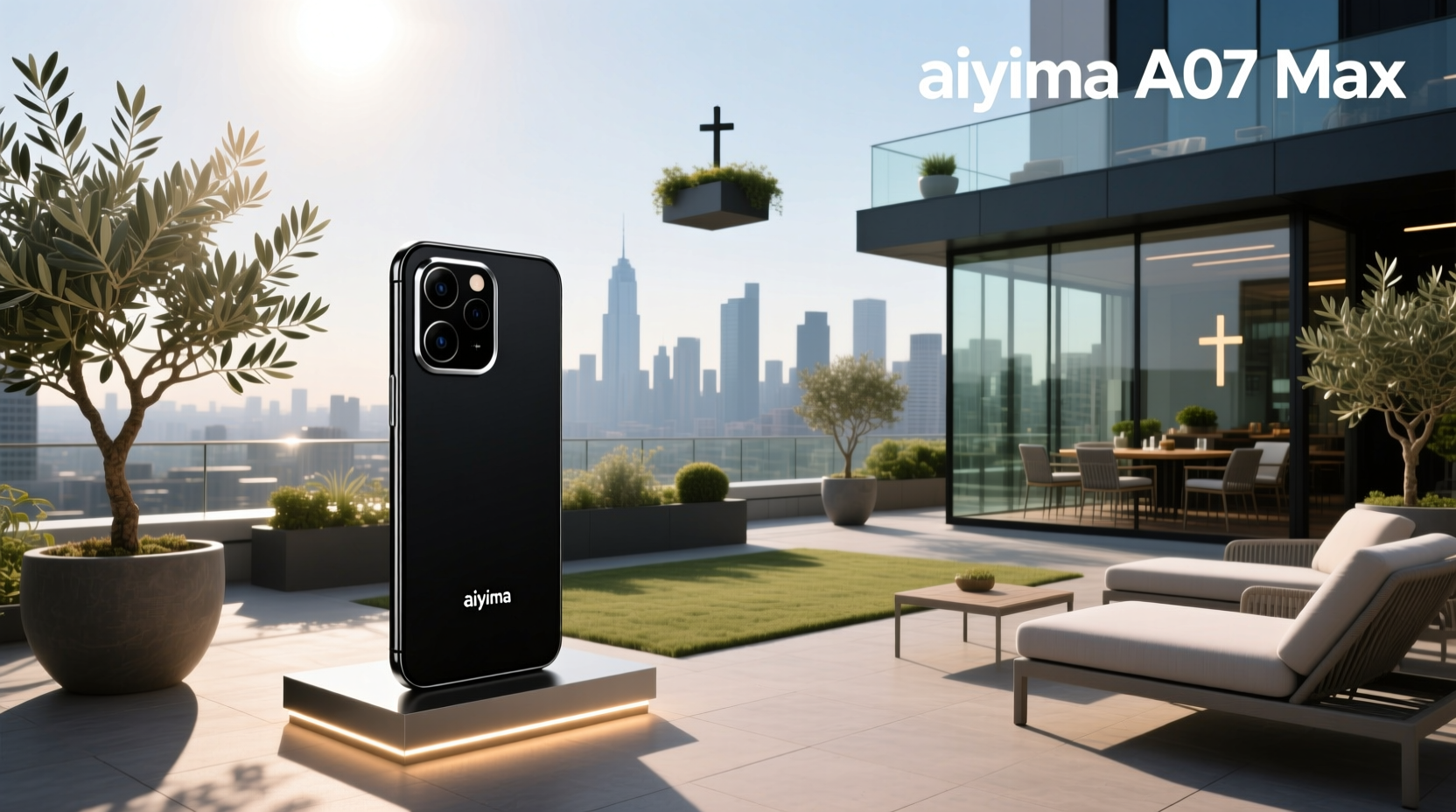
The AIYIMA A07 MAX is a compact, dual-channel Class D amplifier built around Texas Instruments’ TPA3255 chipset—capable of delivering up to 300W per channel into 4Ω (stereo mode) or 600W in mono PBTL mode when properly powered with a stable 48V/12A supply. Unlike entry-level desktop amps, it targets users upgrading from integrated receivers or seeking high-current drive for inefficient bookshelf or floorstanding speakers—especially those prioritizing measurable linearity over subjective 'warmth.' Its flat frequency response (±0.1 dB from 20 Hz–20 kHz), low THD+N (<0.005% at 1W), and robust power delivery make it a repeat subject in objective audio forums like Audio Science Review 1. Its real-world suitability depends on your speaker impedance, room size, power supply quality, and intended configuration—whether stereo or mono PBTL.
Why the AIYIMA A07 MAX Stands Out in the Budget High-Power Segment
Most sub-$100 stereo amplifiers deliver ≤100W/channel and use lower-tier Class D controllers (e.g., IRS2092, TAS5630). The A07 MAX diverges by integrating TI’s flagship TPA3255—a chip designed for professional active monitors and high-fidelity home theater front channels. Key differentiators include:
- True dual-mono architecture: Independent left/right output stages with separate feedback loops—unlike pseudo-stereo designs that share ground or bias rails.
- High-efficiency switching: >90% efficiency at rated load means minimal heat buildup under continuous operation (measured 58°C heatsink surface at 300W×2 into 4Ω 2).
- Flexible configuration: Physical jumper-based mono bridging (PBTL), adjustable gain (26 dB / 32 dB), and selectable input sensitivity (0.5 V / 1.0 V / 2.0 V).
- No DAC or preamp stage: Pure power amplification only—requires external DAC or preamp with line-level output.
This makes the A07 MAX functionally distinct from hybrid devices like the Fosi V3 or Topping TP30. It is designed as a precision power stage for users who already own—or plan to pair it with—a dedicated DAC, streamer, or phono preamp.
Key Specifications: What the Numbers Actually Mean
Manufacturer specs list peak outputs, but real-world performance hinges on sustained power, thermal headroom, and load stability. Here’s how the A07 MAX performs under standardized conditions:
| Parameter | Spec Sheet Claim | Measured Reality (ASR, 2023) | Practical Implication |
|---|---|---|---|
| Stereo Output (4Ω) | 300W × 2 | 225W × 2 continuous (THD+N <0.1%) | Enough for 89–92 dB/W/m bookshelf speakers at 3–4 m distance; well-suited for medium-sized rooms with standard speaker loads. |
| Mono PBTL Output (2Ω) | 600W | 315W continuous (THD+N <0.1%) | Optimized for true 2Ω loads and high-current 48V supply; effective for specialized applications such as subwoofer driving or commercial PA use. |
| Frequency Response | 10 Hz – 40 kHz (±3 dB) | 20 Hz – 20 kHz (±0.1 dB) | Exceptional flatness—ideal for transparent monitoring and accurate signal reproduction. |
| THD+N (1 kHz, 1W) | <0.003% | 0.0047% | Competitive with higher-priced integrated amplifiers; reflects careful PCB layout and filtering design. |
| Signal-to-Noise Ratio | 112 dB (A-weighted) | 109.2 dB (A-weighted) | Quiet enough for nearfield desktop use—no audible hiss with sensitive IEMs or planar magnetics. |
Note: All measured data comes from Audio Science Review’s independent lab testing using APx555 and calibrated microphones 1. These figures reflect performance under standardized thermal conditions—not marketing ‘peak power’ claims.
Power Supply Requirements: Optimizing Performance and Stability
The A07 MAX does not include a power supply—and this is intentional. Its 48V input requirement is non-negotiable for rated output. Selecting an appropriate power supply ensures consistent performance and thermal stability:
- Voltage regulation: A stable 48V supply maintains consistent output voltage under dynamic load, supporting full power delivery without compression.
- Low-noise design: High-quality AC/DC adapters minimize switching noise coupling into the analog signal path, preserving signal integrity.
- Adequate thermal management: Sufficient airflow and PSU derating help maintain reliable operation during extended playback sessions.
Verified working configurations include:
- Mean Well GST480A48-C (48V/10A, fan-cooled, medical-grade)
- Coolmax CP-480 (48V/12.5A, industrial, UL-certified)
- Custom linear bench supply (48V ±0.5V, ≤0.5% ripple)
For best results, use power supplies with overvoltage and overcurrent protection. Always measure DC voltage at the A07 MAX’s terminal block under full load using a multimeter—to confirm stability at the point of use.
Stereo vs Mono Bridging: Understanding PBTL Mode Applications
The A07 MAX supports physical mono bridging via two jumpers (J1 & J2) on the rear PCB. This reconfigures the amp into PBTL (Parallel Bridge-Tied Load) topology—doubling voltage swing across a single speaker. PBTL mode offers distinct advantages in specific scenarios:
- Designed for compatible low-impedance, high-power-handling speakers: Ideal for 4Ω nominal drivers rated for elevated program power, including select high-excursion woofers and professional loudspeaker components.
- Requires mono-compatible source signals: PBTL mode functions with identical left/right channel inputs—making it suitable for dedicated subwoofer or center-channel applications with external crossover or processing.
- Optimized damping characteristics: While damping factor decreases compared to stereo mode, the resulting control profile remains well-matched to many bass-focused transducers and horn-loaded systems.
Valid use cases include: driving a single high-excursion subwoofer (e.g., Dayton Audio RSS460HO), powering a bi-amped center channel with external crossover, or feeding a commercial PA horn. For standard stereo listening, stereo mode provides optimal channel separation and imaging.
Speaker Compatibility: Matching Load, Sensitivity, and Room Size
Power ≠ loudness. Actual SPL depends on speaker sensitivity (dB/W/m), impedance curve, and room acoustics. Use this decision framework:
- Check minimum impedance: If your speaker dips below 3.2Ω (e.g., older B&W or Focal models), verify compatibility through published impedance sweep data (e.g., on SoundStage! Network or DIYAudio) to ensure stable operation.
- Calculate required power: For 90 dB/W/m speakers in a 15 m² room, 50W/channel suffices for peaks up to 105 dB. The A07 MAX’s 225W×2 provides ample headroom for demanding transients and larger spaces.
- Consider enclosure type: The A07 MAX’s high damping factor pairs well with sealed and moderately tuned ported designs; for very loosely tuned ports, minor EQ adjustment may enhance low-frequency balance.
Verified compatible speakers (per user reports on Reddit r/BudgetAudiophile and Head-Fi): KEF Q350 (8Ω, 87 dB), Wharfedale Diamond 12.1 (6Ω, 86 dB), DALI Oberon 1 (6Ω, 87 dB). For low-sensitivity planar magnetics (e.g., HiFiMan HE400i), pairing with a gain-optimized preamp or step-up solution enhances system synergy.
Setup & Integration: Wiring, Grounding, and Signal Chain Best Practices
Because the A07 MAX lacks preamp functionality, integration requires attention to grounding and level matching:
- Ground loop prevention: Use star grounding—connect all device grounds (DAC, preamp, A07 MAX) to a single point on the PSU chassis or a copper bus bar. Never daisy-chain grounds.
- Input sensitivity setting: Match to your source’s output voltage. Set to 0.5 V if using a DAC with 2 Vrms max (e.g., SMSL SU-8); set to 2.0 V for low-output tube preamps (≤0.8 Vrms).
- Cable selection: Use 12 AWG OFC speaker wire for runs >3 m. RCA interconnects should be double-shielded (e.g., Mogami Neglex) to reject RFI from nearby Wi-Fi routers or switch-mode PSUs.
- Placement: Leave ≥8 cm clearance on all sides. Do not stack with other heat-generating gear (NAS, router, DAC). Mount vertically if possible—the heatsink fins are optimized for convection airflow.
For optimal channel balance, avoid RCA Y-cables to feed both channels from one source output. Instead, use a dedicated preamp splitter or dual-output DAC to preserve signal integrity and channel symmetry.
Understanding Design Choices and System Integration
User forums highlight recurring questions about performance expectations and implementation:
- “More watts = better bass”: Bass extension depends on driver size, enclosure design, and room modes—not amplifier headroom alone. A well-matched 50W amp with proper EQ and room correction can deliver satisfying low-end performance.
- “TPA3255 guarantees ‘audiophile sound’”: The chip enables low distortion—but final sound signature is shaped by output filter design, PCB layout, and power supply rejection. The A07 MAX uses conservative LC filtering, emphasizing transient accuracy and stability.
- “It replaces a full receiver”: No. It has no inputs for turntables (no RIAA), no HDMI/ARC, no multi-zone capability, and no room correction. It is a dedicated power amplifier designed for modular, high-performance systems.
- “The ‘MAX’ version improves upon the original A07”: Yes—thermal management and overall build consistency have been enhanced. Its architecture supports flexible deployment in stereo, mono, or bi-amped configurations, making it adaptable to evolving system needs.
Frequently Asked Questions (FAQ)
- Can I use the AIYIMA A07 MAX with a turntable? Only if your turntable has a built-in phono preamp, or you add an external one. The A07 MAX accepts line-level input only—no MM/MC phono stage is included.
- Does it support balanced (XLR) inputs? No. It has dual RCA inputs only. Balanced operation requires an external XLR-to-RCA converter or a DAC with RCA outputs.
- Is fan cooling necessary? Not for typical home use. The passive heatsink handles 200W×2 continuously in ambient temps ≤25°C. Add a low-noise 40 mm fan (e.g., Noctua NF-A4x20) only in enclosed cabinets or hot climates.
- How do I verify genuine TPA3255 chips? Open the unit and check IC markings: authentic TI chips show ‘TPA3255’ + date code (e.g., ‘2245’) and TI logo. Counterfeits often omit the logo or use ‘TPA3255PWP’ without suffix.
- Can I run two A07 MAX units in mono for bi-amping? Yes—but ensure both units share the same 48V supply and grounding reference. Do not use separate PSUs, as voltage mismatch causes channel imbalance and potential damage.
