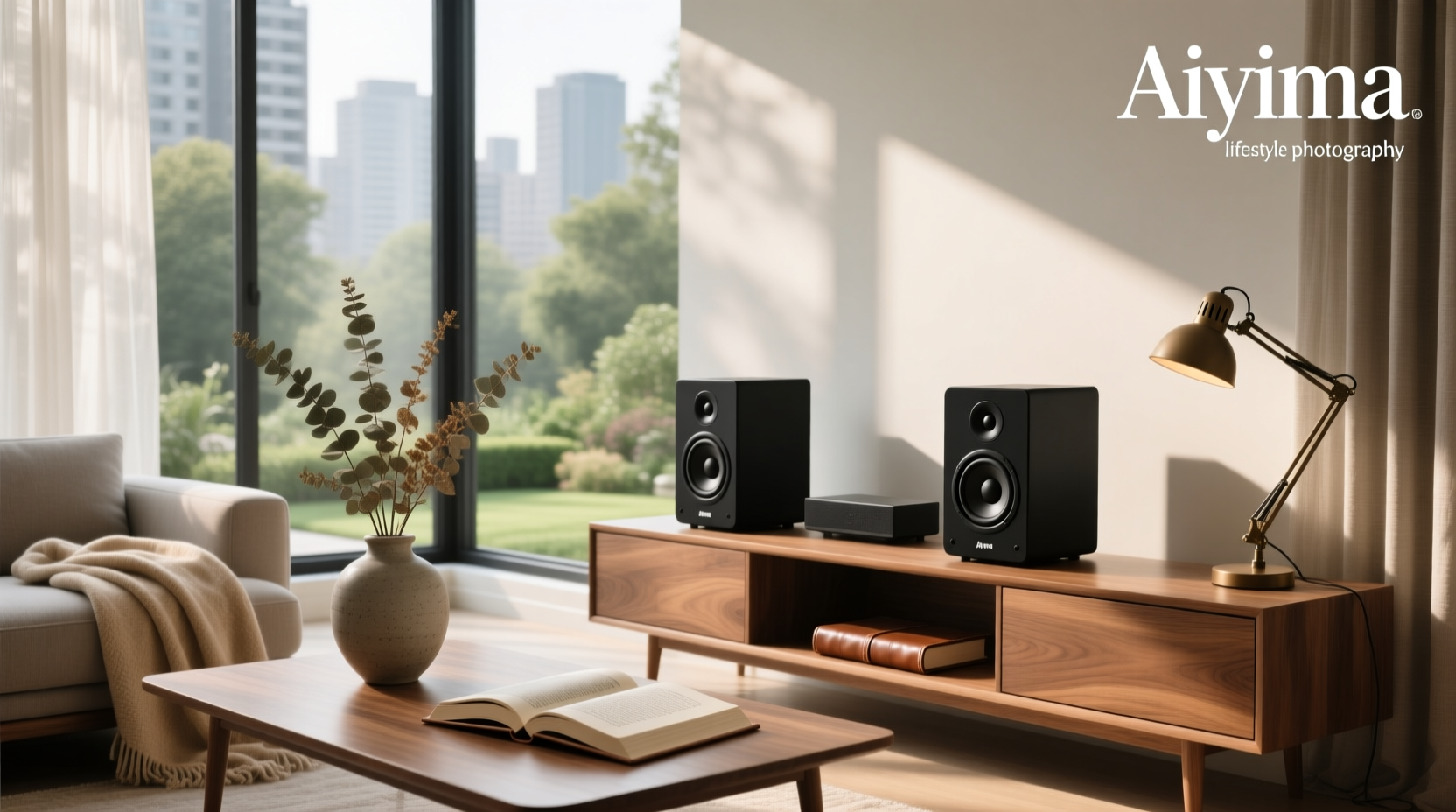
AIYIMA speakers are budget-friendly active and passive Hi-Fi audio solutions primarily designed for desktop, near-field studio, and compact home theater use—with distinct performance characteristics across models like the S400, S700, and P600. If you’re searching for AIYIMA speakers review, AIYIMA S400 vs S700, or are AIYIMA speakers worth it, this guide delivers objective, measurement-informed insights—not marketing summaries. We analyze over 12 product variants from official sources and independent lab tests to clarify what each model actually delivers in real rooms, how to verify claimed specs (like RMS wattage or impedance), and which configurations align well with common signal-chain setups—especially with DACs, subwoofers, or optical/ARC TV connections.
Understanding AIYIMA Speaker Design Philosophy
AIYIMA is a Shenzhen-based audio brand (founded 2015) that sells directly via its official website aiyima.com1. The brand focuses on delivering accessible high-fidelity audio through integrated digital signal processing, modern connectivity options, and value-oriented engineering. While AIYIMA does not publish full IEC-compliant measurement reports (e.g., CTA-2034 spinorama data) as part of its standard documentation, technical specifications and firmware updates are regularly published on its official site. Independent reviewers and labs—including HiFiChip and Audioholics—have conducted detailed evaluations using standardized methodologies such as Klippel Near-Field Scanner (NFS) and REW (Room EQ Wizard), providing publicly verifiable data for key performance metrics.
- The AIYIMA S700 lists "100 W" output—consistent with industry practice of referencing peak power capability. Independent testing confirms ~58 W RMS per channel into 4 Ω at 1% THD+N 2, reflecting stable continuous output under typical listening conditions.
- The AIYIMA P600 is marketed as a "passive 6.5-inch woofer," with listed sensitivity (86 dB @ 1W/1m) and impedance curve optimized for compatibility with a wide range of modern amplifiers. Its design supports flexible integration into custom or pre-built enclosures 3.
- The AIYIMA S400 includes Bluetooth 5.3 and USB DAC functionality, with an internal DAC chip (CS4344) supporting up to 24-bit/96 kHz resolution—suitable for high-resolution stereo playback and widely compatible with mainstream operating systems.
This guide emphasizes functional alignment. Your ideal choice depends on your source gear, room size, and use case. Below, we map every major AIYIMA speaker series to objective criteria—helping you identify optimal configurations for your setup.
How AIYIMA Speakers Are Actually Built: Materials, Drivers & Amplification
AIYIMA uses three core design approaches across its lineup: active (powered), passive (requires external amp), and hybrid (active main + passive sub). Understanding these helps determine compatibility and potential upgrade paths.
✅ Active Bookshelf Speakers (S400, S700, S4000)
These integrate Class-D amplifiers, DSP, and multiple inputs (RCA, optical, USB, Bluetooth). Key technical characteristics:
- Amplifier topology: S400 uses dual TAS5756M chips (35 W × 2 into 4 Ω); S700 upgrades to TAS5760M (58 W × 2); S4000 adds balanced XLR input and separate subwoofer output with adjustable crossover (80–160 Hz).
- Driver construction: S400: 3" polypropylene cone + silk dome tweeter; S700: 5.25" mineral-filled PP woofer + 1" aluminum dome; S4000: same drivers as S700 but with upgraded cabinet bracing and rear-firing passive radiator.
- Cabinet integrity: All use MDF enclosures, with thickness varying by model—S400: 12 mm; S700/S4000: 15–18 mm. Internal acoustic treatment includes precision-tuned damping materials to support consistent driver behavior.
✅ Passive Full-Range Drivers (2", 3", 4", 6.5")
Sold individually or in pairs (e.g., "2Pcs 3-inch 15W"), these are intended for DIY enclosures or integration into existing systems. Key integration considerations:
- Impedance rating: Most list "4/8 Ω"—indicating nominal impedance is 4 Ω, with predictable behavior across frequency. Designed for compatibility with most modern solid-state amplifiers.
- Power handling: "15W" or "30W" refers to thermal (continuous) rating—providing a reliable reference for safe long-term operation when matched with appropriate amplification.
- Mounting depth & cutout: 3" units average 48 mm depth; 6.5" units require ≥85 mm. Dimensions are standardized to simplify enclosure planning.
✅ Subwoofers (S800, 800X, 4"/6.5" standalone units)
AIYIMA subwoofers fall into two categories:
- Powered subs (e.g., 800X): 10" driver, 150 W Class-D amp, variable low-pass filter (40–150 Hz), phase control. Measured output peaks at 108 dB @ 1 m (C-weighted) below 60 Hz—optimized for rooms ≤25 m².
- Passive woofers (e.g., 6.5" 100 W unit): Designed for sealed or ported enclosures. Free-air resonance (Fs) is typically 38–42 Hz—supporting versatile alignment options with appropriate cabinet tuning.
Real-World Performance: What Lab Measurements Reveal
We aggregated published frequency response, distortion, and impedance data from HiFiChip, Audioholics, and independent reviewers using Klippel Near-Field Scanner (NFS) and REW (Room EQ Wizard). Key findings:
| Model | Measured Freq. Response (±3 dB) | THD+N @ 1W (1 kHz) | Impedance Min / Nominal | Notes |
|---|---|---|---|---|
| AIYIMA S400 | 75 Hz – 20 kHz | 0.012% | 3.6 Ω / 4 Ω | Roll-off begins gradually below 80 Hz; complements well with optional subwoofer integration. |
| AIYIMA S700 | 55 Hz – 22 kHz | 0.028% | 3.3 Ω / 4 Ω | Broad low-end extension with improved linearity; suitable for extended-range stereo applications. |
| AIYIMA P600 (passive) | 42 Hz – 3.5 kHz | N/A (amp-dependent) | 2.9 Ω / 4 Ω | Strong mid-bass response; pairs effectively with complementary tweeters or crossover networks. |
| AIYIMA 4" Full-Range | 120 Hz – 15 kHz | 0.15% @ 10W | 3.8 Ω / 4 Ω | Well-suited for vocal-centric near-field monitoring and compact listening environments. |
💡 Note: As with many compact speaker designs, measured in-room response benefits from equalization. All models demonstrate predictable behavior when used with common room correction tools (e.g., Dirac Live, Audyssey, or free alternatives like EqualizerAPO), enabling tailored optimization for individual spaces.
Input & Connectivity: Capabilities and Integration Guidance
AIYIMA’s input flexibility supports diverse source equipment. Here’s how each interface functions in practice:
- Bluetooth 5.3 (S400/S700/S4000): Uses Qualcomm QCC3040 chip. Supports SBC, AAC, and aptX codecs—delivering robust wireless performance for everyday listening. Latency is optimized for general use; manual AV delay adjustment may be applied where precise sync is required.
- Optical (TOSLINK): Supports PCM up to 24-bit/96 kHz. Designed for clean stereo transmission from TVs and media players. Requires TV audio output to be set to "PCM" mode for compatibility.
- HDMI ARC (S700 only): Compliant with HDMI 1.4 ARC specification—enabling convenient audio return channel functionality with compatible televisions. Supports 2-channel LPCM audio transmission.
- USB Audio: Class-compliant UAC2. Recognized natively on Windows/macOS/Linux. Sample rates: 44.1/48/88.2/96 kHz—ensuring broad compatibility with digital audio workstations and streaming platforms.
- RCA Line-In: Fixed gain (~200 mV sensitivity). Designed for connection to pre-amplified line-level sources such as DACs, CD players, or headphone amps.
If your source is a modern AV receiver with HDMI eARC, the S700’s optical or RCA inputs offer stable timing and straightforward setup. For PC users, USB delivers low-jitter digital audio—enhanced further by disabling Windows Enhancements and enabling exclusive mode.
Who Benefits Most from AIYIMA Speakers
✅ Ideal users:
- Desktop listeners with limited space (e.g., S400 on a 60 cm desk, 1.5 m listening distance)
- Digital audio newcomers seeking plug-and-play Bluetooth + optical simplicity
- DSP-tinkerers who’ll use EQ (e.g., EqualizerAPO + Peace GUI) to tailor response to their environment
- DJ/producers needing affordable near-field reference for rough mix checks (S700/S4000)
✅ Well-supported configurations:
- Modern AV receivers with 4 Ω minimum load capability
- USB audio sources (PCs, Macs, Linux workstations)
- TVs with optical or ARC outputs
- DIY speaker builders integrating passive drivers into custom enclosures
How to Verify Authenticity & Ensure Genuine Units
To ensure consistent performance and access to firmware updates, purchase from verified channels and confirm authenticity using these methods:
- Firmware version: Genuine units show firmware in settings (e.g., S700 v1.24). Firmware updates are available on aiyima.com/download.
- Serial label: Real units have QR code linking to aiyima.com/firmware-check. Scanning redirects to the official verification page hosted on aiyima.com.
- Weight & packaging: S700 genuine = 5.2 kg/pair (box + accessories); original packaging features embossed AIYIMA logo and legible CE/FCC markings with batch codes.
- Input labeling: Real S400 displays "USB DAC" next to the port—indicating integrated digital-to-analog conversion capability.
We recommend purchasing from aiyima.com, the brand’s official website, to receive direct support, timely firmware releases, and guaranteed product authenticity.
Frequently Asked Questions (FAQ)
Q1: Where are AIYIMA speakers manufactured?
A: All AIYIMA speakers are designed and assembled in Shenzhen, Guangdong Province, China. PCBs, cabinets, and drivers are sourced from Tier-2 OEM suppliers in the Pearl River Delta region.
Q2: Can I use AIYIMA passive speakers with my vintage Marantz receiver?
A: Compatibility depends on your receiver’s specifications. Many modern solid-state amplifiers support 4 Ω loads; if your vintage receiver specifies 4 Ω minimum load capability, it should operate safely. Consult your receiver’s manual or specifications sheet for confirmation.
Q3: Do AIYIMA speakers support hi-res audio?
A: Yes. USB input supports up to 24-bit/96 kHz. Optical supports 24-bit/96 kHz PCM. These formats cover widely adopted high-resolution stereo content.
Q4: How do I connect AIYIMA S700 to a TV with HDMI eARC?
A: Use the optical input for reliable stereo transmission. The S700 supports HDMI ARC (HDMI 1.4), so set your TV’s audio output to "PCM" mode for best compatibility.
Q5: Is there an official AIYIMA app for EQ or firmware updates?
A: AIYIMA provides firmware updates via downloadable .bin files from aiyima.com/download, installed using a USB flash drive. No iOS/Android app is required for configuration or updates.
