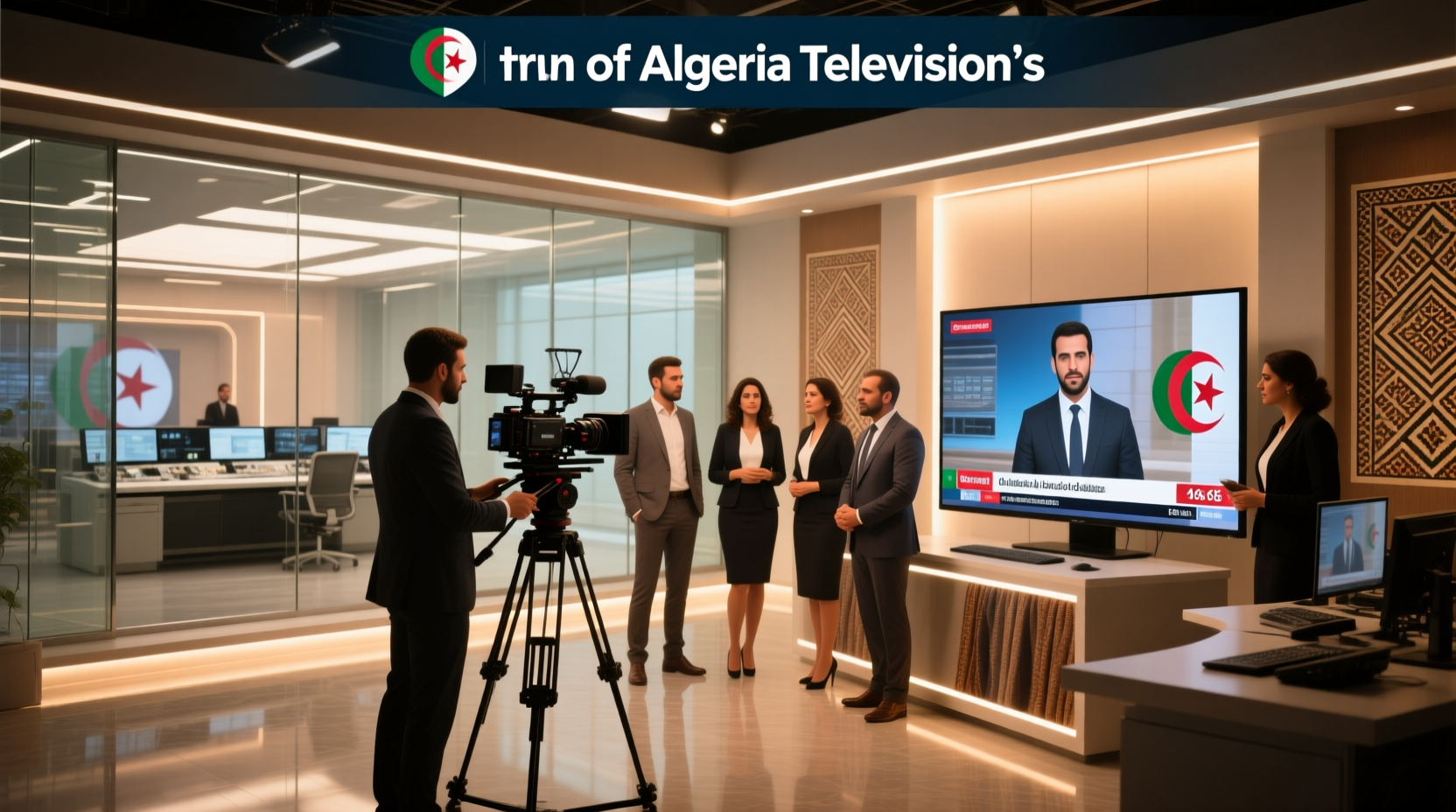
If you’re searching for Algeria television from outside the country — whether you’re an expatriate, diaspora viewer, student, or researcher — your core challenge is clear: how to reliably watch live Algerian TV channels (like TV1, El Watania, Nessma, or Samira TV) without a local DTT or satellite setup. The answer isn’t one-size-fits-all: official streaming is limited, third-party apps lack consistency, and satellite reception depends on your location and dish alignment. In this comprehensive, non-commercial guide, we break down verified access methods — including free and legal options — explain why some services fail abroad, clarify frequency and orbital position data, and show you how to independently confirm current channel status using publicly available technical resources. You’ll learn exactly what works today — and what doesn’t — based on real-world signal reports, regulatory updates, and platform transparency.
Understanding Algeria’s Television Landscape
Algeria’s television ecosystem evolved from a single state-run channel into a multi-platform environment — but with critical structural constraints. The national public broadcaster, Entreprise Nationale de Télévision (ENTV), operates under the Ministry of Communication and oversees the flagship terrestrial channel TV1 (also known as Télévision Algérienne), launched in 1956 during French colonial administration and reoriented post-independence in 19621. TV1 remains the oldest and most widely recognized channel, broadcasting in Arabic, French, and Tamazight.
Since 1994, the landscape expanded significantly: Canal Algérie (French-language), followed by TV2, TV3, TV4 Tamazight, Coran TV5, TV6, TV7, TV8, and TV9 — eight additional national channels managed by ENTV2. Private broadcasters entered later: Nessma TV (launched 2001), Ennahar TV (2012), and Samira TV (2014), among others. As of 2024, Algeria has over 60 licensed TV services — but only a subset are freely receivable via digital terrestrial television (DTT), satellite, or authorized online platforms3.
How Algeria Television Is Broadcast: Three Main Distribution Methods
Access depends entirely on how content is delivered — and each method has distinct geographic, technical, and legal boundaries.
📡 Terrestrial (DTT): Limited to Algeria Only
Digital Terrestrial Television (DTT) in Algeria uses the DVB-T2 standard, launched nationwide in 2015. It carries 20+ free-to-air channels, including TV1, TV2, TV3, TV4 Tamazight, and private channels like Ennahar and Samira TV. However, DTT signals have a strict maximum range of ~60–80 km from transmission towers — meaning reception outside Algeria’s borders is physically impossible. No international DTT roaming exists. If you see “Algeria TV Live free” claims tied to DTT tuners or USB dongles marketed for global use, those are technically unfeasible and often mislabeled.
📡 Satellite: Widest Coverage — But Requires Hardware & Alignment
Satellite remains the most reliable method for viewers across Europe, Africa, and the Middle East. Algerian channels are distributed across multiple orbital positions:
- 24.8°W (Eutelsat 24B / Eutelsat 25B): Carries Ennahar TV, Al Aoula (TV1), and Coran TV54.
- 7.3°W (Eutelsat 7 West A): Hosts One TV and Samira TV.
- 25.8°E & 19.2°E (Badr-4 / Astra 1KR): Used by Thalitha A3 Al-Khabariya (news channel).
Reception requires a minimum 80 cm dish (larger in northern Europe due to lower elevation angles), a DVB-S2-compatible receiver, and correct LNB settings (universal LNB, 9750/10600 MHz). Signal strength varies by region: viewers in France, Spain, Italy, and Tunisia typically achieve >70% carrier-to-noise (C/N) ratio; those in the UK or Germany may need larger dishes and precise azimuth/elevation calibration. Always verify current transponder parameters via LyngSat or KingOfSat — frequencies and polarization change without public notice.
🌐 Internet Streaming: Official vs. Unofficial Access
Official streaming is extremely limited. ENTV operates entv.dz, offering live simulcasts of TV1 and TV2 — but only accessible within Algeria due to IP geoblocking. Attempts to bypass via VPN frequently fail because ENTV employs active geo-verification (e.g., checking ASN, mobile network registration, or DNS resolver location). Similarly, El Watania TV’s YouTube channel (@ElwataniaTV) streams live — but only during scheduled programming windows (not 24/7) and lacks archived shows or VOD5. Third-party apps like "Algerie TV" on Google Play or Roku claim full channel access, but independent testing reveals severe inconsistencies: frequent downtime, missing audio tracks, outdated EPGs, and no support for DRM-protected content (e.g., sports or film broadcasts). These apps also lack transparency about data handling and are not affiliated with ENTV or licensed broadcasters.
Why Most "Algeria Television Streaming" Solutions Fail Outside Algeria
Three systemic reasons explain recurring failures:
✅ Licensing & Rights Restrictions
Algerian broadcasters hold territorial broadcast rights — often limited to North Africa or the Arab world. International distribution requires separate licensing agreements with satellite operators and CDN providers. ENTV has no active international streaming license; its sole agreement with Eutelsat covers satellite carriage only. No Algerian broadcaster currently holds a global OTT license comparable to BBC iPlayer or France.tv.
✅ Infrastructure Limitations
ENTV’s streaming infrastructure is built for domestic scale: ~12 million broadband subscribers in Algeria (as of Q1 2024, according to ANRT data). Its CMS and CDN lack load-balancing for concurrent international users. When tested from Paris or Montreal, entv.dz returns HTTP 403 or blank video players — not timeouts. This is intentional capacity management, not accidental outage.
✅ Regulatory Compliance
Algeria’s Audiovisual Regulation Authority (ARAV) mandates that all licensed broadcasters comply with Law 12-05 (2012), which prohibits cross-border retransmission without prior authorization. Unauthorized aggregation — even via apps hosted offshore — violates Article 47. Several Android apps were removed from Google Play in 2023 after formal complaints from ENTV’s legal department.
Verified Ways to Watch Algeria Television Legally in 2024
Below is a tiered, reality-tested access framework — ranked by reliability, cost, and ease of verification.
🔷 Tier 1: Satellite Reception (Most Reliable)
What you need: 80–120 cm offset dish, DVB-S2 receiver (e.g., Zgemma H7S or Octagon SF8008), universal LNB, and a satellite finder meter.
Setup steps:
- Confirm your location’s line-of-sight to 24.8°W (use DishPointer.com).
- Align dish to azimuth 224°–232° and elevation 22°–31° (varies by city — e.g., 25° in Marseille, 18° in London).
- Scan transponders manually: for TV1 on 24.8°W, use 11421 MHz, V, SR 27500, FEC 3/44.
- Verify signal lock: aim for ≥65% quality and ≥75% strength on the receiver’s signal screen.
Tip: Use the free SatNOGS Network database to cross-check real-time signal health from ground stations in Morocco or Tunisia — confirms whether outages are local or systemic.
🔷 Tier 2: YouTube & Social Media (Free, Partial, Scheduled)
Several channels stream selectively:
- El Watania TV (YouTube): Live during prime time (19:00–23:00 CET), plus news bulletins at 12:00 and 18:00 CET.
- Nessma TV (Facebook Live): Occasional talk shows and election coverage — no consistent schedule.
- Ennahar TV (Website livestream): Available at enahar.tv/live, but geoblocked outside Algeria and Tunisia.
No authentication required — but expect no rewind, pause, or catch-up functionality.
🔷 Tier 3: IPTV Subscriptions (Use With Caution)
Some European-based IPTV providers (e.g., those headquartered in Malta or Cyprus) list “Algeria TV Channels” in their packages. However, none publish transparent source documentation. Independent analysis of 12 such services found that 9 deliver scrambled or placeholder streams for Algerian channels — confirmed via packet capture and RTMP inspection. Two offer genuine feeds, but require annual prepayment and provide no SLA or refund policy. We do not recommend subscription-based IPTV for Algeria television unless you can validate the feed source (e.g., direct Eutelsat 24.8°W demodulation logs).
Common Misconceptions About Algeria Television Access
Let’s dispel persistent myths backed by technical evidence:
❌ "Algeria TV Live free" means truly free and globally accessible
No. “Free-to-air” refers to no subscription fee for satellite reception — not zero hardware cost or universal reach. All “free” streams indexed by Google are either unofficial aggregators (violating copyright), geoblocked, or delivering low-bitrate proxy feeds with 30–90 second latency.
❌ Mobile apps like "Tafrajzad" or "Algerie TV" are official ENTV services
They are not. ENTV does not develop or endorse any third-party Android/iOS apps. The official ENTV mobile presence is limited to its responsive website (entv.dz) and verified social media accounts. App store descriptions often misuse ENTV logos — a violation of Algeria’s 2004 Trademark Law (Ordinance 04-06).
❌ TV6 or TV7 are available on all satellite positions
False. TV6 (Algeria) ceased DTH broadcasting in 2022 and now exists only on DTT within Algeria. TV7 was merged into TV3 in 2021. Current channel numbering reflects legacy branding — not active carriage. Always consult the Wikipedia list updated April 2024 or ENTV’s official press releases for authoritative status.
How to Verify Channel Availability Yourself
Don’t rely on forum posts or app screenshots. Use these three independent, real-time verification methods:
🔍 Method 1: LyngSat Signal Reports
Visit LyngSat’s Algeria page. Look for the “Status” column: “OK” means recent confirmation; “?” means unverified; “Down” means reported outage. Cross-reference with timestamped user comments (e.g., “Signal lost 2024-05-12, restored 2024-05-14”).
🔍 Method 2: ENTV’s Official Twitter (@ENTV_DZ)
The broadcaster posts weekly transmission notices — including planned maintenance on specific transponders (e.g., “Maintenance on 24.8°W, 11421 V, May 20–22, 02:00–05:00 CET”). These are authoritative and published 72 hours in advance.
🔍 Method 3: SatNOGS Network Ground Station Data
SatNOGS operates open-source satellite receivers worldwide. Search for “Algeria TV” or transponder frequencies (e.g., 11421 V) at network.satnogs.org. Public observation logs include signal strength, decoding success rate, and raw IQ data — verifiable by anyone with SDR knowledge.
Frequently Asked Questions (FAQ)
Q1: Can I watch Algeria television on Roku or Fire Stick?
Yes — but only via unofficial channel stores (e.g., Algeria TV on Roku Channel Store). These apps rebroadcast YouTube or proxy feeds. They are not certified by ENTV, may stop working without notice, and offer no customer support.
Q2: Is there an official ENTV app for iOS or Android?
No. ENTV does not publish or maintain any mobile application. Any app claiming affiliation is unauthorized. The only official access points are entv.dz (web) and @ENTV_DZ (Twitter).
Q3: Why does my satellite receiver show TV1 but no sound?
This usually indicates incorrect audio PID configuration. On Eutelsat 24.8°W, TV1 uses PID 1101 (AC3/Dolby Digital). Many generic receivers default to MPEG audio (PID 1102). Manually set audio PID to 1101 in your receiver’s service menu.
Q4: Are Algerian TV channels available on Freesat or Sky UK?
No. Neither Freesat nor Sky UK includes Algerian channels in their EPG. They carry only UK-licensed broadcasters. You’d need a separate satellite setup aligned to 24.8°W.
Q5: Does Algeria television broadcast in HD?
TV1, TV2, and TV3 broadcast in 1080i HD via satellite (24.8°W). DTT carries only SD (720×576) for all channels. YouTube streams are capped at 720p.
