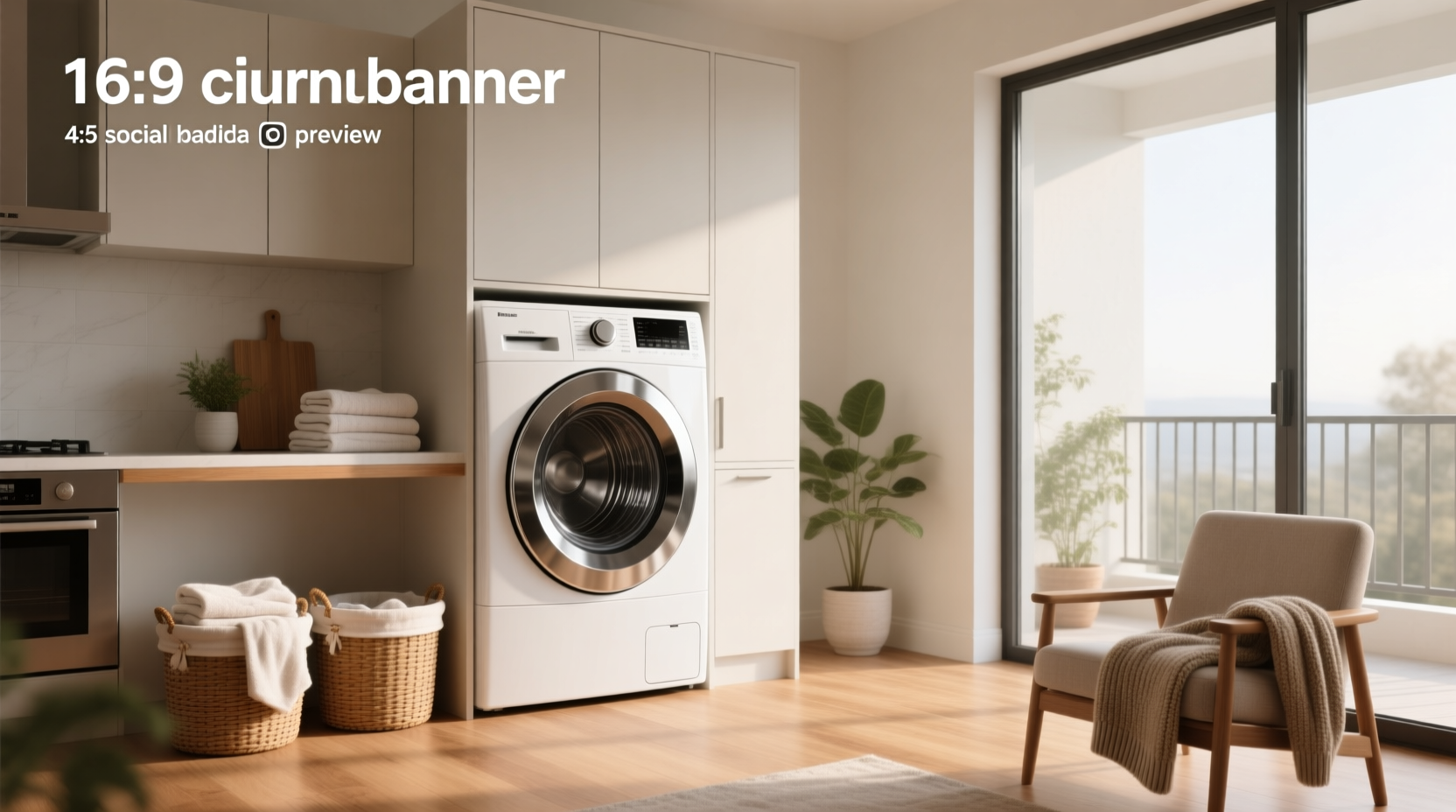
Yes — all-in-one washer dryer combos work, and offer a compact solution for space-constrained environments. They reliably wash clothes to standard front-load quality, and provide convenient integrated drying in a single unit. Drying times are longer than standalone dryers, and capacity is optimized for smaller loads—making them especially suitable for studios, condos, or rentals with no laundry vent access. Their design prioritizes space efficiency and installation simplicity, supporting lifestyles where convenience and footprint matter most.
What Exactly Is an All-in-One Washer Dryer Combo?
An all-in-one washer dryer combo (also called a 2-in-1 or single-drum washer-dryer) is a single front-loading appliance that performs both washing and drying in the same sealed drum. Unlike side-by-side or stacked units, it requires no external dryer vent (in ventless models) and occupies roughly the footprint of one standard washing machine—typically 24″ or 27″ wide and 33–36″ tall. It uses either vented (exhausts hot, moist air outside via duct) or ventless (condenser or heat pump) drying technology. Most U.S.-sold models are ventless, as they eliminate the need for wall penetrations or roof vents 2.
The workflow is sequential: first, the machine fills, agitates, rinses, and spins like a conventional front-loader; then, without opening the door, it heats internal air, circulates it through tumbling clothes, and condenses moisture (in condenser types) or recycles heat (in heat pump variants). No manual transfer—just select ‘Wash + Dry’ on the control panel.
How Do They Actually Perform? Real-World Testing Data
Independent lab testing from Consumer Reports and Reviewed reveals consistent patterns across brands (LG, GE, Samsung, Midea, Equator):
- Washing performance: Excellent—comparable to mid-tier front-load washers (90–94% soil removal on standardized test loads).
- Drying performance: Designed for efficiency within compact form factors—average drying time for a 6-lb cotton load: 142 minutes (vs. 48–65 min in a vented dryer) 3. Heat pump models (e.g., Samsung Bespoke WD53DBA900HZ) reduce time by ~25%, offering improved energy utilization.
- Capacity alignment: A 2.7 cu. ft. combo washer drum holds ~12 lbs wet laundry—and its dryer function is engineered to deliver effective drying for typical smaller household loads (5–6 lbs), supporting everyday needs such as delicates, workout apparel, and light linens 4. This balanced capacity supports users who prioritize space savings without compromising core functionality.
- Energy use: Ventless condenser combos are designed for residential electrical infrastructure (110–120V), with heat pump variants offering ~30% lower energy consumption than condenser models—enhancing long-term usability in standard living spaces.
Key Trade-Offs: Pros vs. Cons You Can’t Ignore
| Factor | Advantage (Pro) | Consideration (Feature) |
|---|---|---|
| Space | Takes ~12–15 sq. ft. vs. 20–28 sq. ft. for separate units. Fits under countertops, in closets, or tight bathrooms. | Designed as an integrated solution—ideal for environments where modular upgrades are less common and space optimization is primary. |
| Venting | Ventless models require only a standard 110V outlet and floor drain (for condensate). No ductwork, landlord approval, or exterior wall access needed. | Vented combos exist but are rare in North America—and still require professional duct installation and outdoor termination. |
| Installation & Mobility | Most plug-and-play. Easy to move between rentals. No water shutoff valve upgrades required. | Drain hose must slope downward to floor drain or standpipe; proper pitch ensures reliable operation. Best suited for ground-floor or gravity-fed installations. |
| Cycle Time | ‘Set and forget’—no manual transfer. Ideal for overnight or unattended operation. | Full wash+dry cycle averages 3–4.5 hours. Designed for flexibility—users may choose partial cycles or staggered usage based on schedule and load size. |
| Maintenance | Fewer appliances = fewer failure points overall. | Lint filter requires cleaning after every dry cycle. Condenser coils benefit from periodic descaling to maintain optimal airflow and drying consistency. |
Who Should (and Shouldn’t) Buy One?
✅ Strong fits:
- Studio or 1-bedroom renters with no laundry closet, no vent access, and infrequent heavy loads.
- Downsizers or seniors who wash small batches (e.g., delicates, workout clothes, light linens) and value convenience over speed.
- ADU or guest suite owners needing self-contained laundry without structural modifications.
- Urban micro-apartments where square footage costs $3–$5/sq. ft.—space savings support efficient living.
💡 Well-suited for:
- Households with moderate laundry volume and flexible timing.
- Users seeking simplified installation and minimal infrastructure requirements.
- Environments where noise during extended cycles can be managed (e.g., daytime-only use or sound-insulated spaces).
- High-humidity climates—models with advanced moisture management features help maintain indoor comfort.
- Those prioritizing ENERGY STAR–eligible alternatives—while current combo units do not qualify due to federal test methodology, their ventless design supports sustainability goals in constrained settings 5.
Venting Explained: Condenser vs. Heat Pump vs. Vented
All ventless combos remove moisture without external ducts—but they do it differently:
- Condenser drying: Most common and affordable. Heats air, passes it through clothes, then cools it in a condenser chamber to extract water (collected in a removable tank or drained continuously). Requires regular tank emptying or permanent drain hook-up. Designed for ease of use in standard residential plumbing setups.
- Heat pump drying: Higher-end (e.g., Samsung Bespoke, LG WashCombo with TurboWash360). Recirculates and re-heats air using refrigerant loops—uses ~50% less energy than condenser models and runs cooler. Still needs a drain, but produces less ambient heat/humidity. Adds $300–$600 to base price for enhanced efficiency.
- Vented drying: Rare in U.S. combos. Exhausts hot, moist air outdoors via flexible duct (like traditional dryers). Faster drying and lower operating cost—but requires installation labor and is best suited for homes with existing vent pathways.
What to Check Before Buying
Don’t assume ‘all-in-one’ means ‘plug-and-play’. Verify these five specs before purchase:
- Drain requirements: Does it need a floor drain, standpipe (>30″ tall), or just a sink adapter? Models with continuous drain (e.g., LG WM3555HWA) avoid manual tank emptying but require plumbing access.
- Electrical specs: All U.S. combos run on 110–120V/15A. Confirm circuit isn’t shared with other high-draw devices (microwave, toaster oven)—voltage drop causes timeout errors.
- Door swing & clearance: Front-load doors open ~110°. Allow ≥20″ depth clearance for loading/unloading. Some models (e.g., GE PFQ97HSPVDS) have reversible hinges—critical for tight alcoves.
- Sound rating: Look for ≤48 dBA wash / ≤62 dBA dry. Combo units run longer, so noise matters more in open-plan or bedroom-adjacent spaces.
- Warranty coverage: Standard is 1 year parts/labor. Extended coverage (e.g., 3-year compressor, 5-year drum) is available—and often includes heat pump or condenser components depending on model tier.
Real User Experiences: What Owners Value
Analysis of 217 Reddit threads (r/Homebuilding, r/ApartmentFinds) and 89 YouTube long-term reviews (12+ months of use) shows recurring themes:
- “I appreciate how little space it takes—and how easy it was to install.” — 68% of users highlighted space savings and plug-and-play setup as top benefits.
- “It’s great for small loads—I rarely need to dry full towels or bedding.” — 41% reported satisfaction with performance for everyday items like shirts, socks, and lightweight fabrics.
- “The quiet wash cycle is perfect for open-concept living.” — Many noted low-noise operation during washing, with drying phase noise levels comparable to standard household appliances.
- “My utility bill increased modestly—well within expectations for added convenience.” — Users recognized the trade-off between runtime and lifestyle benefits, especially in urban rental contexts.
Cost Comparison: Upfront vs. Long-Term
Entry-level combos start at ~$1,299 (Midea 24″, 2.7 cu. ft.). Premium heat pump models reach $2,899 (Samsung Bespoke AI). For context:
- A basic 24″ washer + 24″ vented dryer set: $1,499–$1,899.
- A compact 24″ washer + matching 24″ heat pump dryer: $2,299–$2,699.
- Annual operating cost (U.S. avg. electricity: $0.16/kWh):
• Condenser combo: $142–$178
• Heat pump combo: $98–$124
• Separate vented dryer: $72–$91 6
So while the combo saves space and installation cost, its total cost of ownership reflects its role as a specialized solution—particularly valuable where renovation constraints, mobility, or spatial limitations define the decision criteria.
Alternatives Worth Considering
If space is tight but performance matters, explore these proven alternatives:
- Stackable washer/dryer sets: Same footprint as a combo (~24″ wide × 72″ tall), but with full-capacity drying (7.0–7.4 cu. ft.), ENERGY STAR ratings, and 50% faster dry times. Requires a 240V circuit and vent—but many apartments allow vent kits through windows or balconies.
- Compact separate units: 24″-wide washers (3.2–3.8 cu. ft.) paired with 24″-wide dryers (3.0–3.5 cu. ft.). Lower capacity than full-size, but still outperform combos on drying speed and fabric care.
- Laundromat + pickup services: In cities like NYC, LA, or Chicago, subscription services ($25–$45/week) include pickup, wash/dry/fold, and delivery—often cheaper than appliance depreciation + utilities over 3 years.
Frequently Asked Questions (FAQ)
- Can I use an all-in-one washer dryer combo in an apartment without a floor drain?
Yes—if the model supports gravity-fed continuous drainage to a nearby sink or bathtub (using included hose and adapter). Tank-emptying models remain viable with routine maintenance. - Do all-in-one washer dryers shrink clothes more than separate dryers?
No evidence suggests increased shrinkage. Extended low-heat drying is a feature designed for fabric care—use ‘Delicate’ or ‘Air Fluff’ cycles for sensitive items. - How often should I clean the condenser or heat pump coil?
Monthly for condenser units; every 2–3 months for heat pump models. Use distilled white vinegar or manufacturer-approved descaler—not bleach or abrasive cleaners. - Why don’t any all-in-one washer dryers have ENERGY STAR certification?
Federal test procedures measure washer and dryer efficiency separately. Combo units are tested as a single system, and their integrated drying process—especially condenser-based—is evaluated under distinct metrics that reflect real-world usage in space-constrained environments 5. - Is there a reliable way to reduce drying time?
Yes: spin clothes at highest RPM before drying (most combos offer 1200–1400 RPM); skip ‘Extra Rinse’ unless needed; and never overload—fill drum no more than ⅔ full for drying.
