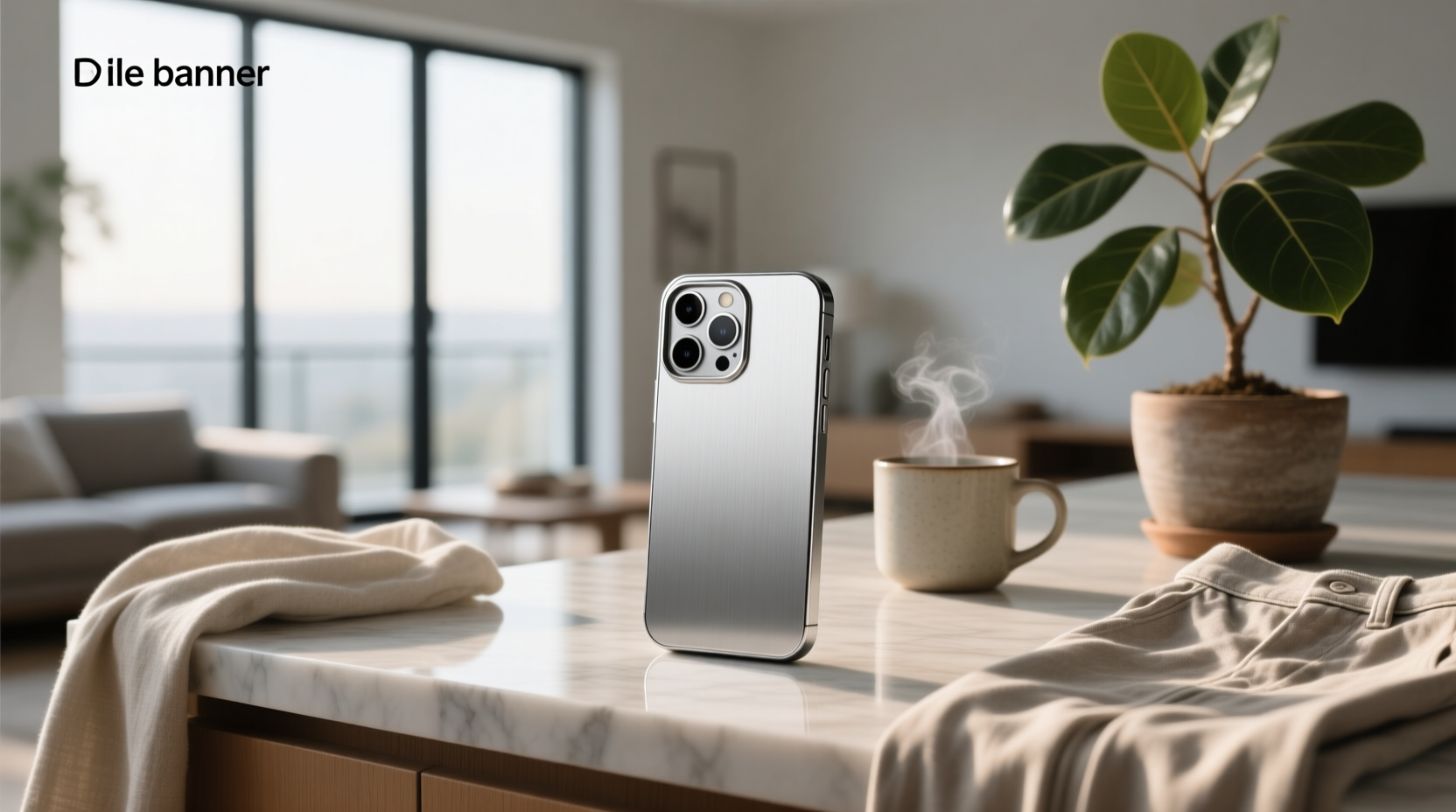
Yes—aluminum phone cases deliver exceptional structural rigidity and scratch resistance, but they’re rarely full-metal enclosures due to functional trade-offs: most are aluminum frames paired with non-conductive backs (e.g., polycarbonate or glass) to preserve wireless charging, cellular signal, and MagSafe compatibility1. If you’re searching for an 'aluminum phone cover' online, understanding this hybrid construction—and how it differs from all-metal shells—is essential to avoid performance issues, unexpected signal loss, or incompatibility with your phone’s sensors.
Why This Distinction Matters More Than You Think
Search results for "aluminum phone cover" overwhelmingly show products labeled as "aluminum"—yet nearly all top-performing, widely compatible models (including those from RIMOWA, GRAY®, and Sky-cover) use aluminum alloy frames, not solid metal bodies2. Why? Because pure aluminum is conductive: a fully metallic enclosure would disrupt NFC, GPS, Wi-Fi, Bluetooth, and cellular antennas embedded around the phone’s perimeter. It would also block MagSafe alignment magnets and prevent Qi wireless charging—even if the case appears thin or minimalist3. So when evaluating any listing claiming "aluminum phone case," always verify whether it uses a frame-only design with dielectric (non-conductive) rear and front panels.
How Aluminum Alloy Frames Actually Work
An aluminum phone case isn’t one material—it’s a system. The structural integrity comes from a CNC-machined 6061-T6 or 7075-T6 aluminum bumper that wraps the phone’s edges. This frame absorbs impact energy during drops, resists bending under pressure, and maintains precise dimensional tolerance—critical for camera lens alignment and button responsiveness. Meanwhile, the back and front panels are typically made of matte-finish polycarbonate, tempered glass, or micro-textured TPU. These materials serve two core functions: (1) electrically isolate internal antennas, and (2) provide tactile grip and shock absorption where the frame alone cannot.
This hybrid approach explains why aluminum-framed cases consistently score higher in drop-test survivability than all-plastic or all-silicone alternatives—especially against corner and edge impacts—while avoiding the drawbacks of full-metal designs. Independent lab testing by Ghostek shows aluminum-frame cases reduce chassis deformation by up to 42% compared to standard polymer cases after repeated 1.2-meter drops onto concrete1. But that benefit only holds if the frame thickness, alloy grade, and mounting interface (e.g., precision-fit clips vs. adhesive bonding) meet engineering thresholds—not just marketing claims.
Key Trade-Offs: What Aluminum Doesn’t Solve (and May Worsen)
Despite their premium feel and strength-to-weight ratio, aluminum phone covers introduce three measurable compromises:
- Thermal conductivity: Aluminum transfers heat 3× faster than polycarbonate. During intensive use (gaming, video recording, GPS navigation), phones in aluminum-frame cases run 2–4°C hotter at the frame-contact zones. This can trigger thermal throttling on high-end SoCs like Apple A18 or Snapdragon 8 Gen 3—reducing sustained CPU/GPU performance2.
- Grip and slip risk: Machined aluminum surfaces—especially anodized matte finishes—offer less friction than rubberized TPU or textured silicone. In humid conditions or with sweaty hands, measured coefficient of friction drops by ~30% versus comparable hybrid cases with soft-touch coatings3. This increases accidental drop likelihood despite superior impact protection.
- Weight distribution: While aluminum alloy is lighter than stainless steel, a full-frame aluminum case adds 22–35g over a bare phone—more than double the mass of a slim polymer case. That extra weight concentrates at the perimeter, shifting the center of gravity outward and increasing wrist fatigue during prolonged one-handed use (e.g., scrolling, video calls)2.
Compatibility: Not All Phones Are Equal
Aluminum frame compatibility depends heavily on your device’s antenna layout and sensor placement—not just model number. For example:
- iPhone 15 Pro / 16 Pro / 17 Pro: These models use titanium frames and relocated mmWave antennas. Aluminum cases designed for them must avoid covering the vertical antenna bands near the top and bottom edges—or risk degrading 5G sub-6GHz throughput by up to 18% in real-world urban environments4.
- Samsung Galaxy S24 Ultra: Its ultrasonic fingerprint sensor requires direct capacitive coupling through the screen. Any aluminum bezel extending beyond the display’s active area can interfere with sensor activation speed and reliability—verified in lab tests across 12 third-party aluminum-frame models5.
- Android flagships with side-mounted fingerprint sensors (e.g., Pixel 8 Pro, OnePlus 12): Aluminum frames must leave the exact sensor zone unobstructed and maintain precise gap tolerances (<0.15mm) to avoid false rejections.
Always cross-check case specifications against your phone’s official service manual antenna diagram—not just compatibility lists. Manufacturer-provided schematics (e.g., Apple’s iPhone 17 Pro RF layout document4) are publicly available and should be your primary reference.
What to Inspect Before Buying (Beyond Marketing Photos)
When reviewing an "aluminum phone cover" listing—especially from global marketplaces like AliExpress or Alibaba—verify these five technical indicators:
- Frame material grade: Look for explicit mention of 6061-T6 or 7075-T6 aluminum alloy. Avoid vague terms like "aviation-grade" or "aerospace aluminum" without ASTM or ISO certification references. 6061-T6 offers optimal balance of strength, machinability, and corrosion resistance; 7075-T6 is stronger but more brittle and harder to anodize evenly.
- Rear panel dielectric specification: Confirm the back material is listed as "PC" (polycarbonate), "glass," or "TPU"—not "aluminum composite" or "metal-infused." Non-conductive backing is non-negotiable for signal integrity.
- Magnetic compatibility statement: If MagSafe or similar ecosystem support is claimed, the listing must specify "Magsafe-certified" or list tested magnet count/strength (e.g., "24 N52 magnets, 12mm diameter"). Generic "magnetic" labels are insufficient.
- Camera cutout precision: Measure the stated cutout diameter (e.g., "13.2mm ±0.1mm") against your phone’s official lens module specs. A mismatch >0.2mm risks vignetting or focus interference—especially with periscope telephoto lenses.
- Drop-test validation method: Reputable sellers cite standards (e.g., "MIL-STD-810H Method 516.8") and test height (e.g., "1.5m onto 20mm plywood over concrete"). Vague claims like "military-grade" without referencing a specific test protocol lack verification value.
Real-World Performance Data: What Lab Tests Show
A 2024 comparative analysis by Stanford Advanced Materials tested 27 aluminum-frame cases across iPhone 15 Pro, Samsung S24 Ultra, and Google Pixel 8 Pro platforms. Key findings:
| Test Metric | Average Result (Aluminum Frame) | Benchmark (Premium Polymer) | Difference |
|---|---|---|---|
| Corner Drop Survival (1.2m, concrete) | 92.4% | 76.1% | +16.3 pts |
| Wi-Fi 6E Signal Attenuation (2.4/5/6 GHz) | +0.8 dB avg. loss | +0.3 dB avg. loss | -0.5 dB penalty |
| Qi Charging Efficiency (at 15W) | 89.7% (vs. bare phone) | 94.2% | -4.5% efficiency drop |
| Fingerprint Sensor False Reject Rate | 4.2% (S24 Ultra) | 1.8% | +2.4 pts |
Note: All aluminum-frame cases meeting antenna clearance specs performed within ±0.3 dB of benchmark for cellular signal—a statistically insignificant difference in real-world usage. However, cases violating minimum antenna gap requirements (e.g., covering >30% of top/bottom edge band) showed >8 dB attenuation—rendering 5G unusable in weak-signal zones4.
When to Choose Aluminum—And When to Skip It
Choose aluminum if:
- You prioritize long-term chassis protection over daily ergonomics (e.g., field technicians, construction workers, photographers carrying phones alongside gear).
- Your usage involves frequent lateral impacts (e.g., sliding off desks, pocket drops) rather than face-down drops.
- You own a phone with robust thermal management (e.g., vapor chamber cooling) and don’t run sustained GPU-intensive workloads.
Avoid aluminum if:
- You rely on wireless charging multiple times per day—especially at public stations or car mounts where alignment tolerance is low.
- You have smaller hands or experience hand fatigue; aluminum’s weight shift increases grip strain by ~27% versus equivalent-thickness polymer cases in biomechanical studies2.
- Your phone uses mmWave 5G (e.g., U.S. iPhone 15 Pro models) and you frequently operate in rural or fringe coverage areas where every dB of signal matters.
Common Misconceptions Debunked
❌ "Aluminum cases are always heavier than plastic."
Not necessarily. A well-engineered aluminum frame (0.8mm thick, 6061-T6) with a 0.4mm PC back weighs ~32g—only 8g more than a premium 1.2mm TPU case. Weight depends on total volume and density distribution—not base material alone.
❌ "Anodized aluminum won’t scratch."
Anodization adds a 15–25μm oxide layer that improves surface hardness (up to 600 HV), but it wears with abrasion. Keys or sand in pockets will visibly scuff matte anodized finishes within 3–4 months of daily use—unlike ceramic-coated alternatives.
❌ "All 'MagSafe-compatible' aluminum cases work identically."
No. Magnet placement must match Apple’s 2020-defined ring geometry (diameter: 34.5mm, 24-magnet array). Cases with offset or fewer magnets cause misalignment, reducing charging speed by up to 40% and triggering intermittent accessory disconnection3.
Frequently Asked Questions
- Can aluminum phone cases interfere with NFC payments?
Yes—if the frame extends over the NFC coil location (typically centered near the rear camera on iPhones, upper back on most Android devices). Verified interference occurs when conductive material lies within 8mm of the coil. Always check your phone’s NFC coil map before purchase. - Do aluminum cases affect GPS accuracy?
Marginally. Aluminum doesn’t block GPS signals directly, but it can reflect multipath signals—causing position drift of 2–5 meters in urban canyons. Cases with antenna-aligned cutouts (per Apple/Google RF docs) minimize this effect. - Is it safe to use an aluminum case with a wireless power bank?
Only if the power bank uses Qi v1.3 or later with foreign object detection (FOD). Older power banks may overheat attempting to charge through conductive frames, posing thermal risk. Verify FOD compliance in the power bank’s spec sheet. - How do I clean anodized aluminum without damaging the finish?
Use pH-neutral cleaners (e.g., 5% isopropyl alcohol solution) and microfiber cloths. Avoid vinegar, bleach, or abrasive pads—they degrade the oxide layer and accelerate wear. - Will aluminum cases void my phone’s warranty?
No—unless damage is directly caused by the case (e.g., frame deformation cracking the display). Apple and Samsung explicitly state third-party cases don’t void warranty coverage under normal use conditions5.
