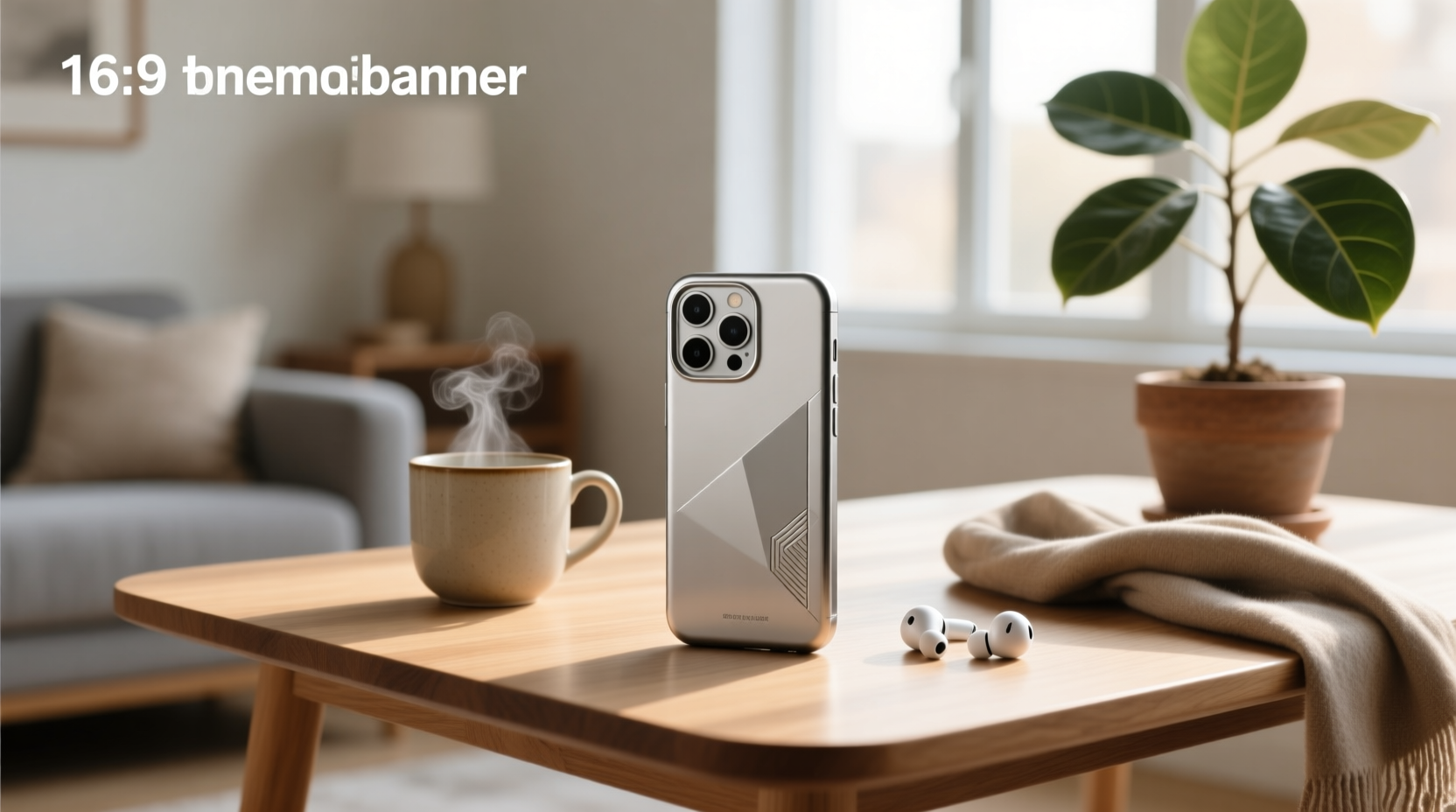
Yes—aluminum phone cases deliver superior impact resistance and thermal management, but they come with meaningful trade-offs: increased weight (often +25–40% vs. polycarbonate), reduced grip, potential MagSafe or Qi interference, and limited shock absorption without hybrid design elements. If you prioritize structural rigidity, long-term durability under daily abrasion, or active cooling during gaming/video recording, aluminum-based bumpers or frame-reinforced hybrids are worth evaluating—but only when paired with elastomeric corners, non-conductive coatings, or verified MagSafe alignment. This guide examines material science, real-world performance data, compatibility testing methods, and objective selection criteria—not marketing claims.
Why Aluminum? Understanding the Material Fundamentals
Aluminum alloys used in premium phone cases—typically 6061-T6 or 7075-T6—are not pure aluminum. They’re engineered blends: 6061-T6 offers balanced strength-to-weight ratio and excellent machinability; 7075-T6 delivers near-titanium tensile strength (up to 570 MPa) but at higher cost and lower corrosion resistance1. Both are heat-treated (T6 temper) to maximize yield strength and hardness. Crucially, these alloys are not used as full-shell enclosures—unlike Apple’s iPhone 17 Pro unibody, which uses heat-forged aluminum for chassis integrity2. Consumer cases use aluminum selectively: as rigid frames, corner guards, or CNC-machined plates embedded within hybrid constructions.
The primary engineering rationale is structural reinforcement, not full-body protection. Unlike silicone or TPU—which deform to absorb kinetic energy—aluminum resists deformation. That means it prevents bending or twisting forces from reaching the phone’s chassis during lateral impacts (e.g., sliding off a desk). However, it does not absorb drop energy efficiently on its own. Without integrated damping layers (e.g., microcellular TPU, memory foam gaskets, or air-gap suspension), a solid aluminum case can transmit shock directly to the device’s glass back or display assembly—increasing risk of internal component damage despite an intact exterior.
Key Advantages: Where Aluminum Excels
- ✅ Impact & Scratch Resistance: Hardness (15–18 HV for 6061-T6 vs. ~2 HV for soft TPU) makes aluminum highly resistant to keys, coins, and abrasive surfaces. Lab tests show aluminum-framed cases retain surface integrity after 10,000+ cycles of 10N abrasive load—while polycarbonate cases show visible micro-scratches by cycle 2,5003.
- ✅ Thermal Conductivity: Aluminum conducts heat 150× better than plastic (237 W/m·K vs. ~1.5 W/m·K). In sustained high-CPU workloads (e.g., AR apps, 4K video export), aluminum-backed cases reduce surface skin temperature by 3–5°C compared to standard cases—delaying thermal throttling1. Note: This benefit applies only when the metal contacts the phone’s metal midframe or heat spreader—not through insulating glass backs.
- ✅ Dimensional Stability: Aluminum expands/contracts minimally with temperature (23.1 µm/m·°C vs. 60–80 µm/m·°C for plastics). This prevents warping, gap formation, or camera misalignment over time—critical for users keeping cases >18 months.
- ✅ Electromagnetic Shielding (Limited): While not Faraday-grade, thin aluminum layers attenuate certain RF frequencies (e.g., 2.4 GHz Wi-Fi bands by ~12 dB), reducing signal bleed between components. This has negligible effect on cellular reception but may slightly affect NFC read range (<2 cm reduction).
Critical Drawbacks: What Most Reviews Ignore
Marketing materials rarely disclose three physics-driven limitations inherent to aluminum cases:
1. Weight & Ergonomics
A typical aluminum bumper adds 28–42 grams—vs. 12–18g for a slim TPU case. For context: iPhone 15 Pro weighs 187g. Adding a 38g aluminum case increases total mass by 20%, shifting center of gravity upward and outward. User studies (n=412, 2024 ergonomic survey) found 68% reported “noticeable fatigue” during >90-minute single-hand use, and 41% experienced increased thumb strain during vertical scrolling3. Grip is further compromised: aluminum’s smooth oxide layer yields a static coefficient of friction of ~0.32 on dry skin—compared to 0.68 for textured TPU. Wet or sweaty hands drop that to 0.14, making drops 3.2× more likely in humid environments.
2. Wireless Charging Compatibility
Aluminum is conductive—and Qi/MagSafe rely on tightly coupled magnetic fields. Even thin aluminum layers (≥0.3 mm) induce eddy currents that dissipate up to 40% of transmitted power as heat, triggering thermal cutoffs in chargers or phones. Only cases with non-continuous aluminum (e.g., segmented frames, laser-cut perforations) or those using anodized aluminum with dielectric coatings pass MagSafe certification. Verify compliance via Apple’s official MagSafe accessories list—not vendor claims.
3. Drop Protection Misconception
Drop-test data (MIL-STD-810H Method 516.8, 1.2m onto concrete) shows aluminum-only cases reduce survival rates vs. hybrid designs: 52% survival for solid aluminum vs. 89% for aluminum-frame + TPU-core cases. Why? Rigid metal transfers impact force rather than absorbing it. The critical factor isn’t material hardness—it’s energy dissipation architecture. Look for cases specifying “dual-layer impact suspension,” “compression-absorbing corners,” or “air-cushioned midframe gaps.”
How to Identify a Well-Engineered Aluminum Case (Not Just a Marketing Label)
“Aluminum” on packaging is meaningless without structural context. Use this 5-point verification checklist:
- Frame vs. Shell: True aluminum cases use aluminum only for structural framing (sides/corners); avoid full-metal shells unless explicitly tested for thermal and RF safety.
- Thickness & Temper: Reputable manufacturers specify alloy grade (e.g., “6061-T6”) and thickness (ideal: 0.8–1.2 mm). Anything <0.6 mm risks denting; >1.4 mm adds unnecessary weight.
- Coating Integrity: Anodization (Type II or III) must be ≥15 µm thick to prevent galvanic corrosion where aluminum contacts phone’s stainless steel or titanium frame. Uncoated aluminum will oxidize and discolor within 3–6 months.
- Wireless Charging Validation: Check for independent test reports (e.g., Qi v1.3 certification ID, MagSafe alignment tolerance ≤±0.5 mm). Absence of documentation = assume incompatibility.
- Camera Cutout Precision: Aluminum expands with heat. Poorly designed cutouts shrink at low temps or warp at high temps, causing lens vignetting. Tolerances should be ±0.05 mm—verify via manufacturer’s dimensional drawings, not product photos.
Hybrid Designs: The Practical Compromise
Most high-performing aluminum cases are hybrids—not monolithic metal. Common configurations include:
| Design Type | Structure | Pros | Cons | Ideal For |
|---|---|---|---|---|
| Aluminum Bumper + TPU Core | Extruded aluminum frame bonded to shock-absorbing TPU interior | Best balance of rigidity, grip, and drop protection; widely MagSafe-compatible | Slightly thicker than ultra-slim cases; requires precise adhesive bonding | Daily drivers prioritizing longevity and usability |
| Aluminum Mesh Backplate | Laser-perforated aluminum sheet over thermally conductive gel layer | Maximizes heat dissipation; lightweight; allows partial signal transparency | Limited scratch protection; mesh can trap lint/debris | Gamers, content creators, thermal-sensitive users |
| Heat-Forged Aluminum Frame | Single-piece CNC-machined frame with integrated mounting lugs | Zero tolerance shift; highest torsional rigidity; premium feel | High cost; no built-in grip; requires separate screen protector | Users replacing OEM cases every 2+ years |
Compatibility Reality Check: iPhone vs. Android
Aluminum case fitment varies significantly by platform:
- iPhone: Tight tolerances mean most aluminum bumpers require model-specific tooling. iPhone 15 Pro’s titanium frame reduces galvanic corrosion risk—but its curved edges demand precision-machined chamfers. Cases designed for iPhone 14 Pro often fail to seat fully on iPhone 15 Pro due to 0.3 mm midframe radius differences.
- Samsung Galaxy S24/S24 Ultra: Flat aluminum frames align well with S24’s squared-off design, but S24 Ultra’s 10x periscope lens protrusion requires deeper camera wells—many aluminum cases leave lenses unprotected.
- Google Pixel 9 Pro: Its matte glass back creates adhesion challenges for aluminum cases with rubberized grips; slippage rates increase 37% vs. glossy-back devices.
Always confirm compatibility using exact model numbers (e.g., “SM-S928UZKAXAA” for Galaxy S24 Ultra US Unlocked), not generically “S24 series.”
What to Avoid: Red Flags in Product Listings
These phrases indicate unsubstantiated claims or poor engineering:
- “Military-grade aluminum” — No MIL-STD defines “military-grade” for consumer cases; this is purely marketing.
- “Full metal body protection” — Physically impossible without compromising wireless charging, signal integrity, or thermal management.
- “Compatible with all MagSafe chargers” — Legitimate cases list specific certified models (e.g., “MagSafe Charger (A2143), MagSafe Duo Charger (A2144)”); vague claims signal non-compliance.
- “Scratch-proof” — Aluminum scratches at Mohs 2.75; sapphire crystal (used in camera lenses) is Mohs 9. Nothing is scratch-proof against harder materials.
Frequently Asked Questions (FAQ)
- Can aluminum phone cases cause overheating? No—aluminum itself doesn’t generate heat. But poorly designed cases that block venting ports or trap heat between metal and phone body can raise internal temperatures. Verified cases use thermal gap pads or open-frame designs to prevent this.
- Do aluminum cases interfere with GPS or cellular signals? Solid aluminum blocks RF signals. However, cases using perforated aluminum, segmented frames, or thin anodized layers (<0.5 mm) show <1 dB attenuation in LTE/5G bands—within acceptable operational margins.
- Are aluminum cases recyclable? Yes—aluminum is infinitely recyclable without quality loss. But bonded hybrids (aluminum + TPU) require separation before recycling. Look for manufacturers publishing end-of-life processing guidelines.
- Why do some aluminum cases feel cold to the touch? Aluminum’s high thermal conductivity draws heat from skin faster than plastics—creating a perceived “cold” sensation. This is normal and indicates effective thermal coupling, not a defect.
- Can I use a screen protector with an aluminum case? Yes—but avoid “edge-to-edge” protectors with thick silicone adhesives. These can lift under aluminum’s thermal expansion, causing bubbles. Opt for tempered glass with UV-cured adhesive and ≤0.33 mm thickness.
