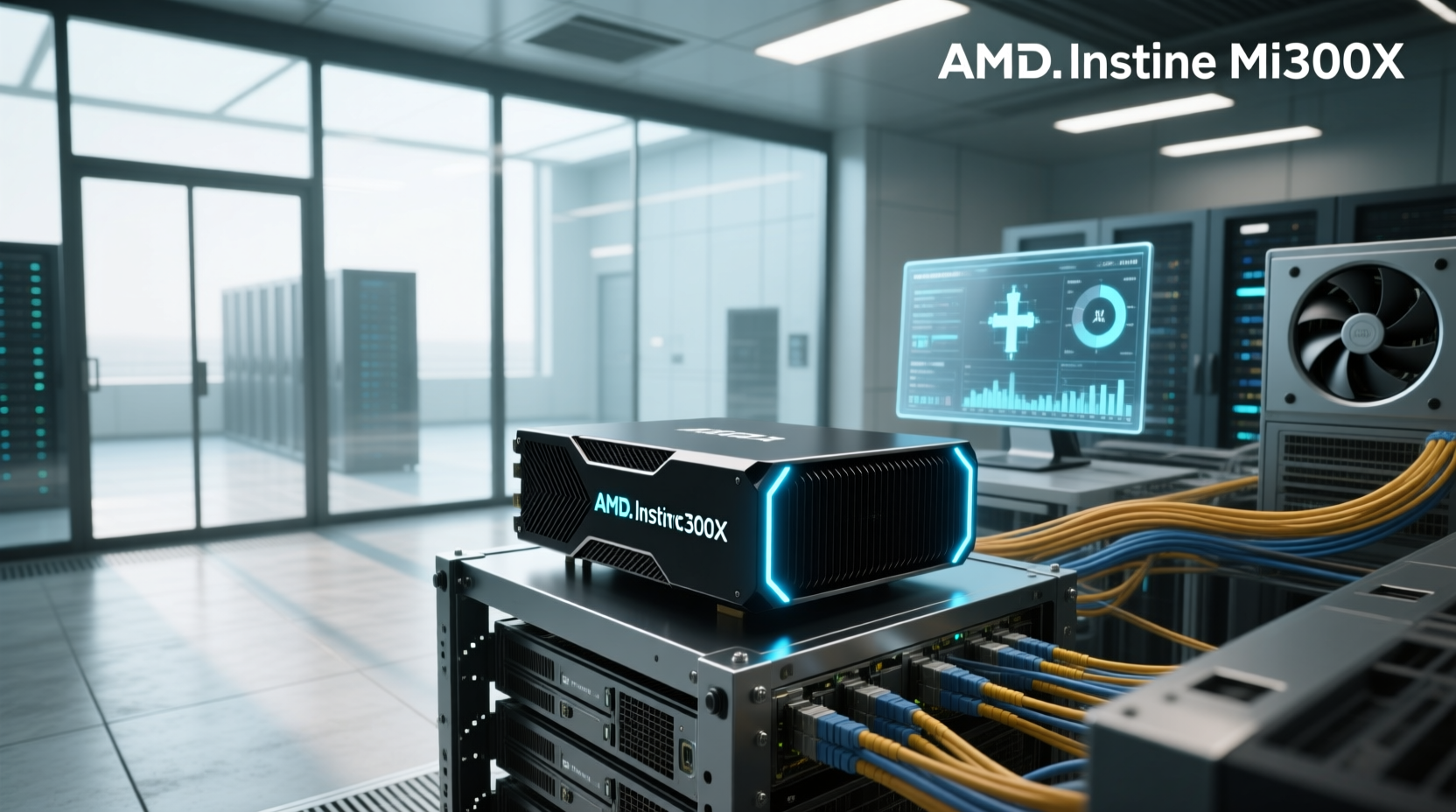
Looking for a practical, no-hype breakdown of the AMD Instinct MI300X—not marketing fluff but real-world facts on what it does well, where it falls short, and whether it fits your AI or HPC use case? You’ve landed in the right place. Launched December 6, 20231, the MI300X is not a gaming GPU—it’s a data-center-class accelerator built for generative AI inference and memory-bound HPC workloads. Its defining feature is 192GB of HBM3 memory with 5.3 TB/s bandwidth2, enabling single-GPU execution of 70B-parameter LLMs like LLaMA-2 or Mixtral—reducing multi-GPU complexity, inter-GPU communication overhead, and inference latency in production deployments. This guide cuts through vendor claims and benchmarks to answer exactly what you need to know before evaluating, procuring, or deploying the MI300X.
Why the MI300X Exists: Solving the Memory Bottleneck in AI Inference
The core engineering rationale behind the MI300X isn’t raw FP8 compute—it’s memory capacity and bandwidth. While NVIDIA’s H100 offers up to 80GB HBM3 and the H200 pushes to 141GB, the MI300X’s 192GB is currently the highest on any commercially available discrete accelerator3. This matters most when model weights exceed GPU memory. For example:
- A quantized 70B LLM (e.g., Qwen2-72B in AWQ 4-bit) requires ~35–40GB VRAM just for weights—leaving little room for KV cache, batch processing, or dynamic context expansion.
- Running unquantized or higher-precision variants (FP16/BF16) can easily demand >100GB. On an 80GB H100, this requires tensor or pipeline parallelism across ≥2 GPUs—introducing latency from PCIe or NVLink transfers and complicating orchestration.
- The MI300X fits the same model *entirely* on one die, eliminating inter-GPU data movement during inference. Real-world tests show up to 16% lower latency than H100 PCIe in identical LLM serving configurations4.
This advantage is specific—not universal. It shines in large-model inference at scale, especially for enterprises running custom LLM APIs, RAG pipelines, or multimodal models with fused vision-language backbones. It does not solve memory pressure in training, where gradient accumulation, optimizer states, and activation checkpoints dominate memory use.
Key Technical Specifications: What’s Under the Hood
The MI300X is built on AMD’s CDNA 3 architecture (codenamed Aqua Vanjaram) using TSMC’s 5nm process. Unlike consumer RDNA chips, CDNA is purpose-built for compute—not graphics. Here’s what defines its capabilities:
| Specification | Value | Notes |
|---|---|---|
| Memory | 192GB HBM3 | 5.3 TB/s peak bandwidth; 2.5× more than H100 SXM5 (2TB/s) |
| Compute Units (CUs) | 304 | Organized across 8 Accelerated Compute Dies (XCDs); not directly comparable to CUDA cores |
| Peak FP8 Performance | ~20.9 PFLOPS | Based on theoretical throughput; real-world sustained performance depends on kernel efficiency and memory utilization |
| Infinity Cache | 256MB shared L3 | Reduces trips to HBM3; critical for irregular memory access patterns in attention layers |
| Form Factor | OCP Accelerator Module (OAM) | Designed for dense server integration (e.g., 8-GPU Lenovo ThinkSystem boards5); not PCIe add-in card |
| Power | 750W TDP | Requires robust server cooling and 12V–HP power delivery; not suitable for edge or workstation use |
| Software Stack | ROCm 6.x+ | Open-source stack; supports PyTorch, TensorFlow, ONNX Runtime; optimized for inference workloads |
Crucially, the MI300X lacks DirectX or Vulkan support—it is not a graphics card. It also does not support real-time ray tracing, video encoding/decoding (AV1/HEVC), or display outputs. Its sole purpose is compute acceleration via ROCm.
Where It Excels: Real-World Use Cases
Understanding when to choose the MI300X helps maximize technical effectiveness and operational efficiency.
✅ Strong Fit: Inference-Heavy Workloads
- LLM Serving at Scale: Microsoft Azure uses MI300X for low-latency inference on large foundation models6. If your priority is throughput (tokens/sec) and consistency (p99 latency), and models are ≥30B parameters, MI300X reduces infrastructure sprawl.
- RAG & Agentic Pipelines: Retrieval-augmented generation benefits from fast, local vector database lookups and concurrent LLM calls—all fitting within 192GB without swapping to CPU RAM or SSD.
- HPC Memory-Bound Simulations: Computational fluid dynamics (CFD), molecular dynamics, and seismic modeling often hit memory bandwidth ceilings. The 5.3 TB/s HBM3 enables faster time-to-solution for datasets that don’t fit in cache.
✅ Considerations for Training and Deployment Scenarios
- Large-Scale Model Training: The MI300X supports FP16/BF16 training workloads via ROCm and demonstrates competitive FP16 throughput in MLPerf Training v4.1 for select models and batch sizes7. It is well-suited for fine-tuning and smaller-scale training tasks.
- Edge or Workstation Deployment: The OAM form factor and 750W power draw make the MI300X best suited for data center environments. For workstation or compact server deployments, alternative accelerators with different form factors may be appropriate.
- Mixed AI + Graphics Rendering: The MI300X is designed exclusively for compute acceleration. When visualization or UI rendering is required, a complementary GPU can be used alongside it in a multi-GPU configuration.
Cloud vs. On-Premise: How to Access the MI300X Today
You cannot buy a standalone MI300X card on retail marketplaces—the chip is sold exclusively to OEMs (Lenovo, Supermicro, Dell) and cloud providers. As of early 2025, availability breaks down as follows:
- Cloud Providers: Available on Microsoft Azure (ND MI300x v5 series), Oracle Cloud Infrastructure (OCI), IBM Cloud, and DigitalOcean Bare Metal8. Pricing varies widely: $0.95/hr (low-priority spot instances) to $6.00/hr (dedicated, high-availability configurations)9. Always verify instance type (e.g., “8x MI300X w/ Infinity Fabric links”) and network topology—P2P bandwidth is optimized with proper fabric configuration.
- On-Premise: Sold only as part of validated systems—e.g., Lenovo ThinkSystem SR675 V3 (8-GPU), Supermicro AS-4145GO-NART (4-GPU), or Dell PowerEdge XE9680. Minimum order quantities apply; lead times average 12–20 weeks. Expect full rack deployments—not single-card purchases.
- Resale Market: Listings on secondary markets (e.g., “AMD Instinct MI300X 192GB HBM3 OAM”) represent enterprise-grade hardware that may be sourced from decommissioned systems. Buyers should evaluate warranty status, thermal history, and firmware licensing directly with authorized resellers.
MI300X vs. Competitors: Focused Comparison by Use Case
Comparisons should focus on your workload—not spec sheets. Here’s how MI300X compares against two key alternatives:
vs. NVIDIA H100 (80GB SXM5)
- Memory Advantage: MI300X provides greater memory capacity (192GB vs. 80GB) and bandwidth (5.3 vs. 2.0 TB/s). For inference, this translates to fewer nodes, simpler scaling, and lower p99 latency.
- Training Capabilities: Both platforms support FP16/BF16 training. The MI300X delivers strong performance in benchmarked scenarios, while the H100 offers broader library integrations across diverse training frameworks.
- Ecosystem Integration: The MI300X works with major AI frameworks including PyTorch and TensorFlow through ROCm. Users benefit from open-source tooling and community-driven optimizations.
vs. NVIDIA H200 (141GB HBM3)
- Capacity and Compute Balance: The H200 offers increased memory (141GB) and higher FP8 compute (48 PFLOPS vs. 20.9), supporting larger models in both inference and training. The MI300X remains advantageous where memory capacity is the primary bottleneck and ROCm compatibility aligns with existing infrastructure.
- Availability & Deployment Flexibility: Both accelerators are available through leading cloud providers and OEM partners. The MI300X provides a compelling option for organizations prioritizing memory density and open software stack adoption.
Selection depends on workload requirements and infrastructure strategy. Choose MI300X if your stack is ROCm-native, your primary bottleneck is memory capacity, and inference efficiency drives your SLAs. Consider H100/H200 if broad framework compatibility or specialized training tooling is essential.
Practical Deployment Checklist: What to Verify Before Committing
Before signing a contract or provisioning cloud instances, validate these five points:
- ROCm Version Compatibility: Confirm your model’s framework version (PyTorch ≥2.2, Triton ≥2.1) is certified with ROCm 6.1+11. Older versions lack MI300X-specific optimizations.
- Infinity Fabric Configuration: In multi-GPU systems, ensure P2P links are enabled and configured correctly. Proper fabric setup maximizes inter-GPU bandwidth efficiency.
- Thermal & Power Validation: In on-premise deployments, verify rack PDUs deliver stable 750W per slot under sustained load—and that ambient airflow meets AMD’s 25°C inlet spec.
- Firmware & Driver Updates: Check OEM release notes for critical MI300X firmware patches (e.g., memory controller stability fixes). Firmware released in Q2 2024 and later includes recommended enhancements.
- Support Contract Scope: Ensure your SLA covers ROCm software support—including guidance on framework integration and performance tuning—not just hardware replacement.
Frequently Asked Questions (FAQ)
Q1: Can I use the AMD Instinct MI300X for AI model training?
A: Yes. It supports FP16/BF16 training workloads via ROCm and delivers strong performance in benchmarked scenarios such as fine-tuning and smaller-scale training. Its architecture is optimized for memory-intensive inference, and ongoing ROCm development continues to enhance training capabilities.
Q2: Is there a PCIe version of the MI300X available for standard servers?
A: No. The MI300X is exclusively offered in the OCP Accelerator Module (OAM) form factor. Systems requiring PCIe connectivity may consider alternatives such as the MI300A (APU) or future CDNA-generation products.
Q3: How does MI300X compare to the MI300A?
A: The MI300A integrates CPU + GPU on one package (CPU + 8 XCDs), targeting HPC and balanced workloads. The MI300X is GPU-only (8 XCDs, no CPU), maximizing memory bandwidth and density for pure AI inference. They share architecture but serve distinct roles.
Q4: What’s the realistic price range for MI300X-based cloud instances?
A: As of Q1 2025, hourly rates range from $0.95 (spot/preemptible, no SLA) to $6.00 (dedicated, 99.9% uptime, full fabric interconnect). Always benchmark your specific model—pricing per token served may differ significantly from list rates.
Q5: Does the MI300X support FP4 or INT4 quantization?
A: Native FP4 support is not documented in official specs or ROCm 6.1. It supports FP8, FP16, BF16, and INT8 via existing libraries (e.g., AWQ, GPTQ). FP4 acceleration may be introduced in future microcode or software updates.
