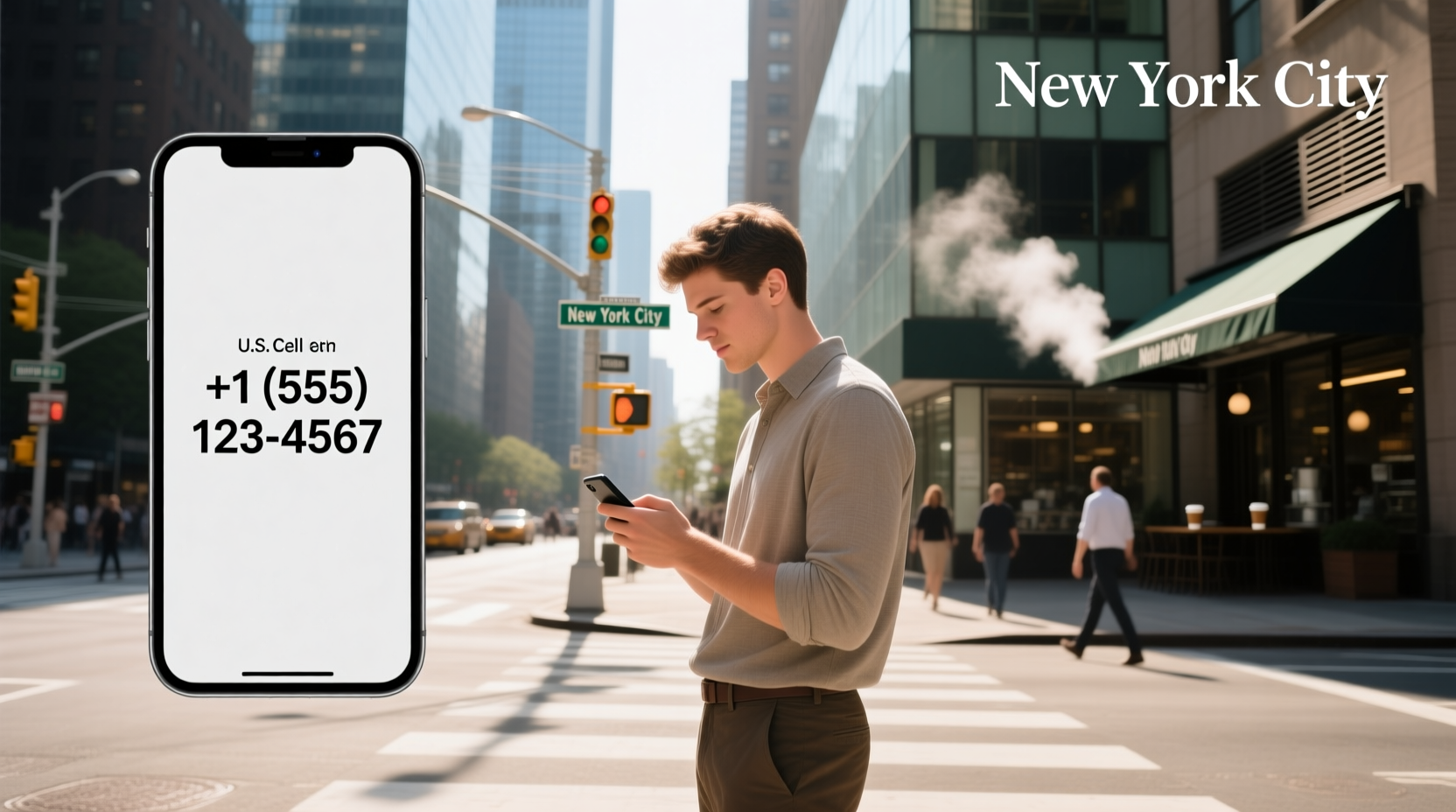
✅ An American cell phone number is always a 10-digit number in the format (XXX) XXX-XXXX, prefixed with the country code +1 when dialed internationally. It contains no letters, hyphens, or spaces in its canonical form — only digits — and follows the North American Numbering Plan (NANP). This applies identically to mobile, landline, and VoIP numbers across the U.S., Canada, and participating Caribbean nations.
If you’re trying to understand, validate, receive, or acquire an American cell phone number — whether for account verification, international calling, remote work, study abroad, or business outreach — this guide gives you the complete, up-to-date technical and practical framework. We’ll clarify common misconceptions (e.g., “Is +1 a phone number?”), explain why area codes no longer reliably indicate location, detail how virtual numbers work (and their limitations), and walk through real-world use cases — all grounded in official numbering standards and verified carrier practices.
📱 What Exactly Is an American Cell Phone Number?
An American cell phone number is not technically distinct from other U.S. telephone numbers in structure or regulatory classification. Under the North American Numbering Plan (NANP), all assigned numbers — regardless of technology (cellular, landline, VoIP, or toll-free) — share the same 10-digit format1:
- 3-digit area code (e.g., 212, 305, 415)
- 3-digit central office (exchange) code (e.g., 555, 789)
- 4-digit subscriber number (e.g., 1234)
Combined: (212) 555-1234 or 2125551234. When written for international use, it becomes +1 212 555 1234.
⚠️ Important nuance: While historically tied to geography, area codes are now portable and non-geographic. A number with a 917 area code may belong to someone in Seattle; a 650 number could be used by a remote worker in Berlin. The Federal Communications Commission (FCC) mandates number portability across carriers and technologies, meaning the original assignment location no longer determines current usage2.
🌐 Why Does the U.S. Use +1 as Its Country Code?
The United States shares the +1 country calling code with 24 other countries and territories under the NANP, including Canada, Bermuda, and most Caribbean nations (e.g., Jamaica, Trinidad and Tobago, Barbados). This unified system was established in 1947 to simplify long-distance dialing across North America.
🔍 Clarifying a top user question: “Is the US country code 001 or 1?” — The correct international prefix is +1. “001” is not a valid country code; “00” is the international exit code used in many countries (e.g., UK, Germany, France) to dial out, followed by “1”. So from London, you’d dial 00 1 212 555 1234; from Tokyo, 010 1 212 555 1234. The “+” symbol replaces your local exit code automatically on smartphones and modern VoIP apps.
❌ Misconception: “Is America +1 a phone number?” No — +1 is only the country code, not a full number. It functions like a routing prefix, telling the global telephony network to direct the call to the NANP region. A standalone “+1” cannot receive calls or texts.
🔢 How Many Digits Does a U.S. Mobile Number Have?
All standard U.S. mobile numbers contain exactly 10 digits. There are no 11-digit or 9-digit consumer mobile numbers in active public use. Some confusion arises because:
- Domestic dialing: Within the U.S., users typically dial just the 10 digits (e.g., 2125551234), omitting “+1” — even for mobile-to-mobile calls.
- International dialing: From abroad, you must include “+1” before the 10 digits.
- Toll-free numbers: These begin with 800, 888, 877, 866, 855, or 844 — still 10 digits total, but billed differently. They are not “mobile” numbers and generally cannot receive SMS from international senders reliably3.
✅ Verified fact: Per the FCC’s Numbering Resource Utilization Forecast, over 99.8% of active U.S. wireless lines use standard 10-digit NANP numbers2. No carrier issues “11-digit” mobile numbers for general consumers.
📡 Can You Get a Real American Cell Phone Number Without Living in the U.S.?
Yes — but with important functional distinctions between physical SIM-based numbers and virtual numbers.
Physical U.S. Mobile Numbers (SIM-Based)
To get a U.S. mobile number tied to a physical SIM card, you need:
- A U.S. billing address (often required for activation)
- A valid U.S. payment method (credit/debit card issued by a U.S. bank)
- Compliance with carrier KYC (Know Your Customer) requirements — increasingly enforced since 2022 via the STIR/SHAKEN framework to combat robocalls
Major carriers (Verizon, AT&T, T-Mobile) allow international customers to sign up online or in-store — but require identity verification matching U.S. government ID or passport + U.S. address documentation. Prepaid plans (e.g., Mint Mobile, Visible) are more flexible but still require a U.S. ZIP code at checkout.
Virtual U.S. Phone Numbers
These are software-assigned numbers delivered via VoIP (Voice over IP). They can receive calls and SMS, and some support MMS and two-factor authentication (2FA). Key considerations:
| Feature | Traditional Carrier Number | Virtual U.S. Number |
|---|---|---|
| Geographic Assignment | Assigned to specific rate center (but portable) | Assigned from available NANP blocks; no physical location |
| SMS Delivery Reliability | Near 100% for all major services | Variable: Works with Google, WhatsApp, most banks; fails with some U.S. financial apps (e.g., Chase, Bank of America) and government portals |
| 2FA Compatibility | Fully supported | Supported by ~70% of services; fails with strict carrier-validation systems (e.g., Apple ID, some healthcare portals) |
| Calling Quality | Dedicated cellular spectrum; consistent latency | Depends on internet stability; may experience jitter or dropouts |
| Regulatory Compliance | FCC-licensed; E911 enabled | E911 often unavailable or limited; not FCC-licensed as a “telecom provider” in all cases |
💡 Pro tip: If you need reliable 2FA or banking verification, avoid free virtual number services (e.g., TextNow, Google Voice for non-U.S. residents). Paid services like OpenPhone or Grasshopper offer higher deliverability — but always test with your target service first.
📍 Do Area Codes Still Indicate Where Someone Lives?
No — not reliably. Since number portability was mandated in 1996 and expanded to wireless in 2003, users keep their numbers when switching carriers or moving across state lines. As a result:
- A person in Portland, Oregon may retain a (212) New York number.
- A Miami-based startup may use (425) Seattle numbers to signal West Coast tech credibility.
- New area codes (e.g., 929 in NYC, 737 in Austin) are added as overlays — serving the same geographic region as existing codes — not new locations.
The FCC confirms that “area codes are no longer geographic identifiers” and advises businesses and developers not to infer location from them2. For true location data, telecom providers use cell tower triangulation or GPS — not the number itself.
🚫 Common Misconceptions About American Cell Numbers
Let’s debunk five widely held but incorrect beliefs:
- “U.S. mobile numbers start with specific digits.” — False. Mobile numbers can begin with any digit 2–9 in the area code and exchange positions. No digit sequence exclusively identifies “mobile” vs. “landline.”
- “You need a Social Security Number to get a U.S. phone number.” — Not required by law. Carriers may request SSN for credit checks on postpaid plans, but prepaid and VoIP services do not require it.
- “All +1 numbers are American.” — Incorrect. +1 serves 25 NANP jurisdictions. A +1-809 number is Dominican Republic; +1-264 is Anguilla. Always check the full 10-digit prefix.
- “Free U.S. number services give you a real, permanent number.” — Most free tiers assign temporary or recycled numbers. Numbers may be reclaimed after inactivity (e.g., 30–90 days), breaking ongoing verifications.
- “If a number has a U.S. area code, it’s safe to call/text.” — Not guaranteed. Scammers routinely spoof U.S. numbers. Always verify sender identity independently — never rely solely on number format.
📋 How to Verify Whether a U.S. Phone Number Is Valid (Not Fake or Spoofed)
There is no public, real-time database of active numbers. However, you can perform layered validation:
Step 1: Syntax Check
Confirm it matches the NANP pattern: 10 digits, area code ≠ 000, 111, 911, or any code starting with 0 or 1. Valid area codes range from 201 to 999, excluding reserved ranges (e.g., 500, 600). Tools like National Nanpa Administration’s NPA/NXX Search let you verify if a prefix is assigned4.
Step 2: Carrier Lookup (CNAM/LNP)
Use a commercial carrier lookup API (e.g., Telnyx, Twilio Lookup) to determine if the number is assigned, its line type (wireless, landline, VoIP), and carrier. Note: Consumer-facing tools rarely provide this for free due to carrier fees.
Step 3: Behavioral Validation
Send a low-risk test message (e.g., “Hi, this is a verification test — please reply ‘OK’”). If no response within 24 hours, or replies are generic/automated, treat with caution. Never use unverified numbers for financial or identity-sensitive actions.
⚖️ Legal & Regulatory Notes You Should Know
U.S. telecommunications are governed by the FCC. Key rules affecting American cell phone numbers:
- Number Portability: You have the right to keep your number when switching carriers or changing service types (e.g., landline → mobile).
- Reassignment Window: After cancellation, carriers must hold numbers inactive for at least 45 days before reissuing them — reducing risk of misdirected messages.
- STIR/SHAKEN: All major U.S. carriers now implement this caller ID authentication framework. Legitimate calls display “Verified” or “Spam Risk”; spoofed calls are increasingly flagged or blocked.
- Do-Not-Call Registry: Applies to telemarketers — not individuals or informational calls. Registering at donotcall.gov reduces unsolicited sales calls5.
🔍 Where People Go Wrong — Practical Pitfalls & How to Avoid Them
Based on real user reports (Reddit, Quora, support forums), here are the top three failure points — and how to sidestep them:
Pitfall #1: Assuming Google Voice = Universal U.S. Number
Google Voice offers free U.S. numbers — but only to users with a verified U.S. phone number and Google Account registered to a U.S. IP address. Non-residents frequently hit geo-blocks or verification loops. Even if obtained, GV numbers often fail 2FA for banks, Apple, and Microsoft.
Pitfall #2: Using Free Apps for Critical Accounts
Apps like TextNow, Dingtone, or Talkatone assign numbers that rotate or expire. One user reported losing access to a Gmail account because its recovery number was deactivated mid-session. Always use carrier-issued or enterprise-grade VoIP numbers for accounts tied to identity or assets.
Pitfall #3: Ignoring Toll-Free Limitations
While 800/888 numbers look “American,” they’re not suitable for SMS-based logins. Major platforms (Discord, Telegram, Signal) restrict inbound messages from toll-free lines due to abuse history. Always confirm line type before relying on it.
📚 References & Authoritative Sources
This guide draws exclusively on publicly available, official sources:
- 1 — Wikipedia, North American Numbering Plan (updated 2024)
- 2 — Federal Communications Commission, Number Portability Overview
- 3 — FCC Guide: Toll-Free Numbers for Consumers
- 4 — National Nanpa Administration, NPA/NXX Search Tool
- 5 — FTC National Do Not Call Registry
❓ Frequently Asked Questions (FAQ)
- Can I get a U.S. cell phone number without a U.S. address?
Yes — via virtual number providers (e.g., OpenPhone, RingCentral) or international prepaid SIMs sold by U.S. carriers. Physical SIM activation usually requires a U.S. address for shipping and billing, but some carriers accept foreign addresses with additional ID verification. - Why does my U.S. number sometimes show as “unknown” or “spoofed”?
This occurs when the caller ID isn’t authenticated via STIR/SHAKEN. Legitimate numbers can appear suspicious if routed through older PBX systems or certain VoIP providers lacking certification. Ask your provider to confirm STIR/SHAKEN compliance. - Are there truly free American cell phone numbers?
“Free” numbers exist (e.g., Google Voice, TextNow), but come with usage limits, expiration policies, and compatibility gaps. No FCC-licensed, fully functional U.S. mobile number is permanently free without trade-offs in reliability or scope. - How do I write my U.S. number for international contacts?
Always use the full international format:+1 XXX XXX XXXX(e.g., +1 212 555 1234). Omit parentheses, hyphens, and spaces unless for visual clarity. Never lead with “011” or “001” — those are exit codes, not part of the number. - Can I use a U.S. number to vote or apply for government services?
No. U.S. voting registration, Social Security, passports, and IRS services require verified residency, citizenship, or lawful presence — not just a phone number. A phone number alone confers no legal status or eligibility.
