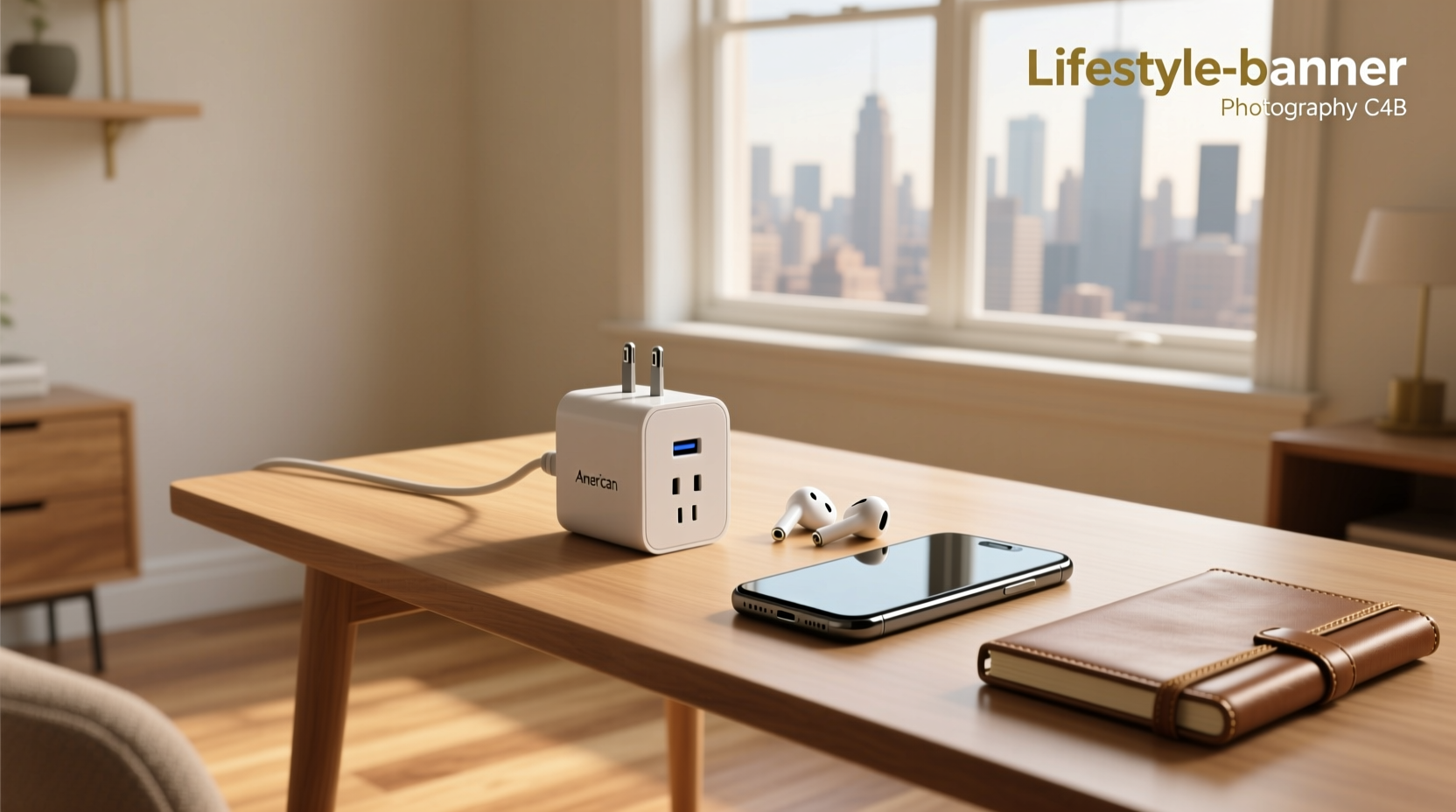
You don’t need a voltage converter—just a physical plug adapter—to use foreign electronics in the U.S. An American charger adapter is a passive device that lets non-North American plugs (like EU Type C, UK Type G, or AU Type I) fit into standard U.S. outlets—Type A (2-prong) or Type B (3-prong grounded). It does not change voltage (120 V AC), so your device must be dual-voltage (100–240 V) to work safely. This applies to nearly all modern smartphones, laptops, tablets, and USB-C power banks—but not older hair dryers, kettles, or single-voltage appliances.
Why This Confusion Exists—and Why It Matters
When travelers search for an "American charger adapter", they’re often mixing three distinct concepts: plug shape compatibility, voltage compatibility, and power delivery capability. The search results show dozens of products labeled “USA adapter” selling for $2.50–$26—but many lack grounding, safety certifications, or proper internal wiring. Worse, some falsely imply they “convert” voltage—a dangerous misconception that can fry devices or create fire hazards 1. Understanding this distinction isn’t optional—it’s essential for device longevity and personal safety.
U.S. Outlet Standards: Type A vs. Type B—Not Just Aesthetic Differences
The United States uses two standardized plug types defined by the National Electrical Manufacturers Association (NEMA):
- Type A: Two flat, parallel, ungrounded pins (120 V, up to 15 A). Common on low-power devices like phone chargers, shavers, and battery-powered electronics.
- Type B: Same two flat pins + a round or U-shaped grounding pin (also 120 V, up to 15 A). Required for most laptops, monitors, kitchen appliances, and any device with a metal chassis or Class I insulation.
Both operate at 120 V ± 5% nominal, 60 Hz frequency, and are rated for up to 1875 W (15 A × 125 V) on standard residential circuits 2. Crucially, neither Type A nor Type B supplies 240 V—despite misleading product listings claiming “up to 240 V” support. That phrasing refers only to the adapter’s insulation rating, not output capability. Real 240 V service in U.S. homes exists only on dedicated circuits (e.g., dryers, ovens) using NEMA 10-30 or 14-50 connectors—not standard wall outlets.
What an American Charger Adapter Does—and What It Absolutely Does Not Do
An authentic American charger adapter performs exactly one function: mechanical interface translation. It maps foreign plug geometries (e.g., EU Schuko Type F, UK BS 1363, AU AS/NZS 3112) onto the physical dimensions and contact layout of NEMA 1-15 (Type A) or NEMA 5-15 (Type B).
It does not:
- Convert AC voltage (100–240 V → 120 V)
- Change frequency (50 Hz → 60 Hz)
- Regulate power output or provide surge protection (unless explicitly built-in and certified)
- Enable fast charging beyond what the host charger and cable support
If your device’s original power supply says “Input: 100–240 V ~ 50/60 Hz”, it’s safe to use with a simple plug adapter. If it says “Input: 220–240 V only”, it requires a step-down transformer—not an adapter—and even then, motorized or heating appliances may run poorly or overheat on 60 Hz 3.
Key Technical Specifications to Verify—Before You Buy
Not all adapters meet minimum U.S. safety expectations. Here’s what to inspect:
| Feature | Minimum Requirement | Why It Matters |
|---|---|---|
| Grounding path | Continuous, low-resistance connection from foreign ground pin (if present) to NEMA B ground slot | Prevents electric shock if internal insulation fails; required for Class I appliances |
| Certification mark | UL 498, CSA C22.2 No. 42, or ETL listed (look for logo + file number) | Verifies independent lab testing for fire, shock, and mechanical stress resistance |
| Current rating | ≥15 A continuous (for Type B); ≥10 A for Type A | Prevents overheating when powering multiple devices via multi-port adapters |
| Material | Flame-retardant thermoplastic (e.g., PC+ABS meeting UL94 V-0) | Reduces fire risk during sustained load or fault conditions |
| Pin retention force | ≥10 N (per pin) per UL 498 Section 27 | Ensures stable contact—prevents arcing, sparking, or intermittent power |
Adapters lacking certification, using brittle plastic, or with loose-fitting pins (common in sub-$5 imports) fail these benchmarks. One 2024 CPSC review found 68% of uncertified travel adapters exceeded surface temperature limits under 10 A load 4.
USB Integration: Convenience vs. Compromise
Many modern “American charger adapters” integrate USB-A or USB-C ports. While convenient, this adds complexity:
- USB-C PD support requires explicit specification: Look for “USB-C Power Delivery”, “PPS compatible”, or listed wattage (e.g., “65W USB-C”). Generic “USB-C port” ≠ fast charging.
- Shared power budget: A 3-port adapter with “65W total” may deliver only 30W to one port if others are in use—check the manufacturer’s power distribution chart.
- No isolation between AC and DC paths: Poorly designed units can leak AC noise into USB data lines, causing touchscreen jitter or audio interference.
For mission-critical devices (e.g., medical equipment, professional cameras), use a separate UL-listed USB wall charger instead of relying on integrated ports.
When You Don’t Need an American Charger Adapter
Three common scenarios where an adapter is unnecessary—or actively harmful:
- Your device uses a detachable C7/C8 “figure-8” or C5/C6 “Mickey Mouse” cord: These are universal and plug directly into U.S. outlets without modification.
- You’re bringing a U.S.-purchased device abroad and returning: Your Apple MacBook charger, Anker USB-C brick, or Dell DA-100 already has a Type B plug. No adapter needed.
- You’re using a USB-C or Lightning cable with a local wall charger: Most hotels and airports now provide USB-C PD ports. Plug your cable in directly—no adapter required.
Also note: Some “American charger adapter” listings on global marketplaces actually sell U.S.-to-foreign converters (e.g., “US to EU adapter”). Always verify the direction: input = foreign plug, output = U.S. outlet.
Regional Variations Within the U.S.—Yes, They Exist
While NEMA standards are national, real-world installation varies:
- Older buildings (pre-1960s): May have ungrounded Type A-only outlets—even for high-power devices. Using a Type B adapter here defeats grounding. Test with an outlet tester first.
- Construction sites & temporary power: Often use NEMA L5-15 (twist-lock) or L5-20 connectors—standard adapters won’t fit.
- RVs & marine applications: Use 30A or 50A shore power inlets (NEMA TT-30, 14-50). Standard 15A adapters are incompatible and unsafe.
Always confirm outlet type visually or with a $5 outlet tester before plugging in expensive gear.
Common Misconceptions—Debunked
Misconception #1: “All USB-C adapters support fast charging.”
Reality: USB-C is just a connector shape. Fast charging requires negotiation via USB Power Delivery (PD) firmware. Many cheap adapters embed basic 5 V / 2.4 A charging only.
Misconception #2: “If it fits, it’s safe.”
Reality: A physically snug fit doesn’t guarantee correct pin mapping. Some EU-to-US adapters reverse live/neutral—creating shock risk even with correct voltage.
Misconception #3: “Dual-voltage devices auto-adjust—so any adapter works.”
Reality: Dual-voltage only addresses input range. It does not protect against poor grounding, excessive heat buildup, or electromagnetic interference from low-quality adapters.
How to Choose the Right American Charger Adapter—A Decision Framework
Ask yourself these four questions:
- What plug types do you bring? (e.g., EU Type F, UK Type G, JP Type A). Match to adapter’s input compatibility list—not marketing copy.
- Do your devices require grounding? Laptops, external SSDs, and audio interfaces do. Phones and earbuds typically don’t.
- Will you charge multiple devices simultaneously? Prioritize models with ≥15 A rating and individual port power specs—not just “4 USB ports”.
- Is safety certification visible and verifiable? Search the UL Online Certifications Directory (https://database.ul.com) using the file number printed on the unit.
If you answer “yes” to grounding needs or multi-device use, skip ultra-compact 2-ounce adapters. They almost never meet thermal or mechanical durability requirements.
Final Verification Steps—Before First Use
Once purchased:
- Check for physical damage: Cracks, misaligned pins, or loose parts indicate manufacturing defects.
- Verify labeling: Must include manufacturer name, model number, input/output ratings, and certification mark (UL, ETL, CSA).
- Test with a known-working device (e.g., phone charger) for 10 minutes. Feel the adapter body—if warm enough to burn skin, stop use immediately.
- Use an outlet tester ($3–$8) to confirm correct hot/neutral/ground wiring at the receptacle itself—not just adapter function.
Remember: A $3 adapter that fails after one trip costs more long-term than a $18 certified unit that lasts five years and protects your $2,000 laptop.
Frequently Asked Questions (FAQ)
- Can I use a European charger in the U.S. with just a plug adapter?
Yes—if the charger’s input label reads “100–240 V ~ 50/60 Hz”. If it says “230 V only”, do not use it without a transformer. - Do I need a different adapter for Canada or Mexico?
No. Canada and Mexico use identical NEMA 1-15 and 5-15 outlets and 120 V / 60 Hz supply. Same adapter works. - Is a “universal travel adapter” suitable for permanent U.S. use?
Not recommended. Universal adapters prioritize portability over durability and thermal management. For daily home/office use, choose a fixed NEMA 5-15 wall charger with USB-C PD. - Why do some American charger adapters have USB-C ports but no power rating?
That’s a red flag. Legitimate units list exact wattage per port (e.g., “USB-C1: 65W, USB-C2: 45W”). Unrated ports likely deliver ≤15W and may throttle unpredictably. - Can I plug a 220 V appliance (like a European coffee maker) into a U.S. outlet using an adapter?
No. An adapter cannot convert voltage. Doing so will severely underpower the device (causing slow heating or motor stall) and may damage its internal components. Only use with a properly rated step-down transformer—and even then, check frequency compatibility.
