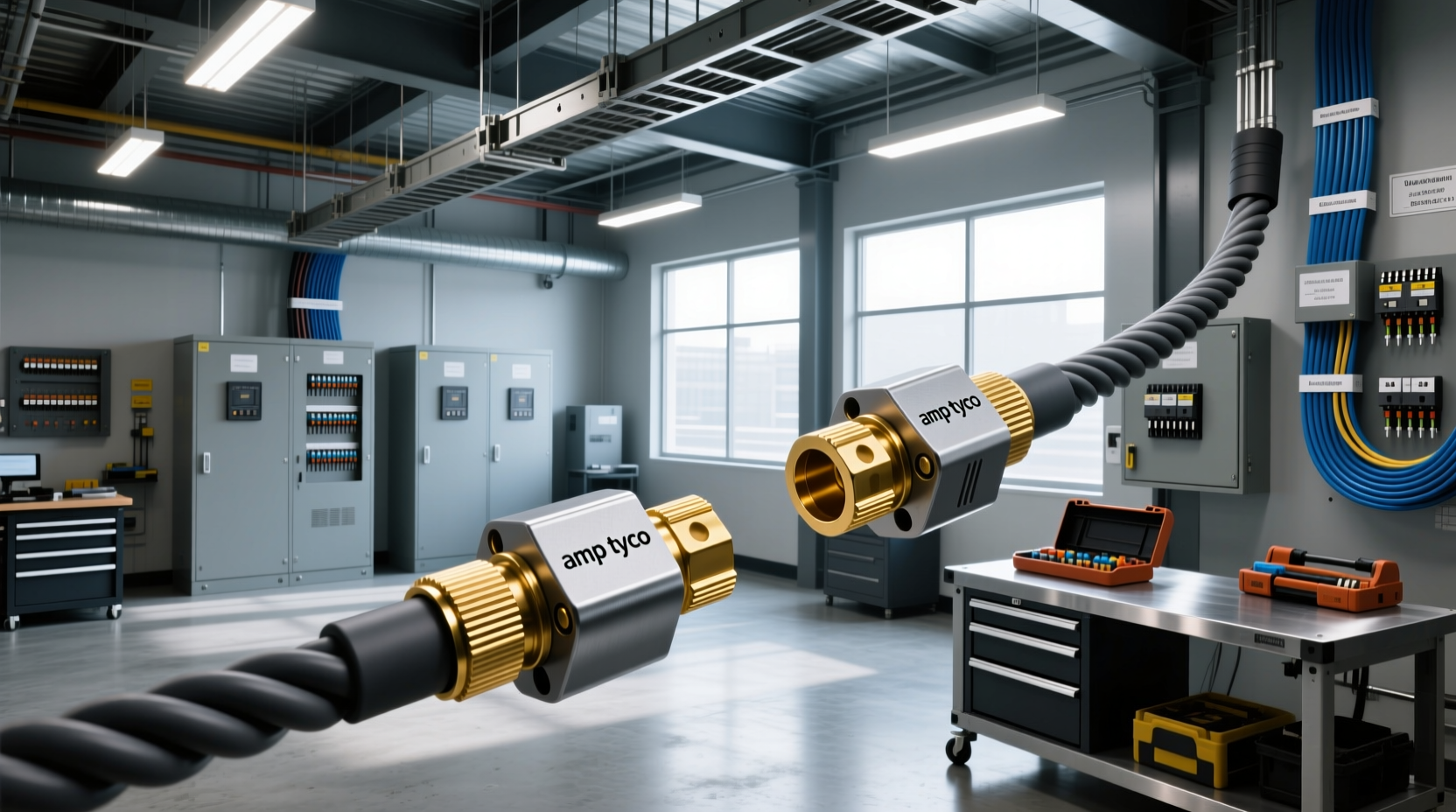
You’re not alone — 'AMP Tyco connectors' is a confusing term because it refers to legacy product lines now unified under TE Connectivity. If you're searching for replacement parts, designing a harness, or troubleshooting a connector failure in automotive, industrial, or power applications, understanding the historical merger (AMP → Tyco → TE), terminal types (e.g., MATE-N-LOK®, SUPERSEAL®, DTM), and critical specs (current rating, IP sealing, crimp compatibility) is essential — not optional. This guide cuts through decades of branding changes to give you actionable, vendor-neutral facts on selection, verification, and interoperability — backed by TE’s official documentation and industry-standard engineering practices 123.
Why the Confusion? The AMP–Tyco–TE Timeline (and Why It Matters)
The phrase 'AMP Tyco connectors' reflects a real-world naming legacy — not a current product category. In 1999, Tyco International acquired AMP Incorporated for $12 billion 4. Then in 2007, Tyco Electronics spun off as an independent company — renamed TE Connectivity in 2011. Today, all former AMP and Tyco connector families are engineered, manufactured, and supported under the TE Connectivity brand.
This matters because:
- Part numbers haven’t changed — e.g., TE part #1-1670901-1 (formerly AMP/Tyco) remains identical in form, fit, and function;
- Datasheets and catalogs are consolidated under te.com, but older documents still circulate with ‘AMP’ or ‘Tyco’ headers;
- Third-party sellers often mislabel — listing ‘AMP Tyco’ as if it were a distinct brand, leading to compatibility risks.
So when you see 'AMP Tyco connectors' online, you’re almost certainly looking at TE Connectivity products — just labeled with outdated nomenclature. Always verify using the official TE part number, not marketing text.
Core Connector Families: Which Ones Are Still Active & Where They’re Used
TE maintains several major legacy families originally developed by AMP. Below is a technical comparison — not a sales list — highlighting mechanical design, typical applications, and key constraints:
| Family Name | Typical Pin Count Range | Sealing (IP Rating) | Current Rating per Contact | Common Applications | Key Interchangeability Notes |
|---|---|---|---|---|---|
| SUPERSEAL® | 2–24 pins | IP67 (when mated & sealed) | 5 A (16 AWG), 13 A (12 AWG) | Under-hood automotive, marine, agricultural equipment | Housings accept both stamped-and-formed and solid-barrel terminals; not interchangeable with DTM housings 2 |
| DT / DTM / DTP | 2–12 pins (DTM), up to 24 (DTP) | DT: unsealed; DTM/DTP: IP67 | 7–13 A (depending on wire gauge & contact plating) | Body control modules, lighting, HVAC, aftermarket wiring kits | DTM and DTP housings share same terminal interface; DT is non-sealed predecessor |
| MATE-N-LOK® | 2–24 pins | Not sealed (IP00) | 10–15 A (14–12 AWG) | Industrial controls, power distribution, battery management systems | Widely copied; only genuine TE terminals ensure proper crimp height and retention force |
| Metri-Pack™ | 2–32 pins | IP67 (standard), IP69K (optional) | 15–30 A | EV battery packs, high-power ADAS sensors, heavy-duty trucking | Not backward-compatible with SUPERSEAL or DTM; requires dedicated tooling |
Note: While many third-party suppliers sell ‘AMP Tyco-compatible’ terminals, TE explicitly warns that non-genuine contacts may fail under thermal cycling or vibration — especially in automotive environments 5. Compatibility isn’t just about physical fit: crimp barrel geometry, plating thickness (typically tin or selective gold), and housing material (PBT or PA66) directly affect long-term reliability.
How to Identify Genuine TE (Formerly AMP/Tyco) Connectors — 5 Verification Steps
Because counterfeit or mislabeled ‘AMP Tyco’ parts flood marketplaces like eBay and Alibaba, verification isn’t optional — it’s a risk mitigation step. Follow this checklist before purchase or integration:
- Check the part number prefix: Genuine TE parts begin with standardized prefixes — e.g., ‘1-’, ‘2-’, or ‘3-’ (like 1-1670901-1). Avoid listings showing only generic descriptors like “6-pin AMP Tyco male” without a full TE part number.
- Confirm housing material markings: Authentic TE housings are laser-etched or molded with part numbers and UL/cUL logos. Look for ‘TE’ or ‘TE Connectivity’ near the latch or cavity side — not just ‘AMP’ or ‘TYCO’.
- Validate terminal specifications: Use TE’s official AMP Connectors Product Page to cross-check crimp height, wire range (e.g., 20–16 AWG), and recommended tools. If the seller can’t provide a TE datasheet link, proceed with caution.
- Review packaging and labeling: Genuine TE products ship in TE-branded static-shielded bags or trays with batch traceability codes. Generic white boxes with handwritten labels are strong red flags.
- Test crimp integrity (if prototyping): Use a calibrated pull-tester. TE specifies minimum wire retention forces (e.g., 13.3 N for 16 AWG in SUPERSEAL). Non-compliant crimps may pass visual inspection but fail at 85°C after 500 thermal cycles 1.
When ‘AMP Tyco Compatible’ Is Acceptable — And When It’s Not
Not every application demands genuine TE components — but knowing the trade-offs is critical:
- Acceptable for low-risk, non-safety-critical use: Prototyping breadboards, hobbyist LED strips, or temporary test fixtures where failure has no safety consequence.
- Unacceptable for regulated or high-reliability environments: Automotive (ISO 16750, SAE J2293), medical devices (IEC 60601), or industrial machinery (IEC 61800). In these cases, component-level certification (e.g., UL File E121070) is mandatory — and only TE-manufactured parts carry it.
- Beware of ‘pin-to-pin compatible’ claims: Many clones match outer dimensions but use thinner contact plating or lower-grade thermoplastics. Under sustained load, they exhibit higher contact resistance growth — leading to voltage drop and localized heating 3.
Key Technical Specifications You Must Check — Beyond Pin Count
Pin count is the most visible spec — but it’s the least predictive of real-world performance. Prioritize these five parameters when comparing options:
- 1. Contact Resistance (mΩ)
- Measured at 100 mV / 100 mA. TE specifies ≤10 mΩ initial, ≤20 mΩ after environmental stress. Values >30 mΩ indicate poor plating or contamination.
- 2. Insertion/Ejection Force (N)
- Indicates mating security. SUPERSEAL spec: 35–65 N insertion, 25–45 N extraction. Too low = risk of back-out; too high = housing deformation during assembly.
- 3. Operating Temperature Range
- Standard TE connectors: –40°C to +125°C. Clones often derate above 85°C — critical for engine bay or EV battery applications.
- 4. Vibration Resistance (Hz/g)
- Per ISO 16750-3: 10–2000 Hz, 20 g. Genuine TE connectors maintain continuity under 50+ hours of random vibration testing. Unverified parts may lose contact intermittently.
- 5. Crimp Tool Compatibility
- TE publishes exact tool part numbers (e.g., 176827-1 for SUPERSEAL 1.0). Using non-approved tools causes inconsistent crimp height — the #1 cause of field failures.
Where to Source Responsibly — Without Falling Into Marketing Traps
Many search results for 'amp tyco connectors' lead to aggregators or resellers who lack engineering support or traceability. Here’s how to source with confidence:
- Authorized distributors only: Digi-Key 6, Mouser 7, and RS Components list live inventory with TE’s official part numbers and datasheets — not generic descriptions.
- Avoid ‘AMP Tyco’-only storefronts: Sites using that phrase exclusively in domain names or store titles often lack TE authorization and cannot provide batch-level certificates of conformance.
- For custom kits or looms: Companies like KSV Looms 2 assemble verified TE components into tested harnesses — useful for small-batch production where tooling investment isn’t feasible.
Common Misconceptions — Debunked
Let’s address recurring myths found across forums and marketplace Q&As:
- Myth: 'AMP' and 'Tyco' connectors are different products. Fact: They are identical parts rebranded post-acquisition. No functional distinction exists.
- Myth: All 6-pin 'AMP Tyco' connectors work interchangeably. Fact: SUPERSEAL 6-pin ≠ DTM 6-pin ≠ MATE-N-LOK 6-pin. Housing pitch, terminal depth, and locking mechanisms differ.
- Myth: Crimping with needle-nose pliers is sufficient for low-current signals. Fact: Even signal contacts require controlled crimp height and barrel compression. Hand tools introduce >±0.1 mm variance — enough to break insulation displacement or reduce retention force by 40%.
- Myth: Waterproof = submersible. Fact: IP67 means protection against immersion up to 1 m for 30 minutes — only when correctly mated, sealed, and undamaged. A single nick in the O-ring or incomplete latch engagement voids the rating.
Frequently Asked Questions (FAQ)
- Are AMP and Tyco connectors the same thing?
Yes — Tyco acquired AMP in 1999, and both brands were fully integrated into TE Connectivity by 2011. There is no technical difference between ‘AMP’ and ‘Tyco’ labeled parts bearing the same TE part number. - Can I use generic terminals with genuine TE housings?
No. TE designs terminals and housings as matched systems. Non-TE terminals may fit visually but often fail retention force tests and accelerate wear on housing latches. - What does 'SUPERSEAL 1.0' mean?
It refers to the contact size — specifically, 1.0 mm² cross-section (approx. 16–14 AWG). It is unrelated to IP rating or pin count. SUPERSEAL 0.5 and 2.8 variants also exist for smaller/larger wires. - Do I need special tools to crimp AMP Tyco connectors?
Yes. TE publishes approved tool lists for each family. Using unapproved tools risks inconsistent crimp height, which causes intermittent opens or increased resistance over time. - Where can I download official AMP connector catalogs or PDFs?
TE hosts all current catalogs and datasheets at te.com/plp/amp-connectors. Avoid third-party PDFs — they’re often outdated or incomplete.
