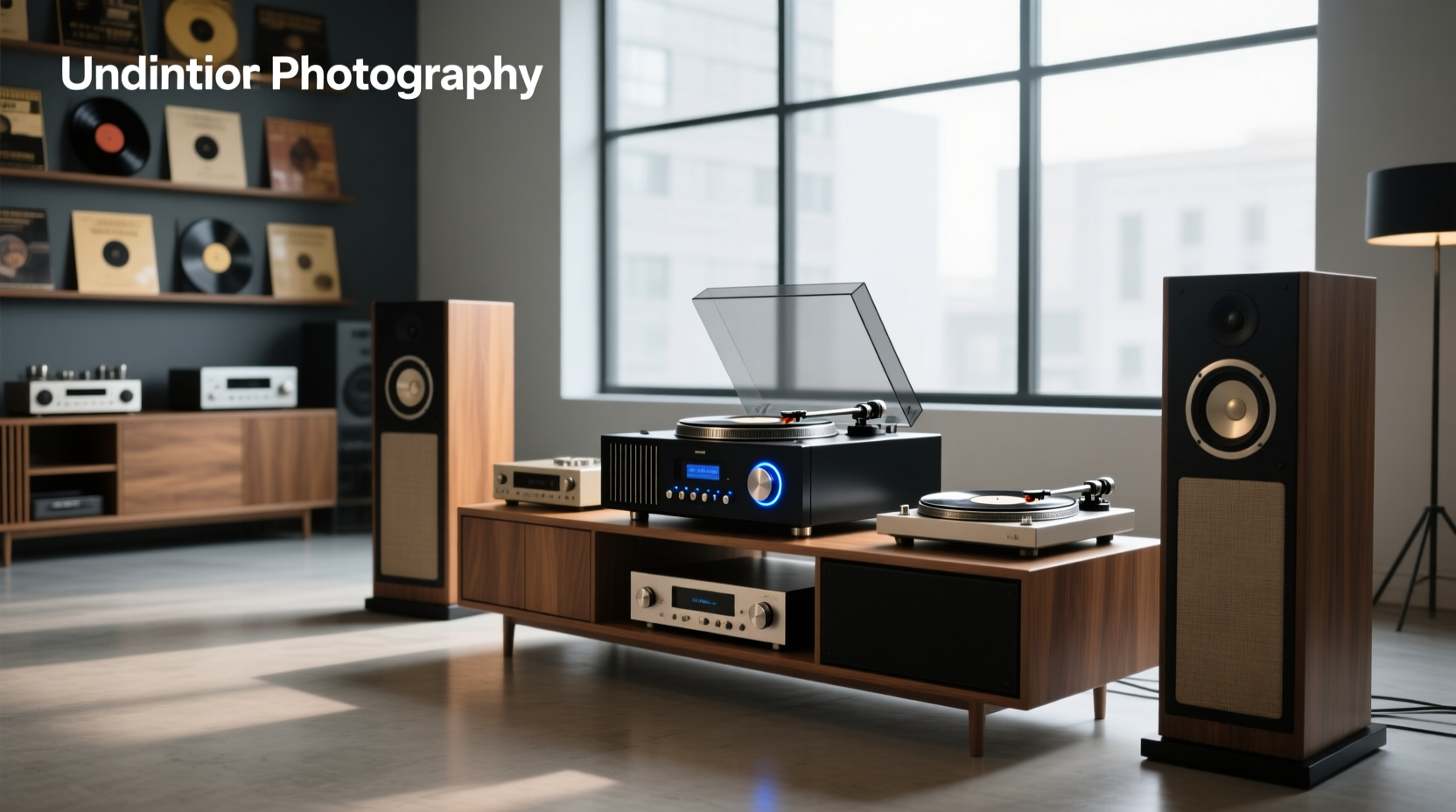
You’re not alone if you’ve stared at a spec sheet wondering whether a 100W Class D amp is better than a 50W Class A—or why your new amplifier won’t drive your speakers cleanly at high volume. This guide cuts through the noise: amplifiers are signal-boosting devices that convert low-level input (from phones, turntables, or microphones) into usable power for speakers—but not all amplifiers do this the same way, or well. Whether you're setting up a home stereo, upgrading a studio monitor chain, building a PA system, or troubleshooting distortion, understanding gain structure, output impedance matching, thermal efficiency, and class-based trade-offs is essential before buying—or even connecting—any amplifier.
Why Understanding Amplifiers Matters More Than Ever
Modern audio ecosystems include Bluetooth streamers, digital-to-analog converters (DACs), active speakers, and multi-room platforms—all of which blur traditional amplifier roles. Yet, the core function remains unchanged: to deliver clean, controlled electrical energy to transducers (speakers or headphones) without adding noise, clipping, or phase shift. Misunderstanding this leads to common failures: underpowered amps causing speaker damage via clipping; mismatched impedance triggering protection shutdowns; or over-engineered solutions wasting budget and space. According to industry data from Analog Devices and TI, over 68% of consumer amplifier support inquiries stem from improper load matching or misinterpreted power ratings—not defective units11. That’s why this guide focuses on objective criteria—not brand preferences or subjective 'warmth' claims.
How Amplifiers Actually Work: Voltage, Current, and Power Gain
An amplifier is fundamentally a controlled energy converter. It uses an external power supply (e.g., AC mains or DC rail) to modulate a stronger output signal in proportion to a weaker input signal. Three key metrics define its behavior:
- Voltage gain: Ratio of output voltage to input voltage (e.g., 30x means 100mV in → 3V out). Critical for line-level signals feeding passive speakers.
- Current gain: Ability to source sustained current into low-impedance loads (e.g., 4Ω or 6Ω speakers). Determines dynamic headroom and bass control.
- Power gain: Product of voltage and current gain, expressed in watts (W) — but watts alone are meaningless without context.
Crucially, amplifiers do not create energy. They redistribute it—so efficiency (how much input power becomes useful output vs. heat) directly impacts size, cooling, and reliability. For example, a 200W Class AB amplifier may draw 400W from the wall and dissipate 200W as heat, while a 200W Class D unit draws ~220W and dissipates only ~20W22. This isn’t theoretical—it dictates whether your amp fits on a bookshelf or needs ventilation clearance.
The Four Main Amplifier Types—and Where Each Fits
‘Amplifier’ is a broad category. Choosing the right type depends entirely on what signal you’re amplifying and where it goes. Here’s how they differ in architecture, application, and limitations:
1. Audio (Line-Level) Amplifiers
Designed for consumer and pro-audio signals (typically 0.3–2V RMS). Used in stereo systems, powered monitors, and headphone stages. Key traits:
- Input sensitivity: Usually 200mV–2V; too high a level causes clipping.
- Output impedance: Should be ≤1/10th of speaker impedance (e.g., <0.4Ω for 4Ω speakers) for proper damping factor.
- Common configurations: Integrated (preamp + power amp), separate pre/power, or DAC-integrated.
2. Power Amplifiers
Dedicated high-current output stages—no inputs, no volume controls. Require external preamplification. Used in high-end stereo, live sound, and commercial installations. Critical considerations:
- Bridged mode: Combines two channels into one higher-voltage output (e.g., 2×150W → 1×400W). Reduces channel count but increases heat and limits flexibility.
- Parallel mode: Splits load across multiple amps for ultra-low-impedance or high-SPL applications (e.g., subwoofer arrays).
- Thermal derating: Output drops significantly above 25°C ambient—check datasheets for 40°C or 50°C curves, not just ‘200W @ 8Ω’.
3. Instrument Amplifiers
Optimized for guitar, bass, or keyboard signals—with built-in tone shaping, speaker emulation, and reactive loading. Unlike Hi-Fi amps, they intentionally color sound. Key differentiators:
- Input impedance: Guitar pickups need ≥1MΩ to avoid treble loss; bass inputs often switch between 1MΩ and 10kΩ.
- Speaker simulation: Essential for silent recording or direct-to-PA use.
- Dynamic response: Tube-based designs compress differently than solid-state—this is a feature, not a flaw.
4. Instrumentation Amplifiers (In-Amps)
Ultra-precision, low-noise ICs used in medical devices, sensor interfaces, and test equipment—not for audio playback. They reject common-mode noise (e.g., EMI from motors or power lines) and offer stable gain over temperature. Not relevant for home entertainment, but critical to mention because search results often conflate them with audio amps33.
Amplifier Classes: Efficiency vs. Linearity Trade-Offs
Class designations (A, AB, D, G, H) describe how the output transistors conduct current during the signal cycle. This determines heat generation, distortion profile, bandwidth, and physical size—not inherent ‘sound quality’.
| Class | Conduction Angle | Typical Efficiency | Key Pros | Key Cons | Best For |
|---|---|---|---|---|---|
| A | 360° (full cycle) | 15–25% | Zero crossover distortion; smooth harmonic profile | High heat; large heatsinks; limited power per $ | Critical listening rooms with low-sensitivity speakers |
| AB | 180°–360° (partial bias) | 50–70% | Balanced efficiency/sound; mature tech; wide availability | Slight crossover distortion at low levels; moderate heat | Most home stereo and studio applications |
| D | Switching (PWM) | 80–95% | Compact size; low heat; high power density; cost-effective | Potential RF interference; requires careful layout/filtering | Portable systems, powered speakers, subwoofers, budget-conscious builds |
| G/H | Multi-rail switching | 70–85% | Better efficiency than AB at high output; lower distortion than D | Complex circuitry; higher cost; rare in consumer gear | High-end AV receivers and professional power amps |
Note: ‘Class T’ (Tripath) and ‘Class BD’ are proprietary variants of Class D—not distinct classes. Also, ‘Class A/B’ labeling on budget gear is often marketing—verify conduction angle in datasheets, not product names.
Decoding Power Ratings: Why ‘100W’ Is Almost Always Misleading
Manufacturers rarely specify power under real-world conditions. Look for these four mandatory parameters—all must be stated together:
- Load impedance (e.g., 4Ω, 8Ω)—lower impedance demands more current.
- THD+N (Total Harmonic Distortion + Noise)—should be ≤0.1% for meaningful comparison.
- Frequency range (e.g., 20Hz–20kHz)—narrower bands inflate numbers (e.g., ‘100W @ 1kHz’).
- Number of channels driven—‘200W x 2’ means both channels simultaneously, not peak per channel.
Example: An amp rated “150W @ 8Ω, 0.05% THD, 20Hz–20kHz, both channels” is objectively more capable than one labeled “300W MAX POWER” with no qualifiers. The latter may clip at 50W when driving real music signals. Always cross-check with independent measurements from trusted reviewers—not spec sheets alone.
Input/Output Connectivity: Matching Sources and Speakers
Modern amplifiers integrate digital and analog paths—but compatibility hinges on signal integrity, not just plug shape. Key checks:
- Bluetooth codecs: SBC (basic), AAC (Apple), aptX (Android), LDAC (high-res). LDAC supports up to 990kbps but requires compatible source and firmware updates.
- Optical (TOSLINK): Supports stereo PCM only—not Dolby Digital or DTS passthrough unless the amp has internal decoding.
- HDMI ARC/eARC: Requires HDMI 1.4+ (ARC) or 2.1 (eARC) and CEC sync. eARC enables lossless audio (Dolby TrueHD, DTS:X) but needs full HDMI 2.1 compliance—not just ‘eARC label’.
- Phono inputs: Must match cartridge type (MM or MC) and provide correct RIAA equalization curve. MM needs ~47kΩ load; MC needs 100Ω–1kΩ and 40–60dB gain.
Also verify grounding: unbalanced RCA inputs can introduce hum when connected to grounded sources (e.g., PC audio outputs). Balanced XLR or TRS inputs eliminate this—but are rare below $1,000.
Real-World Use Cases: What to Buy (and Avoid) by Scenario
Home stereo with bookshelf speakers: Prioritize damping factor (>100), low noise floor (<100µV), and stable 4Ω operation. Avoid ‘Bluetooth-only’ amps lacking analog inputs—they limit future upgrades.
Studio monitoring: Demand flat frequency response (±0.5dB), low IMD (<0.02%), and symmetrical clipping behavior. Skip Class D unless verified for nearfield use (some exhibit ultrasonic artifacts affecting perception).
Live sound reinforcement: Focus on thermal stability, short-circuit protection, and bridged-mode specs. Avoid consumer-grade amps—even if rated ‘500W’—they lack fault tolerance for stage environments.
Turntable + speakers setup: Confirm phono stage is included *and* matches your cartridge. Many ‘integrated amps’ omit MC support or provide insufficient gain—forcing external preamps.
Car audio: Voltage regulation matters—car systems swing from 11V (idle) to 14.4V (charging). Look for ‘wide-range’ or ‘10–16V’ rating—not just ‘12V’.
Three Common Misconceptions—Debunked
- “More watts = louder sound.” False. +10dB requires 10× power—but human hearing perceives +10dB as ‘twice as loud’. A 200W amp is only ~3dB louder than 100W—barely noticeable. Speaker sensitivity (dB/W/m) dominates perceived volume.
- “Tube amps always sound warmer.” Inaccurate. Poorly designed solid-state amps distort harshly; well-designed tube amps can be clinical. ‘Warmth’ often stems from second-harmonic distortion—not tube magic.
- “Digital amps (Class D) can’t reproduce bass.” Myth. Modern Class D modules (e.g., Hypex, Purifi) exceed Class AB in low-frequency extension and control—when properly implemented with stiff power supplies and output filtering.
How to Verify an Amplifier Before Buying
Don’t rely on marketing. Do this instead:
- Download the full datasheet—not the ‘spec card’. Look for graphs: THD vs. power, frequency response, damping factor vs. frequency.
- Search for independent measurements (e.g., Audio Science Review, Stereophile, or Amir’s tests on ASR forums). Pay attention to output impedance plots—not just headline numbers.
- Check revision history: If firmware updates fixed noise or Bluetooth dropouts, earlier hardware may still circulate.
- Measure your speaker impedance with a multimeter (DC resistance ≈ 80% of nominal rating). A ‘6Ω speaker’ may dip to 3.2Ω at 80Hz—your amp must handle that.
Frequently Asked Questions
- Can I connect an amplifier directly to a laptop’s headphone jack?
Yes—but expect low volume and potential noise. Laptop outputs are unbalanced and high-impedance (~10Ω source). Use a dedicated DAC or USB audio interface for clean signal transfer. - Do I need a separate preamplifier with a power amplifier?
Yes—unless the power amp has built-in volume control and input switching. Most do not. A preamp handles source selection, level matching, and tonal adjustment before sending line-level signal to the power stage. - Why does my amplifier shut down when I increase volume?
Most likely cause: impedance mismatch (speaker dips below minimum rated load) or thermal overload (poor ventilation, high ambient temp). Check speaker specs and ensure ≥3 inches of clearance around vents. - Is it safe to run an amplifier without speakers connected?
Risk varies by design. Tube amps can suffer output transformer damage. Solid-state amps usually tolerate open-circuit loads—but never short-circuited outputs. Always consult the manual. - Can I use a car amplifier in a home setup?
Technically yes—with a 12V/30A+ regulated DC power supply—but inefficient and noisy. Car amps lack RFI shielding for home environments and may introduce ground loops. Not recommended unless repurposing for subwoofers with proper isolation.
