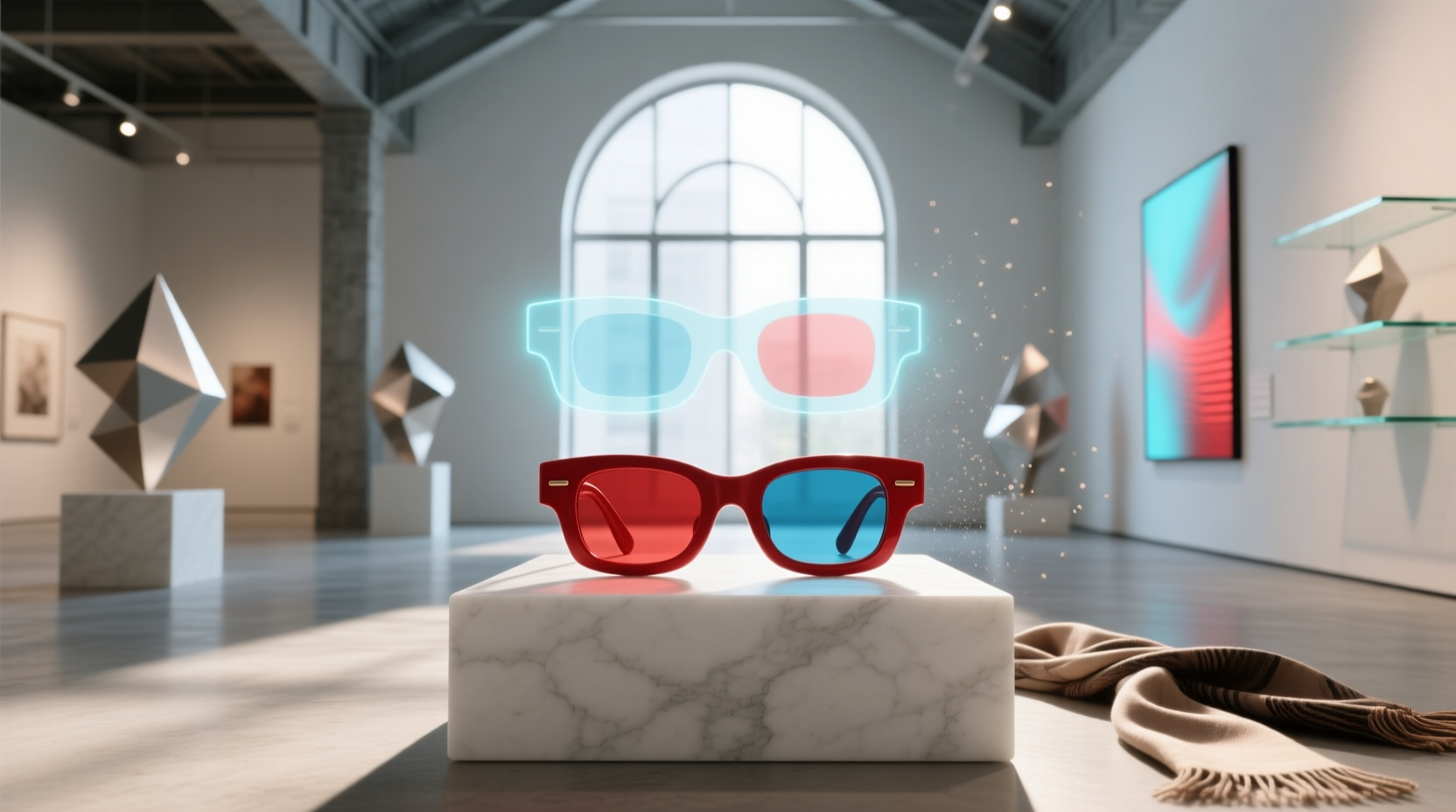
You’ll get a clear, practical understanding of anaglyph glasses—what they are, how red-cyan and red-blue variants differ, where they’re still meaningfully applied (beyond nostalgic 3D movies), and why modern 3D formats largely replaced them—within the first 100 words. This guide answers core questions like what are anaglyph glasses used for?, why is 3D red and blue?, and is anaglyph 3D still used?—with evidence-based comparisons, real-world use cases (including vision therapy and archival media), and objective guidance on when these low-cost 3D tools remain functional versus when they fall short.
What Are Anaglyph Glasses—and Why Do They Look Red and Cyan?
Anaglyph glasses are passive stereoscopic viewing devices that enable perception of depth from a single 2D image or video frame. They consist of two colored filters—one typically red, the other cyan (a blend of green and blue)—mounted in a lightweight frame 1. The underlying principle is color separation: a specially encoded anaglyph image contains two superimposed perspectives—left-eye and right-eye views—each rendered in complementary colors. The red lens blocks cyan tones, allowing only the red-encoded left view to reach the left eye; the cyan lens blocks red, delivering the cyan-encoded right view to the right eye. Your brain then fuses these disparate inputs into a coherent 3D impression—a process known as binocular disparity.
The red-and-blue variant—often misremembered as the ‘original’—was common in early print applications (e.g., 19th-century stereoscopes and comic books) because red and blue dyes were inexpensive and highly contrasting on black-and-white newsprint. However, red-blue suffers from severe color distortion: blue objects appear dark or invisible through the red lens, and red elements vanish through the blue lens. That’s why red-cyan became the de facto standard by the late 20th century: cyan transmits green and blue light while blocking red, preserving more natural mid-tone hues and enabling better luminance balance between eyes 2. Red-green versions exist but are rare—green’s high photopic sensitivity causes visual fatigue and poor contrast with red, making them unsuitable for sustained viewing.
How Anaglyph 3D Works: A Step-by-Step Technical Breakdown
Understanding the workflow clarifies both capability and constraint:
- Image Encoding: A 3D source (e.g., stereo pair photos or dual-camera footage) is processed so the left-eye view is desaturated to red-only (or red-dominant), and the right-eye view is converted to cyan-only (green + blue channels). No true RGB color remains—only color-channel subsets.
- Display: Both filtered views are overlaid pixel-for-pixel. On screen or paper, this appears as a blurry, ghostly composite—often with noticeable fringing around high-contrast edges.
- Filtering: The glasses physically block wavelengths mismatched to each lens. The red lens absorbs cyan light (≈490–520 nm and ≈450–490 nm); the cyan lens absorbs red light (≈620–750 nm).
- Neural Fusion: Visual cortex integrates spatial offsets between the two monochromatic images. Depth is inferred from horizontal disparity—greater offset = perceived closer object.
This method requires no active synchronization (unlike shutter-glass systems), no polarized projectors (unlike RealD cinema), and zero electronics. That simplicity enables compatibility with any display—from smartphone screens to printed posters—but at the cost of chromatic fidelity and interocular crosstalk (‘ghosting’).
Where Are Anaglyph Glasses Still Used Today?
Though largely phased out of mainstream entertainment after 2012 (coinciding with the decline of theatrical anaglyph releases like Spy Kids 3-D: Game Over), anaglyph technology persists in four validated, niche domains:
🔬 Vision Therapy & Binocular Training
Clinical optometrists use red-cyan anaglyphs in structured exercises to assess and treat conditions like convergence insufficiency, amblyopia, and suppression. Standardized tests—including the TNO Stereotest and Titmus Fly Test—rely on anaglyph targets to quantify stereoacuity (depth discrimination down to seconds of arc). Because the technique isolates retinal correspondence without demanding high-resolution displays, it remains accessible in rural clinics and telehealth setups 3. Importantly: therapeutic efficacy depends on precise lens density (OD 0.8–1.2 for red; OD 0.9–1.3 for cyan) and calibrated image brightness—not consumer-grade cardboard glasses.
📚 Archival & Educational Media
Museums, geoscience departments, and historical societies digitize legacy anaglyph content (e.g., NASA lunar surface panoramas from Apollo missions, 1950s geological surveys) for public access. These assets require no proprietary hardware—just correctly formatted files and matching glasses. Universities teaching perceptual psychology often use anaglyph demos to illustrate binocular rivalry and neural plasticity, precisely because the system’s limitations make perceptual mechanisms visible.
🎮 Low-Bandwidth Interactive Content
Independent game developers targeting web browsers or legacy consoles sometimes embed anaglyph rendering for 3D effects without requiring GPU-accelerated shaders. Browser-based WebGL demos (e.g., Three.js examples) can output anaglyph stereo with minimal code overhead—critical for regions with constrained bandwidth or older devices.
🖨️ Print-Based 3D Communication
Scientific journals (e.g., Nature Communications) occasionally publish anaglyph figures to convey volumetric data—molecular structures, neural pathways, or topographic models—where grayscale depth cues would be ambiguous. Unlike digital formats, printed anaglyphs avoid screen flicker and refresh-rate dependency, offering stable viewing under ambient light.
Red-Cyan vs Red-Blue: A Functional Comparison
While both rely on the same optical principle, performance differs significantly:
| Feature | Red-Cyan Glasses | Red-Blue Glasses |
|---|---|---|
| Color Rendering | Moderate: Preserves greens/blues; reds appear muted but recognizable | Poor: Blues appear black or gray; reds dominate; no green representation |
| Luminance Balance | Good: Cyan transmits ~60% of visible light; red ~35% → balanced brightness | Low: Blue filter transmits only ~15% of light → right eye receives significantly less luminance |
| Ghosting (Crosstalk) | Moderate: ~8–12% leakage due to imperfect filter cutoff | High: ~20–30% leakage—especially problematic with white text or bright backgrounds |
| Visual Fatigue | Low-to-moderate (typical session: ≤20 min) | High (often <10 min before headache or eye strain) |
| Common Applications | Vision therapy, modern web demos, scientific publishing | Vintage comics (1950s), educational handouts, novelty items |
Bottom line: If you’re sourcing glasses for current use, red-cyan is the only functionally viable choice. Red-blue is obsolete outside historical reenactment or collector contexts.
Key Limitations—And When to Avoid Anaglyph Altogether
Anaglyph 3D is not a universal solution. Recognizing its boundaries prevents frustration and misapplication:
- ❌ No True Color Perception: Full RGB color space cannot be recovered. Skin tones, vegetation, and sky gradients appear desaturated or falsely tinted. This disqualifies anaglyph for color-critical work (e.g., medical imaging diagnostics, art reproduction).
- ❌ High Ghosting on Bright Content: White backgrounds or high-luminance objects cause pronounced double images. Avoid for presentations with light slides or text-heavy interfaces.
- ❌ Incompatible with HDR & Wide-Gamut Displays: Modern Rec.2020 or DCI-P3 color spaces exceed the narrow gamut anaglyph encoding supports. Viewing on OLED or QLED panels often amplifies fringing.
- ❌ Unsuitable for Extended Viewing: Studies report increased incidence of asthenopia (eye strain), transient afterimages, and mild chromatopsia (color distortion lasting minutes post-use) beyond 15–20 minutes 1. Not recommended for children under age 7 or users with known photosensitive epilepsy.
- ❌ Requires Perfectly Matched Content: Generic 3D videos or side-by-side stereo files won’t work. The source must be explicitly encoded as anaglyph (either red-cyan or red-blue)—and the glasses must match the encoding. Using red-cyan glasses on red-blue content yields near-total failure.
How to Choose & Verify Quality Anaglyph Glasses
Not all red-cyan glasses perform equally. Here’s how to assess suitability:
✅ Lens Optical Density (OD)
Professional-grade lenses use gelatin or dyed acetate with precise optical density: red lens OD ≈ 1.0 ±0.1 (blocks 90% of non-red light); cyan OD ≈ 1.1 ±0.1. Cheap cardboard versions often use ink-printed film with OD <0.6—resulting in >30% crosstalk. Hold glasses up to a white LED: through the red lens, a cyan object (e.g., blue pen) should appear nearly black; through cyan, a red object should vanish.
✅ Frame Fit & Alignment
Improper inter-pupillary distance (IPD) alignment causes diplopia (double vision). Adjustable nose bridges and flexible temples reduce slippage during movement—critical for interactive applications. Fixed cardboard frames assume 62–64 mm IPD; if your IPD falls outside that range (≈5% of adults), expect reduced depth perception.
✅ Material Durability
Cardboard glasses (<$0.15/unit) suffice for one-time events (e.g., museum handouts). For repeated clinical or educational use, injection-molded polycarbonate frames with scratch-resistant coated lenses last 6–12 months with proper cleaning (microfiber + distilled water only—no alcohol).
Why Did Anaglyph 3D Decline in Mainstream Entertainment?
The shift wasn’t arbitrary—it followed measurable technical and ergonomic trade-offs:
- Consumer Display Evolution: LCD/LED TVs introduced motion blur and slow pixel response, worsening anaglyph ghosting. Polarized systems (e.g., RealD) delivered full-color, high-brightness 3D without color loss—once projector brightness reached ≥14 fL (foot-lamberts).
- Content Production Cost: Encoding every frame as anaglyph added rendering time and storage overhead. Stereo 3D pipelines standardized on side-by-side or frame-sequential formats compatible with active and passive cinema systems.
- Health & Comfort Data: A 2011 study published in Optometry and Vision Science found 68% of viewers reported moderate-to-severe discomfort with >15-minute anaglyph exposure, versus 22% with circularly polarized 3D 1. Studios prioritized audience retention over novelty.
That said, anaglyph never disappeared—it retreated to domains where its advantages (zero latency, no sync requirements, universal compatibility) outweigh its drawbacks.
Frequently Asked Questions (FAQ)
- What are anaglyph glasses used for?
They enable stereoscopic 3D viewing from color-encoded 2D sources—used in vision therapy, scientific visualization, archival media, and low-bandwidth interactive content. - Why are 3D glasses no longer red and blue?
Red-blue causes severe color loss and luminance imbalance. Red-cyan provides better brightness matching and preserves green/blue information, reducing eye strain and improving depth stability. - Is anaglyph 3D still used?
Yes—primarily in clinical optometry, STEM education, and preservation of historical 3D imagery—but not in commercial cinema or broadcast TV. - Why is 3D red and blue?
Early printing technology used cheap, high-contrast red and blue inks on newsprint. The color pairing was pragmatic—not optimal—and has been superseded by red-cyan for functional reasons. - Can I use anaglyph glasses with any 3D video?
No. Only content explicitly encoded as anaglyph (red-cyan or red-blue) will work. Side-by-side, top-bottom, or frame-sequential 3D videos require different hardware.
