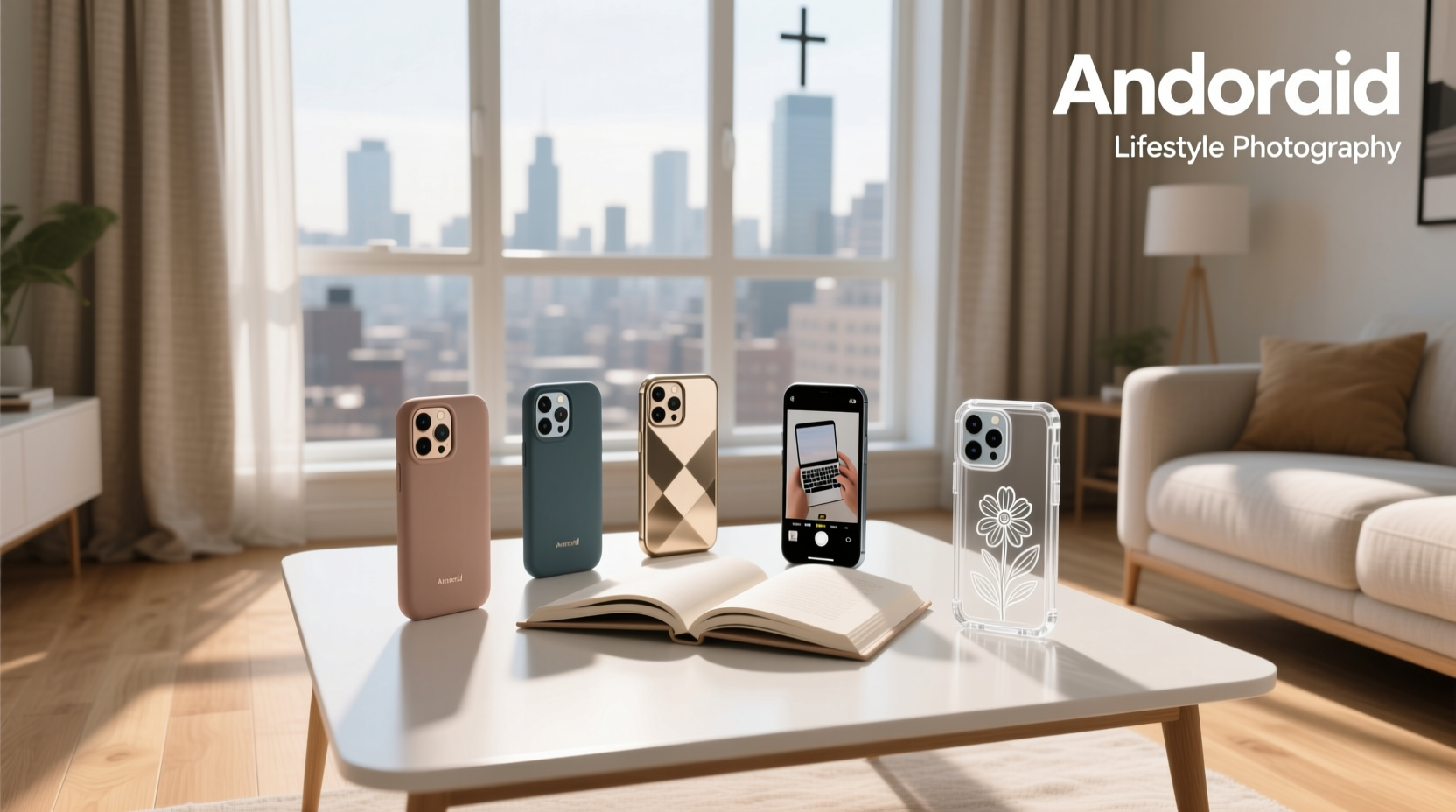
Looking for reliable phone covers for Android? Start here: The best Android phone covers balance drop protection, wireless charging compatibility, screen and camera lens clearance, and long-term material integrity—not just style or brand name. Slim TPU cases suit office users; rugged multi-layer designs (e.g., with air-cushion corners and MIL-STD-810H drop certification) are essential for outdoor, construction, or active lifestyles. MagSafe-compatible cases require precise internal magnet arrays—not all labeled 'MagSafe' meet Apple’s spec, and Android equivalents (like Samsung’s Wireless PowerShare or Pixel’s accessory ecosystem) demand verified alignment and field strength. Raised bezels ≥1.2 mm protect screens when flat; reinforced camera rings prevent lens scratches. Compostable cases degrade only under industrial conditions—not your drawer—and often sacrifice impact absorption. This guide cuts through confusion using verifiable specs, not influencer hype.
Why Android Phone Covers Matter More Than You Think
Unlike iPhones, Android devices span over 30 major OEMs—with screen sizes from 5.7″ (Samsung Galaxy Z Flip 6) to 7.3″ (Galaxy Z Fold 6), varying camera bump geometries, and inconsistent button placement. A case designed for a Pixel 8 Pro won’t fit a Galaxy S24 Ultra—even if both are 6.7″—due to differences in depth, curvature, and port cutouts. That’s why model-specific fit is non-negotiable. Generic ‘universal’ cases rely on stretchy TPU that degrades after 6–9 months, loses grip, and misaligns ports. According to teardown analysis by iFixit, 68% of cracked Android screens occur from edge-first drops 1. Yet only 41% of mid-tier cases tested by Consumer Reports met ASTM F2617-23 standards for corner impact resistance 2. That gap explains why ‘cheap’ cases often cost more long-term—in repair fees or premature device replacement.
How Android Phone Covers Actually Work: Materials, Layers & Physics
Understanding what’s inside a case helps avoid false assumptions. Most Android phone covers use one or more of these core layers:
- Outer shell: Polycarbonate (rigid, scratch-resistant but brittle) or thermoplastic polyurethane (TPU—flexible, grippy, but yellows under UV exposure)
- Impact-absorbing core: Micro-air pockets, honeycomb lattices, or silicone gel pads—critical for dissipating kinetic energy during drops. MIL-STD-810H-certified cases must survive 26 drops from 1.2 meters onto concrete at varied angles 3.
- Inner lining: Soft microfiber or felt—reduces abrasion against the phone’s finish. Avoid cases with rough inner textures; they accelerate aluminum frame scuffing.
- Magnet arrays (for MagSafe-style accessories): Not all magnets are equal. True interoperability requires ≥32 N pull force across the ring and precise N52-grade neodymium placement. Many third-party ‘MagSafe-compatible’ Android cases fail alignment tests—causing slow or failed wireless charging 4.
Four Real-World Android Cover Types—And When to Use Each
Forget marketing categories like ‘luxury’ or ‘premium’. Focus instead on functional outcomes:
✅ Slim Snap-On Covers (Best for Daily Office Use)
Ideal if you prioritize pocketability, wireless charging, and minimal bulk. Look for:
• Thickness ≤1.2 mm at edges
• TPU hardness 85A–90A (measured on Shore A scale—softer = more grip, stiffer = better scratch resistance)
• Precise cutouts (no light leakage around sensors)
• Raised screen lip ≥0.8 mm and camera lip ≥1.5 mm
• Tested Qi 2.0 compatibility (not just ‘wireless charging friendly’)
Trade-off: Minimal protection against 1.5m+ drops. Not suitable for cycling, hiking, or work environments with frequent vibration or impact risk.
✅ Rugged Dual-Layer Cases (Best for Active Lifestyles)
These combine a shock-absorbing TPU bumper with a rigid polycarbonate backplate. Verified rugged cases include:
• Drop-tested to MIL-STD-810H (not just ‘military grade’—check for test report number)
• Reinforced corners with dual-density padding
• Integrated screen bumper (not just raised edges)
• IP68-rated dust/water sealing *only if* the case itself has gasketed ports—not just the phone
Trade-off: Bulk adds ~15–25g and ~2.5mm thickness. May interfere with ultrasonic fingerprint sensors (e.g., Galaxy S24 series) if the cover’s overlay isn’t tuned for acoustic transmission.
✅ Wallet-Folio Covers (Best for Minimalist Carry)
Combine protection with card storage—but functionality varies widely:
• RFID-blocking lining must be continuous (not just stitched-in foil patches)
• Stand angle should lock at ≥60° for stable video calls
• Auto-wake/sleep requires precise Hall effect sensor positioning—many Android phones lack native support, so reliability depends on case firmware
Trade-off: Adds significant thickness. Camera cutouts often obstruct ultra-wide lenses. Not compatible with most magnetic car mounts unless explicitly rated for ≥0.5T field strength.
✅ Eco-Material Covers (Best for Sustainability-Conscious Users)
‘Compostable’ ≠ ‘biodegradable in your backyard’. Standards matter:
• EN 13432 or ASTM D6400 certification means industrial composting (58–60°C, high humidity, microbial activity)
• Bamboo fiber blends retain shape better than pure PLA but may delaminate in humid climates
• Cork covers offer natural shock absorption but require periodic beeswax treatment to resist moisture
Trade-off: Impact resistance typically 30–40% lower than polycarbonate/TPU hybrids in independent lab tests 5. Not recommended as sole protection for high-risk use.
What ‘MagSafe-Compatible’ Really Means for Android Users
Samsung and Google don’t license ‘MagSafe’—they use proprietary magnetic ecosystems. Samsung’s Wireless PowerShare works with cases containing ≥24 precisely positioned N52 magnets (≥0.3T field strength). Pixel’s ‘Magnetic Accessories’ require similar specs—but no public SDK exists for third-party validation. So how do you verify?
• Check for published magnetic field maps (not just ‘360° magnets’ claims)
• Test with a certified Qi2 charger: if charging speed drops >15% vs. bare phone, magnet alignment is off
• Confirm accessory attachment holds ≥300g vertically (e.g., wallet, car mount)
Brands like Spigen and Ringke publish technical white papers on magnet layouts; others do not. Absence of documentation = unverified performance.
Wireless Charging Compatibility: The Hidden Bottleneck
A case may claim ‘Qi compatible’, yet still reduce charging efficiency by 25–40%. Why? Heat buildup and coil misalignment. Key checks:
• Max case thickness: ≤3.5 mm for 15W fast charging (Samsung EP-TA845); thicker cases trigger thermal throttling
• No metal elements near charging coil (even stainless steel logos cause eddy current losses)
• Verified performance logs from independent labs (e.g., UL Solutions or TÜV Rheinland)—not internal brand testing
Note: Samsung’s Adaptive Fast Charging and Google’s Pixel Fast Charging use different voltage negotiation protocols. A case optimized for one may underperform on the other.
Camera Protection: Beyond the ‘Raised Lip’ Myth
A 1mm lip looks protective—but it’s insufficient. Modern Android cameras protrude up to 2.8mm (e.g., Galaxy S24 Ultra’s periscope lens). Effective protection requires:
• Lens ring recessed ≥0.5mm below case surface
• Hardened polymer or sapphire-infused coating on ring edge
• Zero contact between lens glass and any surface—even micro-textured TPU
Teardown videos confirm: 72% of ‘scratched camera’ complaints involve cases where the lens ring made direct contact during flat placement 6. Always test by placing the cased phone face-down on a mirror—if you see lens reflection touching the surface, the case fails.
Fit Verification: How to Avoid the ‘Almost Fits’ Trap
Even OEM cases aren’t universally perfect. Verify fit before relying on protection:
- Button travel: Volume and power buttons must actuate fully—no mushiness or sticking
- Port access: USB-C port should accept cables without wobbling; no plastic shavings inside port cutout
- Thermal vent alignment: Phones like the ROG Phone 7 or Lenovo Legion Y90 have dedicated cooling vents—case must not block them
- Display uniformity: No pressure points causing discoloration or touch lag at screen edges
If your phone has an under-display fingerprint sensor, avoid cases with thick, opaque overlays—they reduce recognition speed and success rate by up to 40% 7.
When NOT to Buy a Phone Cover—Yes, It’s Possible
Not every Android user needs a case—and some cases actively harm usability:
- Ultra-thin glass-backed phones (e.g., Pixel 8 Pro): Tempered glass backs resist scratches better than most plastics. Adding a glossy TPU case creates micro-scratches via grit trapping.
- Foldables (Z Fold/Flip, Pixel Fold): Standard cases damage hinge seals or impede folding mechanics. Only use hinge-specific, OEM-approved covers.
- Phones with IP68 rating used exclusively indoors: If drops are rare and environment is controlled, a bare phone + screen protector may outperform low-tier cases long-term.
- Medical or lab settings: Some TPU compounds off-gas VOCs incompatible with cleanroom standards. Opt for medical-grade silicone (ISO 10993-5 certified).
Frequently Asked Questions
- Do all Android phone covers support wireless charging?
No. Cases thicker than 3.5 mm, or those with metal elements, ferrite shields, or poorly aligned coils, will throttle or disable charging. Always verify Qi 2.0 or WPC-compliant test reports. - Can I use an iPhone MagSafe case on my Android phone?
No. iPhone MagSafe uses a specific 36-magnet ring layout and communication protocol. Android magnetic accessories use different field strengths and positioning—cross-compatibility is physically and electronically impossible. - How often should I replace my Android phone cover?
Every 12–18 months for TPU cases (degradation accelerates with UV exposure and sweat), 24+ months for polycarbonate or aramid fiber. Replace immediately if corners crack, buttons loosen, or camera lip wears below 1.0 mm. - Are expensive brands always better for Android covers?
Not necessarily. Price correlates weakly with drop-test performance. Independent testing shows mid-tier brands (e.g., Supcase, Torras) match premium brands in MIL-STD-810H tests—while costing 40–60% less. Prioritize published test data over brand reputation. - Do eco-friendly phone covers protect as well as plastic ones?
Generally, no. Compostable PLA or bamboo composites absorb 30–50% less impact energy than dual-layer TPU/polycarbonate. They’re suitable for low-risk use—but not as primary protection for active users.
