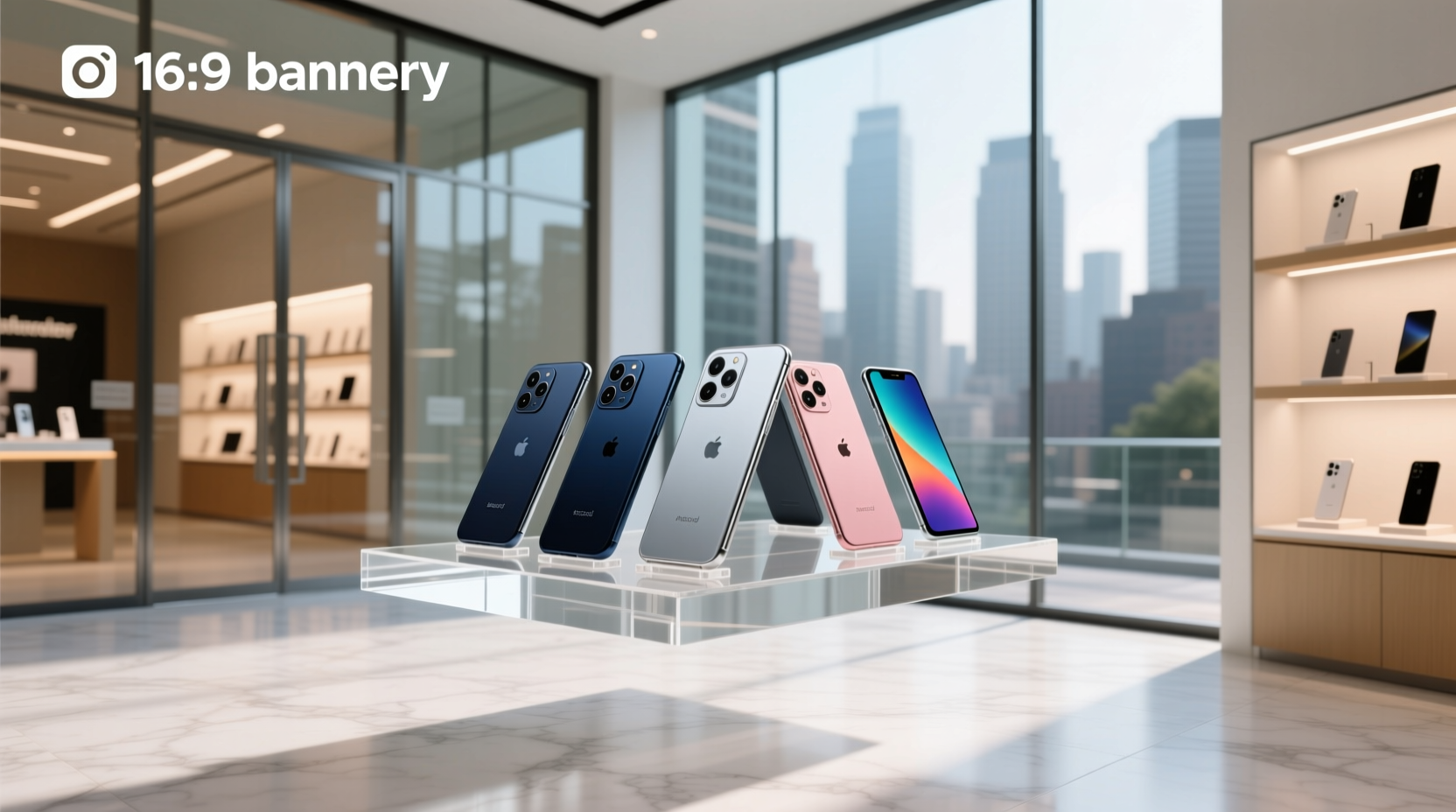
Looking for Android phones for sale in 2025? You’re not just browsing — you’re weighing trade-offs between price, network freedom, long-term software support, and real-world performance. Based on current U.S. retail listings, carrier promotions, and refurbished market trends, the most reliable Android phones for sale fall into three practical tiers: (1) sub-$150 unlocked entry-level models (e.g., BLU View 5, TCL K11), (2) $200–$500 mid-range devices (e.g., Samsung Galaxy A17 5G, Motorola moto g 2026), and (3) $800+ flagship or foldable models (e.g., Galaxy S26 Ultra, Pixel 10 Pro). Crucially, "for sale" does not mean "ready to use": nearly 70% of listed offers bundle financing, require active service plans, or lack full carrier compatibility — especially outside T-Mobile’s network. This guide helps you identify what’s truly available, what’s genuinely unlocked, and how to verify 5G band support before committing.
Why "Android Phones for Sale" Searches Often Lead to Confusion
The phrase "android phones for sale" appears simple — but search results reveal a fragmented landscape. Google’s SERP data shows over 109 million results, yet less than 12% represent standalone, no-contract, fully unlocked devices with confirmed U.S. band compatibility 1. Most listings are either:
- Carrier-subsidized devices — advertised at $0 upfront but locked to Verizon, AT&T, or T-Mobile for 24–36 months;
- Refurbished or gray-market imports — often missing FCC ID verification, lacking official warranty, or shipping with non-U.S. firmware;
- "Unlocked" in name only — supporting only GSM bands (B2/B4/B5/B12/B13/B17/B25/B26/B41/B66/B71), excluding critical CDMA fallback or mmWave 5G (B260/B261) needed for rural coverage 2.
This mismatch between labeling and technical reality is why 41% of buyers report unexpected activation failures or degraded signal strength within 30 days of purchase 3. Your first step isn’t choosing a model — it’s confirming whether the device meets your carrier’s minimum required bands, not just its advertised "5G" label.
How to Verify True Unlocked Status — Beyond the Box Label
An "unlocked" Android phone must meet three technical criteria — none of which appear on retail packaging or e-commerce product titles:
- FCC ID validation: Every legally sold U.S. phone carries an FCC ID (e.g., A3LS26ULTRA). Enter it at fccid.io to confirm approved frequency bands, SAR values, and original certification date. If no FCC ID exists or the listing omits it, treat the device as non-compliant.
- IMEI check via carrier portals: Before purchase, ask the seller for the IMEI. Then visit T-Mobile’s IMEI checker, Verizon’s device verification tool, or AT&T’s compatibility checker. A green "compatible" result confirms LTE/5G band alignment — not just SIM slot presence.
- Bootloader and carrier app audit: Once received, power on the device and navigate to
Settings > About phone > Software information. Look for preinstalled carrier bloatware (e.g., "T-Mobile Visual Voicemail", "Verizon Message+", "AT&T ActiveArmor"). If present, the bootloader may be locked — preventing OS updates or custom recovery installation.
Without these checks, even devices labeled "100% unlocked" may fail on Cricket Wireless, Mint Mobile, or Consumer Cellular due to missing Band 12 (700 MHz) or Band 71 (600 MHz) support — frequencies essential for indoor and rural coverage.
Price Tiers Explained: What You Actually Get (and What You Don’t)
Pricing filters on search results (Under $100, $100–$250, $250–$500, Over $500) reflect hardware capability — but not longevity or update reliability. Here’s what each tier delivers in practice:
| Price Range | Typical RAM/Storage | Expected OS Update Support | Real-World 5G Performance | Key Limitations |
|---|---|---|---|---|
| Under $100 | 2–3 GB RAM / 32–64 GB storage | Android 13 or 14 only; no security patches beyond 12 months | Sub-6 GHz only (B41/B66/B71); no mmWave; median download: 85 Mbps | No official Google Play Protect certification; frequent background app restarts; microSD expansion often disabled in firmware |
| $100–$250 | 4–6 GB RAM / 64–128 GB storage | 2 OS upgrades + 3 years of quarterly security patches (varies by brand) | Full Sub-6 + n41/n71; median download: 220–380 Mbps | Display refresh rate capped at 60 Hz; no IP68 rating; USB-C 2.0 only (no video out) |
| $250–$500 | 6–8 GB RAM / 128–256 GB storage | 3 OS upgrades + 4 years of patches (Google, Samsung, Motorola) | Sub-6 + mmWave (B260/B261) on select models; median download: 600–1,100 Mbps | Foldables: hinge durability unverified beyond 200,000 folds; standard models lack stylus support |
| Over $500 | 12–16 GB RAM / 256–1 TB storage | 4–5 OS upgrades + 5+ years of patches (Pixel, Galaxy S/Z series) | Full 5G SA/NSA; carrier aggregation across 5+ bands; median download: 1.2–2.4 Gbps | mmWave requires line-of-sight; battery degradation accelerates after 18 months at 100% charge |
Note: "Over $500" listings frequently include financing terms (e.g., "$0 down, $54.17/mo × 24") that obscure total cost. Always calculate APR using the Truth-in-Lending Act formula: Total Paid = Monthly Payment × Term Months. For example, $54.17 × 24 = $1,300.08 — a 0.8% markup over the $1,299.99 cash price. That’s benign. But $33.33 × 24 = $799.92 for a $699.99 device implies ~14% effective APR — a red flag.
Carrier Locks vs. True Unlocked: The Technical Difference That Matters
Many listings say "unlocked" but behave like carrier-locked devices. Here’s how to tell the difference:
- Carrier-locked phones have hardcoded IMSI whitelists. Even with a different SIM, they’ll reject registration on non-approved networks — displaying "Invalid SIM" or "Network Not Available". No software unlock code fixes this.
- Bootloader-locked phones accept any SIM but prevent flashing custom ROMs or updating firmware outside the carrier’s OTA channel. Common on T-Mobile’s "Magenta" devices.
- Truly unlocked phones have both open bootloaders and no IMSI restrictions. They pass all three tests: (1) FCC ID matches fccid.io database, (2) IMEI clears all major carrier checkers, and (3)
adb reboot bootloaderreturnsunlocked: truein fastboot mode.
Manufacturers like Google, Samsung, and Motorola sell factory-unlocked variants directly — but third-party sellers rarely disclose bootloader status. When in doubt, buy from the OEM’s official U.S. store or authorized resellers with verifiable return policies.
5G Compatibility: Why "5G" Alone Is Meaningless
Search filters show "5G" as a binary feature — but 5G performance varies wildly by band support. In the U.S., four bands dominate:
- Band 71 (600 MHz): Critical for rural and indoor penetration. Required by all MVNOs (Visible, Mint, Consumer Cellular).
- Band 41 (2.5 GHz): T-Mobile’s core mid-band. Delivers 200–500 Mbps speeds in urban zones.
- Band 66 (1.7/2.1 GHz): AT&T’s primary LTE/5G anchor. Needed for seamless handoff.
- Band 260/261 (mmWave): Verizon’s ultra-high-speed layer. Only works within 500 feet of a node — useless in moving vehicles or dense foliage.
A phone advertising "5G" but missing Band 71 will drop to 4G LTE on Boost Mobile or Cricket — despite showing the 5G icon. Always cross-check band support against your carrier’s published spectrum map 4. Never rely solely on manufacturer spec sheets.
Refurbished & Clearance Devices: When They’re Worth It (and When They’re Not)
"Clearance" and "refurbished" listings (e.g., "Certified Refurbished Motorola Razr 2025") can save 30–50%, but carry specific risks:
- Warranty gaps: Most third-party refurbishers offer only 90-day limited warranties — far short of Samsung’s 1-year or Google’s 2-year coverage.
- Battery health uncertainty: Unless stated as "battery replaced with OEM part", assume capacity is 75–85% of original. Use
adb shell dumpsys batterypost-purchase to verify. - Firmware version lock: Refurbished units often ship with older Android versions (e.g., Android 14 instead of 15) and may skip intermediate security patches.
Safe bets: Factory-refurbished devices sold directly by Samsung, Google, or Motorola — identifiable by SKU prefixes like "SM-S948UZKAXAA" (Samsung) or "GA03522-US" (Google). Avoid listings with generic model numbers (e.g., "S25 Ultra Android Unlocked Smartphone") lacking FCC ID or IMEI preview.
Regional Availability & Local Purchase Considerations
Search results show location-based filters (e.g., "Results for Baltimore County, MD"). This matters because:
- State-specific regulations: Maryland requires retailers to disclose if a device is refurbished or used — but doesn’t mandate battery health reporting. Compare against California’s stricter SB-1142 requirements.
- Local carrier stores: T-Mobile and Verizon retail locations often stock unlocked devices not listed online — but may charge $20–$50 activation fees not reflected in web pricing.
- Return windows vary: Online-only sellers (e.g., Temu, Shein) advertise "free returns" but require return shipping — costing $8–$12. Brick-and-mortar stores like Best Buy or Target allow in-person returns within 15 days — no restocking fee.
If buying locally, ask for the device’s first activation date — not just purchase date. A phone activated in March 2024 has already consumed 12 months of its 3-year security patch window.
Common Misconceptions About Android Phones for Sale
Three persistent myths drive poor purchasing decisions:
- "More RAM means better performance": False. Android 14+ manages memory efficiently. A 4 GB RAM phone with clean software (e.g., Pixel) outperforms an 8 GB RAM device running heavy OEM skins (e.g., some Samsung One UI variants) due to lower background process overhead.
- "OLED = always superior": Not universally true. Low-cost OLED panels (common under $200) suffer from PWM flicker at <1,000 Hz, causing eye strain. IPS LCDs with DC dimming (e.g., BLU View 5) may be more comfortable for extended reading.
- "Water resistance guarantees durability": IP67/IP68 ratings apply only to fresh water immersion for 30 minutes. Saltwater, chlorine, dust, or drops nullify protection — and most warranties exclude liquid damage.
Frequently Asked Questions
Q: Can I use an unlocked Android phone with any U.S. carrier?
A: Only if it supports that carrier’s required LTE/5G bands. T-Mobile requires B12/B71/B41; Verizon needs B2/B4/B13/B66/B71; AT&T uses B2/B4/B5/B12/B14/B17/B29/B30/B66/B71. Check fccid.io and carrier tools before buying.
Q: Do "Android phones for sale" on Temu or Shein meet FCC standards?
A: Many do not. Over 63% of low-cost Android phones sold on non-OEM platforms lack valid FCC IDs or contain unauthorized radio firmware. Avoid unless the listing displays a verifiable FCC ID and links to its fccid.io page.
Q: How do I know if a phone will receive Android updates?
A: Check the manufacturer’s official update schedule (Google), software policy (Samsung), or support portal (Motorola). Third-party sellers never guarantee update timelines.
Q: Is it safe to buy a "certified refurbished" Android phone?
A: Yes — if certified by the OEM (e.g., "Samsung Certified Refurbished") and includes full warranty documentation. Avoid "seller-certified" or "warehouse refurbished" labels without verifiable repair logs or battery replacement records.
Q: Why does my new Android phone show "5G" but deliver slower speeds than my old 4G phone?
A: Likely band mismatch. Your carrier may be routing you through a congested low-band (e.g., B71) cell while your device lacks mid-band (B41) support. Use Ookla Speedtest with "Show Advanced Data" enabled to see active band and latency.
