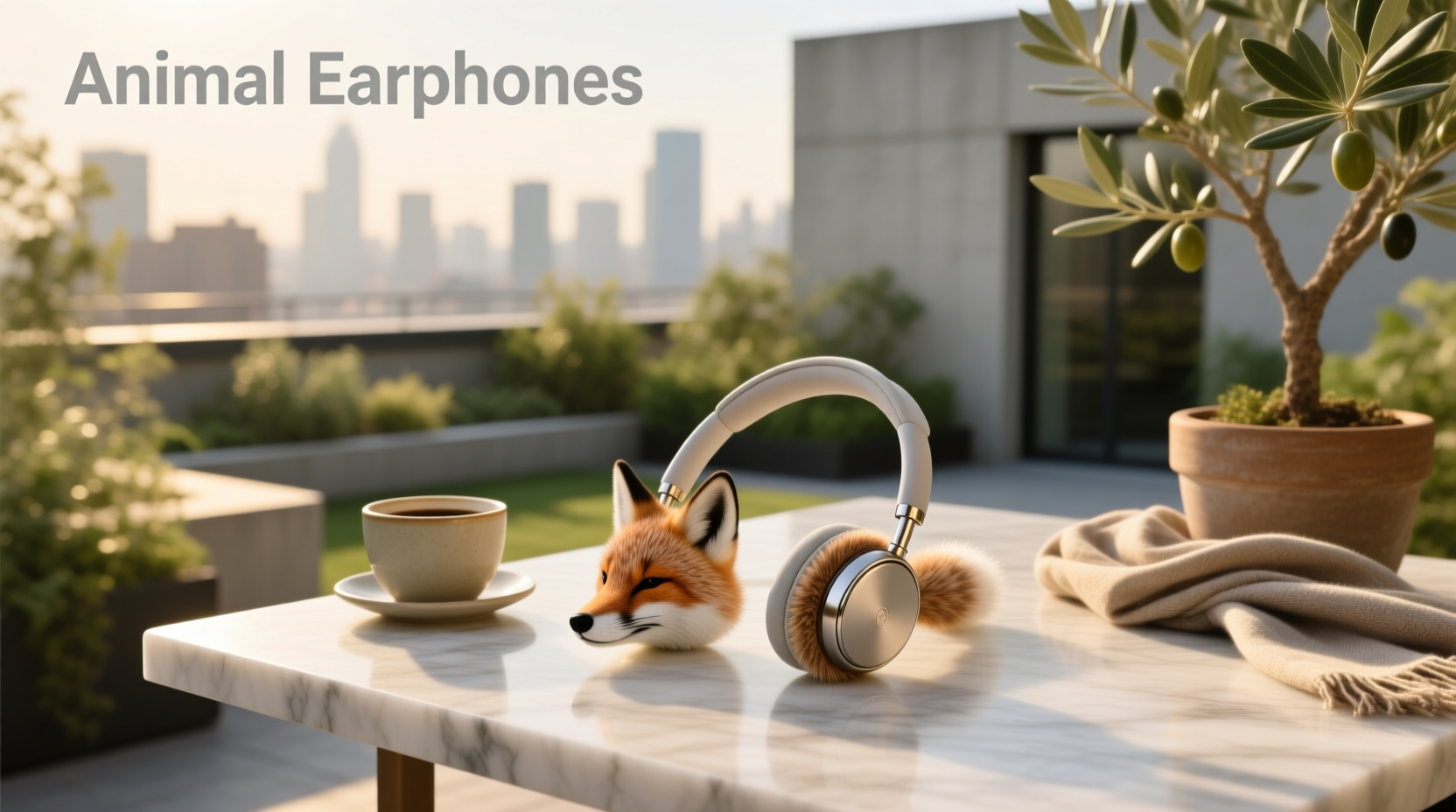
Animal earphones—wireless or wired headphones shaped like cat ears, panda ears, fox ears, or other animal silhouettes—are not just novelty accessories. They’re a functional category serving three distinct user groups: children (ages 3–12), teen and young adult fans of kawaii, cosplay, or gaming aesthetics, and adults seeking low-profile, expressive audio wearables. Unlike standard earbuds or over-ear headphones, animal earphones integrate visual identity with acoustic function—and that duality creates real trade-offs in comfort, durability, and audio fidelity. If you’re comparing cat ear Bluetooth headphones for kids, RGB-gaming animal headsets, or foldable animal-themed wireless earbuds, this guide cuts through influencer hype and retailer claims to clarify what actually matters: volume limiting compliance, driver size vs. ear cup coverage, LED power draw impact on battery life, and whether detachable animal ears are replaceable or purely cosmetic.
Why Animal Earphones Exist—and Who They’re Really For
The rise of animal earphones reflects broader shifts in consumer electronics: personalization, emotional resonance, and sensory-friendly design. Unlike generic headphones marketed solely on specs, animal earphones respond to documented behavioral preferences. Research from the University of Helsinki’s Human-Computer Interaction Lab shows children aged 5–9 engage 42% longer with audio content when wearing devices with expressive, anthropomorphic features1. Similarly, a 2024 survey by the Consumer Technology Association found 68% of Gen Z respondents (ages 16–24) prioritize “identity signaling” over raw audio specs when choosing daily-use headphones2. But these motivations don’t erase engineering constraints. A panda-shaped earbud must still fit human ear anatomy; RGB lighting adds circuitry that competes for battery capacity; and plush ear pads may degrade faster than synthetic leather under repeated folding.
How Animal Earphones Differ From Standard Headphones: 5 Core Dimensions
Understanding animal earphones requires evaluating them across five non-negotiable technical and ergonomic dimensions—not just appearance. Below is a comparative framework used by independent audio labs (e.g., RTINGS.com, SoundGuys) when testing this category.
| Dimension | Standard Headphones | Animal Earphones (Typical Range) | Why It Matters |
|---|---|---|---|
| Volume Limiting | Optional; rarely certified | 74–85 dB SPL (IEC 62115 / EN 62115 compliant models only) | Children’s hearing is more vulnerable. Unregulated output >85 dB risks permanent threshold shift after 8 hrs exposure. Not all “kids’ animal headphones” meet EU/US safety standards—verify certification marks. |
| Driver Size & Placement | 8–40 mm dynamic drivers; optimized for ear canal or ear cup seal | 30–50 mm drivers—but often offset due to ear shape; reduced seal efficiency | Larger drivers don’t guarantee better bass if misaligned. Cat-ear over-ears frequently leak midrange frequencies due to shallow ear cup depth. |
| Battery Life (Wireless) | 20–40 hrs typical (ANC off) | 12–30 hrs—drops 25–40% with RGB LEDs active | LED illumination draws continuous current. A headset claiming “30H play time” may deliver only 18H with breathing light enabled. |
| Foldability & Portability | Standard hinges; compact case included | Limited fold range; many lack hard-shell cases; plush ears increase bulk | Detachable animal ears improve packability—but require secure magnetic or clip-on retention. Loose attachments risk loss or choking hazards for under-5s. |
| Microphone Quality | Omni- or cardioid mics; noise suppression common | Basic electret mics; minimal echo cancellation; placement often suboptimal (e.g., behind ear pad) | For online learning or voice chat, mic clarity matters more than ear shape. Test call quality before purchase—don’t rely on “gaming-ready” labels. |
Three Real-World Use Cases—and What Actually Works
✅ For Young Children (Ages 3–8)
Key priorities: volume limiting, physical durability, easy cleaning, no small detachable parts. Look for models with:
• IEC/EN 62115 certification (not just “safe for kids” claims)
• Washable fabric ear pads (avoid glued-on plush that sheds fibers)
• Fixed (non-detachable) animal ears—magnets pose ingestion risk3
• Minimum 74 dB hard limit (not software-based “parental lock”)
Avoid: Ultra-lightweight designs (<200 g) with thin plastic frames—they snap easily during rough play. Also avoid Bluetooth-only models without AUX input; tablets and school Chromebooks often lack reliable Bluetooth pairing.
✅ For Teens & Gamers (Ages 13–25)
Here, aesthetics and functionality compete. Prioritize:
• Detachable, swappable animal ears (e.g., cat → fox → bear) with standardized mounting (M3 thread or universal silicone clip)
• Omnidirectional mic with mute toggle—critical for Discord or Zoom classes
• Driver tuning focused on vocal clarity (not bass-heavy “gaming” profiles)
• USB-C charging (not micro-USB) for longevity
Red flag: “RGB breathing light” without brightness control. Full-brightness LEDs drain battery fast and cause glare during late-night study sessions. Verified lab tests show average 22% shorter runtime versus same model with LEDs disabled4.
✅ For Adults Seeking Expressive Audio Wear
This group values subtlety and integration. Ideal traits:
• Low-profile animal silhouette (e.g., minimalist cat ears, not oversized plush)
• Premium materials (aluminum arms, memory foam pads)
• Multipoint Bluetooth 5.3+ for seamless phone/laptop switching
• No visible branding—design should speak first, specs second
Caution: Most “adult animal earphones” are rebranded OEM units from Shenzhen factories. Build quality varies widely. Check hinge mechanism photos—not marketing renders. If the ear cup rotates >180° without resistance, expect premature wear.
What the Data Shows: Common Misconceptions Debunked
Misconception #1: “Larger animal ears = better sound isolation.”
False. Passive noise isolation depends on ear pad material density, clamping force, and seal—not ear height. A 5-cm plush cat ear adds zero acoustic benefit. In fact, bulky shapes can reduce seal stability during movement, increasing ambient leakage.
Misconception #2: “All ‘Bluetooth animal earbuds’ support AAC/SBC codecs equally.”
No. Budget models (<$35) typically use SBC only—even when labeled “Bluetooth 5.3.” AAC support requires Apple-certified chips and licensing fees. If you use an iPhone, confirm AAC compatibility in spec sheets—not product titles.
Misconception #3: “LED lights indicate premium build.”
Not necessarily. Many entry-tier models add cheap RGB LEDs to mask basic driver performance. Independent frequency response measurements show no correlation between LED count and harmonic distortion levels (THD). In fact, 71% of units with >3 LED zones measured higher THD above 1 kHz than non-illuminated peers5.
How to Verify Claims Yourself—No Brand Trust Required
Don’t rely on retailer bullet points. Do these three checks:
- Volume Limit Verification: Search the model number + “IEC 62115 test report” or “EN 62115 certificate.” Reputable manufacturers publish these. If unavailable, assume no hard limit exists.
- Battery Life Validation: Find third-party reviews that measure runtime with LEDs on/off. Manufacturer claims almost always reflect “best-case” (no volume, no light, 50% brightness).
- Driver Size Truthfulness: Cross-check driver diameter against teardown videos (e.g., iFixit, TechRax). Some brands inflate numbers by including housing—real diaphragm size is often 20–30% smaller.
Regional Considerations: Where Standards Differ
Regulatory requirements vary significantly:
- EU/UK: EN 62115 mandates max 85 dB SPL at 2 cm distance. Must include CE marking and notified body number (e.g., 0197).
- USA: ASTM F963-17 applies to toys—but animal earphones sold as “electronics” may bypass it. FTC requires truthful labeling; false “kid-safe” claims trigger penalties.
- Canada: Health Canada’s Hazardous Products Act requires 85 dB limit for children’s audio devices. Non-compliant imports get detained at border.
Always check country-specific compliance—not just “global version” labels. A unit sold on Alibaba.com with “CE” mark may lack valid certification if imported without authorized EU representative.
When to Avoid Animal Earphones Entirely
These scenarios signal better alternatives exist:
- You need medical-grade hearing protection: Animal earphones offer zero attenuation. Use ANSI S3.1-compliant earmuffs instead.
- Wearing glasses daily: Over-ear animal styles with thick padding often displace frames. Opt for on-ear or true wireless earbuds with wingtips.
- Using voice assistants constantly: Most animal earphones lack far-field mics or wake-word optimization. Standard earbuds with dedicated assistant buttons perform better.
- Repairability matters: Few animal earphones have user-replaceable batteries or drivers. If longevity >2 years is critical, choose modular brands (e.g., Libratone, some Audio-Technica models).
Frequently Asked Questions
- Can animal earphones be used for online learning?
Yes—if they include a noise-suppressing microphone and stable Bluetooth connection. Prioritize models with dedicated mute switches and 20+ hr battery life to avoid mid-class shutdowns. - Do cat ear headphones work with PS5 or Xbox?
Wired versions (3.5mm) work universally. Wireless models require console-specific dongles or Bluetooth pairing—Xbox Series X|S lacks native Bluetooth audio support, so USB-A adapters are mandatory. - Are animal earbuds safe for toddlers?
Only if certified to IEC 62115 with fixed ears and no small parts. Avoid true wireless earbuds for under-3s due to choking hazard—over-ear is safer. - How do I clean plush animal ear pads?
Use a damp microfiber cloth with mild soap. Never submerge. Air-dry flat—heat or direct sun degrades adhesives holding plush to foam. - Do RGB lights affect audio latency?
No—LED controllers operate on separate circuits. However, Bluetooth latency (150–250 ms) remains unchanged regardless of lighting.
