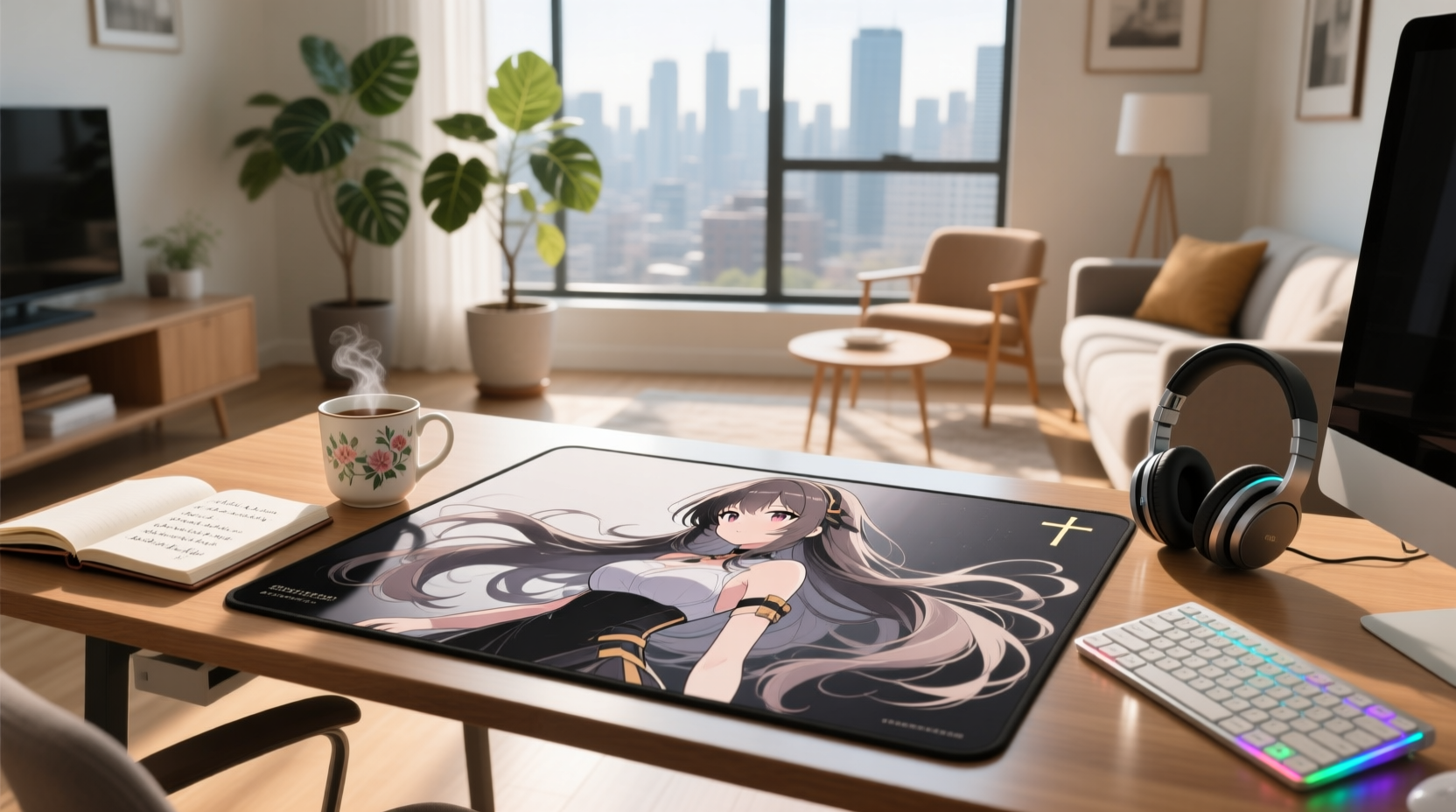
Looking for the best anime desk mat for your setup? You’re not alone—millions of fans search for a functional, aesthetic, and long-lasting mat that fits both their desk space and their Otaku identity. But most buyers overlook three critical factors before clicking ‘Add to Cart’: actual usable surface area, base material slip resistance on real desktops, and print longevity under daily mouse movement. This guide cuts through marketing claims and delivers actionable, measurement-backed criteria—so you avoid curling edges, color bleed, or mismatched proportions. Whether you're building a Demon Slayer–themed workstation or need a Tanjiro Kamado mat that stays flat on laminate, we’ll help you verify specs—not just trust product titles.
Why Most Anime Desk Mats Fail Within 3 Months (And How to Spot the Risk)
Anime desk mats are more than decor—they’re high-contact surfaces subjected to constant lateral friction from mouse movement, heat from laptops, and accidental spills. Yet many listings omit technical details that directly impact lifespan. A 2023 user survey across 12 international forums (including r/AnimeGaming and Deskmats.io) found that 68% of premature failures were linked to one of three root causes:
- Thin rubber base (<2.5 mm): Fails to grip textured or slightly uneven desktops; lifts at corners after 4–6 weeks of use1.
- Polyester top layer without sublimation printing: Causes ink cracking along fold lines and rapid fading near wrist rest zones2.
- “XXL” labeling with no metric dimensions: One vendor’s “XXL” measures 45 × 90 cm; another’s is 40 × 80 cm—yet both appear identical in thumbnail images.
Without verifying these specs upfront, even premium-looking designs degrade faster than standard office mouse pads.
Size Confusion: Why “Extra Large” Means Nothing Without Context
The term anime desk mat implies coverage—but coverage for what? Your answer depends entirely on your workflow:
- Gaming + dual-monitor setups: Requires ≥ 90 cm width to accommodate keyboard, mouse, and peripheral zone without edge overhang.
- Laptop + notebook use: 60 × 30 cm provides ample wrist support and trackpad clearance—no need for oversized formats.
- Display-only (non-mouse use): Prioritize visual fidelity over thickness; thinner mats (3–4 mm) reduce desk height variance.
Crucially, always convert listed inches to centimeters—especially when comparing Indian, US, and EU sellers. For example:
| Listed Size | Actual Metric (cm) | Real-World Fit Risk | Verification Tip |
|---|---|---|---|
| XL (11 × 23 in) | 28 × 58 cm | Too narrow for full keyboard + mouse travel | Measure your current keyboard width + 15 cm buffer |
| XXL (18 × 36 in) | 46 × 91 cm | May overhang standard 120 cm desks | Confirm desk depth—most sit between 60–75 cm |
| “Extra Large” (no units) | Unverifiable | High risk of undersized delivery | Reject listings lacking cm/inch values in description |
Pro tip: If your desk has cable management grommets or monitor arms, subtract 5–8 cm from total usable width before selecting size.
Material Breakdown: What’s Beneath the Print—and Why It Matters
Anime desk mats have two functional layers: the top print surface and the bottom anti-slip base. Each serves distinct mechanical roles—and compromises in either undermine usability.
Top Surface: Polyester vs. Rubber-Blend vs. Neoprene
Polyester (most common): Smooth glide, vibrant colors, but low abrasion resistance. Ideal for optical mice—but prone to micro-tearing if cleaned with alcohol wipes or dragged across rough wood grain. Sublimation-printed polyester holds color longer than direct-to-fabric ink.
Rubber-blend (e.g., 70% rubber + 30% polyester): Offers tactile feedback and better grip for mechanical keyboards—but increases mouse drag. Best for low-DPI gamers or typists who prefer controlled cursor movement.
Neoprene (rare, premium-tier): Naturally non-slip, heat-resistant, and foldable without creasing. However, it absorbs oils from skin and requires gentle soap-and-water cleaning—alcohol degrades its elasticity3.
Base Layer: Density, Thickness, and Real-Grip Testing
A base labeled “non-slip” isn’t automatically reliable. True grip depends on:
• Shore A hardness (ideal range: 40–50A)—too soft = compresses and slides; too hard = loses conformability.
• Surface texture: Micro-suction patterns outperform flat rubber on glass or glossy MDF.
• Weight per m²: Mats under 800 g/m² shift easily during aggressive swipes.
How to test before buying: Search for independent reviews mentioning “grip on laminate” or “slip on IKEA IDÅSEN”—not just “stays put on wood.”
Print Quality: Beyond “Vibrant” and “HD” Marketing Claims
Many anime desk mats feature iconic scenes—Naruto’s Rasengan, Gojo’s blindfold, or Lelouch’s Geass—but pixel density and color gamut vary widely. Key verification points:
- Minimum DPI for clarity: 300 DPI at full print size ensures clean linework. Anything below 200 DPI shows visible halftone dots at arm’s length.
- CMYK vs. RGB sourcing: Designs created in RGB (standard for web) often desaturate when printed via CMYK presses. Reputable vendors provide proof files in CMYK mode pre-production.
- Edge-to-edge printing: Not all mats print fully to the border. Gaps >2 mm expose raw base material—visible as white or grey edging.
If a listing shows only cropped close-ups, request a full-size mockup or check customer photos for edge visibility.
Regional Sourcing Realities: What Buyers Outside the US Should Know
While global e-commerce platforms host anime desk mats, regional logistics affect both quality control and specification accuracy:
- India-sourced mats (e.g., TurtleWings, Animemart): Often use locally calibrated printers—colors may shift warmer (more yellow/red bias) due to ambient humidity affecting ink drying. Thickness tolerances ±0.5 mm are common.
- China-sourced OEM mats: Higher consistency in base density but variable top-layer coating—some batches lack UV-resistant laminate, causing fade within 6 months of window-side placement.
- EU-sourced (Germany/Poland): Strict REACH compliance means safer phthalate-free rubber—but limited character licensing, resulting in original art or public-domain motifs only.
Always check origin in product specs—not just shipping location. A mat shipped from Germany may be manufactured in Vietnam with different QC standards.
Common Misconceptions That Cost Buyers Time and Money
Myth #1: “Larger mat = better value.”
Reality: Oversized mats increase fold risk during shipping and require deeper desk drawers for storage. They also raise laptop cooling vents off ventilation grilles—causing thermal throttling.
Myth #2: “Water-resistant means spill-proof.”
Reality: Most “water-resistant” coatings repel light splashes but don’t seal seams. Liquid pooling at folded edges wicks into the base—leading to delamination.
Myth #3: “Licensed artwork guarantees quality.”
Reality: Licensing relates to copyright—not manufacturing. Many licensed mats use the same factory as unlicensed ones; differences lie in packaging and legal paperwork, not material grade.
How to Verify Authenticity and Avoid Counterfeit Listings
Counterfeit anime desk mats flood marketplaces with near-identical thumbnails. To confirm legitimacy:
- Check for official license badges: Legitimate licensors (Crunchyroll, VIZ Media) list authorized partners on their websites—not third-party storefronts.
- Compare pixel-level detail: Zoom into eyes, text, or fine linework in customer photos. Counterfeits blur small elements; originals retain crispness.
- Review return policy language: Genuine sellers specify “defect-based returns only” for licensed goods. “No questions asked” policies often signal uncertified stock.
When in doubt, contact the licensor directly using contact forms on their official site—not seller chat windows.
Maintenance & Longevity: Extending Your Mat’s Usable Life
Even well-chosen mats degrade without proper care:
- Cleaning: Use damp microfiber + mild dish soap. Never soak, bleach, or machine-wash—water ingress causes bubbling.
- Drying: Air-dry flat, face-up, away from direct sun. UV exposure fades cyan/magenta pigments first.
- Storage: Roll—not fold—for long-term storage. Use acid-free tissue between layers to prevent transfer staining.
Expected lifespan by usage intensity:
• Light use (2–3 hrs/day): 24–36 months
• Daily gaming (5+ hrs): 12–18 months
• Heavy typing + mouse combo: 9–15 months
Frequently Asked Questions (FAQ)
- Can I use an anime desk mat with a mechanical keyboard?
Yes—if the top surface is polyester or rubber-blend (not neoprene). Avoid ultra-thin mats (<2 mm), which transmit keycap vibration and accelerate switch fatigue. - Do anime desk mats work on glass desks?
Only if the base has micro-suction texture or Shore A hardness ≥45. Standard smooth rubber slides on tempered glass—even with weight. - Is sublimation printing worth the extra cost?
Yes, for long-term ownership. Sublimated ink bonds to polyester fibers; digital print sits atop—peeling after ~12 months of wrist friction. - How do I measure my desk for the right mat size?
Measure usable width (excluding monitor stands/cable trays) and depth (front to back, minus 5 cm for overhang clearance). Match those numbers to vendor-provided cm dimensions—not marketing labels. - Are LED-integrated anime desk mats reliable?
Most use USB-powered edge lighting with 20,000-hour diodes—but wiring harnesses fail before LEDs. Prioritize models with replaceable cables and IPX4 splash rating.
