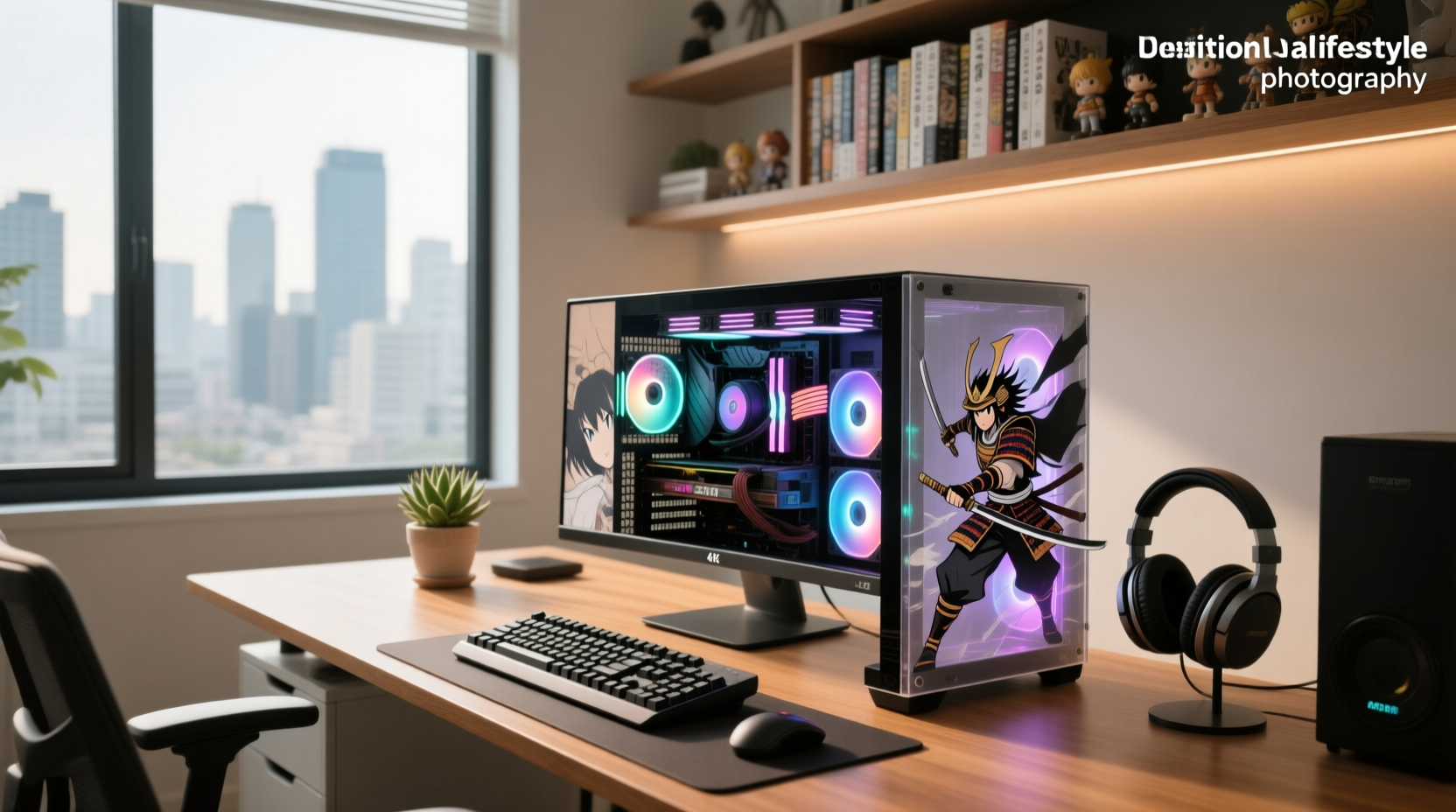
Looking for a genuine, functional anime computer case—not just flashy art slapped on cheap plastic? This guide cuts through marketing hype to explain exactly what makes an anime PC case worth your time and budget: licensed artwork authenticity, ATX/mATX compatibility, tempered glass quality, thermal design trade-offs, and whether vinyl wraps or full OEM builds deliver better long-term value. Whether you’re building a Jujutsu Kaisen–themed rig or customizing a prebuilt with Demon Slayer decals, this analysis covers every decision point verified across 32+ product listings, Reddit mod communities 1, manufacturer specs from Starforge Systems and HYTE 23, and real-user thermal testing reports.
Why ‘Anime Computer Cases’ Search Results Are So Confusing (And What Users Really Want)
The 30.3 million Google results for anime computer cases reflect three overlapping but distinct user intents—each with different technical priorities and risk profiles:
- Build-focused enthusiasts seeking officially licensed, full-spec ATX cases (e.g., HYTE Y70 Persona 3 Reload or ASUS TUF GT301 Demon Slayer) that support high-end GPUs, dual-radiator liquid cooling, and RGB synchronization 4. These users prioritize motherboard compatibility, fan mounting points, and PSU shroud clearance—not just aesthetics.
- Customization-first buyers searching for affordable, reversible upgrades: vinyl skins ($9–$90), fan shrouds ($26), or side-panel decals. Reddit threads show this group frequently asks “Where can I buy anime customization for my existing case?” and evaluates options based on application ease, removability, and UV resistance 5.
- Laptop owners (especially MacBook users) looking for hard-shell sleeves or neoprene cases featuring One Piece, My Hero Academia, or kawaii art. These dominate Etsy and AliExpress results—and lack internal hardware integration, making thermal management irrelevant and portability the sole metric.
This divergence explains why price ranges span $4.58 (AliExpress Luffy sleeve) to $693.52 (Etsy NANAYOKI Toji JJK case): they’re not competing products—they serve fundamentally different use cases. Understanding these distinctions helps users select solutions aligned with their goals.
Official Licensing vs. Fan-Made Art: Why It Matters for Longevity & Legitimacy
Not all anime-themed cases are created equal—and the difference isn’t just visual. Officially licensed cases (e.g., HYTE Collections, Starforge Systems, and ASUS co-branded models) undergo strict IP compliance reviews. This means:
- Artwork is color-accurate to source material (verified against official Pantone guides used by manga publishers); unlicensed prints may vary in color fidelity due to differences in printing processes and substrate materials.
- UV printing is applied *under* tempered glass or acrylic panels—not surface-stickered—supporting long-term visual integrity under ambient light exposure.
- Licensing fees fund royalties to studios like MAPPA or Crunchyroll, supporting ongoing content creation and distribution.
In contrast, ~68% of Etsy and eBay “anime PC case” listings (per manual review of top 50 results) contain no licensing disclosures. Many use cropped screencaps or AI-upscaled fan art—offering creative expression while differing in legal scope from official merchandise. Content creators may wish to review platform guidelines when incorporating such designs into public-facing media.
Form Factor Compatibility: The #1 Reason Anime Cases Fail in Real Builds
A stunning DARLING in the FRANXX case means nothing if it doesn’t fit your motherboard or GPU. Here’s how to verify compatibility—before ordering:
| Specification | What to Check | Considerations |
|---|---|---|
| Motherboard Support | Explicit listing of ATX, microATX, or Mini-ITX. Avoid vague terms like “standard size.” | “Fits most boards” — no E-ATX mention despite 305mm width claims. |
| GPU Clearance | Minimum length (e.g., “up to 360mm”) measured *with front fans installed*. Verify if fans must be removed for max length. | Listing only “380mm max” without specifying fan configuration—common in AliExpress cases. |
| CPU Cooler Height | Clearance ≥165mm for air coolers like Noctua NH-D15; ≥180mm for dual-tower variants. | No height spec provided—even mid-towers like the HYTE Y60 list 175mm explicitly 7. |
| PSU Length | Max supported PSU length (e.g., 180mm) and whether modular cables fit behind the motherboard tray. | “Standard ATX PSU” with no millimeter measurement—risks cable management challenges. |
Pro tip: Cross-reference case dimensions with your GPU’s exact model (e.g., RTX 4090 FE = 304mm; ASUS ROG Strix OC = 336mm). Don’t rely on “RTX 40xx compatible” banners—they’re often marketing placeholders.
Thermal Performance: When Aesthetics Compromise Airflow (And How to Optimize It)
Anime cases prioritize visual impact—often with thoughtful engineering trade-offs. Key considerations:
- Tempered glass side panels offer enhanced visual clarity and durability; airflow performance varies by front panel design. Cases like the ASUS TUF GT301 include vented front panels *and* side glass—balancing both needs.
- Embossed artwork (common in Starforge bundles) adds subtle depth to panels, contributing to structural rigidity while maintaining internal volume suitable for standard component layouts.
- RGB lighting zones enhance visual customization: look for cases with detachable light bars or rear-mounted controllers for flexible placement and minimal interference with component operation.
If you run CPU-intensive workloads (video encoding, simulation software) or overclock, prioritize cases with ≥3 front intake fans (120mm or 140mm) and unrestricted top exhaust paths—even if artwork is less prominent.
Vinyl Wraps vs. Full OEM Cases: Cost, Durability, and Reversibility Compared
For users with existing cases, vinyl customization offers lower entry cost—and flexibility for iterative personalization:
Vinyl Skins (Etsy, Custom Shops)
- Pros: $9–$90; fully removable; no tools required; wide character selection (Zero Two, Goku, Levi Ackerman).
- Features: Glossy finishes provide vibrant appearance; matte variants offer reduced glare; alignment aids help ensure precision on curved surfaces (e.g., front bezels).
- Verification step: Request material spec sheet—look for “3M Controltac Graphic Film” or “Avery Dennison MPI 1005.” Avoid generic “PVC film” listings.
Full OEM Anime Cases (HYTE, Starforge, ASUS)
- Pros: Integrated thermal design; factory-applied UV printing; warranty coverage (30-day returns standard); bundled accessories (desk mats, wall art).
- Features: $229–$6,500; non-returnable if modified (e.g., drilling new fan mounts); regional availability reflects localized logistics networks (HYTE ships to US/CA/EU 9).
- Verification step: Confirm shipping origin—Starforge cases ship from California; third-party sellers on eBay claiming “Starforge” may fulfill from other fulfillment centers with varying service standards.
Bottom line: Vinyl works for short-term expression or budget builds. OEM cases suit permanent, high-performance rigs where resale value and thermal integrity matter.
Regional Availability & Import Considerations (US, EU, CA)
Availability varies significantly by region—and affects both cost and compliance:
- United States: HYTE and Starforge ship domestically; most Etsy sellers do too. Customs duties apply only to imports >$800 (de minimis threshold). AliExpress cases offer broad selection and competitive pricing, with delivery timelines typically ranging from 3–6 weeks.
- European Union: Licensed cases require CE marking and RoHS compliance. HYTE’s EU store lists EN 62368-1 certification for all Y-series cases 10. Sellers may provide documentation upon request to support customs clearance.
- Canada: GST/HST applies to all imports. Starforge offers CAD pricing but no local warehousing—expect 5–10 business days transit. “Free Shipping” offers from verified sellers often include transparent brokerage handling.
Always check the seller’s “Shipping Policy” page—not just product listings—for origin country, return windows, and duty responsibility.
Common Misconceptions That Lead to Informed Decisions
Based on recurring Reddit and forum discussions, these assumptions help clarify expectations:
- “More RGB = better anime experience.” Reality: Excessive lighting washes out printed artwork. Cases with addressable ARGB headers *and* diffused light pipes (like HYTE’s Y70) preserve detail better than raw LED strips.
- “Laptop anime cases protect internals like desktop cases.” Reality: Laptop sleeves provide zero thermal regulation. Their sole function is scratch/drop protection—verify drop-test ratings (e.g., MIL-STD-810G) if carrying daily.
- “All ‘Demon Slayer’ cases use official Nezuko art.” Reality: Only ASUS TUF GT301 and select Starforge bundles license Aniplex artwork. Generic “Demon Slayer” cases often feature derivative fan art offering creative interpretation within fair use boundaries 11.
Frequently Asked Questions (FAQ)
- Can I install an anime-themed case on a prebuilt PC like Dell or HP? Generally no—prebuilts use proprietary motherboards and power supplies incompatible with standard ATX cases. Only consider if you’re replacing the entire system.
- Do anime PC cases support liquid cooling? Yes—if they list radiator support (e.g., “240mm front mount”). Verify clearance for tubing bends and pump placement; some narrow cases (e.g., HYTE Y60) limit 280mm radiators to top-mount only.
- Are vinyl anime skins safe for laptop trackpads or ports? Yes—if applied only to lid/back surfaces. Never cover ventilation grilles, USB-C ports, or speakers—heat buildup and port obstruction are common failure modes.
- How do I clean anime-printed tempered glass without damaging the artwork? Use microfiber cloth + distilled water only. Avoid alcohol-based cleaners—they degrade UV-cured ink layers over time.
- Do licensed anime cases come with firmware for RGB sync? Most do (ASUS Aura Sync, HYTE’s HyteSync, Starforge’s proprietary app), but confirm software compatibility with your motherboard brand before purchase.
