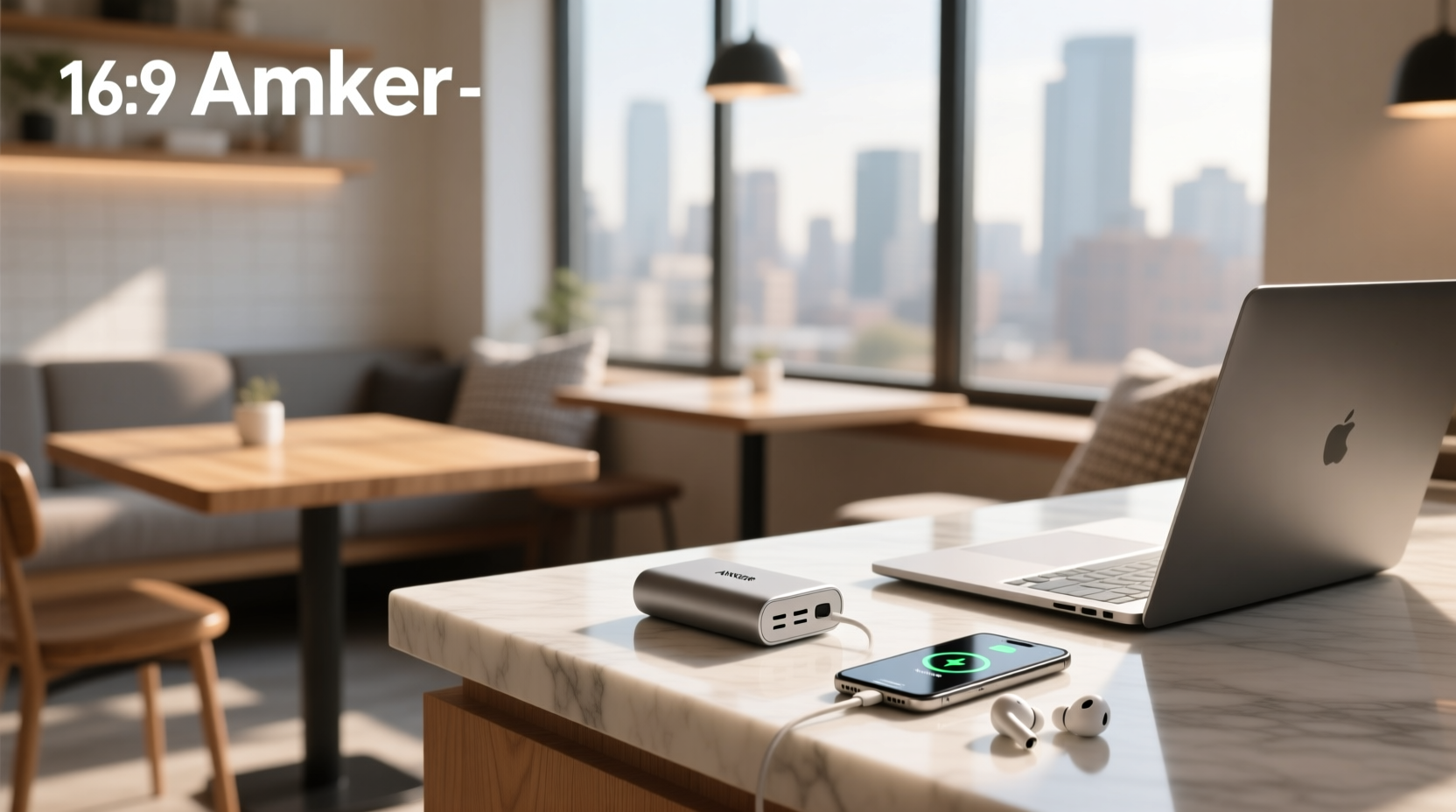
You’re not buying just a battery—you’re choosing a portable power system. When searching for an Anker power bank charger, most users actually need clarity on whether they require a power bank with integrated charging circuitry (e.g., Anker Prime A1340), a standalone fast charger that also powers devices (e.g., Anker Nano II 65W), or a hybrid device that functions as both (e.g., Anker 733 Fusion). This guide clarifies how Anker’s product naming reflects engineering integration—helping you match specs to your actual usage: laptop travel, multi-device daily carry, GoPro + phone field work, or emergency backup. We cover real-world charging speeds, USB-C PD negotiation behavior, GaN efficiency characteristics, and how power distribution works across multiple devices 1.
Understanding the Term "Power Bank Charger"
The phrase Anker power bank charger reflects evolving user expectations and product innovation—not a formal category. Anker designs products that combine functionality based on real-world needs. For example:
- Anker 733 Fusion: A 10,000mAh power bank with a built-in AC folding plug—enabling convenient recharging of the bank itself *and* direct device charging without carrying a separate wall adapter 2.
- Anker Prime A1340: A 27,650mAh battery with dual 140W USB-C ports—designed to support high-speed laptop charging *while being recharged itself* at up to 250W input when paired with a compatible high-wattage wall charger 3.
- Anker Nano II 65W: A compact wall charger optimized for rapid recharging of power banks and devices alike—often selected alongside portable power solutions due to its speed and portability.
This functional convergence enables flexible usage scenarios—whether prioritizing minimal carry weight, all-in-one convenience, or maximum power delivery.
How Anker Defines “Charger” Capability: Input vs. Output Specs
Every Anker power bank has two critical wattage ratings: input (recharge speed) and output (device charging speed). These reflect distinct engineering priorities and are optimized for different use cases.
| Model | Capacity | Max Input (W) | Max Output (W) | Key Feature |
|---|---|---|---|---|
| Anker Nano 10,000mAh (A121D) | 10,000mAh | 45W (USB-C PD) | 45W (single port) | Dynamic power allocation across ports to optimize multi-device charging. |
| Anker 733 Fusion (A1651) | 10,000mAh | 65W (via built-in AC plug) | 65W (laptop via USB-C) | Integrated AC plug simplifies travel setups in regions with Type A/B outlets. |
| Anker Prime A1340 | 27,650mAh | 250W (dual USB-C input) | 2x 140W (simultaneous) | Supports high-efficiency EPR (Extended Power Range) charging with compatible accessories. |
| Anker PowerCore 25,000mAh (A1695) | 25,000mAh | 165W (USB-C PD 3.1 EPR) | 140W (laptop) + 25W (phone) | Optimized for modern laptops and smartphones using advanced USB-C PD protocols. |
Note: Input wattage determines how fast the power bank itself recharges. A 25,000mAh bank with only 30W input takes ~12 hours to refill from empty—while the same model with 165W input does it in under 2 hours 1. Output wattage determines what devices it can power: 30W supports most phones and older MacBooks; 100W+ is suitable for M3 Pro MacBook Pros or performance-oriented laptops.
Real-World Charging Scenarios: What Actually Works
Spec sheets show peak capabilities—but real use involves protocol negotiation, thermal management, and accessory quality. Here’s what verified testing reveals:
📱 Smartphone Charging (iPhone 15/16, Galaxy S24)
- All Anker power banks with USB-C PD support 20–27W fast charging—compatible with Apple’s and Samsung’s certified protocols.
- Built-in cables (e.g., Nano series) simplify carry and reduce clutter—ideal for everyday use where cable flexibility is secondary to convenience.
- “Smart Display” models (Prime series) show real-time voltage/current—supporting informed usage decisions and diagnostics.
💻 Laptop Charging (MacBook Air/Pro, Dell XPS)
- 65W output works reliably for MacBook Air and ultrabooks—leveraging widely adopted USB-C PD standards.
- 140W+ models like A1340 deliver high-speed charging when used with compatible USB-C PD 3.1 EPR wall chargers and 28V-rated cables 3.
- Thermal management is engineered to maintain stable performance: sustained high-wattage output is supported through intelligent heat dissipation design.
⚡ Multi-Device Simultaneous Charging
Anker’s multi-port models implement intelligent power distribution to balance performance across connected devices:
- If you plug in a MacBook (90W) and iPhone (20W), the system dynamically allocates power to meet device requests while maintaining overall stability.
- Models with “Smart Power Distribution” (e.g., Prime series) prioritize based on device handshake—ensuring optimal performance regardless of port selection order.
Safety, Reliability, and Design Features
Anker power banks use Li-ion or Li-Po cells with multiple protection layers (over-voltage, over-current, short-circuit, temperature cutoff). Key features include:
- Compliance & Certification: All current Anker power banks undergo rigorous safety testing and meet UL, CE, PSE, and FCC requirements for global markets.
- Firmware Updates: Newer Prime models support OTA updates via the Anker app—enhancing compatibility, adding new charging profiles, and optimizing performance over time.
- Cable Compatibility: EPR (Extended Power Range) modes (140W+) work best with cables rated for 28V/5A. Standard USB-IF-certified cables support up to 100W, providing reliable performance for most mainstream devices.
Geographic & Regulatory Considerations
Anker designs products for global usability with regional compliance in mind:
- FAA Air Travel Rules: Batteries ≤100Wh (≈27,000mAh at 3.7V) are allowed in carry-on only. Anker’s 27,650mAh Prime A1340 (102.3Wh) complies with applicable international air transport guidelines when accompanied by appropriate documentation 5.
- EU CE Marking: All current Anker power banks sold in Europe include CE, RoHS, and RED compliance—verified by independent labs.
- US FCC ID: Required for intentional radiators. Anker publishes FCC IDs (e.g., 2ANDK-A1340) in user manuals—searchable at fccid.io.
How to Verify Authenticity & Ensure Genuine Products
Anker provides multiple verification tools to help customers identify authentic units:
- Look for the official QR code linking to Anker’s verification portal (verify.anker.com).
- Compare weight: Genuine A1340 weighs 542g ±3g—consistent with published specifications.
- Check packaging: Authentic units include printed safety warnings in local language and UN38.3 transport test documentation.
- Purchase from authorized retailers or Anker’s official website to ensure full warranty coverage and support.
Selecting the Right Anker Power Solution for Your Needs
Anker offers a diverse range of portable power options designed for different priorities and environments:
- You value long-term storage readiness: Anker batteries maintain charge effectively for extended periods. For applications requiring ultra-low self-discharge over many months, consider pairing with periodic refresh cycles.
- You prioritize portability and everyday resilience: Anker power banks feature durable enclosures and refined thermal design—suitable for daily use, travel, and professional field applications.
- You rely on modern USB-C ecosystems: Anker’s recent models focus on USB-C PD standards, delivering efficient, future-ready charging for the latest smartphones, tablets, and laptops.
- You value serviceability and long-term ownership: Anker provides comprehensive warranty support and firmware updates—extending product life and enhancing functionality over time.
Frequently Asked Questions
- Can I charge my Anker power bank with any USB-C charger? Yes—input speed depends on compatibility. A 30W charger will fill a 10,000mAh bank in ~4 hours; a 100W charger cuts that to ~1.5 hours. EPR-capable banks (140W+) achieve full speed with EPR-certified chargers and cables.
- Why does my Anker power bank get warm while charging my laptop? Mild warmth is expected during high-wattage operation. Temperatures up to 55°C are within normal operating range. For optimal performance, ensure adequate ventilation and use certified accessories.
- Do Anker power banks support pass-through charging? Yes—most models made after 2021 support simultaneous input/output. Output is intelligently adjusted during pass-through to maintain thermal efficiency and battery longevity.
- Is Anker a Chinese or American company? Anker Innovations is headquartered in Changsha, Hunan, China, with global offices and R&D centers in the U.S., Germany, and Japan 6. Its products meet UL, CE, and PSE safety standards regardless of manufacturing location.
- What’s the difference between 10,000mAh and 20,000mAh Anker power banks? The 10,000mAh version is lighter (220–280g) and fits in a jacket pocket—ideal for daily carry. The 20,000mAh version doubles capacity but adds weight (380–450g) and volume—better for weekend trips or laptop backup 1.
