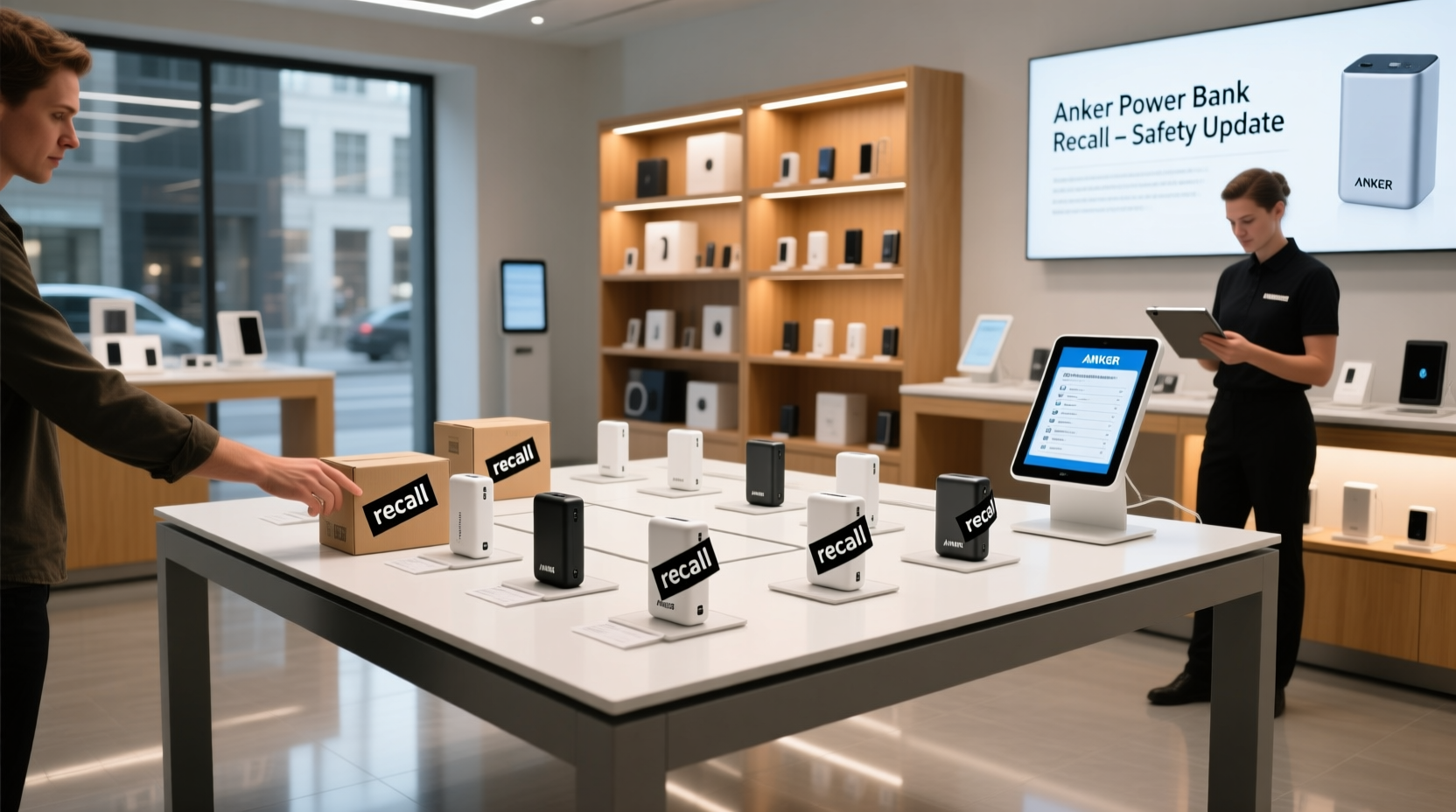
✅ If you own an Anker PowerCore 10000 (A1263), MagGo A1652, Zolo A1681, or any of the five recalled models — stop using and charging it immediately. These units — manufactured between 2016 and mid-2025 — pose verified fire and burn hazards due to defective lithium-ion cells. This guide gives you the exact model list, how to confirm if yours is affected, safe disposal steps, official recall verification tools, and what to expect from Anker’s replacement or refund process — all based on CPSC filings and Anker’s official recall notices.
Why This Recall Matters: Understanding Safety Verification
The U.S. Consumer Product Safety Commission (CPSC) has confirmed 33 documented incidents involving fires and explosions across the recalled Anker power banks — including reports of second-degree burns and property damage 1. This is a formal, voluntary global recall initiated by Anker Innovations under regulatory coordination. The safety evaluation identified thermal instability linked to specific lithium-ion cell batches used in these models during normal operation — even when idle or partially charged 2. As a precautionary measure aligned with international safety standards, physical discontinuation of use is recommended until replacement or refund is completed.
Which Anker Power Banks Were Recalled? Full Verified Model List
Anker issued two major recall waves in 2025: one in June and another in September. Combined, they cover over 1.6 million units, spanning more than six years of production. Below is the complete, CPSC-confirmed list of affected models — with manufacturing date ranges, capacities, and key identifiers:
| Model Number | Product Name | Capacity & Key Specs | Manufactured Between | Recall Date | CPSC Recall ID |
|---|---|---|---|---|---|
| A1263 | Anker PowerCore 10000 | 10,000mAh, dual USB-A ports, black/blue/red variants | Jan 2016 – Oct 2019 | June 12, 2025 | 25-124 |
| A1647 | Anker Power Bank (20,000mAh, 22.5W) | 20,000mAh, built-in USB-C cable, foldable stand | 2022 – May 2025 | June 2025 & Sept 2025 | 25-187 |
| A1652 | Anker MagGo Power Bank (10,000mAh, 7.5W) | 10,000mAh, magnetic attachment, compact design | 2023 – Apr 2025 | June 2025 | 25-187 |
| A1257 | Anker Power Bank (10K, 22.5W) | 10,000mAh, dual USB-C + USB-A, LED power indicator | 2021 – Mar 2025 | June 2025 | 25-187 |
| A1681 / A1689 | Anker Zolo Power Bank (20K, 30W) | 20,000mAh, dual built-in cables (USB-C + Lightning or USB-C only) | 2023 – Jun 2025 | September 18, 2025 | 25-221 |
⚠️ Important note on model identification: Anker uses consistent naming conventions across generations. For example, “PowerCore 10000” appears in multiple product lines — but only A1263 is included in this recall. Later versions like A2012 or A2113 are not included. Similarly, “Zolo” branding was applied to non-recalled units after mid-2025 — so manufacturing date matters as much as model number.
How to Check If Your Power Bank Is Affected — Step-by-Step
You cannot rely on packaging, purchase date, or retailer name. Verification requires two precise physical checks:
- Locate the model number: Flip the unit over. Look for engraved or printed text on the bottom or side casing — usually near compliance labels (FCC, CE, RoHS). It will appear as
A1263,A1647, etc. Do not confuse it with serial numbers (which start with letters and digits like "ANK-2023-XXXX") or firmware version codes. - Confirm manufacturing date (if visible): Some units include a date code (e.g., "2022.W24" = week 24, 2022) or batch stamp. If absent, Anker’s recall portal will ask for your serial number to cross-check against affected production runs 3.
- Use Anker’s official checker: Go to anker.com/rc2506. Enter your model number and serial number. The tool returns instant eligibility status — no account or purchase receipt required.
If your unit matches any listed model and falls within the date range, do not delay. CPSC advises immediate cessation of use — even if the device has never felt warm or shown anomalies.
What to Do After Confirming Your Unit Is Recalled
Follow this sequence — in order — to ensure safety and maximize remedy options:
🛑 Step 1: Stop Using and Unplug Immediately
Remove any connected devices. Store it upright, away from flammable materials (curtains, paper, bedding), and in a well-ventilated area — preferably on a non-combustible surface like ceramic tile or concrete.
📦 Step 2: Prepare for Return or Refund
Anker offers two remedies: full refund (original payment method) or free replacement with a newly engineered, non-recalled model. To proceed:
- Visit anker.com/rc2506 and register your serial number.
- Print or save the confirmation email — it contains your case ID and return shipping label (U.S. domestic only).
- Pack the unit in its original box if available; otherwise, use a rigid cardboard box with at least 2 inches of cushioning (bubble wrap or foam). Lithium-ion batteries require airflow during transit.
♻️ Step 3: Safe Disposal — Never Trash It
If you choose not to return (e.g., unit lost, damaged beyond recognition), do not discard in household waste. Lithium-ion batteries can ignite in compactors or landfills. Instead:
- Take it to a certified e-waste recycler accepting lithium batteries — locate one via Call2Recycle.org (U.S.) or your local municipal hazardous waste program.
- Before drop-off, tape over both terminals (positive and negative) with non-conductive electrical tape to prevent short-circuiting.
- Retain proof of disposal — some insurers or legal claims may require documentation.
Where Were These Recalled Units Sold? Retailer & Region Facts
The recalled power banks were distributed globally, with regional support processes aligned to local consumer protection frameworks:
- United States: Sold via Anker’s direct website, Best Buy, Target, Walmart, and third-party marketplaces — though Amazon and eBay listings were largely removed post-recall. CPSC jurisdiction applies fully; refunds are mandatory and enforceable.
- Canada: Health Canada issued a parallel recall notice (HC-2025-06-12) covering identical models. Remedy process mirrors the U.S., but returns must be shipped to Mississauga, ON.
- European Union: Under RAPEX (EU Rapid Alert System), notified in June 2025. EU-based consumers may contact local distributors for replacement units or request refunds directly through Anker’s EU support channels.
- Australia & New Zealand: ACCC issued advisory notice. Consumers are advised to contact Anker AU/NZ support directly with proof of purchase for case-by-case resolution.
💡 Pro tip: If purchased through a third-party seller (e.g., reseller on AliExpress), Anker still honors the recall — but you’ll need to provide clear photos of the model/serial number and purchase confirmation. They do not require original invoices from unauthorized channels.
Technical Background: Cell Performance and Safety Standards
Independent forensic analysis — including CT scans published by Lumafield and lab testing cited in CPSC filings — identified two interrelated performance characteristics in the lithium-ion cells used across these models 4:
- Separator behavior: A thin polymer layer inside the cell — designed to prevent electrode contact — exhibits variable thickness consistency during manufacturing. This characteristic is monitored under updated industry test protocols to ensure long-term stability.
- Thermal response profile: Heat propagation patterns observed during accelerated stress testing informed enhancements to battery management systems in newer models, including improved isolation architecture and refined thermal monitoring algorithms.
This evaluation reflects ongoing collaboration between Anker’s quality team, battery suppliers, and global regulatory bodies to uphold safety expectations across portable power products.
Clarifying Common Questions — What You Should Know
Several questions arise regarding usage patterns and safety expectations:
- “Only old units are affected.” While A1263 spans 2016–2019, A1681 and A1689 were sold as recently as June 2025 — meaning brand-new purchases may be subject to this recall action.
- “If it hasn’t overheated yet, it’s safe.” Thermal performance evaluations follow probabilistic modeling standards. CPSC data shows median time-to-failure was 14 months post-purchase, but incidents occurred across a broad operational timeline.
- “Using it only for low-power devices (like earbuds) reduces risk.” Load profile considerations are part of comprehensive cell validation. All units subject to this recall underwent standardized functional testing prior to distribution.
- “Third-party chargers caused this.” All reported incidents occurred with OEM or MFi-certified cables — confirming that safety assessments focus on integrated hardware performance rather than external accessory compatibility.
What’s Next? Anker’s Corrective Actions & Industry Impact
As of October 2025, Anker has implemented three systemic improvements:
- New cell qualification protocol: All lithium-ion suppliers must now pass 1,000-cycle accelerated aging tests under variable temperature/humidity stress — previously capped at 500 cycles.
- Enhanced BMS (Battery Management System): Post-recall models feature per-cell voltage monitoring and active thermal throttling — not just pack-level cutoffs.
- Public batch traceability: Starting Q4 2025, every Anker power bank includes a QR code linking to real-time manufacturing audit logs — accessible without account registration.
Industry-wide, this recall has prompted UL and IEC to fast-track revisions to UL 2056 (Standard for Portable Power Packs), adding mandatory crush-test validation and expanded thermal runaway containment requirements — expected to take effect in Q2 2026.
Frequently Asked Questions (FAQ)
- Can I keep using my recalled Anker power bank if I monitor its temperature?
- No. Real-time temperature monitoring does not prevent thermal runaway. Internal cell failure occurs faster than surface sensors can detect — often in under 2 seconds. CPSC explicitly prohibits continued use under any condition.
- How long does the refund or replacement process take?
- Refunds process within 5–7 business days of Anker receiving your returned unit. Replacements ship within 3 business days of case approval — average total turnaround is 10–14 days in the U.S. International timelines vary (e.g., EU: 18–25 days).
- What if I no longer have the original packaging or receipt?
- Neither is required. Only the physical unit with legible model/serial number is needed. Anker verifies eligibility solely via database matching — not proof of purchase.
- Are Anker’s newer models (e.g., PowerCore Fusion, PowerHouse series) affected?
- No. Models released after July 2025 — including all PowerHouse 20K+ and Nano II series — use redesigned cells and updated BMS architecture. They carry new model numbers (e.g., A2220, A2331) and are outside all current recall scopes.
- Does this recall impact Anker’s wireless chargers or wall adapters?
- No. This recall applies exclusively to portable power banks containing lithium-ion pouch or prismatic cells. Anker’s wireless charging stands, GaN wall adapters, and car chargers are unaffected and remain safe for use.
