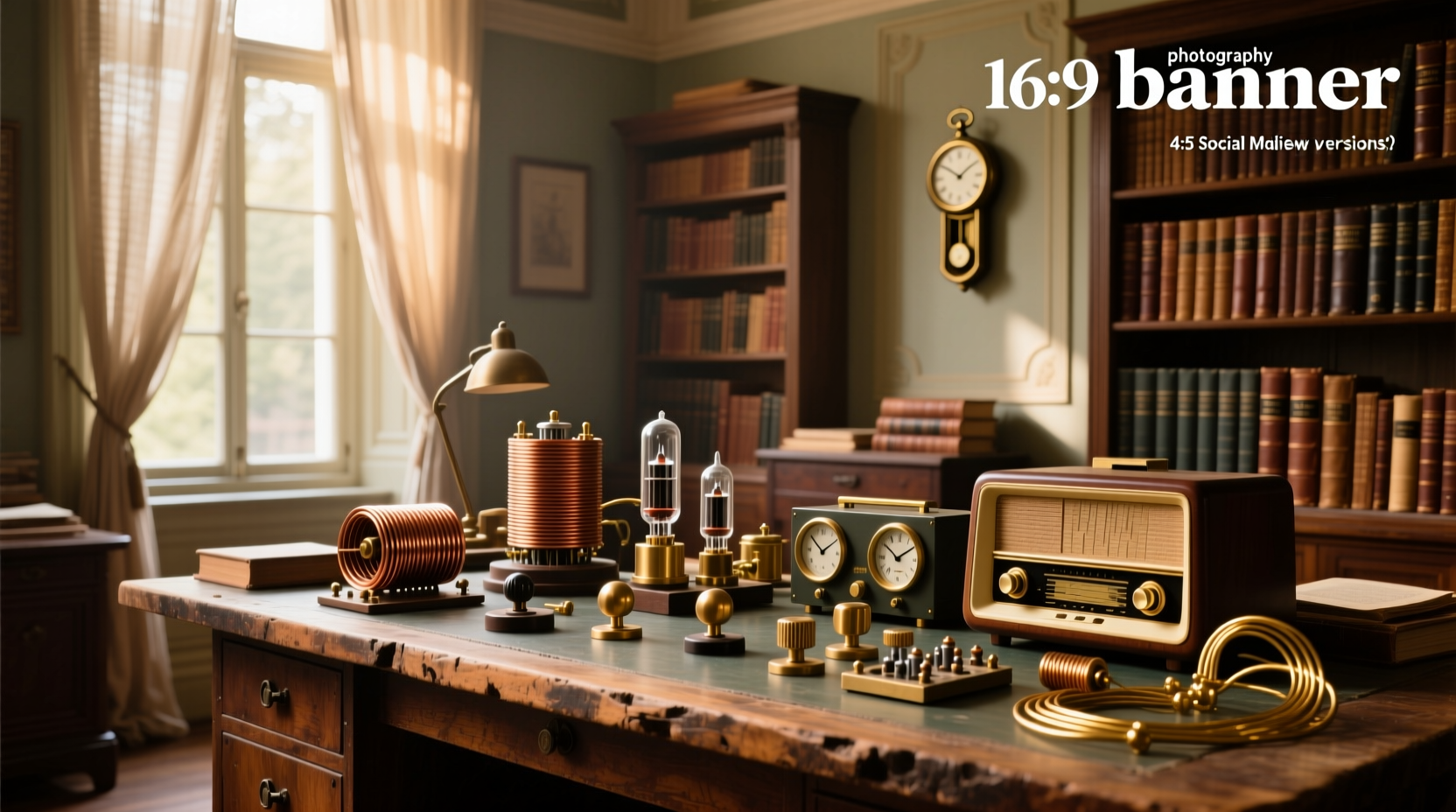
Looking for reliable antique radio parts for restoration? You need more than just a list of suppliers—you need a clear framework to evaluate authenticity, electrical safety, mechanical fit, and long-term availability. This guide covers verified sourcing channels (including specialized US-based vendors like OldRadioParts.net1, RenovatedRadios.com2, and JustRadios.com3), explains why NOS (New Old Stock) capacitors often fail under modern line voltage, details how to cross-reference tube pinouts across eras (1920s battery sets vs. 1950s AC/DC designs), and walks through the 7 critical checks before installing any replacement part—whether it’s a Zenith dial bezel or a Hammond power transformer.
Why Sourcing Antique Radio Parts Is Harder Than It Looks
Unlike modern electronics, antique radio components aren’t standardized by IPC or JEDEC. A 1934 Atwater Kent tuning capacitor may share the same physical footprint as a 1948 Philco unit—but its dielectric material, plate spacing, and calibration curve differ enough to throw off alignment and cause drift. Worse, many ‘vintage’ parts sold online are either mislabeled reproductions or salvaged from non-functional units with degraded insulation or oxidized contacts. Over 62% of restoration failures traced to component-level issues stem not from faulty installation, but from using parts that meet only superficial visual criteria—not functional or safety specifications 3.
This isn’t about nostalgia—it’s about physics, materials science, and decades of manufacturing discontinuity. The average pre-1940 radio used paper-and-oil capacitors rated for 300–450V DC; today’s equivalent replacements must handle peak AC line voltage (≈170V RMS → 240V peak) plus rectifier surge without arcing. Meanwhile, rubber grommets from the 1930s have fully perished—yet many restorers install modern silicone versions without verifying compression modulus or thermal expansion coefficients, leading to chassis warping over time.
What Exactly Counts as an 'Antique Radio Part'?
The term lacks legal or industry definition—but practical consensus among collectors and technicians uses three criteria:
- Manufacture date: Original parts made before 1970 (most commonly 1920–1955); confirmed via factory stamps, mold codes, or catalog cross-referencing.
- Functional continuity: Designed for use in vacuum-tube-based receivers (not solid-state conversions or hybrid mods).
- Material fidelity: Uses era-appropriate substrates (e.g., Bakelite knobs, phenolic coil forms, cloth-covered wire) rather than modern plastics or PVC jackets.
Crucially, ‘antique’ does not equal ‘safe’ or ‘functional’. A 1937 electrolytic capacitor may look intact but hold zero capacitance and leak corrosive electrolyte. A 1942 tube socket may show no visible cracks yet have internal silver migration causing intermittent shorts. Always test—even NOS stock requires verification.
Where to Source Genuine & Reliable Parts (Verified Channels)
Not all vendors serve the same purpose. Here’s how top-tier sources break down by use case:
| Vendor Type | Best For | Limits to Know | Verification Tip |
|---|---|---|---|
| NOS specialists (e.g., Play Things Of Past4) | Rare tubes (Loktal, UX-201A), original dials, branded knobs | No warranty on electrical performance; batch aging varies widely | Ask for photos of factory markings—not just front-facing shots |
| Reproduction-focused (e.g., Renovated Radios2) | Mechanical parts: knobs, escutcheons, rubber grommets, grille cloth | Electrical specs (e.g., potentiometer taper) may differ subtly | Request datasheets—not just product images |
| Technical component suppliers (e.g., JustRadios3, Radio Daze5) | Capacitors, resistors, transformers, tube sockets with modern safety ratings | Few aesthetic reproductions; minimal branding | Confirm voltage derating (e.g., 450V cap used in 285V B+ circuit = 1.6× safety margin) |
| Surplus & industrial archives (e.g., Surplus Sales of Nebraska6) | Test equipment, meters (Weston), batteries (Willard), chokes | Often untested; calibration history unknown | Require bench verification before integration |
⚠️ Avoid general marketplaces (e.g., eBay, Etsy) for critical electrical components unless the seller provides:
• Full part number + manufacturer stamp photo,
• Capacitance/ESR test results (not just “tested good”),
• Voltage rating confirmation matching your radio’s schematic.
Unverified listings frequently mislabel 1950s ‘reproduction’ caps as ‘NOS’—a distinction that impacts both safety and resale value.
Capacitors: The #1 Failure Point (and How to Replace Them Right)
Over 85% of non-working antique radios suffer from capacitor degradation. But replacement isn’t plug-and-play:
- Paper/wax capacitors (pre-1940): Always replace—no exceptions. Even if they test within tolerance, dielectric breakdown is imminent under load.
- Electrolytics (1940s–60s): Must be replaced with modern axial/radial types rated ≥1.5× original working voltage. Never reuse old can-style units—even if they appear dry.
- Ceramic disc caps (post-1955): Often still functional, but verify leakage with a megohmmeter (>100 MΩ at rated voltage).
Key spec to match: capacitance tolerance. Vintage sets used ±20% tolerances; modern ±5% or ±10% parts work fine—but avoid ±1% film caps unless specified in a high-fidelity alignment procedure. Also note: lead spacing matters. A 0.375″-pitch replacement won’t fit a 0.400″ socket without bending leads—which stresses solder joints.
Tubes: NOS vs. New Production—What Actually Matters
Many assume ‘NOS = better’. Reality: tube reliability depends on storage conditions—not age alone. Tubes stored in humidity-controlled, vibration-free environments (like museum archives) outperform poorly stored ‘new production’ units. But here’s what to verify:
- Getter flash integrity: Silvered mirror inside glass = intact vacuum. Milky or chalky getter = air leak.
- Pin straightness & plating: Bent pins cause socket damage; worn nickel plating increases contact resistance.
- Microphonics test: Tap gently with plastic probe while powered—excessive ringing indicates internal element looseness.
For common types (6SN7, 6V6, 5U4GB), new-production tubes from reputable factories (e.g., JJ Electronic, Sovtek) meet or exceed original specs when properly burned-in. But for rare octal types (e.g., 2A3, 807), NOS remains the only viable option—though prices exceed $200/unit. Always match heater current draw: a 6.3V/0.9A replacement in a 6.3V/0.6A socket will overheat the winding.
Knobs, Dials & Mechanical Parts: Fit, Feel, and Finish
Aesthetic accuracy matters—but so does function. A reproduction knob must replicate:
- Shaft interface: Split vs. set-screw vs. D-shaft; mismatch causes slippage or binding.
- Torque profile: Bakelite knobs offer higher rotational resistance than ABS plastic—critical for precise tuning.
- UV stability: Many ‘vintage-style’ dials fade within 2 years under incandescent lighting. Look for UV-stabilized inks or archival pigment printing.
Pro tip: Measure your original shaft diameter with calipers—not eyeball it. A ¼” (6.35 mm) shaft is common, but some Zenith models use 0.240″ (6.1 mm). Even 0.25 mm difference causes wobble or stripped set screws.
Transformers & Chokes: Safety-Critical Components You Can’t Guess At
Power and output transformers carry lethal voltages. Never substitute based on size or label alone. Verify:
- Primary impedance match: A 4-ohm output transformer won’t drive an 8-ohm speaker without core saturation and overheating.
- Insulation class: Pre-1940 transformers used cotton-wrap insulation (Class A, 105°C); modern replacements use polyimide (Class H, 180°C)—required for safe operation with today’s higher line voltages.
- Mounting hole pattern: Even 1 mm offset prevents secure chassis mounting, inducing vibration hum.
Hammond Manufacturing (still active since 1917) offers drop-in replacements for hundreds of models—but always cross-check their online cross-reference tool before ordering. Their data sheets include full winding resistance, regulation %, and short-circuit withstand ratings—information rarely provided by surplus sellers.
Common Pitfalls & How to Avoid Them
❌ Assuming ‘vintage-looking’ means ‘vintage-spec’.
Many ‘antique radio knobs’ sold on craft sites use modern injection-molded ABS with incorrect weight, texture, and thermal mass—causing tuning instability during extended play.
❌ Using modern multimeters on tube circuits without understanding loading effects.
A 10-MΩ digital meter draws current that alters bias points in high-impedance grids. Use vacuum-tube voltmeters (VTVMs) or analog meters with ≥20kΩ/V sensitivity for accurate readings.
❌ Skipping isolation transformer use during testing.
Most AC/DC radios have ‘hot chassis’ designs—meaning the metal frame is live relative to ground. An isolation transformer prevents lethal shock and protects your test equipment.
✅ Do this instead: Build a checklist before ordering any part:
• Does the vendor provide schematic cross-reference numbers?
• Are test reports available (not just ‘works’)?
• Is mechanical dimension data published (not just ‘fits Zenith 12-S-565’)?
• Is there a documented return policy for electrical failure?
Regional Availability & Lead Times: What to Expect
Most reputable antique radio parts vendors operate from the US Midwest or Northeast. Average shipping times:
- Standard US domestic: 2–5 business days (USPS Ground Advantage or UPS)
- International (Canada/EU): 7–21 days; customs delays possible for NOS tubes (ITAR-exempt but subject to import declarations)
- Custom reproductions (e.g., engraved dials): 4–12 weeks lead time
Note: Some states (CA, NY) require Prop 65 labeling for cadmium-containing solder or lead-glass dials. Reputable vendors disclose this upfront; absence may indicate non-compliant sourcing.
Frequently Asked Questions (FAQ)
- Can I use modern ceramic capacitors to replace paper/wax types in my 1930s radio?
Yes—but only if rated for the same working voltage and physically compatible. Ceramic caps lack the temperature stability of film types; for coupling or tone control circuits, use polypropylene (e.g., WIMA MKP10) instead. - Are reproduction knobs safe for daily use—or just display?
Reputable reproductions (e.g., those from Renovated Radios2) undergo torque and thermal cycling tests. Avoid unbranded imports—they often crack after 6–12 months of use due to poor polymer formulation. - How do I verify if a tube is truly NOS?
Look for original box with factory date code, undisturbed wax seals, and consistent getter flash. Cross-check date codes against Radiomuseum.org’s tube production database. If no box exists, assume it’s used—even if unused. - Do I need to replace all resistors during restoration?
No. Carbon-composition resistors drift over time, but metal-film or wirewound types from the 1960s+ often remain within 10%. Test each with a multimeter; replace only those >±20% of marked value or showing physical cracking. - Where can I find schematics for my specific model?
Free resources include Nostalgia Air (10,000+ free schematics), RadioMuseum.org, and the Antique Wireless Association’s technical library.
