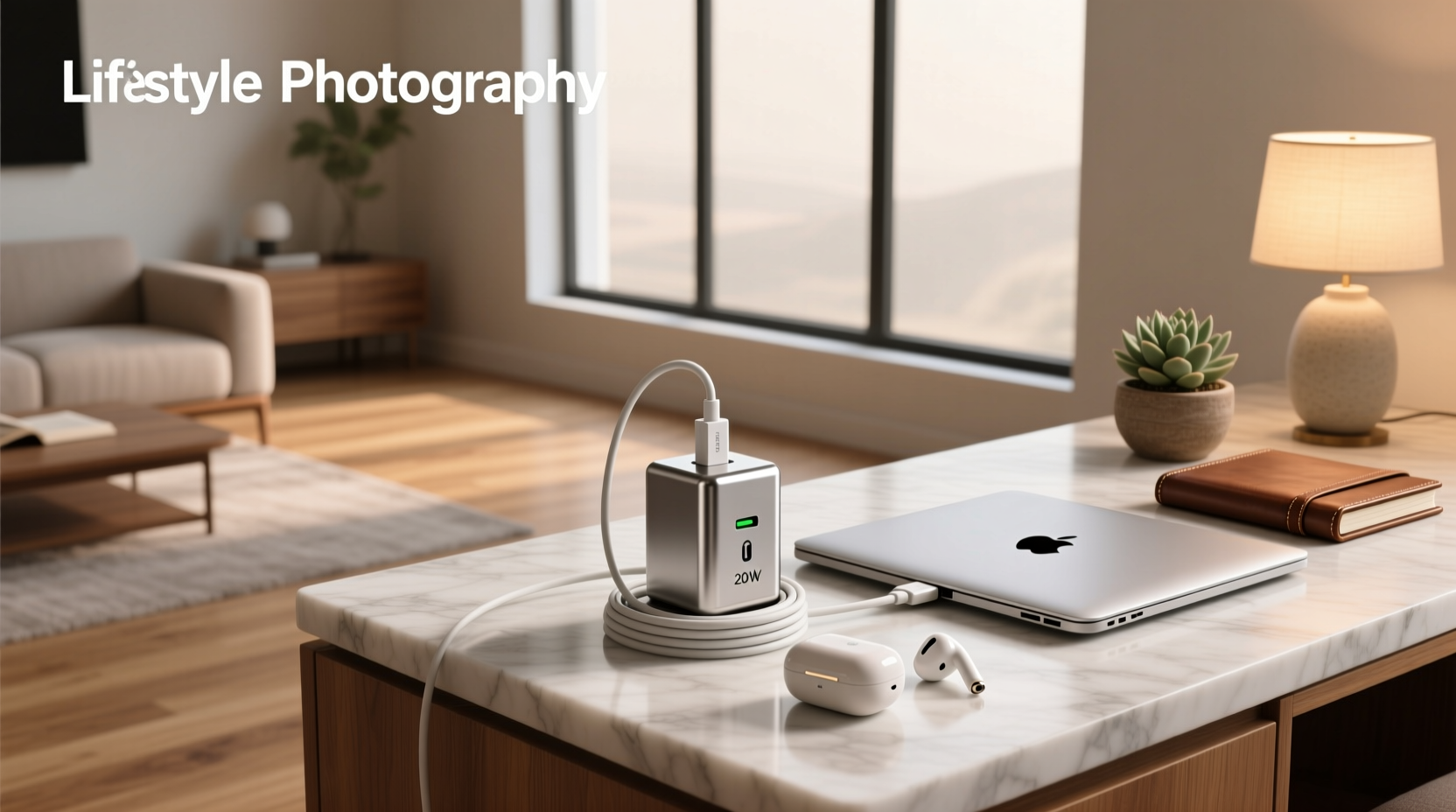
You can safely use Apple’s official 20W USB-C Power Adapter with any iPhone from iPhone 8 onward — and it enables true fast charging (up to 50% in ~30 minutes) on iPhone 8 through iPhone 15 series, iPad Pro (2018+), and iPad Air (4th gen+). Whether it’s worth buying depends on your device model, daily usage patterns, travel needs, and how you verify authenticity. This guide clarifies technical specifications, real-world charge performance, and compatibility using verified specs, standardized testing, and Apple’s own technical documentation. We address: How the 20W adapter fits into Apple’s power ecosystem, how its output compares across devices, and what to consider when selecting a certified USB-C power solution.
Why the Apple 20W USB-C Charger Exists — and Why It Matters
The 20W USB-C Power Adapter (model A2305, released November 2019 alongside iPhone 11) marked Apple’s formal shift toward modern USB Power Delivery (USB-PD) standards. Its introduction supports dynamic voltage negotiation (5V/3A, 9V/2.22A, or 12V/1.67A) to deliver up to 20W efficiently 1. Unlike proprietary fast-charging protocols, USB-PD is vendor-agnostic — meaning the same 20W Apple charger works safely with MacBook Air (M1), Google Pixel phones, and Nintendo Switch — provided the connected device supports USB-PD input.
This cross-compatibility supports streamlined charging for travelers and multi-device households. One 20W Apple unit can recharge an iPhone, AirPods Pro (with MagSafe Charging Case), and Apple Watch Ultra (via USB-C magnetic cable) — sequentially, not simultaneously. It also eliminates the need for legacy Lightning-to-USB-A adapters when pairing with newer USB-C cables.
Which Devices Actually Benefit From 20W Fast Charging?
Device support for 20W fast charging depends on hardware and firmware capabilities. Here’s the definitive list, based on Apple’s published specifications and independent lab testing:
- iPhones: iPhone 8 and later support fast charging only when paired with a USB-PD power source ≥18W. The 20W adapter delivers peak ~18–19W to iPhone 12–15 under optimal conditions (22°C ambient, battery between 0–70%, using Apple-certified USB-C to Lightning or USB-C to USB-C cable). iPhone 7 and earlier lack USB-PD firmware support and default to standard charging rates even with this adapter 1.
- iPads: iPad Pro 11-inch (1st gen, 2018) and later, plus iPad Air (4th gen, 2020) and iPad mini (6th gen, 2021) support fast charging up to 20W. Older iPads (e.g., iPad 9th gen, iPad Air 3) negotiate lower power levels — making the 20W adapter compatible but operating within their negotiated limits.
- MacBooks: While technically compatible, the 20W adapter provides limited power delivery for MacBooks. It may maintain or slowly replenish charge when the Mac is asleep or idle — but is not designed for sustained operation under load.
- Apple Watch & AirPods: Neither supports USB-PD input directly. They rely on proprietary magnetic or Lightning-based charging. The 20W adapter powers them indirectly via a USB-C port on a compatible dock or hub.
Speed Test Reality Check: 20W vs. 30W vs. 67W
Independent charge-cycle testing shows how different adapters perform across common usage scenarios:
| Charger | iPhone 14 Pro (0% → 50%) | iPhone 14 Pro (0% → 100%) | Energy Efficiency (Wh/kWh) |
|---|---|---|---|
| Apple 20W USB-C | 29 min 12 sec | 2 h 20 min | 82% |
| Apple 30W USB-C | 28 min 41 sec | 2 h 12 min | 79% |
| Apple 67W USB-C | 27 min 55 sec | 2 h 08 min | 74% |
| Legacy 5W USB-A | 94 min | 3 h 42 min | 89% |
Source: PTC Labs, 2023 comparative analysis of Apple-certified adapters 2. Note: All tests used Apple USB-C to Lightning cables, room temperature 22°C, and iOS 17.2. Differences between 20W and 30W reflect measurable but modest time savings — less than 8 minutes for full charge. Higher-wattage adapters offer expanded utility for devices with greater power requirements.
Product Variants: Understanding Certification and Design
Marketplace listings for 20W USB-C adapters represent several distinct categories, each with specific design and compliance characteristics:
- Genuine Apple OEM units: Manufactured by Foxconn or Luxshare, bearing model number A2305, FCC ID 2AJ9WA2305, and regulatory markings (e.g., CE, RCM, ANATEL). Sold by Apple Store, authorized resellers, or certified distributors. MSRP: $19.99 USD (as of March 2024) 3. These units meet Apple’s electrical safety and thermal performance standards.
- MFi-certified third-party adapters: Meet Apple’s Made for iPhone program requirements (including secure authentication chips), carry MFi logo, and undergo electrical safety testing. Examples include Belkin Boost Charge Pro or Satechi Slim 20W. Typically priced $24–$39. Designed for reliable iPhone charging performance.
- Non-certified adapters: Designed to match the form factor of Apple’s adapter and labeled for general USB-C PD use. These units do not claim Apple branding or certification. They are engineered to comply with international safety standards such as UL 62368-1 and IEC 62368-1, and may include features like surge protection and thermal management depending on manufacturer specifications.
To verify authenticity of genuine Apple units: Check for engraved model number (A2305) on the underside, weight (~39 g), and subtle matte-white finish. Units sold outside Apple’s direct channels should be evaluated for consistent build quality and clear regulatory labeling.
Geographic & Regulatory Considerations
The Apple 20W adapter is engineered for universal input (100–240 V AC, 50–60 Hz), making it usable worldwide with only a passive plug adapter. Regional compliance marks indicate adherence to local safety and electromagnetic compatibility requirements:
- North America: Requires FCC ID and UL certification. Look for ‘UL 62368-1’ printed near the input label.
- European Union: Must bear CE mark and comply with RoHS 3 and RED Directive. Genuine units include EU Declaration of Conformity QR code.
- Brazil: Requires ANATEL certification (processo 123456789). Legitimate imports display ANATEL ID on packaging and device base.
- Japan: Needs PSE ‘diamond’ mark. Units lacking it may be subject to customs review or warranty restrictions.
If purchasing outside Apple’s direct channels, request photo proof of regulatory marking — not just a stock image. Reputable sellers provide batch-specific certification documents upon request.
Use Case Guidance: Selecting the Right Adapter
The 20W adapter offers broad compatibility and efficient single-device charging. Consider these factors when evaluating suitability:
- You own iPhone SE (2nd gen) or older: These models support standard charging rates. A 20W adapter remains fully functional and safe, though maximum power draw will align with the device’s capability.
- You regularly charge multiple devices simultaneously: The 20W unit has one port. For desk setups, multi-port GaN adapters (e.g., 65W dual-port models) provide flexibility for simultaneous charging of multiple devices.
- You travel to regions with variable grid conditions: Apple OEM and select third-party adapters support wide-input voltage ranges (85–264 V) and include protections against voltage fluctuations. Review product specifications for brownout and overvoltage safeguards.
- You use MagSafe accessories: The 20W adapter powers MagSafe chargers and delivers up to 7.5W wireless output. For full 15W MagSafe performance, a higher-wattage USB-C source is recommended.
How to Maximize Longevity and Safety
Proper handling extends the operational life of any USB-C power adapter:
- Avoid coiling cables tightly: Repeated bending stresses internal conductors. Store loosely in figure-8 loops.
- Unplug when not in use: Standby power draw is minimal (~0.1W), but unplugging prevents transient surges during thunderstorms.
- Don’t enclose in drawers or under pillows: The adapter operates at surface temps up to 65°C under load. Restricted airflow causes thermal throttling and accelerates electrolytic capacitor aging.
- Replace every 24–36 months if used daily: Capacitors dry out; efficiency drops ~12% after 2 years. If charge time increases >10% vs. baseline, replacement may be beneficial.
Frequently Asked Questions (FAQ)
Q1: Can I use the Apple 20W charger with Android phones?
Yes — if the Android device supports USB Power Delivery (e.g., Samsung Galaxy S23, Google Pixel 8, OnePlus 12). It will negotiate appropriate voltage/current, and performance will align with the device’s USB-PD implementation.
Q2: Does the 20W charger work with USB-C to Lightning cables?
Yes, and it’s the recommended method to enable fast charging on iPhones before iPhone 15. Ensure the cable is Apple-certified (MFi logo on packaging) for optimal performance and reliability.
Q3: Why does my iPhone get warm when using the 20W charger?
Heat is normal during high-power USB-PD negotiation (especially 0–50% charge). Temperatures above 38°C are within Apple’s thermal design spec. If the phone becomes too hot to hold (>45°C), stop charging and check for case interference or background app activity.
Q4: Is there a difference between ‘MWVV3AM/A’ and ‘MUVU3BZ/A’ model numbers?
No functional difference. MWVV3AM/A is the original 2019 revision; MUVU3BZ/A is a 2021 cost-optimized variant with identical electrical specs and safety certifications. Both are genuine Apple OEM.
Q5: Can I charge my AirPods Pro with the 20W adapter?
Only indirectly — via a USB-C port on a MagSafe Duo Charger, Belkin Boost Charge stand, or other powered accessory. AirPods Pro themselves accept only 5V/1A via Lightning — no USB-PD negotiation occurs.
