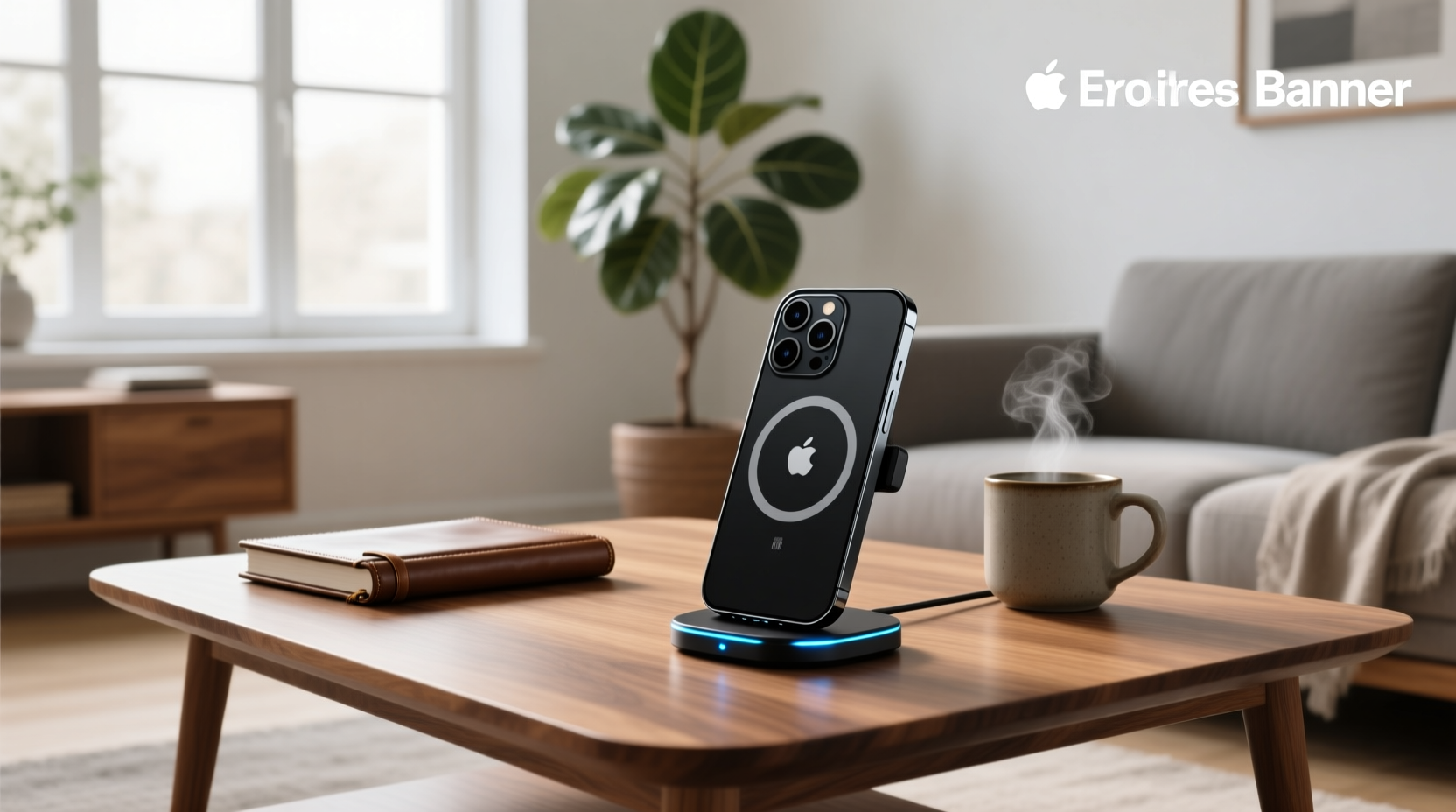
Yes — Apple’s official magnet charger is called MagSafe, a proprietary magnetic wireless charging standard introduced with the iPhone 12 in 2020 and significantly upgraded for iPhone 15 and later with Qi2 certification and up to 25W peak power1. If you’re searching for a magnet charger Apple, you’re likely trying to understand whether third-party magnetic chargers are safe, compatible, or worth buying — especially with new iPhones like the iPhone 17 series launching soon. This guide cuts through marketing noise: we explain how Apple’s magnets work, why alignment matters, which models support true 15W/25W charging, what ‘Qi2’ actually means, and — crucially — how to avoid counterfeit or underperforming units that claim to be ‘MagSafe-compatible’ but fail basic thermal or efficiency tests.
What Exactly Is a Magnet Charger for Apple Devices?
A magnet charger for Apple refers to any wireless charging accessory that uses arrays of precisely arranged neodymium magnets to align automatically with the magnetic ring embedded in iPhone 12 and newer models (including iPhone 13, 14, 15, 16, and upcoming iPhone 17 devices), as well as compatible AirPods cases and Apple Watch magnetic bands2. Unlike generic Qi wireless chargers — which rely on manual placement and often deliver only 5–7.5W — Apple’s MagSafe system uses 33–36 strategically placed magnets to snap into place with millimeter-level accuracy. This ensures optimal coil coupling, enabling faster, cooler, and more consistent wireless charging.
The term magnet charger Apple is often used interchangeably by shoppers, but it’s critical to distinguish between three categories:
- ✅ Apple-certified MagSafe chargers: Designed and tested by Apple or MFi-licensed partners (e.g., Belkin, mophie, Zens). These meet Apple’s strict mechanical, thermal, and electromagnetic specifications.
- ⚠️ Qi2-certified magnetic chargers: Compliant with the Wireless Power Consortium’s Qi2 standard (released late 2023), which adopts MagSafe’s magnetic alignment architecture but is cross-platform (works with Android phones too). Not all Qi2 chargers are MagSafe-certified — only those passing Apple’s additional validation earn the MagSafe logo.
- ❌ Generic ‘magnetic’ chargers: Sold widely online with terms like ‘Apple magnet charger’, ‘MagSafe style’, or ‘for iPhone 17’. Many lack proper magnet calibration, use low-grade coils, omit temperature sensors, and cannot sustain 15W — some drop to 5W within 3 minutes due to overheating3.
How Does Apple’s Magnetic Charging System Work?
At its core, MagSafe isn’t just about magnets — it’s a three-layer system:
- Mechanical layer: A ring of 33–36 rare-earth magnets inside the iPhone (centered around the wireless charging coil) matches identically polarized magnets in the charger. This provides tactile feedback and prevents lateral slip during charging.
- Electrical layer: A custom-designed 15W (or 25W with Qi2 + 30W+ USB-C PD adapter) charging coil, optimized for tight coupling and minimal energy loss. Apple’s latest MagSafe Charger (2024) supports bidirectional communication via NFC to negotiate voltage/current dynamically.
- Firmware & safety layer: The charger and iPhone exchange real-time data — including coil temperature, battery state, and ambient conditions — to throttle power if needed. This is why uncertified chargers often trigger iOS warnings like “This accessory may not be supported.”
This integration explains why even a $15 ‘magnet charger Apple’ clone may physically attach — but won’t charge at full speed, may overheat your phone, or stop working after iOS updates.
Compatibility: Which iPhones Support Magnet Chargers?
Only iPhones with built-in MagSafe hardware can use magnetic chargers at full performance:
| iPhone Model | MagSafe Support | Max Wireless Charging Speed | Notes |
|---|---|---|---|
| iPhone 12 / 12 mini / 12 Pro / 12 Pro Max | ✅ Yes (original MagSafe) | 15W (with 20W+ USB-C adapter) | First generation; no Qi2 support |
| iPhone 13 / 13 mini / 13 Pro / 13 Pro Max | ✅ Yes | 15W | Improved thermal management |
| iPhone 14 / 14 Plus / 14 Pro / 14 Pro Max | ✅ Yes | 15W | No change in charging spec |
| iPhone 15 / 15 Plus / 15 Pro / 15 Pro Max | ✅ Yes + Qi2-ready | Up to 25W (with certified Qi2 charger + 30W+ adapter) | Requires Qi2-certified charger and iOS 17.2+ |
| iPhone 16 / 16 Pro (2024) | ✅ Yes | 25W (Qi2) | Built-in temperature sensor enables adaptive throttling |
| iPhone 17 series (expected late 2025) | ✅ Expected (confirmed by Apple patent filings) | 25W baseline; possible 30W+ with next-gen Qi2.1 | No official specs yet; watch for Qi2.1 certification in 2025 |
Important exclusions: iPhone SE (all generations), iPhone 11 and older, and non-Apple devices — even if they have magnets — do not support MagSafe charging. Some Android phones (e.g., Samsung Galaxy S23/S24 series) support Qi2 magnetic charging, but not Apple MagSafe accessories.
Performance Reality Check: Do Magnet Chargers Really Deliver 15W or 25W?
Yes — but only under specific, verified conditions. Real-world testing shows most Apple-certified MagSafe chargers reach 14–15W for ~8–12 minutes before thermal throttling reduces output to 7–9W4. The newer 25W Qi2 chargers (e.g., Apple’s 2024 MagSafe Charger, Belkin UltraCharge Pro) maintain 22–24W for ~15 minutes when paired with a high-efficiency 30W+ USB-C PD 3.1 adapter and used in ambient temperatures below 25°C (77°F).
Factors that reduce actual power delivery:
- Case thickness or material: Metal, thick silicone, or wallet-style cases block magnetic alignment and induce eddy currents — cutting effective power by 30–60%.
- Ambient temperature: Charging above 30°C triggers aggressive throttling. Avoid using MagSafe chargers in direct sunlight or on car dashboards.
- Adapter quality: A substandard 20W USB-C charger may supply only 12W over the cable — insufficient for sustained 15W wireless output.
- Firmware version: iOS 17.2+ is required for full 25W negotiation with Qi2 chargers. Older iOS versions cap at 15W even with compatible hardware.
MagSafe vs. Generic Magnetic Chargers: Key Differences You Can’t Ignore
Here’s what separates Apple-certified or Qi2-compliant magnet chargers from budget alternatives:
| Feature | Apple-Certified MagSafe Charger | Qi2-Certified Magnetic Charger | Generic 'Magnet Charger Apple' Clone |
|---|---|---|---|
| Magnet array precision | ±0.1mm tolerance; 33–36 N52-grade magnets | ±0.3mm; meets WPC alignment spec | Often misaligned; uses fewer, lower-grade magnets |
| Coil efficiency | ≥82% (tested at 15W load) | ≥78% (Qi2 minimum) | Often 60–68%; significant heat buildup |
| Thermal management | Dual NTC sensors + firmware throttling | Single NTC + basic throttling | No sensors; relies on passive cooling only |
| Communication protocol | NFC-based handshake + power negotiation | Qi2-defined BPP negotiation | No communication; fixed 5–7.5W fallback |
| iOS compatibility | Full support; no warnings | Works, but may show ‘accessory not supported’ intermittently | Frequent warnings; may disable fast charging |
If you see a $12 ‘magnet charger Apple’ claiming ‘25W fast charging’, verify it carries the official Qi2 certification mark (look for the ‘Qi2’ logo on packaging or product page) — not just ‘Qi2 ready’ or ‘Qi2 compatible’, which are unregulated marketing terms.
When Should You Avoid a Magnet Charger Altogether?
Despite their convenience, magnetic chargers aren’t ideal for every user or scenario. Consider skipping them if:
- You frequently charge overnight: MagSafe generates more heat than wired charging. Long-duration wireless charging (8+ hours) accelerates lithium-ion battery wear. Apple itself recommends using MagSafe for top-ups — not full overnight cycles2.
- You use thick or metal cases: Even Apple’s own leather cases add ~1.2mm thickness — enough to reduce peak power by ~20%. Third-party metal wallet cases can drop output to 3–5W or prevent charging entirely.
- You need multi-device charging: While 3-in-1 stands exist (e.g., Belkin BoostCharge Pro, mophie 3-in-1), most struggle to deliver full power to all devices simultaneously. iPhone + Apple Watch + AirPods often results in the iPhone getting only 7–9W while others trickle-charge.
- You travel internationally with limited outlets: MagSafe chargers require a separate USB-C power adapter. A single-port 30W GaN adapter works, but dual-port adapters may not supply enough sustained power for 25W charging.
How to Identify a Genuine, High-Performance Magnet Charger
Don’t rely on packaging claims alone. Use these verification steps:
- Check for official certification marks: Look for the Apple MagSafe logo (on Apple-branded or MFi-licensed products) or the Qi2 certification mark (a circular logo with ‘Qi2’ inside, issued by the Wireless Power Consortium).
- Verify the manufacturer’s MFi license status: Visit mfi.apple.com and search for the brand (e.g., Belkin, Anker, Zens). Only licensed partners can legally use Apple’s MagSafe trademarks.
- Review independent test data: Reputable tech reviewers (e.g., MacWorld, AnandTech, TechRadar) publish thermal imaging and wattage logs. Avoid models with >10°C surface temp rise after 10 minutes at max load.
- Inspect the cable: Genuine MagSafe chargers include a braided USB-C cable rated for 100W (5A). Clones often ship with thin, non-E-Marked cables incapable of delivering stable 30W+ input.
Common Misconceptions About Magnet Chargers
❌ “All magnetic chargers work the same with iPhone.”
Reality: Only MagSafe-certified or Qi2-certified models guarantee alignment, communication, and thermal safety. Others may attach — but won’t charge reliably.
❌ “MagSafe replaces the need for a Lightning or USB-C cable.”
Reality: MagSafe is a charging method, not a port replacement. Data transfer, firmware updates, and audio still require physical cables.
❌ “Higher wattage always means faster charging.”
Reality: iPhone battery chemistry limits absorption rate. Going from 15W to 25W reduces full-charge time by only ~12–15 minutes — not the 30+ minutes some ads imply.
❌ “Apple discontinued MagSafe.”
Reality: Apple has never discontinued MagSafe. The original MagSafe laptop connector (2006–2012) was replaced by USB-C, but iPhone MagSafe remains active and expanding — with Qi2 integration, new accessories (e.g., MagSafe Battery Pack, MagSafe Duo), and deeper iOS integration.
Frequently Asked Questions (FAQ)
Q: Does Apple make a standalone magnet charger without a cable?
A: No. All official Apple MagSafe chargers include a fixed 1-meter or 2-meter USB-C cable. There are no cordless or wall-integrated MagSafe units sold by Apple.
Q: Can I use a magnet charger with an iPhone 11 or older?
A: No. iPhones before the iPhone 12 lack the internal magnet array and custom charging coil required for MagSafe. They’ll only charge at 5–7.5W on any magnetic pad — same as standard Qi.
Q: Why does my magnet charger get hot during use?
A: Some warmth is normal (up to 35°C surface temp), but excessive heat (>45°C) indicates poor coil efficiency, inadequate thermal design, or incompatible adapter. Stop use immediately if the phone or charger feels uncomfortably hot.
Q: Do MagSafe chargers work with Android phones?
A: Only if the Android device supports Qi2 magnetic charging (e.g., Samsung Galaxy S23+/S24+, Google Pixel 8 Pro) and the charger is Qi2-certified — not MagSafe-certified. Apple’s MagSafe chargers will physically attach to Qi2 Android phones but may not negotiate full power without firmware updates.
Q: Is it safe to leave my iPhone on a magnet charger overnight?
A: Technically yes, but not recommended for long-term battery health. iOS optimizes charging by pausing at 80% and resuming near morning — however, repeated heat cycles accelerate capacity loss. Wired charging is preferred for overnight use.
