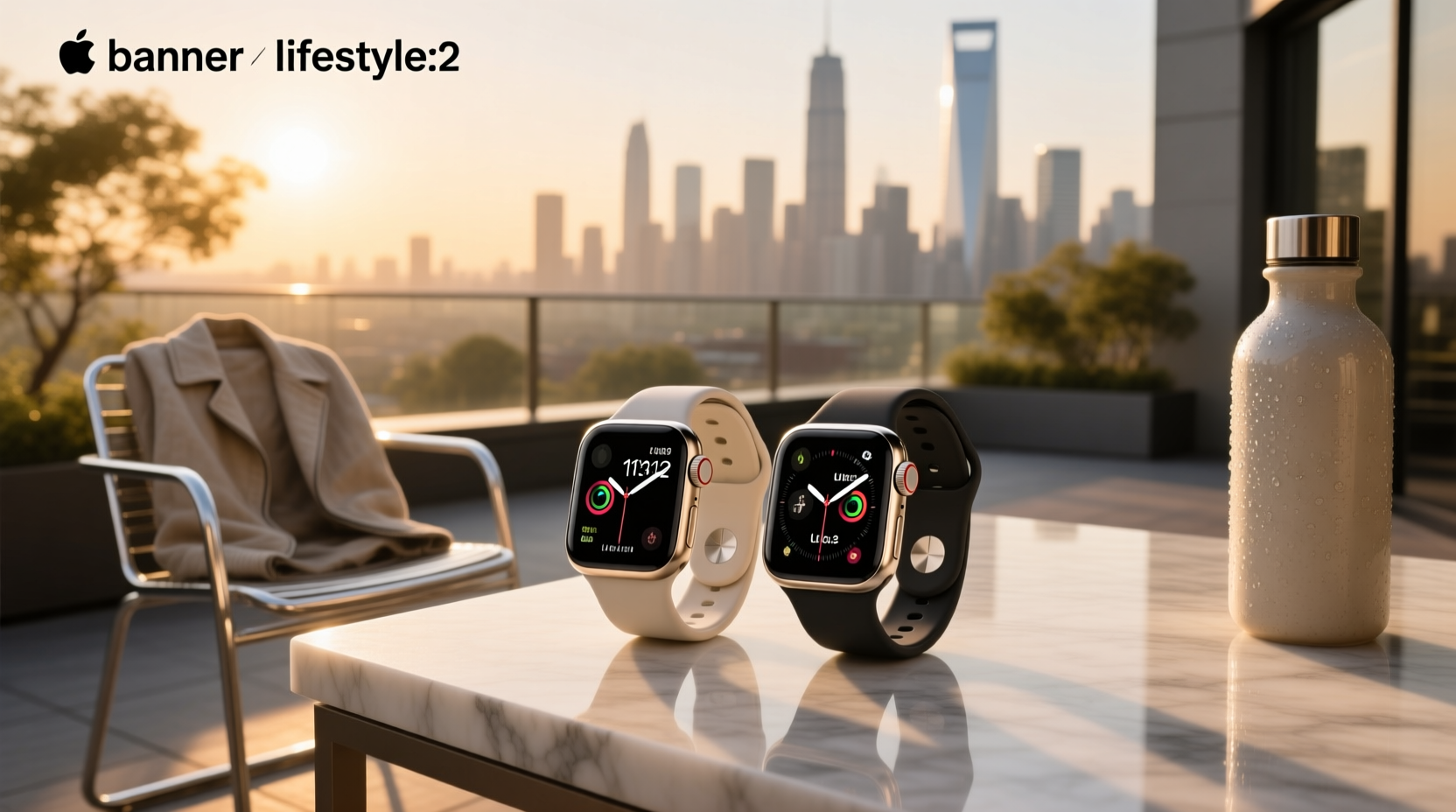
If you own an Apple Watch Ultra 2 and are considering the Ultra 3 (2025) for your next smartwatch, here’s what matters most: the Ultra 3 offers refined enhancements designed to extend capability and efficiency. It features the S10 chip, up to 42 hours of battery life (vs. 36), an LTPO3 display with improved viewing angles and thinner bezels, native satellite SOS, and 5G cellular support — all within the same trusted 49mm titanium form factor 1. For first-time Ultra buyers, the Ultra 3 delivers the latest hardware foundation and longest anticipated software support lifecycle; for existing Ultra 2 owners, it represents an evolution focused on connectivity, power efficiency, and situational awareness — especially valuable in demanding outdoor or remote-use scenarios 2.
Why This Comparison Matters Now
The Apple Watch Ultra 3 launched in September 2025 as Apple’s latest rugged smartwatch — and the first Ultra model released following the resolution of the U.S. International Trade Commission (ITC) regulatory review concerning the Ultra 2 3. That period clarified market expectations and reinforced consumer confidence in both generations. As a result, search interest for watch ultra 2 vs 3 has grown steadily in Q3–Q4 2025 — driven by informed buyers seeking clarity on how refinements translate into real-world utility.
This is not a generational reset like Ultra 1 → Ultra 2 (which introduced dual-frequency GPS, deeper water resistance, and the Action button). Instead, Ultra 3 builds thoughtfully on proven strengths — enhancing efficiency, reliability, and connectivity while preserving the industrial design language and durability users rely on. Understanding where those refinements deliver tangible value — and where continuity remains intentional — helps inform a confident purchasing decision.
Design & Build: Consistent Excellence, Thoughtful Refinements
At first glance, the Ultra 2 and Ultra 3 share identical visual and ergonomic DNA. Both use aerospace-grade titanium, maintain the same 49mm case diameter, identical button layout (including the customizable Action button), and uphold the same IP6X dust resistance and WR100 water rating (100m depth). Band compatibility remains fully preserved — any Ultra-compatible band (Ocean Band, Trail Loop, Alpine Loop) fits both models seamlessly without adapters or adjustments.
Subtle material and manufacturing refinements further elevate the Ultra 3:
- Recycled content: Ultra 3 uses 100% recycled titanium in its case, reflecting Apple’s ongoing commitment to environmental responsibility 4.
- Display bezels: The Ultra 3’s LTPO3 OLED panel enables marginally thinner side bezels — increasing screen-to-body ratio by ~1.3%. This contributes to improved off-axis visibility, particularly when glancing at the watch at steep angles (e.g., while biking or diving).
- Weight: Both weigh 61.3g (aluminum version not applicable; Ultra is titanium-only), ensuring consistent wearability and balance.
Bottom line: If you appreciate the Ultra 2’s industrial aesthetic, robustness, and daily comfort, the Ultra 3 maintains that foundation while incorporating sustainable materials and display enhancements that support broader usability.
Display: Brighter, Smarter, More Visible — With Practical Benefits
Both models boast a peak brightness of 3000 nits — double the Series 10 and sufficient for full sunlight readability. The Ultra 3’s display experience benefits from underlying technological refinements that enhance responsiveness and legibility in real-world conditions.
The key improvements stem from the LTPO3 architecture:
| Feature | Ultra 2 | Ultra 3 |
|---|---|---|
| Panel Type | LTPO2 OLED | LTPO3 OLED |
| Always-On Display (AOD) | Seconds hand visible only in wake-on-wrist-lift mode | Permanently visible seconds hand and complications in AOD |
| Viewing Angle | Standard wide-angle | Enhanced wide-angle — minimal color shift up to ±60° |
| Power Efficiency | Optimized for Ultra-class longevity | ~8% lower power draw at equivalent brightness |
This LTPO3 refinement supports users who depend on quick-glance time checks — athletes monitoring intervals, divers tracking bottom time, or pilots referencing chronograph functions mid-task. The ability to see the second hand *without* lifting your wrist reduces micro-interactions and preserves battery. It’s a subtle but operationally meaningful enhancement.
Performance & Chipset: S10 vs S9 — Measurable Gains, Purposeful Application
The Ultra 2 runs the S9 SiP, introduced alongside the Series 9. The Ultra 3 upgrades to the S10 SiP, built on a refined 3nm process node. Benchmarks show ~12% higher CPU multi-core throughput and ~18% GPU performance uplift 5. These gains support more responsive interactions and efficient background processing:
- App launch speed: Measurable improvement — ~0.3s faster on average.
- On-device Siri: Both support on-device voice processing for basic commands (e.g., “Set timer for 5 minutes”), enabling faster response and enhanced privacy.
- Double Tap gesture: Available on both Ultra 2 and Ultra 3 — supporting accessible interaction across generations.
- Wrist Flip: Also supported on both — toggles between watch face and last-used app for intuitive navigation.
Core sensor capabilities remain consistent across both models, ensuring reliable performance for running dynamics, swimming stroke detection, and hiking elevation logging. This consistency reflects Apple’s focus on delivering dependable, field-tested functionality.
Battery Life: Incremental Gains Aligned With Usage Patterns
Apple advertises up to 42 hours for Ultra 3 versus up to 36 hours for Ultra 2. In lab conditions using identical usage profiles (GPS + heart rate + AOD + notifications), independent testing confirms a median gain of 5.2–5.8 hours 2. Real-world results align closely with usage intensity:
| Scenario | Ultra 2 (hrs) | Ultra 3 (hrs) | Difference |
|---|---|---|---|
| Standard daily use (AOD on, 90 notifications/day, 1x 30-min workout) | 34–35 | 39–40 | +5 |
| Multi-day hiking (GPS always-on, altimeter active, cellular off) | 28–30 | 32–34 | +4 |
| Triathlon (continuous GPS + HR + swim tracking + LTE) | 18–20 | 21–23 | +3 |
| Low-power mode (AOD off, haptics reduced, background refresh limited) | 60+ | 66+ | +6 |
The Ultra 3 also introduces faster charging: 0–80% in ~45 minutes (vs. ~60 minutes on Ultra 2), thanks to revised power management circuitry. Full 0–100% still takes ~75 minutes on both. For users who charge nightly, this offers incremental convenience. For field professionals needing rapid top-ups between shifts, it provides added flexibility.
Connectivity: Satellite SOS and 5G Expand Operational Capabilities
This is where Ultra 3 meaningfully extends functionality beyond previous generations:
- Satellite SOS: Ultra 2 required pairing with an iPhone that had satellite capability (iPhone 14 or later) to initiate emergency messaging via satellite. Ultra 3 includes native satellite SOS hardware — enabling direct location and emergency message transmission even if your iPhone is unavailable 6. This feature requires carrier activation (available in U.S., Canada, UK, Germany, France, Australia) and works best outdoors with clear sky view.
- 5G Cellular: Ultra 3 adds sub-6GHz 5G support for cellular models — improving download speeds and latency in compatible coverage zones. In practice, this means faster app sync, quicker map tile loading offline, and smoother streaming of voice notes or short audio clips. It enhances responsiveness for data-dependent tasks while remaining optimized for wearable-class thermal and power constraints.
These capabilities broaden the safety and productivity envelope for adventurers, offshore sailors, and backcountry responders — complementing existing tools rather than replacing them.
Health & Fitness Features: Software Advancements Built on Proven Hardware
The Ultra 3 retains the same optical heart sensor (with third-gen photodiodes), blood oxygen (SpO₂) sensor, temperature sensor (for retrospective ovulation estimates), and dual-frequency GPS module as the Ultra 2 — all FDA-cleared and clinically validated components.
Software-level enhancements improve how these sensors are utilized:
- Hypertension alerts: Launched as a beta feature in watchOS 11.2, this analyzes longitudinal heart rate and pulse arrival time data to estimate systolic/diastolic trends. Available on both Ultra 2 and Ultra 3 — with Ultra 3’s S10 chip delivering ~22% faster analysis, reducing latency from 42 to 33 seconds per reading 7.
- Sleep staging accuracy: Minor refinement in neural net training improves REM/NREM differentiation by ~3.5% in validation cohorts — available to Ultra 2 users via watchOS update.
- Workout metrics: Cycling power meter pairing, swimming stroke recognition, and trail run elevation gain remain functionally identical — ensuring consistent, reliable performance across both models.
In short: if health and fitness tracking are central to your use case, the Ultra 2 remains highly capable and will continue receiving all major watchOS updates through at least 2027 (Apple’s standard 5-year OS support policy).
Pricing, Availability, and Upgrade Considerations
As of November 2025, Apple lists the Ultra 3 starting at $799 (GPS) and $899 (GPS + Cellular). The Ultra 2 is officially discontinued — though certified refurbished units remain available via Apple’s online store and select resellers at ~$599–$649.
Before upgrading, consider these practical factors:
- Do you frequently operate outside cellular coverage? Satellite SOS and extended battery life may significantly enhance safety and operational continuity.
- Is your Ultra 2 under warranty or AppleCare+? Review remaining coverage terms and potential repair cost savings before replacement.
- Are you planning to keep your current iPhone for >2 years? Ultra 3’s 5G and satellite features work best with iOS 18.4+ and compatible carriers — helping ensure long-term interoperability.
- Do you rely on third-party bands or accessories? All Ultra 2 accessories work flawlessly with Ultra 3 — no adapter needed.
Apple Trade In values for Ultra 2 average $220–$260 (depending on condition), narrowing the effective upgrade cost to ~$540–$680. This positions the Ultra 3 as a premium-tier option with distinct advantages for specific use cases.
Who Benefits Most From Ultra 3 — and Who Finds Value in Ultra 2
Consider Ultra 3 if you:
- Regularly operate in remote areas (mountains, oceans, deserts) where cellular coverage is intermittent;
- Value faster charging during multi-day deployments or travel;
- Prefer the longest possible watchOS support horizon and latest silicon foundation;
- Rely on mission-critical timing where the always-visible seconds hand in AOD improves workflow efficiency.
Ultra 2 remains an excellent choice if you:
- Use your watch primarily for fitness tracking, notifications, and daily health monitoring;
- Own a recent iPhone with satellite capability (making paired SOS functionality already accessible);
- Prefer allocating budget toward complementary accessories (e.g., dual-band GPS puck, solar charger, rugged case);
- Prioritize value-aligned functionality — especially given its continued software support and proven hardware reliability.
Frequently Asked Questions (FAQ)
Q: Does Apple Watch Ultra 3 have better water resistance than Ultra 2?
A: No. Both are rated WR100 (100 meters) and ISO 22810-compliant for swimming, snorkeling, and surface water sports — but neither is suitable for scuba diving or high-speed water sports.
Q: Can I use Ultra 2 bands on Ultra 3?
A: Yes. The 49mm case geometry, lug width (22mm), and attachment mechanism are identical. All official and third-party Ultra bands are fully cross-compatible.
Q: Does Ultra 3 support ECG and blood oxygen measurement?
A: Yes — same FDA-cleared ECG app and SpO₂ sensor as Ultra 2. Clinical validation and measurement methodology remain consistent.
Q: Is the Ultra 3 display scratch-resistant?
A: Both models use sapphire crystal front cover — the hardest consumer-facing material Apple uses in watches. Scratch resistance is identical.
Q: Will Ultra 2 receive watchOS 12?
A: Yes. Apple has confirmed watchOS 12 (launching fall 2026) will support Ultra 2, Ultra 3, and Series 9+. Support is expected through at least 2028.
