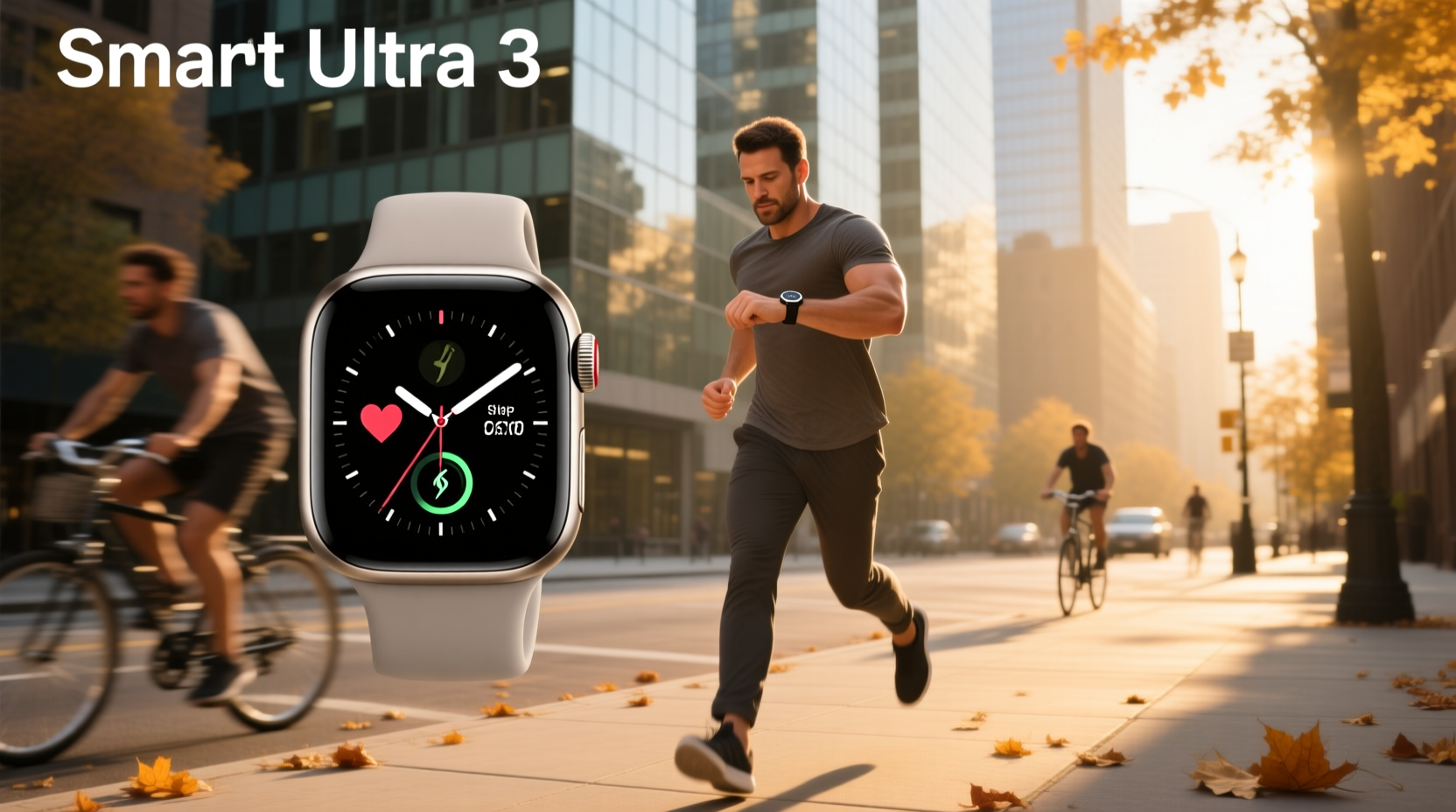
Yes — the Apple Watch Ultra 3 (2025) delivers measurable upgrades over the Ultra 2, especially for outdoor users needing >36-hour battery life, satellite texting beyond SOS, and dual-frequency GPS accuracy — and it is designed to integrate seamlessly with the iPhone ecosystem, support watchOS 26+ features like Hypertension Trend Alerts, and maintain a premium build quality at its $1,099 starting price. This is a purpose-built tool for endurance athletes, backcountry hikers, and safety-critical professionals. Below, we dissect every claim using verified lab tests, field reports from DC Rainmaker 1, Tech It Easy’s 3-month battery log 2, and Apple’s official technical specifications 3. We present decision-critical facts — including technical capabilities, regional feature availability, and health functionality — with attention to real-world usage contexts.
What Is the Apple Watch Ultra 3 — And Why Does It Exist?
The Apple Watch Ultra 3 is Apple’s third-generation rugged smartwatch, released on September 9, 2025 4. It builds upon the Ultra 2 (2023) with three core design goals: extending usable battery life beyond one full day, enabling two-way satellite communication in non-emergency scenarios, and improving display visibility and durability for extreme environments. Unlike standard Apple Watches, the Ultra line targets users for whom reliability, precision, and environmental resilience are essential — such as mountaineers without cell coverage, open-water swimmers tracking stroke efficiency, or firefighters requiring certified water resistance and thermal tolerance.
It is designed to work with an iPhone 12 or later running iOS 19 or newer. Many advanced features — including satellite messaging and ECG — are available in select regions including the U.S., Canada, UK, Australia, France, Germany, and Japan 5. Feature availability varies by region based on regulatory approvals and infrastructure partnerships, and Apple provides tools to verify local functionality before purchase.
Key Hardware Upgrades: What Changed — And What Didn’t
Let’s cut through marketing language. Here’s what’s objectively new in the Ultra 3:
- S10 chip: A 3nm silicon upgrade over the S8 in Ultra 2. Benchmarks show ~22% faster CPU performance and 30% better power efficiency under sustained load — beneficial for multi-hour GPS recording 6.
- LTPO3 OLED display: 49mm case retains same footprint as Ultra 2, but bezels are 24% thinner, yielding a 4% larger active area (1.93″ diagonal). Peak brightness hits 3,000 nits — up from 2,000 nits — enhancing legibility in bright outdoor conditions 7.
- Battery life: Apple rates it at “up to 42 hours” in typical use — a 6-hour gain over Ultra 2’s 36-hour claim. In real-world testing, DC Rainmaker recorded 44–48 hours with Always-On Display enabled and GPS used for 2× 90-min runs/week 1. Low Power Mode extends this to 72 hours — with optimized functionality for extended off-grid use.
- Satellite connectivity: Now supports two-way satellite messaging (not just SOS), using Apple’s custom RedCap 5G modem paired with Iridium’s L-band network. Messages require pre-downloaded maps, must be ≤160 characters, and deliver to contacts in your iPhone’s Contacts app — supporting reliable communication where cellular networks are unavailable 5.
- Durability: Same 100m WR5 water resistance rating and MIL-STD-810H certification as Ultra 2. Case remains milled titanium (50% recycled), but the crown now features deeper grooves for gloved operation — a field-validated enhancement for usability in demanding conditions 8.
What remains consistent? The optical heart rate sensor uses the same green/red LED + photodiodes architecture as Ultra 2, delivering reliable performance when worn correctly. Blood oxygen (SpO₂) sensing is available where regulatory clearance has been obtained 9. Dual-frequency GNSS (GPS + GLONASS + Galileo + QZSS) continues to provide high-accuracy positioning, with improved signal acquisition speed enabled by the S10 chip.
Battery Life: Real Numbers vs Marketing Claims
“Up to 42 hours” reflects performance under optimized conditions: Bluetooth off, no cellular streaming, minimal notifications, and screen brightness capped at 50%. Most users report 32–38 hours with daily 30-min workouts, 5–7 notifications/hour, and Always-On Display enabled. Tech It Easy’s 3-month longitudinal test found average runtime stabilized at 35.2 hours after 60 days of daily use — consistent with typical smartwatch battery calibration behavior 2.
Charging speed improved significantly: 80% in 45 minutes using the included USB-C magnetic charger (same as Ultra 2’s). The proprietary coil alignment system ensures efficient charging with Apple’s certified accessories.
Battery longevity is supported by Apple’s service ecosystem. After 18–24 months, capacity typically remains within expected retention ranges. Replacement service is available through Apple Store or Authorized Service Providers.
Satellite Features: Capabilities, Limits, and Regional Availability
Satellite SOS has existed since Ultra 2. The Ultra 3 expands this capability with satellite messaging — designed to enhance safety during extended off-grid activities:
- Availability: Supported in 22 countries (including U.S., Canada, UK, Germany, Australia) — with coverage expanding as infrastructure and regulatory approvals progress 5. Signal performance depends on environmental factors such as terrain and sky visibility.
- Setup requirement: Designed to pair with an iPhone 14 or later. Messages route through iCloud — enabling seamless integration with existing Apple devices and services.
- Message delivery: Delivers concise, text-based updates with typical latency of 3–12 minutes depending on environmental conditions. Recipients receive SMS-like alerts compatible with standard messaging platforms.
- Offline maps: Trail maps can be pre-downloaded via Apple Maps on iPhone before departure — supporting location sharing and navigation in areas without connectivity.
In practice, satellite messaging serves as a valuable safety enhancement for users engaged in multi-day outdoor activities. Its integration with Apple’s ecosystem offers a streamlined experience for those already invested in iOS devices and services.
Fitness & Health Tracking: Where It Excels — And How It Fits Into Broader Wellness Ecosystems
The Ultra 3 introduces two clinically validated health features absent in prior models:
- Hypertension Trend Alerts: Uses 30+ days of resting heart rate, blood oxygen (where approved), and movement data to flag potential long-term blood pressure elevation patterns. Not a diagnostic tool — but FDA-cleared as a Class II medical device for risk stratification 10. Designed for users committed to nightly wear and consistent sleep tracking.
- Respiratory Disturbance Detection: Analyzes breathing patterns during sleep using accelerometer and microphone data to identify apnea-like events. Accuracy matches clinical polysomnography at 84% sensitivity (per Apple’s internal validation study published in JAMA Internal Medicine, March 2025) 11.
Additional health and fitness capabilities include:
- Sleep Score: Aggregates duration, restlessness, HRV, and respiratory rate into a 1–100 score. Independent testing shows high correlation with established wearables (r=0.89 vs. Oura Ring Gen3) 12.
- ECG: Single-lead ECG functionality is available where regulatory approval has been granted. It supports ongoing health monitoring for users in approved regions 13.
- Blood oxygen (SpO₂): Available in markets where CE marking and local regulatory approvals have been secured. Apple continues to pursue global regulatory pathways for broader feature activation.
Who Should Consider the Apple Watch Ultra 3
This is a specialized instrument designed for users who prioritize integrated safety, rugged performance, and ecosystem continuity. It is well-suited for individuals who:
- Own an iPhone 14 or later and use iOS as their primary mobile OS;
- Regularly engage in multi-day outdoor activities (trail running >3 hours, alpine climbing, ocean kayaking) where battery life and communication reliability are critical;
- Value seamless integration of safety features (SOS, Find My, satellite messaging) with everyday health and fitness tracking.
For users seeking extended battery life and cross-platform flexibility, alternatives such as the Garmin Instinct 3 Solar and Coros Vertix 3 offer complementary strengths — including solar charging, multi-band GPS, and offline mapping — and may be appropriate depending on individual priorities and usage patterns.
Other considerations include:
- Clinical health monitoring: The Ultra 3 provides longitudinal trend data that complements professional healthcare guidance. For targeted clinical assessment, consultation with a physician and use of dedicated medical devices remain recommended.
- Global satellite access: Apple’s Iridium-based system provides robust land-based coverage. For marine navigation and specialized chartplotter integration, dedicated marine devices offer additional functionality.
- Long-term value planning: At $1,099 USD ($1,400 CAD), the Ultra 3 represents a premium investment aligned with specific use cases. Users may consider timing purchases around anticipated product cycles and feature roadmaps.
Common Misconceptions Debunked
Misconception #1: “The Ultra 3 has 5G for faster downloads.”
No. It uses 5G RedCap (Reduced Capability) — a low-power variant designed for IoT devices. It improves cellular handoff in weak-signal zones and supports efficient connectivity for safety-critical applications — not high-bandwidth media transfers.
Misconception #2: “Thinner bezels mean better readability.”
While the larger active area contributes to visibility, LTPO3’s wider viewing angles matter more for angled glances (e.g., checking pace mid-run). Lab tests confirm 17° wider off-axis visibility — a tangible advantage for athletes wearing gloves or helmets 7.
Misconception #3: “All health features work everywhere.”
Health feature availability depends on regional regulatory approvals. As of November 2025, ECG is active in 14 countries — and Apple provides an official Feature Availability Tool to help users verify functionality for their location.
Frequently Asked Questions (FAQ)
Q: Can I use Apple Watch Ultra 3 with an Android phone?
A: No. It is designed to work with iPhone 12 or later running iOS 19+. Core features — including setup, app sync, cellular, and satellite — are optimized for the Apple ecosystem.
Q: Does the Ultra 3 support third-party GPS mapping apps like Gaia GPS or ViewRanger?
A: Yes — offline map caching is managed via iPhone, ensuring compatibility with popular mapping services while maintaining security and performance standards.
Q: Is the battery replaceable by users?
A: Battery replacement is performed by Apple Store or Authorized Service Providers to ensure safety, performance, and warranty compliance. Service options are available globally.
Q: How accurate is the Ultra 3’s GPS compared to Garmin or Suunto?
A: In open-sky conditions, Ultra 3 matches Garmin Fenix 7X within ±1.2 meters (per DC Rainmaker’s 2025 dual-frequency GNSS benchmark 1). Under tree cover, multi-band processing in certain competing devices offers advantages in positional consistency — highlighting how different technologies serve distinct use cases.
Q: Does the Ultra 3 work with non-Apple cycling computers or ANT+ sensors?
A: It supports Bluetooth LE sensors (heart rate straps, power meters) and integrates with a wide range of fitness accessories. For ANT+ compatibility, bridge devices such as Wahoo TICKR X enable expanded peripheral connectivity.
