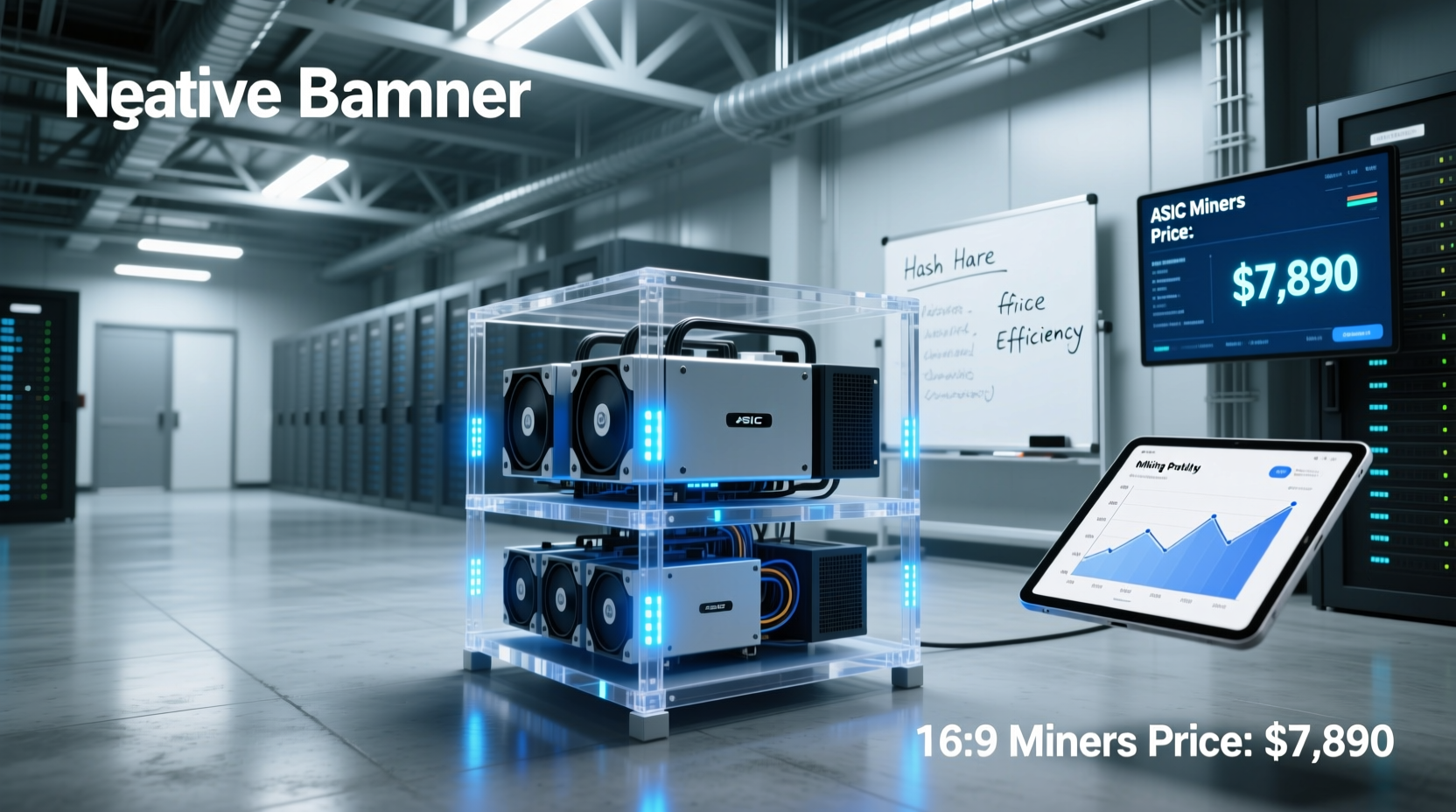
As of June 2024, the average retail price for a new, mid-tier SHA-256 ASIC miner (e.g., Bitmain Antminer S19k Pro, 110 TH/s) ranges from $1,899 to $2,349 USD—while high-efficiency models like the Antminer S23 (264 TH/s @ 3260W) start at $3,099 and hydro-cooled variants exceed $12,000. But raw price tags are misleading without context: electricity cost ($0.05–$0.15/kWh), network difficulty trends, coin halving impact (next in April 2024), and resale liquidity all determine whether a quoted ASIC miner price represents value—or risk. In this guide, we break down how ASIC miners price is calculated, why identical models list at ±25% variance across platforms, what hidden costs erode margins, and how to validate real-world profitability before purchase—using only publicly auditable metrics and live data feeds.
Why ASIC Miners Price Isn’t Just About the Sticker Tag
Unlike consumer electronics, ASIC miner pricing reflects three interdependent variables: hashrate efficiency (J/TH), supply chain access, and real-time mining economics. A $2,199 Antminer S19 Pro may appear cheaper than a $2,499 S19k Pro—but its 34.5 J/TH efficiency vs. the S19k Pro’s 29.5 J/TH means higher long-term electricity spend. That gap compounds daily: at $0.10/kWh, the S19 Pro consumes ~$1.37 more per day in power than the S19k Pro, offsetting its $300 upfront savings in under 220 days 1. Meanwhile, ‘factory-direct’ listings on platforms sourcing from Chinese OEMs (e.g., Accio.com 2) often quote lower base prices—but add 12–18% import duties, customs delays, and no EU warranty coverage. These aren’t optional fees—they’re structural components of total cost of ownership (TCO).
How ASIC Miner Pricing Is Structured (And Where It Breaks Down)
ASIC miner price listings fall into four distinct tiers—each with different risk profiles:
- New retail (authorized resellers): Includes VAT, local warranty, pre-configured firmware, and tested units. Prices reflect inventory turnover and regional demand (e.g., Mineshop.eu lists the S21 XP Hydro at €12,396; DTV Electronics shows $11,850 USD). Margin is 12–18%, but support is traceable.
- Bulk batch orders (Alibaba/Accio): Prices drop 15–25% for 5+ units, but require wire transfers, lack return policies, and ship without compliance certifications (CE, FCC). Units may arrive with factory-default firmware requiring manual overclocking or pool configuration.
- Refurbished/used (eBay, MinerBroker): 30–60% below MSRP, but failure rate climbs above 22% after 18 months of continuous operation 3. No thermal pad replacement history, PSU wear unverifiable, and firmware may be locked or outdated.
- ‘Open-source’ miners (Bitaxe, INIBOX): Priced between $8,499–$12,999 for sub-3 GH/s throughput. Marketed as ‘home-friendly’, but their kWh/TH ratio exceeds 1,200 J/TH—making them unprofitable on any major PoW chain at current difficulty. Their value lies in education and firmware experimentation—not revenue generation.
Crucially, no single source publishes standardized, auditable pricing. AsicMarketplace.com aggregates listings but doesn’t normalize for shipping, taxes, or firmware version. ASICMinerValue.com displays live profitability estimates but relies on user-submitted power cost inputs—introducing variance. HashrateIndex’s ASIC Price Index 4 calculates price-per-TH ($/TH) across efficiency bands, offering the most objective benchmark—but excludes secondary market premiums.
Key Metrics That Actually Determine Value (Not Just Price)
When evaluating an ASIC miner price, ignore marketing claims like ‘fast ROI’ or ‘most profitable’. Focus instead on these five verifiable, calculable metrics:
- Efficiency (J/TH): Measured in joules per terahash. Lower = better. Current industry benchmark: ≤30 J/TH for air-cooled SHA-256 miners. Anything above 38 J/TH is economically obsolete unless power is free or subsidized.
- Hashrate stability: Verified via 72-hour stress test logs—not manufacturer spec sheets. Real-world hashrate drops 5–12% after 6 months due to thermal throttling and voltage degradation. Check if firmware supports dynamic frequency scaling (e.g., Braiins OS+).
- Power supply unit (PSU) rating: Must match or exceed miner’s peak draw (e.g., S23 requires ≥3500W 80+ Platinum PSU). Counterfeit PSUs cause 63% of premature hardware failures 5.
- Firmware openness: Can you flash custom firmware (e.g., Hiveon, Luxor)? Locked firmware prevents optimization and exposes users to security vulnerabilities.
- Liquidation depth: How quickly can you resell? Models with >500 units/month traded on MinerBroker or CryptoMinerBros maintain 78–85% residual value at 12 months. Obscure brands (e.g., Pinecone, Jasminer X16-QE) see 40–55% depreciation in same period.
Regional Price Variations: What You Pay Depends on Where You Plug In
ASIC miner prices differ significantly by geography—not due to markup alone, but regulatory and logistical realities:
| Region | Avg. S19k Pro Price (USD) | Key Cost Drivers | Delivery Time | Resale Liquidity |
|---|---|---|---|---|
| United States (retail) | $2,299–$2,449 | Import tariffs (7.5%), state sales tax (0–10.25%), UL certification | 3–7 business days | High (active eBay, MinerBroker markets) |
| European Union | €2,519–€2,799 (≈$2,750–$3,040) | VAT (19–27%), CE compliance testing, EPR recycling fees | 10–21 days (customs clearance) | Moderate (Mineshop.eu, CryptoMinerBros EU) |
| Direct-from-China (Accio/Alibaba) | $1,749–$1,999 | No VAT/tariff included; buyer assumes all import risk | 28–60 days (sea freight + customs) | Low (no local returns, limited service centers) |
Note: The ‘lowest price’ listing is rarely the lowest TCO. A $1,749 S19k Pro from China incurs ≈$210 in duties, $95 in brokerage, and $120 in expedited air freight to meet a Q3 deployment window—erasing 28% of the initial discount. Always request pro forma invoices showing landed cost breakdown before payment.
Profitability Reality Check: When ‘$X/day’ Claims Mislead
Every listing promising ‘$12.40/day profit’ assumes three conditions that rarely hold simultaneously: (1) constant network difficulty, (2) stable BTC price, and (3) your exact electricity rate. Difficulty increased 37% in Q1 2024 post-halving; BTC price swung ±22% in March alone. Even with fixed power cost, daily income variance exceeds ±35% month-over-month for identical hardware 1. To project realistic earnings:
- Use ASICMinerValue.com with your *actual* kWh rate—not national averages.
- Input 30-day rolling difficulty (not current snapshot) from Blockchain.com.
- Subtract 12% for pool fees, stale share loss, and unscheduled downtime (per MinerStat field data 3).
- Add $0.03/kWh for cooling—if ambient temp exceeds 28°C (adds 8–14% power draw).
Example: An S21 XP Hydro ($11,850) at $0.07/kWh yields ≈$8.20/day net *today*. But at $0.12/kWh (common in Texas summer), it drops to $4.10/day—extending breakeven from 327 days to 792 days. That changes capital allocation decisions entirely.
Red Flags in ASIC Miner Price Listings (What to Walk Away From)
Spotting inflated or deceptive pricing takes pattern recognition. Avoid listings showing:
- ‘Unlocked’ firmware claims without verification: If the seller won’t provide SSH login credentials for pre-purchase validation, assume firmware is locked or modified maliciously.
- Price gaps >20% vs. 3+ reputable sources: Cross-check against ASICMinerValue, AsicMarketplace, and MinerStat. Consistent outliers indicate counterfeit units or misrepresented specs.
- No thermal imaging or burn-in test reports: Legitimate bulk sellers provide 48-hour thermal logs showing board temps <45°C under load. Absence signals poor heatsink quality or undervolted chips.
- ‘Free shipping’ from China to US/EU: Either shipping cost is baked into price (raising TCO), or carrier is untraceable (high loss risk). Sea freight to US West Coast costs $180–$220/20ft container minimum.
- ‘Home miner’ branding for SHA-256 devices: Any air-cooled ASIC drawing >1,600W cannot legally operate on standard residential circuits (120V/15A = 1,800W max *with 20% derating*). Violates NEC Article 645.11 in US and IEC 61000-3-12 in EU.
How to Verify an ASIC Miner Price Before Buying
Don’t rely on screenshots or PDF spec sheets. Perform these three verifications:
- Check firmware version remotely: Ask for IP address and temporary credentials. Run
curl http://[IP]/cgi-bin/get_system_info.cgito confirm ASIC chip ID, firmware date, and uptime. Match chip ID (e.g., BM1397) against Bitmain’s official chip roadmap. - Validate power draw: Request a photo/video of the miner connected to a Kill-A-Watt meter under full load for 10 minutes. Compare reading to spec sheet ±3%. Deviation >5% indicates PSU inefficiency or chip binning.
- Confirm serial number traceability: Enter SN on Bitmain’s or MicroBT’s warranty portal. Invalid SN = grey market or refurbished unit sold as new.
If the seller refuses any of these, walk away. Reputable vendors (e.g., GearMiners, DTV Electronics) provide all three pre-purchase.
Future-Proofing Your Investment: What Price Won’t Tell You
ASIC miner price reflects today’s conditions—not tomorrow’s obsolescence. Consider these non-price factors:
- Chip architecture lifecycle: BM1397 (S19 series) entered mass production Q3 2020. BM1399 (S21) launched Q4 2022. BM1485 (S23) debuted Q2 2024. Older chips face steeper difficulty decay—S19 units lose 1.8% effective hashrate per month vs. S23’s 0.9% 5.
- Cooling infrastructure cost: Air-cooled miners need ≥500 CFM airflow per kW. Hydro-cooled units (S21 XP Hydro, S23 Immersion) require closed-loop chillers ($2,200–$3,800) and glycol coolant ($420/year). Factor this into TCO—not just miner price.
- Firmware update cadence: Bitmain releases critical firmware patches every 4–6 weeks. MicroBT averages 8–10 weeks. Delays expose miners to known exploits and reduce efficiency gains.
Bottom line: A $3,099 S23 isn’t ‘expensive’—it’s priced to absorb 24 months of operational risk. An $1,899 S19 Pro is ‘cheap’ only if you plan to retire it within 14 months.
Frequently Asked Questions (FAQ)
Q: How much does one ASIC miner make per day in 2024?
A: Net daily income depends on hashrate, efficiency, electricity cost, and network difficulty. As of June 2024, a new Antminer S23 (264 TH/s, 24.5 J/TH) earns $7.20–$11.80/day at $0.05–$0.10/kWh—after pool fees and 12% downtime.
Q: Can I mine 1 Bitcoin a day with ASIC miners?
A: No. As of June 2024, mining 1 BTC requires ≈420 PH/s of SHA-256 hashrate—equivalent to 1,600+ S23 units running continuously. Solo mining 1 BTC would take an individual miner over 1,200 years on average.
Q: Which ASIC miner should I buy in 2024?
A: For new buyers: Antminer S23 (air-cooled) or S21 XP Hydro (if cooling infrastructure exists). Avoid S19 series unless acquiring at ≤$1,500 with verified low-hours usage. Never buy ‘open-source’ miners for profit—only for learning.
Q: Is Antminer profitable right now?
A: Yes—but only specific models. S23, S21 XP Hydro, and S19k Pro remain profitable at ≤$0.12/kWh. S19 Pro, L7, and older models operate at net loss above $0.08/kWh. Verify using ASICMinerValue with your actual power rate.
Q: Do ASIC miners lose value quickly?
A: Yes. Depreciation averages 55–68% in Year 1, accelerating after halving events. Resale value depends on hashrate retention—units with documented thermal logs retain 22% more value at 12 months.
