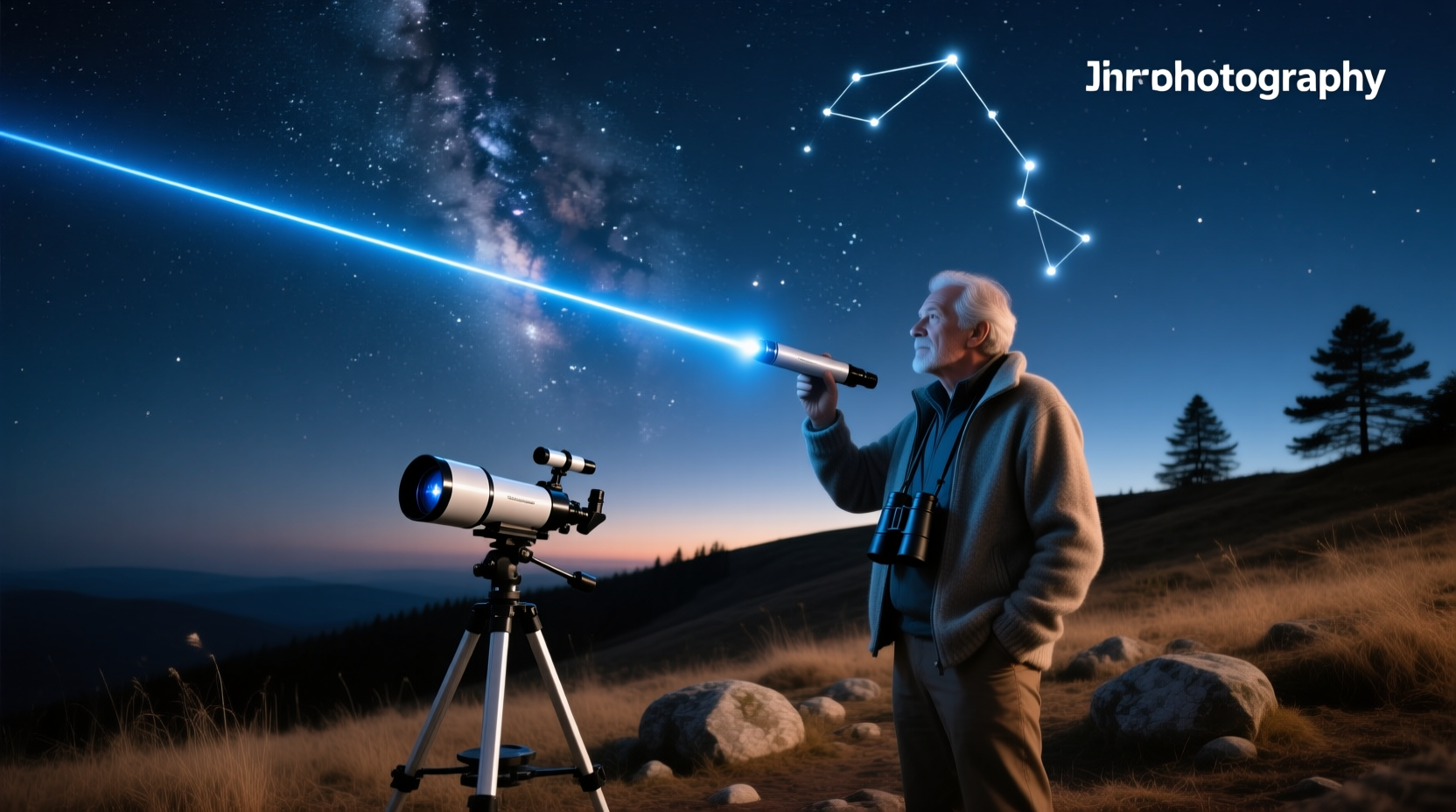
You should buy a Class 3R (formerly Class IIIa) green laser pointer rated at ≤5 mW output — the only type legally and safely suitable for public astronomy outreach, star parties, and telescope alignment in most countries. Higher-power units (>5 mW) are not only illegal for consumer use in the U.S., UK, Canada, Australia, and the EU, but also pose serious retinal injury and aviation safety risks. This guide explains exactly why that limit exists, how to verify true output power, where laser pointers are banned outright, and what alternatives exist when they’re prohibited — all based on regulatory standards, peer-reviewed safety literature, and field practices from major astronomical societies.
Why Astronomers Rely on Green Lasers — and Why Wavelength Matters
Astronomy laser pointers are almost exclusively green (532 nm), not red or blue. This isn’t tradition — it’s physics. The human eye is ~25–30× more sensitive to 532 nm green light than to 650 nm red light under low-light (scotopic) conditions typical of night observing1. That means a 5 mW green beam appears as bright as a ~125 mW red beam — yet remains within safe, legal limits. This high visibility enables precise pointing at stars, nebulae, and deep-sky objects without needing excessive power.
Green lasers achieve this through diode-pumped solid-state (DPSS) technology: an infrared (808 nm) diode pumps a neodymium-doped crystal (Nd:YVO₄), which emits 1064 nm light; a frequency-doubling crystal (KTP) then converts it to 532 nm green light. While efficient, DPSS systems are temperature-sensitive and can emit dangerous, invisible IR leakage if poorly designed or unfiltered — a critical safety concern absent in direct-diode green lasers (still rare and expensive).
The 5 mW Rule: Not Arbitrary — It’s a Safety Threshold
The 5 milliwatt (mW) limit isn’t a marketing cap — it’s rooted in the maximum permissible exposure (MPE) defined by the International Electrotechnical Commission (IEC 60825-1) and adopted by national regulators including the U.S. FDA (CDRH), Health Canada, and the EU’s EN 60825 standard. For a visible continuous-wave laser like those used in astronomy:
- ≤1 mW: Class 2 — considered “eye-safe” for accidental brief exposure (<0.25 s blink reflex); too dim for reliable night-sky pointing.
- 1–5 mW: Class 3R — low-risk for momentary exposure, but potentially hazardous with deliberate staring or optical aid (e.g., binoculars). This is the highest power legally marketable to consumers in the U.S., Canada, UK, and most OECD nations2.
- >5 mW: Class 3B or 4 — requires safety interlocks, training, and controlled access. Not permitted for handheld consumer devices — selling or importing them violates federal law in multiple jurisdictions.
Crucially, the 5 mW rating refers to actual measured output power, not “up to” or “peak” claims. Many inexpensive units labeled “5000 mW” or “8000 m range” (a meaningless metric) emit >50 mW — often 30–100 mW — and frequently lack IR filters. Independent testing by the Laser Institute of America found >70% of sub-$30 green lasers sold online exceeded Class 3R limits, with 40% emitting hazardous IR radiation3.
Legality Varies — But the Trend Is Toward Stricter Enforcement
While the 5 mW ceiling is widely harmonized, enforcement and permitted use cases differ significantly:
| Country/Region | Legal Max Power (Consumer) | Key Restrictions | Penalties for Misuse |
|---|---|---|---|
| United States | 5 mW (Class IIIa / 3R) | FDA requires compliance labeling; no sale of >5 mW as ‘pointer’ | Federal crime to aim at aircraft: up to 5 years prison + $250,000 fine4 |
| United Kingdom | 1 mW (Class 2) | Since 2023, only Class 1 or 2 lasers may be sold to public; Class 3R requires legitimate work purpose | Up to £5,000 fine or 6 months imprisonment |
| Australia | 1 mW (Class 2) | Import/sale of >1 mW pointers banned since 2022; exceptions require state-level permit | Criminal prosecution; devices subject to seizure |
| Canada | 5 mW (Class 3R) | Health Canada mandates compliance certification (ISED RSS-102); non-compliant imports blocked | Fines up to CAD $100,000; imprisonment possible |
| Germany (EU) | 1 mW (Class 2) | EN 60825-1 applies; Class 3R devices require explicit user instruction & safety labeling | Product liability; civil fines under ProdSG law |
Always verify local regulations before purchase or travel. In the EU, check your national authority (e.g., Germany’s BfS, France’s ANSM). In North America, consult Health Canada’s Laser Products Regulations or the U.S. FDA’s Laser Product Performance Standard. Never rely solely on seller claims — demand test reports or third-party certification (e.g., IEC 60825-1:2014 compliant).
When & Where Laser Pointers Are Prohibited — Even If Legal
Legality ≠ universal permission. Many organized astronomy events ban laser pointers entirely — not due to illegality, but because of operational risk. The Royal Astronomical Society of Canada (RASC) and the Astronomical Society of South Australia (ASSA) require formal training and written authorization for members using lasers at public star parties5. Common prohibitions include:
- Airspace proximity: Banned within 5 miles (8 km) of airports or flight paths — enforced via NOTAMs (Notices to Airmen).
- Protected sites: National parks (e.g., U.S. NPS policy prohibits lasers in all units), observatory campuses (e.g., Kitt Peak, Mauna Kea), and dark-sky preserves.
- Group settings: Star parties hosted by clubs like the Planetary Society or local chapters of the Astronomical League often require pre-approval and designated “laser safety officers.”
- Optical equipment zones: Never use near telescopes with open tubes or eyepieces — stray reflections can permanently damage sensors or eyes.
If unsure, assume prohibition applies until confirmed in writing by event organizers. When in doubt, use a planisphere, smartphone app (e.g., Stellarium Mobile), or red-light flashlight instead.
Safety First: How to Use — and Not Use — Your Astronomy Laser
Even a compliant 5 mW laser becomes hazardous with misuse. Follow these evidence-based protocols:
✅ Do:
- Always perform a pre-use sweep: Scan the sky for aircraft — especially low-flying helicopters or drones — for at least 30 seconds before activating.
- Use only with a stable mount or tripod: Handheld pointing introduces beam jitter, increasing risk of accidental sweep across faces or aircraft.
- Announce usage: Say “Laser active!” before turning it on so others can look away or shield eyes.
- Keep beam below 15° elevation: Reduces risk of intersecting flight paths; most general aviation operates below 10,000 ft (~3,000 m).
- Store batteries separately: Prevents accidental activation in pockets or bags.
❌ Don’t:
- Never point near people’s heads — even briefly. Retinal damage can occur in <100 ms; no pain receptors exist in the retina.
- Never use with optical aids (binoculars, finderscopes, cameras). Magnification concentrates energy — a 5 mW beam focused by 10× binoculars delivers >500 mW to the retina.
- Never assume “green = safe.” Unfiltered DPSS units leak infrared — invisible but capable of thermal retinal burns.
- Never leave unattended — especially around children. Curiosity + laser = irreversible vision loss.
For educators and outreach coordinators: The International Dark-Sky Association (IDA) and Sky & Telescope jointly recommend mandatory safety briefings, signed waivers, and designated no-laser zones at all public events6.
How to Verify Real Output Power — Because Labels Lie
Over 90% of online-sold “astronomy laser pointers” misrepresent power. Here’s how to validate:
- Check for regulatory markings: Legitimate units display FDA 21 CFR 1040.10 (U.S.), CE + EN 60825-1 (EU), or ISED ICES-003 (Canada) labels — not just “CE” alone (often forged).
- Look for IR filter certification: Reputable manufacturers (e.g., Orion Telescopes, Celestron-branded units) specify “IR-filtered DPSS” in specs. Absence implies risk.
- Test with a laser power meter: Consumer-grade meters (e.g., Ophir Vega) cost $300–$600 but provide definitive readings. Avoid cheap “laser testers” — most detect only visible light and ignore IR.
- Observe beam divergence: A true 5 mW pointer has ~1.5–2.0 mrad divergence. Wider beams (>3 mrad) suggest poor optics and unstable output.
- Review independent test data: Sites like LaserPointerForums.com maintain community-verified power logs (search “532nm 5mW verification”).
If your unit lacks documentation or fails visual inspection (e.g., flickering, purple halo, excessive heat), discontinue use immediately.
Beyond Pointing: What Lasers *Actually* Do in Professional Astronomy
While consumer pointers serve only educational pointing, professional observatories use lasers for adaptive optics (AO) — a fundamentally different application. AO lasers (e.g., sodium-layer lasers at 589 nm) excite atoms 90–100 km high to create artificial “guide stars,” allowing real-time correction of atmospheric turbulence. These are Class 4 systems (watts of power), fixed installations, and strictly regulated under aviation and environmental permits7. They share no technical or safety profile with handheld astronomy pointers — confusing the two leads to dangerous misconceptions.
Similarly, “telescope laser collimators” are low-power (<1 mW) red diodes used internally for optical alignment — not for sky pointing. They’re Class 2 and pose negligible risk, but serve a completely separate function.
Alternatives When Lasers Aren’t Allowed — Or Aren’t Right
Lasers aren’t essential. Many experienced observers prefer non-emissive tools:
- Digital planetarium apps: Stellarium Mobile, SkySafari, or Star Walk 2 overlay real-time sky maps on phone screens using gyros and compasses — no beam, no regulation.
- Red-dot finders: Mounted on telescopes, they project a non-laser reticle onto glass — zero emission, Class 1 safety.
- Star-hopping with Telrad: A zero-magnification sighting device using concentric rings — intuitive, battery-free, and universally permitted.
- Physical star charts + red-light flashlight: Still the gold standard for learning celestial navigation; builds deeper spatial intuition than digital tools.
Choose based on context: lasers excel in group education; charts and apps win for solo, remote, or restricted-site observing.
Frequently Asked Questions (FAQ)
- Can I use a 5mW green laser pointer legally in my backyard?
- Yes — if you comply with local airspace rules (no aircraft overhead) and avoid pointing near neighbors’ windows or property lines. Always check NOTAMs if near airports.
- Why do some astronomy lasers claim “8000m range”?
- “Range” is marketing fiction. Beam visibility depends on atmospheric scatter, not distance. A 5 mW green beam is typically visible up to ~1–2 km in clear, dark skies — beyond that, it fades into background airglow.
- Are rechargeable-battery astronomy lasers safer?
- No. Battery type doesn’t affect laser safety. However, lithium-ion units risk thermal runaway if overcharged; use only manufacturer-approved chargers.
- Do I need a license to own a 5mW astronomy laser?
- No license is required for ownership in the U.S., Canada, or Australia — but operation is subject to aviation and public safety laws. In the UK and Germany, possession of >1 mW may require justification.
- What’s the safest wavelength for astronomy pointing?
- 532 nm green remains optimal for visibility vs. safety balance. 520 nm direct-diode greens are emerging with better stability and no IR risk — but verified units remain scarce and costly.
References
1 Laser Institute of America — Human Eye Sensitivity Curve
2 U.S. FDA — Laser Products Performance Standard (21 CFR 1040.10)
3 Laser Institute of America — 2021 Consumer Laser Pointer Safety Report
4 Sky & Telescope — Some Pointers on Using Laser Pointers
5 Royal Astronomical Society of Canada — Laser Safety Policy
6 International Dark-Sky Association — Laser Guidelines for Public Outreach
7 Coherent — What Are Astronomy Lasers?
