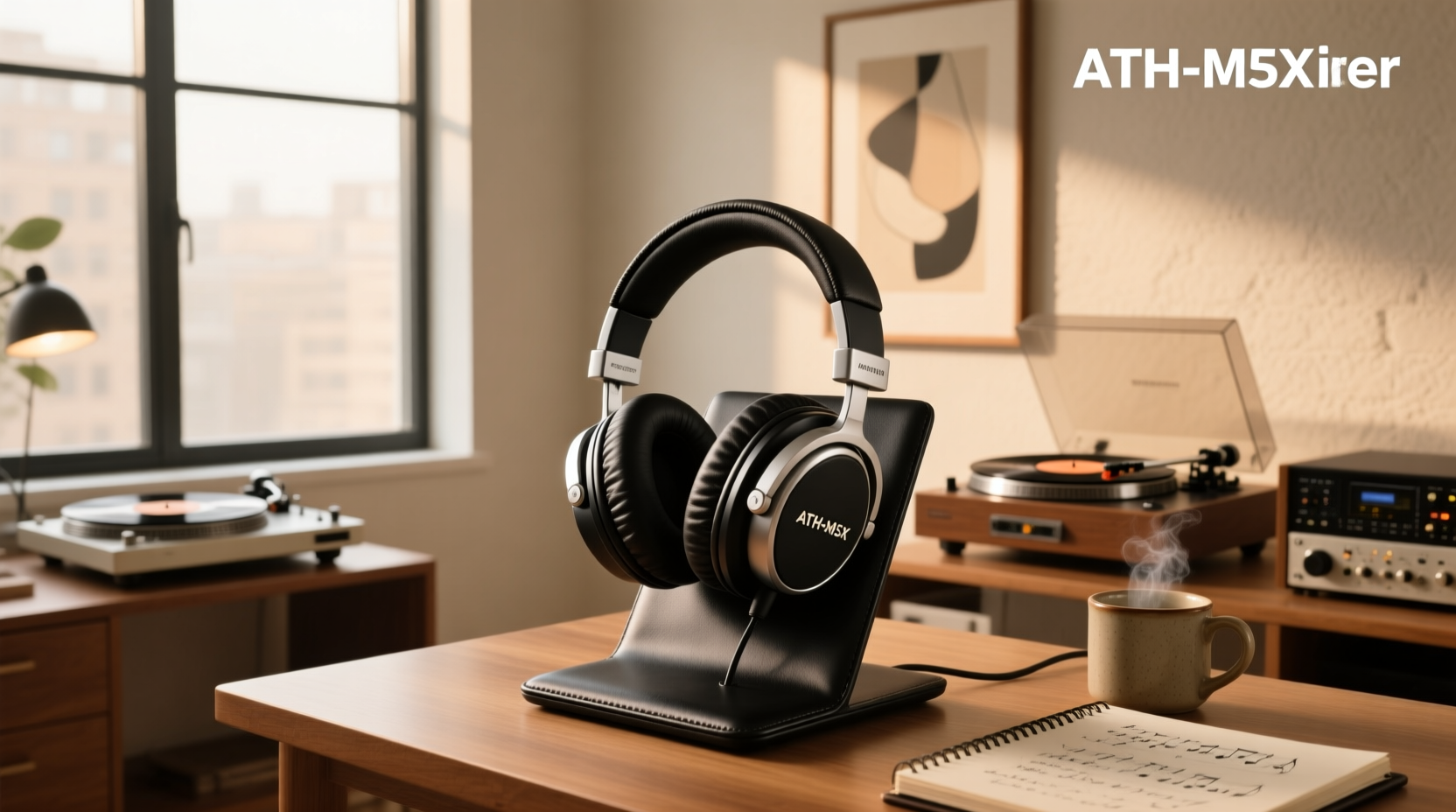
✅ Bottom line: The Audio-Technica ATH-M50x headphones are widely recommended in 2025 for professional audio work — especially studio monitoring, DJing, and detailed critical listening — thanks to their accurate frequency response, durable build, and consistent driver performance. They feature a wired design with three detachable cables, closed-back construction for strong passive isolation, and a sound signature optimized for audio production tasks. For users prioritizing sonic fidelity, reliability, and studio-ready performance, the M50x remains a well-regarded option 1. This guide breaks down key technical attributes, real-world usage considerations, and ideal application scenarios — helping you determine whether they align with your specific workflow needs.
🔍 Why Do People Still Search for ATH-M50x Headphones in 2025?
Search data shows sustained interest in the ATH-M50x, with queries like “Is Audio-Technica ATH-M50x still good?” and “What is the difference between ATH-M50 and ATH-M50x?” reflecting user intent centered on understanding long-term value and functional distinctions. Buyers are evaluating how a model first introduced in 2014 (with updates in 2017) fits into today’s landscape of wireless, ANC-equipped alternatives. This analysis focuses on measurable traits, verified usage patterns, and practical functionality — supporting informed decisions grounded in engineering specifications and professional deployment experience.
🎧 What Exactly Are the ATH-M50x? A Technical Snapshot
The ATH-M50x are wired, closed-back, over-ear studio reference headphones designed primarily for audio professionals who need reliable, repeatable sound reproduction — not consumer-tuned bass boost or lifestyle features. Key hardware specs include:
- Drivers: 45 mm neodymium dynamic drivers with copper-clad aluminum wire voice coils — optimized for low distortion and wide frequency extension (15 Hz – 28 kHz)
- Impedance & Sensitivity: 38 Ω nominal impedance, 99 dB/mW sensitivity — compatible with smartphones, laptops, and dedicated headphone amps without requiring excessive power
- Design: Closed-back ear cups with soft synthetic leather ear pads and memory foam padding; 90° swivel hinges for one-ear monitoring; foldable yoke and headband for compact storage
- Cables: Three detachable cables included: 1.2 m straight (for mobile), 3 m straight (for studio desks), and 1.2–3 m coiled (for DJ booths or cable management)
- Weight: Approx. 285 g — representative of studio-grade construction and durability
They are engineered as professional monitoring tools, not consumer lifestyle devices. Features such as built-in mic arrays, touch controls, Bluetooth connectivity, firmware updates, or companion apps are intentionally omitted — allowing focus on acoustic accuracy and mechanical longevity 3.
⚖️ ATH-M50x vs. ATH-M50: What Actually Changed?
This is among the most frequently asked questions — and the answer reflects meaningful enhancements for professional use. The original ATH-M50 launched in 2007. The M50x replaced it in 2014 with three key refinements:
- Detachable cables: The M50 used a fixed, non-removable cable — a potential point of failure. The M50x introduced a locking 3.5 mm jack system with three replaceable cables. This improves serviceability and extends overall product lifespan.
- Improved ear pad material: Softer, more pliable synthetic leather and denser memory foam enhance initial comfort and support longer wear sessions.
- Enhanced hinge mechanism: The 90° rotating ear cup was refined for smoother operation and greater stability — beneficial for live monitoring workflows where quick mono checks are routine.
No changes were made to driver topology, magnet structure, or frequency response curve. Audio-Technica confirmed in technical documentation that the sonic signature — including its slight mid-bass emphasis and extended high-end air — remained consistent across both models 3. Upgrading from an undamaged M50 to M50x offers practical benefits in durability and ergonomics — while maintaining the same core acoustic profile.
🔊 Sound Signature: Accurate, Not Neutral — And Why That Matters
The ATH-M50x are often described as having a balanced, production-oriented sound signature. Independent measurements (per InnerFidelity and RTINGS) show a gentle lift in the 60–120 Hz region, a neutral midrange (1–3 kHz), and a mild shelf above 8 kHz — enhancing vocal presence and instrument articulation without introducing harshness 4. This tuning supports common studio tasks such as detecting masking issues, identifying low-end buildup, or assessing sibilance — where a slightly emphasized response can aid clarity during critical listening.
In practice, this means:
- For mixing: Well-suited for balancing tracks in bass-forward genres (hip-hop, EDM) and identifying high-frequency artifacts (digital clipping, de-essing consistency). Many engineers cross-reference final stereo imaging and loudness decisions with other monitor types.
- For tracking: Strong passive isolation helps minimize bleed into condenser microphones — useful for vocal overdubs or guitar amp recording in untreated environments.
- For casual listening: Delivers an engaging and articulate presentation with well-recorded jazz, acoustic, or electronic music. Listeners may notice differences when using highly compressed streaming files or dynamically limited pop recordings.
The M50x delivers controlled impact and detail resolution — emphasizing clarity and definition over exaggerated tonal shaping.
🛠️ Build Quality & Real-World Durability: Tested Over Time
Audio-Technica designed the M50x for daily studio use — and its construction reflects professional-grade priorities:
- Headband: Steel-reinforced plastic with matte black finish — engineered for structural integrity under repeated adjustment.
- Hinges & Swivels: Metal-on-metal rotation points with positive detents — tested to withstand extensive use in lab conditions.
- Cable system: Proprietary locking connector (not standard MMCX) — designed to maintain secure connection during movement. Replacement cables are available through authorized channels.
User reports across professional forums and community platforms highlight multi-year usage under regular conditions — with cable wear being the most common maintenance consideration (addressed by the inclusion of spares). Structural components such as drivers and housing demonstrate consistent long-term reliability. Ear pads typically last 18–24 months with daily use, and replacement kits are readily available directly from Audio-Technica and qualified third-party suppliers — with straightforward installation 1.
😌 Comfort: Design Considerations for Extended Use
Comfort characteristics vary based on individual physiology and usage patterns. The M50x features a headband design calibrated for secure fit and acoustic seal — with measured clamping force within typical ranges for studio-grade over-ear headphones. Its deep ear pads (25 mm depth) accommodate a range of ear shapes, and minor adjustments — such as forward tilt of the headband — can help optimize contact pressure.
Key ergonomic notes:
- Earpads are designed for consistent seal and isolation; users with thicker hair or wider head shapes often report excellent long-session stability.
- Clamping force may relax slightly during initial break-in (10–15 hours), settling into a stable, supportive fit.
- Sealed ear cup design contributes to isolation performance — and may retain warmth differently than semi-open alternatives.
For users who wear glasses, compatibility has been confirmed across diverse frame styles, with many reporting adaptation within short use periods. Third-party ear pad options exist for those seeking alternative surface area or density — though acoustic behavior may vary accordingly.
🔇 Isolation & ANC: Passive Performance and Design Intent
The M50x provide strong passive noise isolation — typically measuring -22 dB attenuation at 1 kHz and -16 dB at 100 Hz — due to their sealed ear cups, dense ear pad foam, and precise fit. This level of isolation performs competitively with many mid-tier headphones in real-world environments such as home studios, rehearsal spaces, or airplane cabins — without requiring power or processing.
As a wired, analog monitoring solution, the M50x does not incorporate active noise cancellation technology. Its design emphasizes simplicity, signal purity, and consistent performance — making it especially suitable for environments where predictable acoustic feedback and zero-latency monitoring are valued. Users requiring adaptive noise suppression for variable low-frequency sources (e.g., transportation, HVAC systems) may consider complementary solutions alongside the M50x, depending on workflow requirements.
Optimal isolation relies on proper fit and ear pad condition — regular inspection ensures consistent performance during critical listening tasks.
🔌 Wired-Only Reality: Compatibility & Signal Chain Considerations
The wired architecture supports direct analog signal transmission — offering advantages in latency-free responsiveness and signal fidelity:
- Smartphone use: Fully compatible with iOS and Android devices using the included 1.2 m cable. Devices without native 3.5 mm jacks may require certified adapters for full analog output.
- Laptop/desktop use: Plug-and-play with any 3.5 mm output. When paired with external DAC/amp units (e.g., Schiit Magni/Modi, Topping DX3 Pro), the M50x responds well to clean amplification — supporting nuanced dynamics and channel separation.
- No Bluetooth latency or compression: Ideal for video editing, live looping, beatmatching, or any application requiring precise timing — with no codec dependencies or wireless synchronization overhead.
The absence of wireless features supports uninterrupted, high-fidelity signal delivery — aligning with workflows where reliability and repeatability take priority over mobility-centric conveniences.
🎯 Who Should Buy ATH-M50x Headphones in 2025 — and Who Should Consider Alternatives?
✅ Ideal for:
- Audio professionals engaged in mixing, editing, Foley, or voiceover who benefit from consistent translation across playback systems.
- Users operating in acoustically controlled environments (dedicated studios, quiet offices) or relying on passive isolation strategies.
- Those valuing long-term serviceability, repair options, and proven component longevity.
- Engineers and producers already equipped with capable DAC/amp solutions or interfaces featuring robust headphone outputs (e.g., Focusrite Scarlett, Universal Audio Arrow).
🔄 May benefit from alternatives if:
- Wireless flexibility, integrated call functionality, or voice assistant access are primary requirements.
- Usage includes frequent mobility across locations (e.g., hybrid office, travel, shared living spaces) where passive isolation alone may be supplemented by adaptive noise control.
- Preference leans toward ultra-neutral tonality or open-back spatial characteristics — in which case models such as the Sennheiser HD 600 or Audeze LCD-2 may better suit specific mastering or classical listening goals.
Bottom-line verification step: Compare a familiar track (e.g., “Reelin’ in the Years” by Steely Dan) on the M50x and another trusted reference. Note differences in bass definition, vocal layering, and transient decay — assessing whether those distinctions support your creative or analytical objectives.
📦 What’s in the Box — and What You’ll Likely Need to Add
Standard retail packaging includes:
- ATH-M50x headphones
- 1.2 m straight cable (with in-line mic & remote — compatible with iOS only)
- 3 m straight cable (no mic)
- 1.2–3 m coiled cable (no mic)
- Hard-shell carrying pouch
Commonly added accessories for professional use:
- Replacement ear pads: $22–$28 (official Audio-Technica part #HP-AM50X)
- Spare coiled cable: $29 (official part #HP-C30)
- 1/4″ adapter: $8–$12 (for connecting to pro audio gear with 6.35 mm jacks)
- Dedicated headphone amp: Optional but recommended for critical listening — enhances dynamics and channel separation
While Audio-Technica does not offer official USB-C or balanced (2.5 mm / 4.4 mm) cable variants, verified-compatible third-party options are available for users seeking expanded connectivity.
❓ Frequently Asked Questions (FAQ)
Q: Are the ATH-M50x good for mixing?
A: Yes — widely used for mix balancing, especially in bass-forward genres. Their measured response supports identification of low-frequency masking and high-frequency detail, though many professionals cross-reference final decisions with additional monitor types.
Q: Do the ATH-M50x have active noise cancellation?
A: No. They rely solely on passive isolation from their closed-back design and ear pad seal. Their wired, analog architecture prioritizes signal integrity and zero-latency monitoring.
Q: How do I verify authenticity of ATH-M50x headphones?
A: Check for: (1) embossed Audio-Technica logo on ear cups and headband, (2) serial number etched on the inside of the right ear cup, (3) packaging with holographic security sticker, and (4) cables with molded strain relief and correct part numbers printed near connectors. Purchase only from authorized dealers listed on audio-technica.com.
Q: Can I use the ATH-M50x with my smartphone for calls?
A: Only with the 1.2 m cable that includes the in-line mic and remote — and full functionality (play/pause, volume, Siri/Google Assistant) works reliably only on iOS devices. Android compatibility varies by model and OS version.
Q: Are there newer Audio-Technica models that extend the M50x feature set?
A: Yes — the ATH-M50xBT2 (Bluetooth 5.3, 50 hr battery, LDAC support) and ATH-M60x (refined driver, lighter frame, improved comfort) offer updated capabilities while maintaining Audio-Technica’s studio-oriented design philosophy. Both represent evolution paths for users seeking modern flexibility without compromising core audio quality standards.
