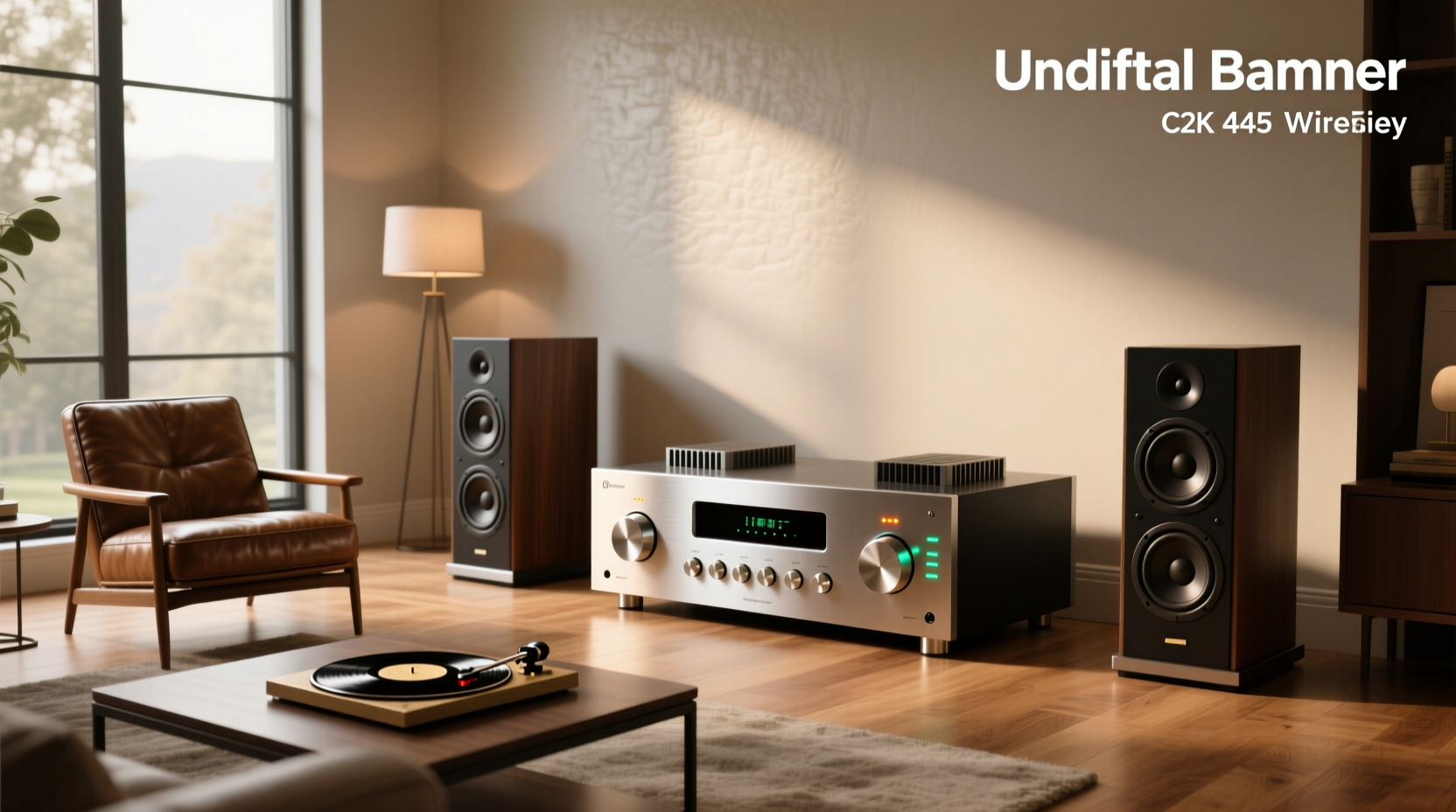
Choosing the right audio amplifier for speakers is not about chasing the highest wattage or cheapest price—it’s about matching electrical characteristics, signal path integrity, and real-world listening needs. If your passive speakers sound thin, distorted at volume, or fail to reach satisfying dynamics, the issue is rarely the speakers themselves—it’s often an underpowered, mismatched, or functionally inadequate amplifier. This guide cuts through marketing noise to explain exactly how to select a compatible, future-proof amplifier based on measurable parameters (impedance, sensitivity, power handling), topology (Class AB vs. Class D), architecture (integrated vs. power amp + preamp), and input/output requirements—whether you’re powering bookshelf speakers in a dorm room, driving floorstanders in a 250 sq ft living space, or building a multi-zone background music system.
Why Speaker-Amplifier Matching Matters More Than Raw Wattage
Many users assume higher wattage always means better performance. In reality, inadequate current delivery, impedance mismatch, and clipping due to insufficient headroom cause far more audible problems than modest power ratings. For example, a 40W/channel Class AB amplifier with robust current reserves and stable damping factor often outperforms a 150W Class D unit with poor low-impedance control when driving 4Ω speakers 1. Conversely, low-sensitivity speakers (e.g., 84 dB @ 1W/1m) demand significantly more clean power than high-sensitivity models (92+ dB)—regardless of nominal rating.
Key matching criteria include:
- Speaker impedance (ohms): Most home speakers are rated 4–8Ω. Amplifiers must be stable into the lowest impedance your speakers present across the frequency range—not just their nominal rating. Some budget amps list ‘4Ω support’ but derate output or overheat above 1 kHz; check manufacturer datasheets for continuous power into 4Ω and thermal management specs.
- Sensitivity (dB/W/m): A speaker rated 87 dB delivers ~2× the loudness of an 84 dB model using the same amplifier power. Use this to estimate required clean power: +3 dB requires doubling power; +10 dB requires 10× power. For near-field desktop use, 20–30W may suffice; for medium rooms (200–400 sq ft) with average sensitivity (86–89 dB), 50–100W per channel is typical.
- Power handling (RMS, not peak): Match amplifier RMS output to speaker RMS rating—not peak or program power. Exceeding speaker RMS by >1.5× increases risk of thermal failure; underpowering risks clipping-induced tweeter damage. Always prioritize clean, unclipped output over headline wattage.
Integrated Amplifier vs. Power Amplifier: Which Architecture Fits Your Setup?
The distinction between integrated amplifiers and separate power amplifiers defines your system’s flexibility, upgrade path, and signal chain purity.
Integrated Amplifiers: All-in-One Simplicity
An integrated amplifier combines a preamplifier (input switching, volume control, phono stage if included) and power amplifier in one chassis. They dominate the $150–$1,000 range and suit most users—especially those with multiple sources (turntable, streaming device, TV, Bluetooth). Key considerations:
- Input count & type: Ensure enough analog (RCA), digital (optical/coaxial), and wireless (Bluetooth 5.0+, AirPlay 2, Chromecast) inputs for your ecosystem. Note: Bluetooth codecs matter—AAC works well with Apple devices; aptX HD or LDAC improves Android fidelity 2.
- Phono stage inclusion: Only needed if using a moving-magnet (MM) turntable. Built-in stages vary widely in noise floor and RIAA accuracy; dedicated external phono preamps often outperform budget integrated solutions.
- Headphone output: Not all integrated amps include a proper headphone amp—some use passive attenuation. Look for dedicated op-amp or discrete headphone circuitry if critical.
Separate Power Amplifiers: Performance & Scalability
A standalone power amplifier accepts line-level signals only (no volume control or input switching). It requires pairing with a preamplifier or AV receiver. This approach offers advantages where:
- You already own a high-quality preamp or streamer with analog outputs;
- You need higher power, lower distortion, or specialized features (e.g., balanced XLR inputs, mono-block configuration);
- You plan to upgrade components incrementally (e.g., keep preamp while upgrading power section).
Separates typically deliver superior channel separation, lower noise floors, and higher damping factors—but add cost, complexity, and rack space. Entry-level separates start around $300 (e.g., Emotiva BasX A2L+), while audiophile models exceed $2,000 3.
Class D vs. Class AB: Efficiency, Heat, and Sound Quality Trade-offs
Amplifier class refers to its internal circuit design—not quality tier. Both Class AB and modern Class D can deliver excellent fidelity when engineered well.
Class AB Amplifiers
Traditional analog design: transistors conduct continuously, delivering smooth harmonic response and wide bandwidth. Pros include natural midrange texture and proven reliability. Cons: lower efficiency (40–65%), significant heat generation, heavier transformers, and larger chassis. Ideal for users prioritizing tonal authenticity and willing to accommodate ventilation space.
Class D Amplifiers
Digital switching design: transistors act as fast on/off switches, modulating pulse width to reconstruct audio. Modern implementations (e.g., Hypex, Purifi, ICEpower modules) achieve THD+N below 0.005% and bandwidth beyond 100 kHz. Pros: 90%+ efficiency, compact size, minimal heat, lightweight. Cons: potential EMI interference with poorly shielded circuits, and some early designs suffered from ‘digital hardness’—largely resolved in post-2018 models. Best for space-constrained setups, multi-channel systems, or battery-powered applications.
Crucially: Class does not dictate price or performance. A $70 Fosi Audio V3 (Class D) measures objectively better than many $500 legacy Class AB units in distortion and damping factor 4. Focus on published measurements—not topology alone.
Channel Count & Configuration: Beyond Stereo
While stereo (2-channel) dominates home listening, other configurations serve specific needs:
- 2.1-channel: Adds a subwoofer output (often with adjustable crossover). Common in compact desktop or entry-level systems. Verify if crossover is fixed or variable—and whether it’s active (line-level) or passive (speaker-level).
- 4-channel: Enables bi-amping (two amps per speaker) or front/rear zone distribution. Requires careful gain matching and impedance awareness—many 4-ch amps aren’t designed for simultaneous 4Ω loads on all channels.
- Multi-channel (5.1+, 7.1): Typically found in AV receivers or dedicated home theater power amps. Only necessary if running surround sound with passive speakers. Note: Most ‘home theater amplifiers’ are merely multi-channel power amps—they lack preamp functionality and require an AV processor or receiver.
Connectivity: What Inputs and Outputs Do You Really Need?
Modern amplifiers offer varied connectivity—but not all are equally useful or implemented well:
| Interface | Use Case | Caveats |
|---|---|---|
| Bluetooth | Wireless streaming from phones/tablets | Verify version (5.0+ preferred), supported codecs (SBC only = baseline quality), and latency (<100 ms for video sync) |
| Optical/Coaxial | Digital audio from TV, game console, CD player | Ensure sample rate support matches source (e.g., 192 kHz for high-res files); some budget amps downsample |
| USB Audio | Direct computer connection (bypasses PC DAC) | Requires ASIO/Core Audio drivers; check OS compatibility and max resolution (e.g., PCM 32-bit/384 kHz, DSD256) |
| Phono (MM/MC) | Turntable integration | MM is common; MC requires higher gain/low noise—rare in budget amps. Test with your cartridge’s output voltage. |
| Preamp Outputs | Adding external subwoofer or power amp | Confirm if fixed or variable level; variable allows independent volume control |
Common Pitfalls to Avoid When Buying
Based on real-world user reports and technical reviews, these issues recur most frequently:
- Ignoring speaker wire gauge and length: Thin 22 AWG wire over >25 ft causes measurable power loss—especially with high-current Class AB amps. Use 16 AWG minimum for runs >10 ft 5.
- Assuming ‘200W MAX’ equals usable power: Peak or PMPO ratings are meaningless. Demand RMS (continuous) power into 8Ω and 4Ω, measured at <0.1% THD.
- Overlooking ventilation: Even efficient Class D amps need airflow. Enclosing in tight cabinets causes thermal throttling—audible as dynamic compression.
- Buying without auditioning or measuring: Specifications don’t guarantee synergy. If possible, test with your speakers—or consult independent measurement databases like Audio Science Review.
How to Verify Compatibility Before Purchase
Don’t rely solely on marketing claims. Follow these verification steps:
- Locate your speaker’s spec sheet: Find nominal impedance, minimum impedance curve (if available), sensitivity, and RMS power handling.
- Find the amplifier’s full datasheet: Not just the product page—search “[brand] [model] datasheet PDF”. Look for: continuous power into 4Ω/8Ω, THD+N at 1W and full power, damping factor, S/N ratio.
- Check thermal derating graphs: Reputable brands publish power vs. temperature charts. Avoid amps that drop >20% output above 35°C ambient.
- Read third-party measurements: Sites like Audio Science Review, Stereophile, and Hi-Fi News publish objective tests—including impedance sweeps and FFT analysis.
Frequently Asked Questions (FAQ)
Q: Can I use a car amplifier for home speakers?
A: Technically yes—but not recommended. Car amps run on 12V DC and require high-current power supplies to operate on AC. They lack home-oriented inputs (phono, optical), often have unstable 4Ω behavior, and generate excessive RF noise near sensitive electronics.
Q: Do I need a separate DAC if my amplifier has digital inputs?
A: Not necessarily—but quality varies widely. Budget amps often use basic DAC chips (e.g., ES9023) with mediocre jitter rejection. If streaming high-res files, consider a dedicated DAC feeding the amp’s analog inputs.
Q: Will a more expensive amplifier always sound better?
A: Not linearly. The biggest gains come from eliminating mismatches (e.g., underpowering inefficient speakers). Once matched, diminishing returns set in—$1,500 may offer subtler improvements over $500, not transformative ones.
Q: Can I connect two pairs of speakers to one amplifier?
A: Only if the amp supports A/B switching or dual-zone operation—and total impedance stays within safe range. Wiring two 8Ω speakers in parallel creates a 4Ω load; verify the amp is 4Ω-stable before doing so.
Q: What’s the difference between an audio amplifier and a power amplifier?
A: ‘Audio amplifier’ is a broad term covering any device that boosts audio signals. ‘Power amplifier’ specifically refers to the final stage that drives speakers—requiring line-level input. Integrated amplifiers contain both preamp and power amp sections.
