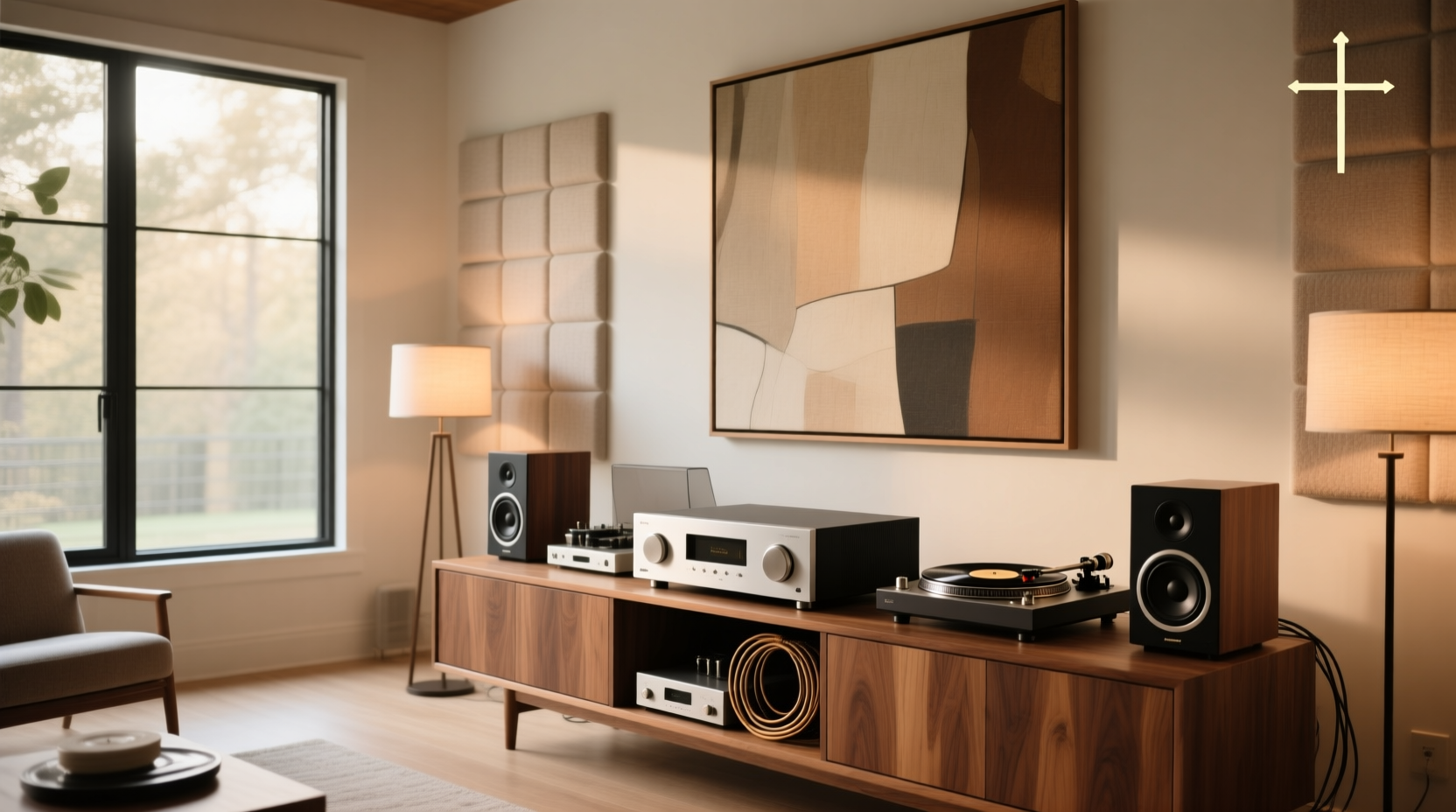
Choosing the right audio amplifier isn’t about chasing wattage or brand names—it’s about matching electrical output, signal integrity, and topology to your speakers, room size, and listening habits. Whether you’re building a compact desktop setup, upgrading a home stereo, integrating into a multi-zone PA system, or powering car subwoofers, understanding what an audio amplifier actually does—and how its design choices affect real-world performance—is the only reliable foundation for decision-making. This guide cuts through marketing noise to explain amplifier classes (AB vs. D vs. G), channel configurations (2-channel vs. 5.1 vs. multi-zone), power measurement pitfalls (RMS vs. peak vs. PMPO), input compatibility (Bluetooth, optical, analog), and thermal/safety considerations—all grounded in measurable engineering trade-offs, not subjective sound claims 1. We’ll show you exactly which specs matter—and which ones rarely do—in practice.
What Is an Audio Amplifier? A Functional Definition
An audio amplifier is an electronic circuit that increases the amplitude (voltage and/or current) of a low-power audio signal—such as from a smartphone, DAC, turntable preamp, or microphone—so it can drive loudspeakers or headphones with sufficient energy and fidelity. It does not generate sound; it enables transducers (speakers) to reproduce sound accurately. Crucially, amplification must preserve the waveform’s shape: distortion occurs when the output deviates from the input’s timing, frequency balance, or dynamic range 2. This distinguishes true amplifiers from powered speakers (which embed the amp) or active crossovers (which split signals before amplification). In consumer contexts, ‘audio amplifier’ most often refers to a power amplifier—the final stage delivering watts to speakers—or an integrated amplifier, which combines preamplification (volume, source selection, tone control) and power amplification in one chassis.
Why Amplifier Class Matters—And Why It’s Often Misunderstood
Amplifier “class” describes the internal transistor biasing and conduction strategy—not digital vs. analog, nor quality ranking. Common classes include:
- Class A: Transistors conduct continuously (360° of waveform cycle). Delivers ultra-low distortion but runs extremely hot and wastes >80% of input power as heat. Rare in consumer power amps due to inefficiency; mostly found in high-end headphone amps or small-signal stages.
- Class AB: Combines efficiency of Class B (transistors conduct ~180° each, alternating) with reduced crossover distortion via slight forward bias. Typical efficiency: 50–65%. Dominates mid-tier integrated and stereo power amps for home use—balanced warmth, control, and thermal manageability 3.
- Class D: Uses pulse-width modulation (PWM) switching at ultrasonic frequencies (>300 kHz). Efficiency exceeds 90%, enabling compact, cool-running designs. Not inherently ‘digital’—it processes analog inputs, converts to pulses, then filters back to analog. Modern implementations rival Class AB in measured linearity when properly engineered—but cheap variants suffer from EMI, limited bandwidth, and poor RF rejection.
- Class G/H: Variants using multiple supply rails to reduce voltage drop across output transistors during high-demand passages. Improves efficiency over AB without PWM complexity. Found in professional touring and high-end home amps.
Key takeaway: Class alone doesn’t predict sound quality. A well-designed Class D amp (e.g., using TPA3255 or IRS2092S ICs) can outperform a poorly implemented Class AB. Focus instead on published THD+N (Total Harmonic Distortion + Noise) at rated power, damping factor (>100 recommended for dynamic speaker control), and S/N ratio (>100 dB typical for quiet backgrounds).
Power Ratings: RMS, Peak, and Why PMPO Is Meaningless
‘200W per channel’ means little without context. Critical distinctions:
- RMS (Root Mean Square): Continuous, sustained power output into a specified load (e.g., 8Ω) at defined THD (usually 0.1% or 1%). This is the only standardized, repeatable metric for comparing real-world capability.
- Peak/Max Power: Short-term burst capability (often 10–100 ms). Useful for transient response but irrelevant for average listening levels.
- PMPO (Peak Music Power Output): A marketing term with no standard definition. Values are frequently inflated 3–5× RMS and hold no engineering validity. Avoid products listing PMPO without RMS 4.
Also critical: impedance dependency. An amp rated at 100W into 8Ω may deliver 150W into 4Ω—if its power supply and output stage are robust enough. Check if the spec sheet lists power at both 4Ω and 8Ω. Underpowered amps driven into clipping cause more speaker damage than clean, higher-powered units.
Channel Count & Topology: Matching Function to Use Case
‘Number of channels’ defines independent output paths—not total speaker count. Confusion arises because:
- A 2-channel (stereo) amp powers left/right speakers. Essential for music-focused setups, desktop audio, or as a dedicated front-channel upgrade in surround systems.
- A 4-channel amp can drive stereo pairs (e.g., front + rear) or bi-amp a single pair (separate highs/lows). Common in car audio and distributed audio (e.g., 2 zones × 2 channels).
- A 5.1 or 7.1 channel device is typically an AV receiver—integrating decoding, processing, and amplification. True discrete multi-channel power amps (e.g., 5-channel monoblocks) are rare outside high-end home theater.
- Multi-zone amplifiers (e.g., Ahuja TZA2000DP) provide separate volume control and source routing per zone, often with 70V line outputs for commercial ceiling speakers—unsuitable for direct 4/8Ω home speakers without impedance-matching transformers.
For passive speakers: match channel count to driver configuration. Driving a 3-way floorstander with a 2-channel amp is correct; feeding a center channel from a 2-channel unit requires Y-cabling (degrading signal integrity) or an external passive center tap—neither ideal.
Input Options & Connectivity: Beyond Bluetooth Hype
Modern amplifiers advertise ‘Bluetooth’, ‘USB’, ‘optical’, and ‘coaxial’—but functionality varies widely:
- Bluetooth: Version matters (5.0+ supports aptX HD or LDAC for near-lossless streaming; 4.2 often caps at SBC). Built-in codecs determine maximum resolution—not just ‘supports Bluetooth’. Also check if it’s receiver-only (no transmitter) and whether it introduces latency (>150ms disrupts video sync).
- Digital inputs (optical/coaxial): Require internal DAC conversion. Quality depends on DAC chip (e.g., AK4490 vs. CS4344) and analog output stage—not just presence of the port. An amp with optical input but no volume control on that path forces source-level adjustment, limiting dynamic range.
- Phono inputs: Only relevant if connecting a turntable without a separate phono preamp. Requires RIAA equalization curve correction—integrated phono stages vary drastically in noise floor and overload margin.
- Line-level inputs (RCA/XLR): Universally compatible. XLR offers balanced noise rejection over long cable runs; RCA suffices for short distances (<2m).
Red flag: ‘FM radio + USB + SD card’ bundles often indicate cost-cutting in core amplification circuitry. These features add convenience but rarely enhance sonic performance.
Form Factor & Thermal Design: Why Size Isn’t Just About Space
Compact ‘mini’ amplifiers (e.g., PAM8403-based boards) prioritize portability over thermal headroom. Their 3W–15W RMS ratings assume forced-air cooling or very light loads. In enclosed cabinets or continuous use, they throttle output or shut down. Conversely, larger heatsinks and toroidal transformers in traditional AB amps sustain full power longer but require ventilation clearance (minimum 10 cm on all sides). For rack-mounted installations, verify depth—many ‘slim’ amps exceed 35 cm including connectors and cooling fins.
Power supply quality is non-negotiable. Switch-mode supplies (common in Class D) must be well-filtered to prevent noise coupling into analog stages. Linear supplies (in AB/G amps) offer lower noise floor but run hotter and heavier. No universal ‘better’—only context-appropriate trade-offs.
Speaker Compatibility: The Unavoidable Physics Check
An amplifier must electrically match your speakers. Key parameters:
- Impedance rating: Most home speakers are 4Ω, 6Ω, or 8Ω nominal. Amps specify minimum stable load (e.g., ‘4Ω stable’). Driving 4Ω speakers with an 8Ω-minimum amp risks overheating and protection shutdown.
- Sensitivity (dB @ 1W/1m): A 87 dB speaker needs ~2× the power of a 90 dB speaker to reach the same volume. Low-sensitivity planar magnetics (e.g., 83 dB) demand high-current, high-damping-factor amps—Class D excels here; weak AB designs struggle.
- Power handling (program vs. peak): Match amp RMS to speaker’s continuous (not peak) rating. A 100W speaker paired with a 150W amp is safer than a 50W amp pushed to clipping.
Always consult the speaker manufacturer’s recommended amplifier power range—not just max rating. Exceeding upper limits risks voice-coil damage; falling far below causes lack of control and bass flabbiness.
Common Pitfalls & When to Skip a Purchase
Based on real-world failure patterns observed across thousands of user reports and service logs:
- Avoid ‘all-in-one’ feature bundles under $100 USD equivalent: Units combining Bluetooth, FM, USB playback, graphic EQ, and remote control almost always compromise amplifier section PCB layout, grounding, and component quality. THD often exceeds 1% at moderate volumes.
- Don’t assume ‘high wattage’ equals ‘louder’: Perceived loudness doubles with ~10 dB increase, requiring ~10× more power. Going from 50W to 500W yields only +10 dB SPL—less than turning volume up 2 clicks on most preamps.
- Beware of unverified ‘HiFi’ claims: No regulatory body certifies ‘HiFi’ labeling. Demand published measurements (THD+N vs. frequency, IMD, square-wave response) — not just ‘flat frequency response’ marketing copy.
- Ignore ‘tube warmth’ in hybrid designs under $300: Single 12AU7 tubes in budget amps act as glorified buffers—not true voltage gain stages. Real tube amplification requires proper heater supply, high-voltage rails, and output transformers—costing significantly more.
Frequently Asked Questions (FAQ)
- Can I connect an audio amplifier directly to a computer’s headphone jack? Yes—but expect low-level signal and potential ground loop hum. Use a dedicated USB DAC or line-out (if available) for cleaner results.
- Do I need a separate DAC if my amplifier has optical input? Yes—the optical input feeds a built-in DAC. Its quality determines resolution limits. For high-res files (24-bit/192kHz), verify DAC chip specs and filter options.
- Is Class D less reliable than Class AB? No—modern Class D ICs (e.g., TI’s TPA series) have MTBF (Mean Time Between Failures) exceeding 100,000 hours when thermally managed. Failure rates correlate more with build quality than topology.
- Why do some amplifiers list ‘damping factor’ while others don’t? Damping factor measures an amp’s ability to control speaker cone motion post-signal. High values (>200) benefit dynamic, low-impedance speakers. Omission often indicates marginal output impedance—check output impedance spec instead.
- Can I use a car amplifier in a home setup? Only with a compatible 12V DC power supply capable of sustained >30A delivery. Car amps lack AC mains filtering and safety certifications (UL/CE) for residential use—fire risk and noise interference are significant concerns.
