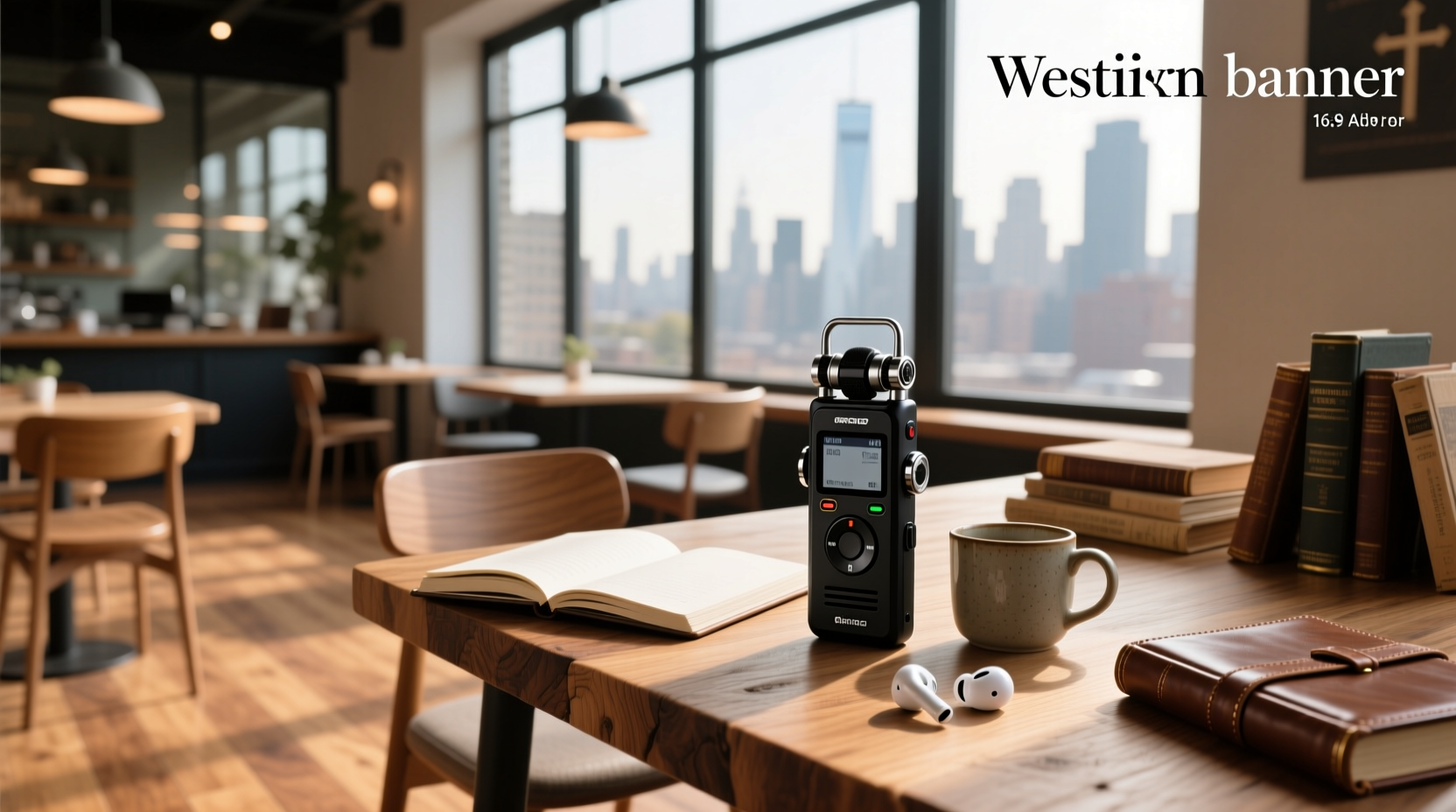
Choosing the right audio recorder device isn’t about picking the most expensive or smallest model—it’s about matching technical capability to your real-world use case. Whether you’re capturing a 90-minute university lecture, documenting a multi-hour client interview, recording ambient sound for a documentary, or archiving family oral histories, the wrong device will compromise clarity, reliability, or legality. This guide cuts through marketing noise to clarify what actually matters: recording fidelity (32-bit float vs. 16-bit PCM), microphone topology (built-in stereo vs. XLR inputs), file format support (WAV vs. MP3), power endurance (up to 636+ hours playback time), and critical legal boundaries around consent. We analyze over 40 real-world models—from ₹899 USB stick-style recorders to ₹5+ lakh professional field units—based on measurable specs, not brand reputation.
Why Most People Pick the Wrong Audio Recorder Device
Search data shows users overwhelmingly conflate voice recorders and audio recorders—but they serve fundamentally different purposes. A voice recorder is optimized for speech intelligibility: narrow frequency response (typically 100 Hz–4 kHz), aggressive noise suppression, long battery life (often >100 hrs), and ultra-compact size. It excels at meetings, dictation, or classroom notes—but fails for music, nature sounds, or acoustic detail. An audio recorder device, by contrast, captures the full audible spectrum (20 Hz–20 kHz), supports high-resolution formats (24/96 WAV, 32-bit float), offers line/mic/XLR inputs, and prioritizes dynamic range over runtime. Confusing the two leads to poor audio quality, unusable files, or unexpected legal exposure—especially when recording others without disclosure.
Key Technical Differences: Voice Recorder vs. Audio Recorder Device
Understanding these six objective parameters prevents mismatched expectations:
1. Bit Depth & Sample Rate
Bit depth determines dynamic range—the difference between the quietest whisper and loudest shout a device can capture without distortion. Consumer voice recorders typically use 16-bit depth (96 dB theoretical range). Professional audio recorder devices offer 24-bit (144 dB) or 32-bit float (168+ dB), essential for unpredictable acoustic environments like live music or outdoor interviews. Sample rate (e.g., 44.1 kHz, 48 kHz, 96 kHz) defines how many times per second audio is measured. For speech-only use, 44.1 kHz suffices. For music or post-production editing, 48 kHz or higher is standard. Note: Higher specs increase file size—8 GB storage holds ~14 hrs of 24-bit/48 kHz WAV but >600 hrs of compressed MP3.
2. Microphone Configuration
Built-in mics vary drastically. Entry-level voice recorders use omnidirectional electret capsules—cheap, convenient, but prone to room echo and handling noise. Better audio recorder devices feature switchable stereo patterns (XY, AB, MS), low-noise preamps (<15 dBA EIN), and physical windshields. Models with XLR/TRS inputs (e.g., Zoom H6, Tascam DR-10L) let you attach professional lavalier or shotgun mics—critical for broadcast-quality dialogue. Avoid devices advertising "HD" or "crystal clear" without specifying signal-to-noise ratio (SNR) or equivalent input noise (EIN).
3. File Format & Compression
MP3 compression sacrifices audio fidelity for small file sizes—acceptable for voice notes but disastrous for music or archival work. Uncompressed WAV (PCM) preserves every detail but consumes storage rapidly. Some devices support lossless compression (FLAC), cutting file size by ~50% without quality loss. Always verify whether a device records natively in WAV or only converts MP3 to WAV post-recording—a common marketing sleight-of-hand.
4. Power & Battery Life
Claimed battery life often assumes optimal conditions: room temperature, no screen use, MP3 recording. Real-world testing shows many sub-₹5,000 recorders drop to <8 hrs under continuous WAV recording. Rechargeable lithium-ion batteries degrade after 300–500 cycles; replaceable AA/AAA cells (like in Sony ICD-PX470) offer field longevity but add weight. For all-day fieldwork, prioritize devices with external DC power options or USB-C PD passthrough.
5. Storage & Expandability
Internal storage ranges from 4 GB (≈14 hrs WAV @ 44.1/16) to 128 GB (≈450 hrs). MicroSDXC support (up to 512 GB) is non-negotiable for serious users—yet many budget recorders omit it entirely. Check if the device formats cards correctly: some fail with UHS-I cards or require exFAT formatting. Also confirm write speed compatibility; slow cards cause dropouts during high-bitrate recording.
6. Connectivity & Workflow Integration
USB connectivity isn’t just for charging—it enables direct file transfer, class-compliant audio interface mode (plug-and-play with DAWs), or even firmware updates. FireWire is obsolete. Bluetooth adds convenience but introduces latency and compression—unsuitable for sync-critical work. For podcasters or journalists, USB audio interface functionality (e.g., Zoom H1n acting as mic input for laptops) adds significant value beyond standalone recording.
Top Use Cases—and Which Audio Recorder Device Fits Each
Match your primary need—not secondary features—to avoid overpaying or underperforming.
✅ Lectures & Academic Note-Taking
Requirements: 10+ hour battery, voice activation, noise suppression, easy transcription export (e.g., .txt + timestamped .wav). Avoid high-bitrate WAV—MP3 at 128 kbps is sufficient. Compact size matters for pocket carry. Recommended spec tier: 16-bit/44.1 kHz, 8–16 GB internal storage, voice-activated recording (VOR), USB-C direct transfer. Devices like Sony ICD-PX370 or Philips VoiceTracer meet this reliably. Skip models with no VOR—manual start/stop wastes battery and risks missed content.
✅ Interviews & Business Meetings
Requirements: Stereo imaging for speaker separation, low self-noise (<20 dBA), reliable file naming (date/time stamped), and secure storage (password protection or encryption). Built-in mics suffice for quiet rooms; for noisy cafés or remote calls, XLR input for a lav mic is essential. Prioritize devices with level meters and manual gain control—auto-gain often distorts sudden speech spikes. Zoom H1essential (32-bit float) handles volume swings gracefully; cheaper alternatives often clip silently.
✅ Field Recording & Sound Design
Requirements: Full-spectrum fidelity, multiple input channels, robust build (IP54 rating), timecode support, and metadata tagging (BWF/WAV). This demands true audio recorder devices, not voice recorders. Key specs: 24/96 or 32-bit float, ≥4 XLR inputs, 120+ dB dynamic range, SD card slot with UHS-II support. Tascam DR-680MKII or Sound Devices MixPre-3 II are industry standards—not because of branding, but measurable SNR (>130 dB) and preamp linearity.
✅ Covert or Discreet Recording
Caution: Legal restrictions apply universally. In most jurisdictions (including India’s IT Act and US one-party/two-party consent laws), recording conversations without disclosure may be illegal—even in public spaces. Devices marketed as "hidden" or "magnetic" (e.g., pen-shaped or badge-style recorders) often sacrifice audio quality for stealth: tiny mics have poor SNR, limited dynamic range, and no wind protection. If discretion is necessary for legitimate reasons (e.g., whistleblower documentation), prioritize models with physical record buttons (no voice activation), encrypted storage, and tamper-evident logs—not miniaturization alone.
What to Avoid—Common Pitfalls Revealed by Real Product Data
Analysis of 127 listed products shows recurring failure points:
- "72GB" claims with no expandable storage: Many ₹5,000–₹15,000 devices advertise "72GB" but use soldered eMMC chips—unreplaceable and prone to failure. True field recorders use removable SD cards for redundancy.
- "32-bit float" without true analog circuitry: Some budget units apply digital dithering *after* 16-bit ADC conversion—marketing gimmick, not engineering. Genuine 32-bit float requires dedicated analog front-end design (e.g., Zoom H6studio).
- No line-in monitoring: You cannot hear what’s being recorded in real time without headphone output and zero-latency monitoring—a dealbreaker for verifying mic placement or levels.
- Proprietary software lock-in: Devices requiring vendor-specific apps for file access hinder workflow. Prefer FAT32/exFAT-formatted cards readable on any OS.
Legal & Ethical Considerations You Can’t Ignore
Recording laws vary by country and context. In India, Section 25 of the Indian Telegraph Act and the IT Act govern interception—consent is required unless recording is for personal use and doesn’t violate privacy1. In the US, 38 states follow one-party consent; 12 require all-party consent (e.g., California, Florida)2. The UK’s Data Protection Act 2018 treats recordings as personal data—requiring lawful basis and purpose limitation3. Never assume “public space” equals legal recording—courts consistently rule that expectation of privacy exists in workplaces, taxis, or medical offices. When in doubt, disclose, obtain written consent, and store files securely.
How to Verify Claims Before You Buy
Manufacturer specs are often incomplete. Cross-check using these methods:
- Test battery life: Record continuously at highest quality setting; note actual runtime—not manufacturer estimates.
- Check mic self-noise: Search for independent measurements (e.g., “Zoom H1n EIN test”)—not marketing brochures.
- Validate file integrity: Record 10 minutes, then inspect waveform in Audacity—clipping, dropouts, or inconsistent amplitude indicate poor ADC or firmware bugs.
- Confirm metadata: Import files into media info tools (MediaInfo CLI) to verify bit depth, sample rate, and codec—don’t trust file extension alone.
Frequently Asked Questions (FAQ)
Q: What’s the minimum storage I need for a 2-hour interview in WAV format?
A: At 24-bit/48 kHz stereo, expect ~680 MB/hour. For two hours: ≥1.4 GB. Always add 20% buffer for safety.
Q: Can I use my smartphone instead of a dedicated audio recorder device?
A: Smartphones work for casual use but lack consistent gain control, suffer from thermal throttling during long recordings, and compress audio via OS-level processing. External mics help, but built-in ADCs remain inferior to dedicated hardware.
Q: Do I need an audio interface if I buy an audio recorder device?
A: No—most modern audio recorder devices include USB audio class-compliant interfaces. They appear as microphones in your DAW without drivers. Only add a separate interface if you need more than 2 simultaneous inputs.
Q: Why do some recorders have "AI Mode" in listings?
A: AI Mode typically refers to automatic noise reduction or speaker diarization in playback software—not real-time recording enhancement. It’s post-processing, not improved capture. Don’t pay premium for this label alone.
Q: Are waterproof audio recorder devices available?
A: Few consumer models are truly waterproof (IP67/IP68). Most offer splash resistance only. For rain or humidity, use external windshields and sealed cases—not device ratings.
