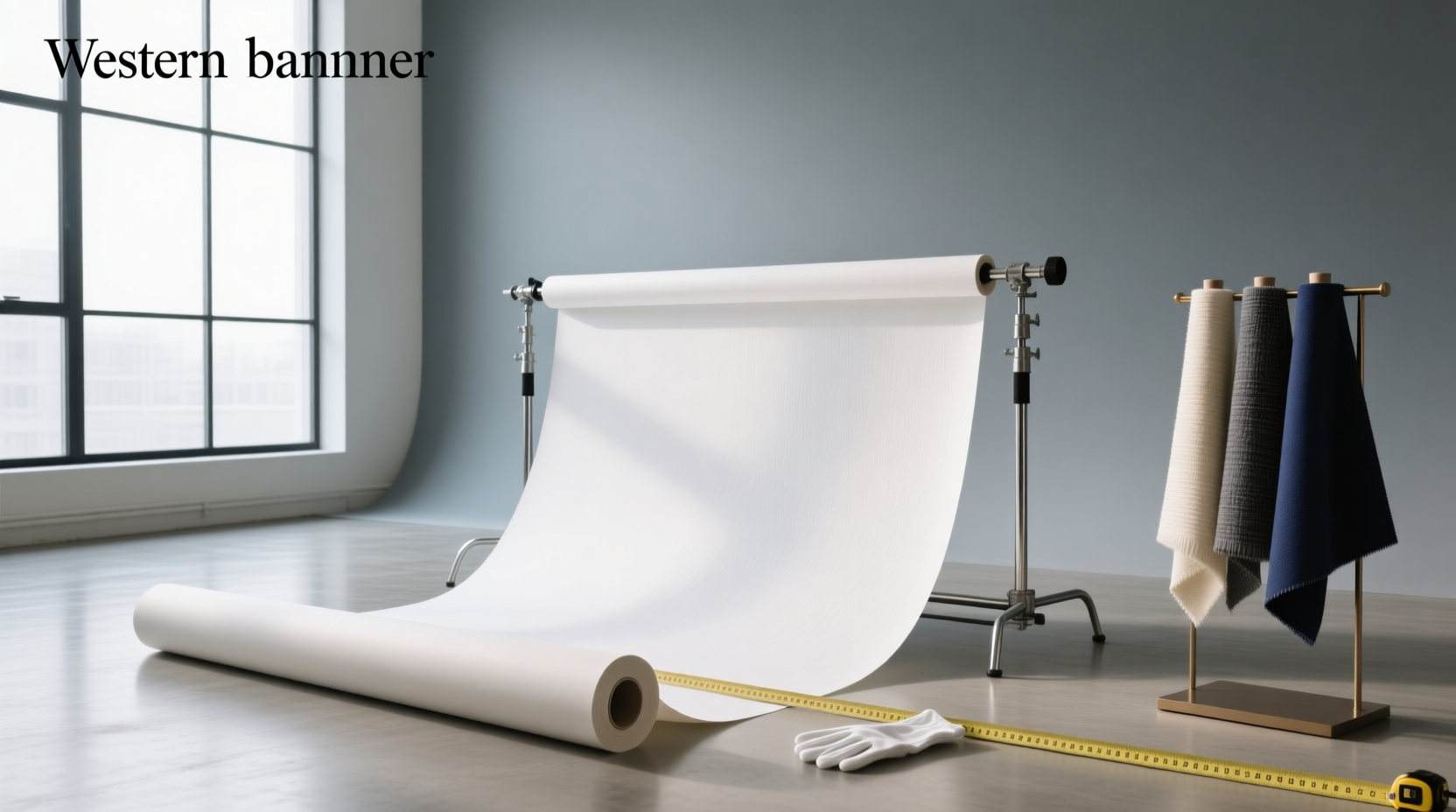
You need a seamless backdrop roll paper that matches your studio height, lighting setup, and shooting frequency—not just the cheapest or widest option. Most photographers start with a 53" (1.35 m) wide × 16 ft (4.9 m) roll in Arctic White (#01) or Pure White (#69), but optimal choice depends on three objective factors: paper weight (31–180 gsm), roll dimensions relative to your ceiling height and support system, and color code consistency across brands. This guide walks through every technical specification, real-world trade-offs, and setup pitfalls—so you avoid curling edges, light bleed-through, or premature tearing during shoots.
Why Backdrop Roll Paper Specifications Matter More Than Brand Names
Backdrop paper isn’t generic craft paper. Its performance hinges on precise manufacturing tolerances—especially thickness uniformity, surface tooth, and tensile strength. A 31-gauge (≈110 gsm) roll may tear when tensioned on a heavy-duty crossbar; a 180-gauge (≈180 gsm) roll resists sagging under studio lights but costs 2.3× more and requires stronger hardware. The most common mistake? Assuming “wider = better.” In reality, a 107" (2.72 m) roll only makes sense if your studio ceiling is ≥12 ft (3.66 m) and you’re using a dual-motor roller system. Otherwise, excess width increases drag, wrinkles, and waste during trimming.
Understanding Backdrop Roll Dimensions: Width, Length, and Real-World Fit
Roll width is the single most consequential spec—and also the most misunderstood. Standard widths include:
- 53" (1.35 m): Fits most home studios (8–10 ft ceilings); compatible with entry-level stands like Neewer or Impact; minimal waste when shooting headshots or ¾-length portraits.
- 86" (2.18 m): Requires ≥11 ft ceiling clearance; used for full-body fashion or group shots; needs reinforced crossbars (≥1.5" diameter steel) to prevent bowing.
- 107" (2.72 m): Professional studio standard; supports infinity cove setups; demands ceiling-mounted track systems or floor-to-ceiling uprights with 3-point anchoring.
Length matters less than you think. While 36 ft (11 m) rolls seem economical, they’re rarely fully used: typical portrait sessions consume 6–12 ft per shoot. A 16 ft (4.9 m) roll yields ~3 clean full-height backdrops before edge wear sets in. Longer rolls increase handling difficulty—especially when unrolling manually—and raise risk of kinking at the core.
Weight & Gauge: What ‘31-Gauge’ Actually Means (and Why It’s Misleading)
“Gauge” is an outdated imperial measurement still used in marketing—but it doesn’t directly indicate thickness or durability. A 31-gauge paper may range from 105–115 gsm depending on fiber density and calendering. What matters is grams per square meter (gsm), measured under ISO 536:2019 standards. Here’s how gsm translates to real use:
| gsm Range | Typical Use Case | Pros | Cons |
|---|---|---|---|
| 100–120 gsm | Home streaming, student projects, occasional product shots | Low cost ($12–$22/roll), easy to cut and replace | Shows light bleed-through with >500W continuous lighting; curls at edges after 2–3 hours of tension |
| 140–160 gsm | Professional portrait studios, newborn photography, e-commerce | Minimal curling, consistent matte finish, handles LED and strobe lighting evenly | Requires sturdier stands; 20–30% heavier to unroll manually |
| 170–180 gsm | Film production, chroma key video, high-volume commercial studios | Negligible stretch or sag over 8+ hour shoots; zero light transmission even at 1000W | Not compatible with spring-loaded roller kits; needs motorized or counterweighted systems |
Always verify gsm—not gauge—on the manufacturer’s spec sheet. If only “gauge” is listed, assume 31-gauge ≈ 110 gsm, 40-gauge ≈ 145 gsm, and 50-gauge ≈ 175 gsm 1.
Color Codes Aren’t Universal—Here’s How to Match Them Across Brands
A #69 Bright White from Savage isn’t identical to #69 from Huamei or Kate Backdrop—even if both claim “CIE Lab D65 white point.” Differences arise from pulp source (bleached vs. unbleached wood fiber), optical brighteners, and coating formulation. For color-critical work (e.g., product catalogues or brand-aligned video), rely on measured Delta E (ΔE) values, not names or numbers.
Key verified color benchmarks (per CIE 1976 L*a*b*):
- Arctic White (#01): L* = 95.2 ± 0.3, a* = −0.8 ± 0.2, b* = −1.1 ± 0.2 — neutral cool tone, minimal blue shift
- Pure White (#69): L* = 94.7 ± 0.4, a* = −0.3 ± 0.3, b* = −0.2 ± 0.3 — warm-neutral, best for skin tones under tungsten lighting
- Storm Gray (#70): L* = 62.1 ± 0.5, a* = 0.1 ± 0.2, b* = −0.9 ± 0.3 — true neutral gray, avoids green/magenta cast in mixed lighting
If your workflow includes color grading, test a 1-ft sample under your actual lights before ordering full rolls. Never assume “gray” means the same across suppliers 2.
Setup Systems: Which One Matches Your Space and Workflow?
How you mount the roll determines longevity, safety, and shot consistency. Three main systems exist:
1. Freestanding Crossbar Systems (Most Common)
Two uprights + horizontal bar + paper clamp. Ideal for spaces with no wall/ceiling anchors. Key specs to check:
- Upright height adjustment range (must exceed your ceiling height minus 6")
- Bar load rating (≥25 kg for 107" rolls at full tension)
- Clamp jaw depth (≥1.5" to grip 3" cardboard cores without slippage)
⚠️ Avoid plastic-core stands rated ≤15 kg—they flex under 86"+ rolls, causing visible bowing in wide-angle shots.
2. Wall-Mounted Track Systems
Aluminum extrusion tracks mounted to studs, with rolling carriers. Best for permanent studios. Requires:
- Stud spacing ≤16" o.c. (standard in North America)
- Minimum 3.5" wall depth for secure lag-bolt anchoring
- Carrier wheel hardness ≥85A durometer (softer wheels deform and skip)
3. Ceiling-Suspended Motorized Systems
Used in broadcast studios. Needs structural engineer sign-off for ceiling joist reinforcement. Not recommended unless your facility has ≥14 ft clear height and dedicated power circuits.
Storage, Handling, and Shelf Life: What No One Tells You
Backlight paper degrades predictably—and not just from light exposure. Humidity is the primary enemy: above 60% RH, cellulose fibers absorb moisture, reducing tensile strength by up to 40% within 6 months. Store rolls horizontally (not vertically) on pallets ≥6" off concrete floors. Never store near HVAC vents or exterior walls.
Shelf life by gsm:
- 100–120 gsm: 12–18 months max (even sealed in plastic)
- 140–160 gsm: 24–30 months if stored at 45–55% RH and 18–22°C
- 170–180 gsm: 36+ months with climate-controlled storage
Check batch codes before purchase. Reputable suppliers print manufacturing date (YYYY-MM) on the core label. Avoid rolls without date stamps—especially from marketplaces with unclear inventory turnover 3.
Common Mistakes That Waste Time and Money
Mistake #1: Using double-sided tape to secure edges
It leaves residue, damages wall paint, and fails under heat from studio lights. Use reusable silicone edge grips or weighted sandbags instead.
Mistake #2: Cutting paper while still on the roll
This causes micro-tears along the cut line, leading to unraveling mid-shoot. Always unroll fully onto a clean, flat surface first—then trim with a rotary cutter and aluminum straightedge.
Mistake #3: Assuming all “seamless” papers are wrinkle-free
True seamlessness means no splices—but surface texture varies. Papers with higher calendering pressure (≥200 N/mm²) yield smoother finishes. Ask for surface roughness (Ra) values: Ra < 0.8 µm = ideal for macro product shots.
When to Choose Paper Over Vinyl or Fabric
Paper excels where absolute matte diffusion, zero reflectivity, and low cost-per-use matter most. But it’s not universal:
- Choose paper if: You shoot static subjects (portraits, products), need perfect light absorption, or change backgrounds daily.
- Choose vinyl if: You need wipe-clean durability, outdoor use, or curved cove installations (paper cracks below 10°C).
- Choose fabric if: You require portability, wrinkle resistance during travel, or textured surfaces (linen, muslin).
Note: Paper cannot be reused after heavy creasing or water exposure. Vinyl lasts 3–5 years with care; fabric lasts 5–10 years but shows lint and pilling over time.
Frequently Asked Questions (FAQ)
- Can I use backdrop paper outdoors?
No. Paper absorbs moisture rapidly, sags under wind load, and yellows within hours of UV exposure. Use weather-resistant vinyl or polyester fabric instead. - How do I prevent curling at the bottom edge?
Apply 2–3 lb of even downward tension using sand-filled PVC pipes (diameter = roll width ÷ 4). Never use clips alone—they create localized stress points. - Is there a difference between photo paper and background paper?
Yes. Photo paper has resin coatings for inkjet printing and reflects light; background paper is uncoated, matte-finish, and optimized for light absorption. Using photo paper as a backdrop causes hotspots and inconsistent exposure. - Do I need fire-rated backdrop paper for studio use?
In the US, NFPA 701 certification is required only for public venues (schools, theaters, hotels). Home studios and private commercial spaces aren’t mandated—but always check local municipal fire codes before installation. - Can I paint or spray over backdrop paper?
Not reliably. Acrylics crack when paper flexes; solvent-based sprays dissolve the surface. For custom colors, order pre-dyed rolls or use fabric backdrops designed for painting.
