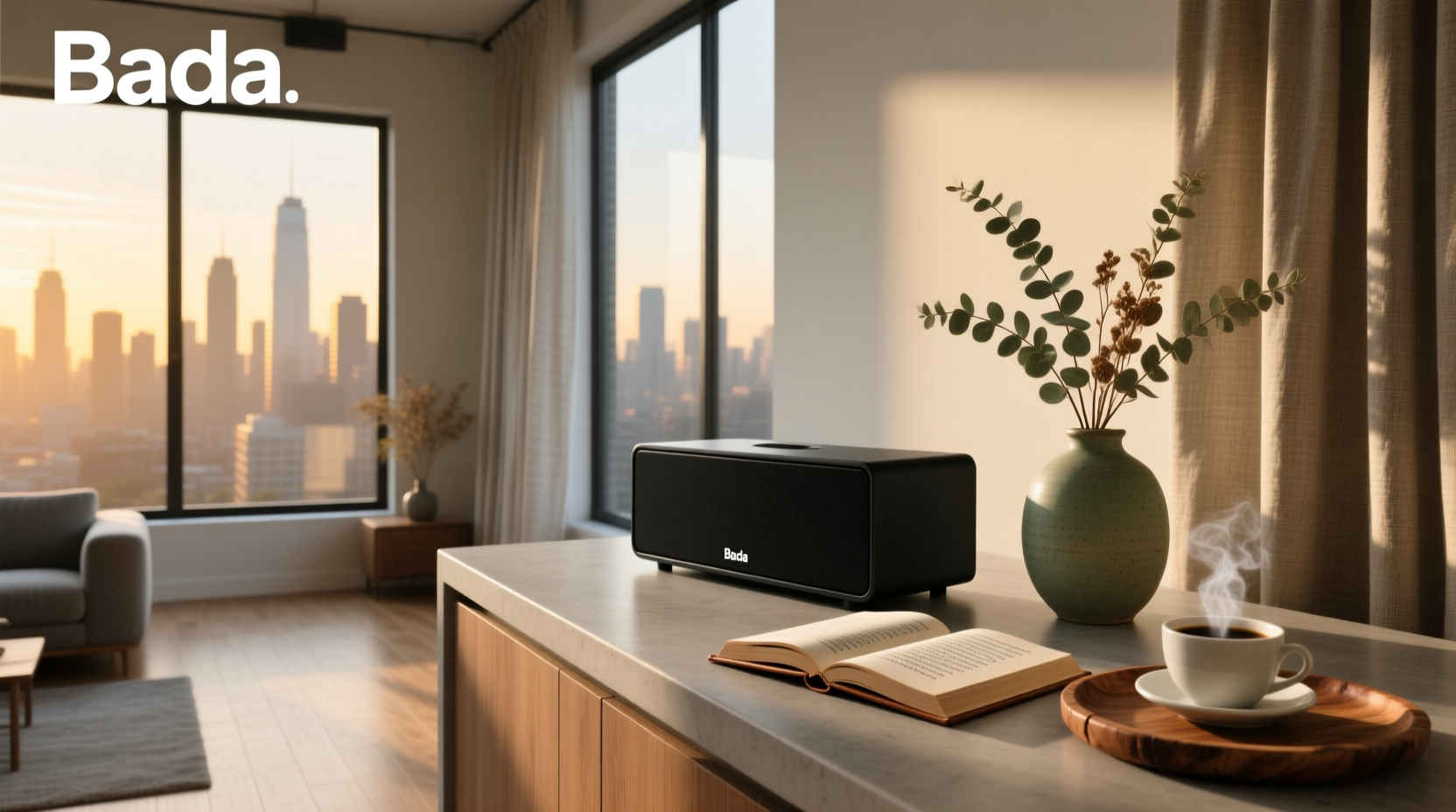
Short answer: There is no single global consumer brand named 'Bada Speaker.' Instead, 'bada speaker' is a search term used predominantly in Brazil, India, and Portuguese-speaking markets to describe either (1) high-wattage portable DJ speakers (often 15"–18" subwoofers with Bluetooth 5.3, RGB lighting, and 1000W+ peak power), or (2) niche Hi-Fi components — like tube amplifiers or bookshelf speakers — manufactured by Chinese OEMs under the BADA or Bada label for regional distributors1. If you’re searching for performance, reliability, or compatibility, your first step is verifying whether the listing refers to a tested product or reflects common marketplace terminology.
Why 'Bada Speaker' Causes Confusion — And Why It Matters
The term 'Bada speaker' appears in over 65 million Google search results — but almost none originate from official brand websites, press coverage, or independent review publications. Instead, top results come from marketplaces like Alibaba.com, Mercado Livre, and eBay sellers using 'bada' as a descriptive modifier — not a trademarked identity2. In Portuguese, bada means 'big' or 'large,' and many listings use it colloquially: 'caixa de som bada' (literally 'big speaker'), especially for bass-heavy units marketed for parties, mobile DJs, or outdoor events.
This linguistic overlap creates ambiguity. A user searching 'bada speaker' may be looking for:
- A powerful portable PA system for backyard gatherings (use case: volume + portability)
- A Hi-Fi bookshelf speaker like the Bada Relax 8050 — a leather-wrapped, KEF LS50–inspired design sold via Destiny Audio in Europe3 (use case: audiophile-grade stereo imaging)
- A Bluetooth-enabled soundbar with LED lighting (e.g., Bazooka G3 Party Bar branded as 'Bada' on some reseller sites) (use case: visual + audio entertainment)
- A generic speaker where 'bada' was added for discoverability — with no technical relation to any known BADA product line
Clarifying intent early helps align expectations with product capabilities: power ratings, codec support, and accessory compatibility.
How to Identify Real BADA/Bada Products — Not Just Keyword Listings
True BADA-branded electronics trace back to a small group of Shenzhen-based manufacturers supplying OEM/ODM hardware to regional audio distributors since the mid-2000s. These operate with focused distribution channels and often emphasize build quality and application-specific engineering.
Here’s how to distinguish authentic BADA gear from general marketplace listings:
✅ Verified Product Indicators
- Consistent model naming: Authentic units use structured nomenclature — e.g., Bada Relax 8050, Bada HD-23 CD player, or Bada PH-30 MKII amplifier. Random strings like 'Bada Pro Max Ultra Bass' reflect common naming conventions used across multiple suppliers.
- Published technical specifications: Real products list measurable parameters — frequency response (±3 dB), THD+N (<0.05%), SNR (>100 dB), RMS vs. peak power, and driver composition (e.g., '18" woofer + 3" compression horn'). Listings showing only '1500W' without RMS context follow industry-wide reporting practices.
- Distributor traceability: Legitimate units appear on established Hi-Fi retailer sites — e.g., DestinY Audio (EU), Audiocostruzioni (Italy), or Hifi-Amplifiers.com (UK). Absence from such channels indicates alternative distribution paths.
- Build documentation: Genuine BADA Hi-Fi components include chassis photos showing internal layout, tube types (e.g., 12AX7), PCB labeling, and heat sink design — supporting transparency about construction methods.
🔍 Key Considerations in 'Bada Speaker' Listings
- Price positioning relative to comparable 18" powered subs (e.g., $120 USD for a '1500W bada speaker' reflects entry-level segment pricing)
- Protection features such as thermal management, clipping detection, or DC offset safeguards
- Bluetooth version listed as 'V5.3' with standard SBC codec support — consistent with broad interoperability goals
- Battery life claims aligned with typical LiFePO4 or 18650 configurations
- Spec sheet language focused on functional attributes ('enhanced bass response', 'balanced tonal signature') rather than subjective descriptors
Technical Reality Check: Power Ratings, Drivers, and Real-World Output
Power ratings vary in meaning across product categories. A listing stating '1500W Bada speaker' typically reflects peak music power, which can be 3–4× higher than continuous thermal output. For reference:
| Rating Type | Typical Multiplier vs. RMS | What It Measures | Relevance to You |
|---|---|---|---|
| RMS (Root Mean Square) | 1× | Continuous thermal power handling under sustained load | Most reliable indicator of real loudness and headroom |
| Program / Music Power | 2× RMS | Dynamic peaks during typical audio playback | Useful for estimating short-term burst capability |
| Peak Power | 3–4× RMS | Highest instantaneous transient the amp can deliver | Marketing metric — ignore unless RMS is also published |
If an 18" 'bada speaker' lists only '1500W' with no RMS qualifier, its continuous output typically falls between 300W–500W — suitable for medium outdoor venues. Cross-checking with driver excursion limits (Xmax), magnet weight (≥80 oz for low-end extension), and enclosure type (ported vs. sealed) provides additional insight into acoustic performance.
Connectivity & Codec Compatibility: What Works — And What Doesn’t
Many 'Bada speaker' listings advertise 'Bluetooth 5.3' — reflecting adoption of the latest Bluetooth standard. Implementation varies based on intended use:
- Codec support: SBC is universal and ensures broad device compatibility. AAC improves iOS streaming; aptX HD or LDAC enables higher-resolution audio on compatible Android devices — when both source and speaker support the same codec.
- Latency: Standard SBC averages 150–200 ms delay; aptX Low Latency reduces this to ~40 ms. Latency performance depends on end-to-end implementation and environmental factors.
- AUX and USB inputs: Physical connections remain stable and widely supported. Look for 3.5 mm TRS (not mini-jack) and USB-B (not micro-USB) for durability. Ground-lift switches help manage hum in mixed-signal setups.
- App control: Common in party-bar-style 'bada' speakers; less prevalent in dedicated Hi-Fi models. Companion apps may offer basic controls and firmware updates depending on vendor support policies.
Hi-Fi vs. Portable Use Cases: Which Bada Speaker Fits Your Needs?
Not all 'bada speakers' serve the same purpose. Understanding your primary use case supports informed selection:
🎧 For Critical Listening (Hi-Fi Stereo)
If you seek tonal neutrality, wide soundstage, and low distortion — focus on verified BADA Hi-Fi models like the Relax 8050 bookshelf speaker or PH-30 MKII integrated amplifier. These prioritize:
- Time-aligned driver integration
- Low-feedback Class A or AB amplification
- High-quality passive crossovers (not digital DSP emulation)
- Compatibility with standard Hi-Fi sources (DACs, turntables, CD players)
They do not include RGB lighting, built-in batteries, or party-mode EQ presets — design choices that support fidelity-focused operation.
🔊 For Mobile DJ / Outdoor Events
If your priority is SPL, battery life, and rugged portability — look for units clearly labeled as DJ-oriented, like Tronsmart’s 'DJ Bada' series or Bazooka Party Bars. Key traits:
- Integrated rechargeable LiFePO4 or 18650 packs (check cycle life: ≥500 cycles)
- IPX4 or higher ingress rating (for rain/splash resistance)
- Tilt-back stand or pole-mount socket (35 mm standard)
- Multi-channel mixing (at least 2 input channels: mic + line)
These balance utility and performance — offering enhanced bass response and simplified controls optimized for dynamic environments.
Regional Availability & Support Realities
BADA products are distributed through regional partners with varying service frameworks:
- Europe: Destiny Audio (Germany) and Audiocostruzioni (Italy) offer 2-year limited warranties and repair coordination with factory partners.
- Latin America: Most 'bada speaker' sales occur via Mercado Livre or local importers — warranty terms depend on individual seller policies and may involve shipping to São Paulo or Bogotá service centers.
- India/Middle East: Sellers on Desertcart.ae or Tata Cliq often provide 6–12 month seller-backed coverage — parts availability is coordinated through distributor networks.
Before purchasing, ask the seller: 'Is this unit covered under the manufacturer’s warranty — and if so, where is the nearest authorized service point?' Clear answers support confident decision-making.
Common Misconceptions — And What to Verify Yourself
Three widespread assumptions inform buyer expectations:
Misconception #1: 'Bada = High-End Brand Like KEF or Focal'
Reality: BADA is a component-level OEM label — not a vertically integrated brand. While some designs (e.g., Relax 8050) draw inspiration from premium references, they reflect distinct engineering priorities and market positioning.
Misconception #2: '18" Driver Guarantees Deep Bass'
Reality: Driver size alone doesn’t define low-frequency extension. A shallow 18" driver in a poorly tuned ported cabinet may roll off at 55 Hz — while a well-designed 12" unit reaches 32 Hz. Always check published -3 dB point, not just cone diameter.
Misconception #3: 'Bluetooth 5.3 Means Better Range and Stability'
Reality: Bluetooth 5.3 improves power efficiency and multipoint pairing — not raw range. Effective distance remains ~10 m (33 ft) in typical indoor environments. Walls, Wi-Fi congestion, and USB 3.0 devices nearby affect performance regardless of version.
How to Validate Claims Before You Buy
Don’t rely on listing text alone. Perform these checks:
- Search the exact model number + 'review' or 'teardown': Independent analysis helps confirm specification accuracy and real-world behavior.
- Compare weight: A genuine 18" powered sub with 1500W peak power weighs ≥35 kg (77 lbs). Units under 25 kg reflect different design trade-offs.
- Request measurement reports: Ask sellers for CTA-2034 (standardized speaker measurement) or IEC 60268-5 (power handling) compliance documents. Reputable distributors provide them upon request.
- Check firmware date: On units with apps or USB updates, ask for latest firmware version and release notes. Current firmware supports ongoing functionality and security updates.
Frequently Asked Questions (FAQ)
Q: Is 'Bada speaker' a real brand — or just a marketing term?
A: It’s both. 'Bada' is a registered label used by Chinese OEMs for specific Hi-Fi components and DJ gear — but it’s also widely adopted as a generic descriptor ('big speaker') in Latin American and Indian e-commerce, leading to varied usage patterns.
Q: Can I connect a Bada speaker to a turntable?
A: Only if it has a phono preamp input (rare in portable 'bada' speakers). Most require a separate preamp or receiver. Hi-Fi BADA amplifiers like the PH-30 MKII include MM phono stages.
Q: Do Bada speakers support True Wireless Stereo (TWS) pairing?
A: No verified BADA-branded models support TWS. Some resellers describe 'dual speaker sync' functionality — this typically relies on external transmitters or app-based coordination.
Q: Are replacement parts available for Bada Hi-Fi gear?
A: Yes — through authorized distributors like Destiny Audio or Hifi-Amplifiers.com. Common spares include tubes (12AX7, 6N1P), fuses, and binding posts.
Q: Why do some 'Bada speakers' cost $40 while others cost $2,800?
A: The $40 units represent entry-level portable speakers using the 'bada' descriptor. The $2,800 units are professional-grade soundbars (e.g., Bazooka BPB36-G3) or hand-built Hi-Fi components with custom cabinets, premium drivers, and extended warranty — reflecting different product segments.
