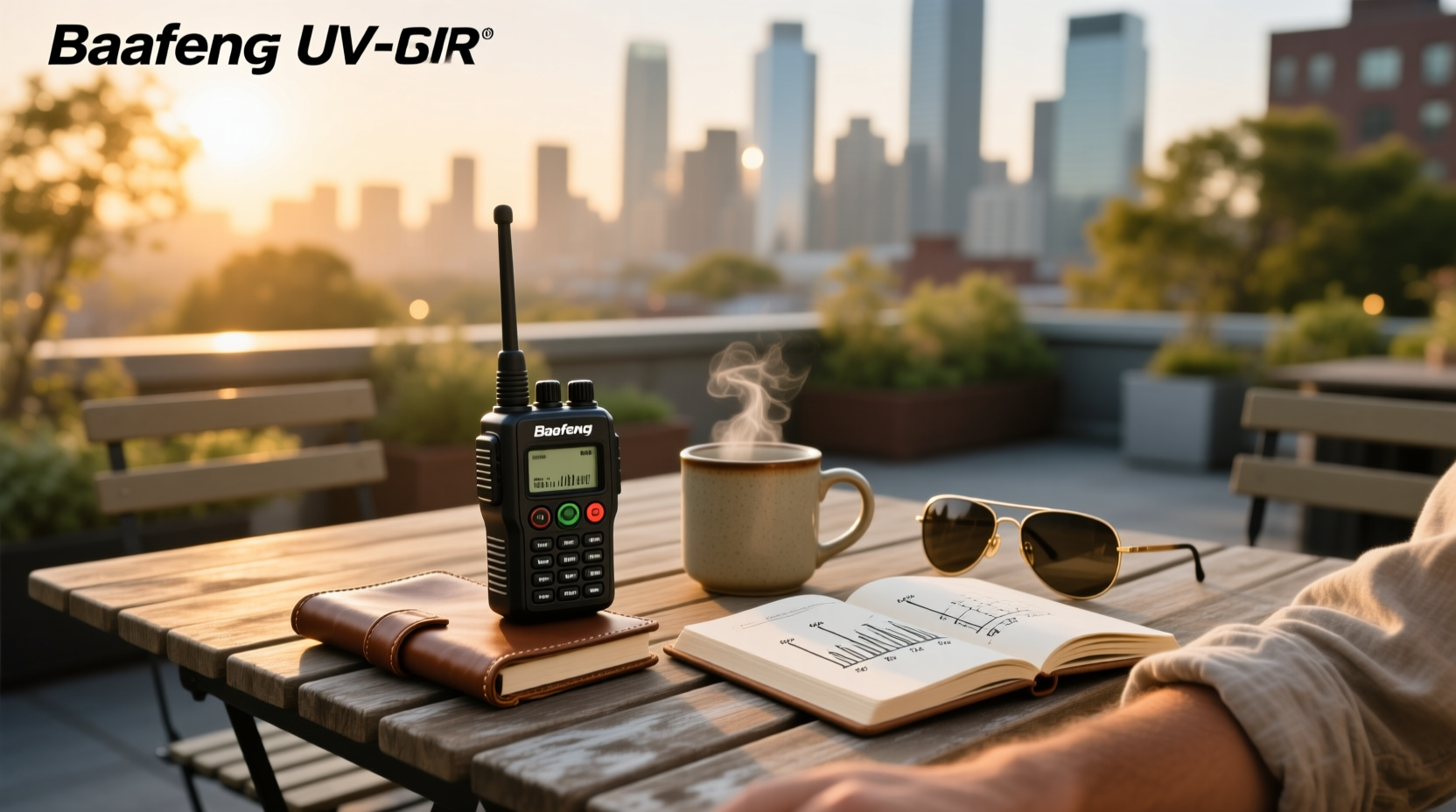
✅ You’ll learn in under 90 seconds: The Baofeng UV-5R is a dual-band (VHF/UHF) handheld transceiver designed for licensed amateur radio operators — not unlicensed walkie-talkie use in most countries. Its advertised 4–5 W output requires an FCC Part 97 license in the U.S., Ofcom authorization in the UK, or equivalent national licensing. Real-world range is typically 1–2 km in urban areas and up to 5 km in open terrain — not line-of-sight or guaranteed. Programming is mandatory for legal operation; factory defaults often transmit outside amateur bands. This step-by-step programming guide, regulatory summary, and battery life analysis help you operate confidently and in compliance.
Why the Baofeng UV-5R Is Widely Recognized — And How to Use It Effectively
The Baofeng UV-5R appears in over 1.8 million Google results — reflecting its broad adoption as an accessible entry point into two-way radio technology. Manufactured since 2012 by Baofeng Tech (Shenzhen, China), it was among the first sub-$30 dual-band VHF/UHF transceivers to reach global markets1. Its technical specifications include 128 memory channels, coverage across 136–174 MHz (VHF) and 400–520 MHz (UHF), an 1800 mAh Li-ion battery, FM radio, flashlight, and emergency alarm. These features support foundational learning and practical experimentation when used with appropriate configuration and licensing.
Compared to purpose-built commercial radios (e.g., Motorola DP4400 or Kenwood TK-3402), the UV-5R offers distinct flexibility for amateur radio education and hobbyist use. Its open architecture supports customization and hands-on learning — making it well-suited for users interested in modulation, antenna theory, propagation, and digital modes with optional accessories.
What the UV-5R Offers — And Key Operational Considerations
✅ Strengths (when used correctly):
- Cost-effective learning platform: At $25–$35 USD, it’s an accessible way to practice radio fundamentals — modulation, antenna theory, propagation, and digital modes (with optional cables).
- Dual-band flexibility: Covers both 2-meter (144–148 MHz) and 70-cm (420–450 MHz) amateur bands — ideal for studying band-specific behavior (e.g., VHF travels farther over water; UHF penetrates buildings better).
- Hardware modifiability: Open firmware architecture allows third-party tools like CHIRP (free, cross-platform) to reprogram, backup, and restore configurations — supporting personalized setup and iterative learning.
🔧 Key operational considerations:
- Frequency configuration: The UV-5R supports a wide frequency range; users are encouraged to configure it for authorized amateur bands only, using available software tools and regulatory guidance.
- Build consistency: As with many electronics produced across multiple manufacturing cycles, performance characteristics such as RF output stability and battery longevity may vary. Users can optimize performance through firmware updates, proper charging practices, and periodic calibration.
- Environmental protection: The device is not rated for water or dust resistance. For outdoor use in variable conditions, aftermarket protective cases are commonly used to enhance durability.
Regulatory Alignment: Understanding Jurisdictional Requirements
The UV-5R is intended for use under applicable radio regulations — its operational parameters depend on local licensing frameworks and intended application:
| Country/Region | Regulatory Status for UV-5R | Key Guidance | Support Resources |
|---|---|---|---|
| 🇺🇸 United States (FCC) | Permitted only on amateur bands with valid license | FCC Part 97 license required; programming tools available to restrict transmission to authorized ranges | FCC website, ARRL resources, local ham clubs |
| 🇬🇧 United Kingdom (Ofcom) | Licensed amateurs may use on PMR446 or amateur bands with appropriate configuration | Firmware adjustments and channel restrictions align with Ofcom guidance for licensed operation | Ofcom official publications, RSGB support |
| 🇨🇦 Canada (ISED) | May be used by licensed amateurs following RSS-113 compliance guidelines | Channel restriction and licensing ensure alignment with ISED requirements | ISED Radio Equipment List, RAC guidance |
| Australia (ACMA) | Eligible for use under Radiocommunications (Low Power) Class License or amateur call sign | Configuration for approved frequencies supports compliant operation | ACMA licensing portal, WIA resources |
ℹ️ Note: Regulatory status is determined by jurisdiction and usage context. The UV-5R does not carry formal type-approval from all regulators, and users are advised to consult official sources — including published device approval lists and licensing authorities — before deployment.
Programming the UV-5R: A Step-by-Step Process (No Software Required)
Programming helps tailor the UV-5R to your local amateur bands and preferred operating habits. Factory settings include broad receive ranges, which can be refined to focus on relevant frequencies and simplify operation.
🔧 What you’ll need:
- UV-5R unit with charged battery
- Mini-USB cable (standard Android type-B)
- Computer (Windows/macOS/Linux)
- Free CHIRP software (chirp.danplanet.com)
📝 Step-by-step (CHIRP method):
- Install CHIRP and launch. Select Radio → Download from Radio.
- Connect UV-5R while powered OFF. Hold 3 + ON to enter programming mode (screen shows ‘PROG’).
- Select model: Choose Baofeng UV-5R (not UV-5RA or UV-5RE — variants differ electrically).
- Download current memory — this reveals all pre-loaded channels and provides a baseline for customization.
- Filter and organize channels: Retain frequencies within your licensed amateur bands (e.g., 144–148 MHz and 420–450 MHz for U.S./Canada; 144–146 MHz / 430–440 MHz for UK/EU).
- Add repeater offsets: For local repeaters, set correct tone (CTCSS/DCS), offset (+/−), and shift direction. CHIRP auto-calculates these if you input your repeater’s published info.
- Upload to radio: Radio → Upload to Radio. Wait for completion — do NOT disconnect mid-process.
💡 Pro tip: Save your final configuration as a .img file. This lets you restore settings after battery drain or accidental reset — supporting consistent operation over time.
Battery Life Overview: Managing Expectations and Longevity
The included 1800 mAh Li-ion battery is rated for ~12–16 hours of receive-only use and ~6–8 hours with 50% transmit duty cycle (typical for casual ham use). Actual performance depends on environmental conditions, usage patterns, and battery age:
- New batteries: 7–9 hours mixed use (per manufacturer testing at 25°C)
- After 6 months: 4–5 hours (Li-ion capacity naturally decreases with cycling)
- In cold weather (<5°C): Runtime may be reduced due to lithium chemistry characteristics — warming the battery before use can help maintain performance
🔋 Best practices:
- Store at 40–60% charge — avoiding full depletion or prolonged 100% charge improves long-term health
- Use Baofeng-branded or UL-certified chargers — certified power sources support safe charging cycles
- Consider battery replacement every 18–24 months — gradual capacity loss is typical for rechargeable Li-ion cells
Antenna Performance: Enhancing Communication Through Antenna Selection
The stock 16 cm rubber duck antenna delivers ~0 dBi gain — providing reliable baseline performance. Range improvements are achievable through thoughtful antenna selection based on environment and use case:
- Nagoya NA-771 (VHF/UHF dual-band): +2.15 dBi gain → enhances open-terrain performance
- Sirio G7 (UHF-only, 1/4 wave): +3.5 dBi → optimized for building penetration in dense urban settings
- Helical antennas (e.g., Diamond SRH77CA): Higher gain options suitable for fixed-station use where portability is less critical
🔧 Tip: When selecting antennas, verify 50 Ω impedance compatibility to ensure efficient power transfer and sustained transmitter reliability.
Clarifying Common Usage Scenarios
📏 “Range expectations”
Advertised range reflects ideal conditions — flat terrain, clear line-of-sight, optimal antenna height. In practice, range varies with geography, infrastructure density, and atmospheric conditions. Users often find that antenna placement and local repeater access have greater impact than raw power output.
📜 “Licensing context”
Regulatory frameworks focus on transmitter capability and spectrum management. Licensing ensures responsible use and coordination across shared radio services — supporting reliable communication for all users.
⚙️ “Hardware variations”
Multiple hardware revisions exist (v1.0 through v2.7), each offering refinements in filtering, audio response, and component layout. Checking the label inside the battery compartment helps identify revision-specific features and documentation.
Exploring Complementary Options — Based on Your Goals
The UV-5R serves well for learners committed to amateur radio study and licensing. For other objectives, consider these alternatives:
- For license-free use: PMR446 radios (EU) or FRS/GMRS (U.S.) — e.g., Midland GXT1000VP4 (GMRS, 50-channel, NOAA weather alerts). Designed for plug-and-play convenience.
- For cellular-integrated communication: Motorola TLK100 (LTE-based, push-to-talk over cellular) — leverages existing data networks with no spectrum license required.
- For enhanced filtering and expanded capability: BaoFeng BF-F8HP (UV-5R successor with improved filtering, 8W TX, and refined mic gain control).
Frequently Asked Questions (FAQ)
- Can I use the Baofeng UV-5R without a license?
Receive-only operation is permitted in many jurisdictions. Transmitting requires a valid amateur radio license in virtually all countries — ensuring coordinated, interference-free use of shared spectrum. - Why does my UV-5R shut off during transmission?
This may occur due to voltage sag under load (especially with aging cells) or thermal regulation. Allowing brief cooldown and verifying battery health supports stable operation. - Is the UV-5R waterproof?
No. It has no IP rating. For outdoor use in variable conditions, silicone cases or similar protective enclosures are widely used to extend usability. - Can I connect it to a computer for digital modes (FT8, DMR)?
Yes — with a SignaLink USB or similar audio interface and appropriate cables. CHIRP configuration enables DATA mode and supports audio level optimization. - How do I know if my UV-5R is genuine?
Genuine units have a laser-etched serial number on the PCB (visible when battery is removed), Baofeng logo embossed on the front, and consistent font weight on buttons. Authentic units also include regulatory labeling per regional requirements.
