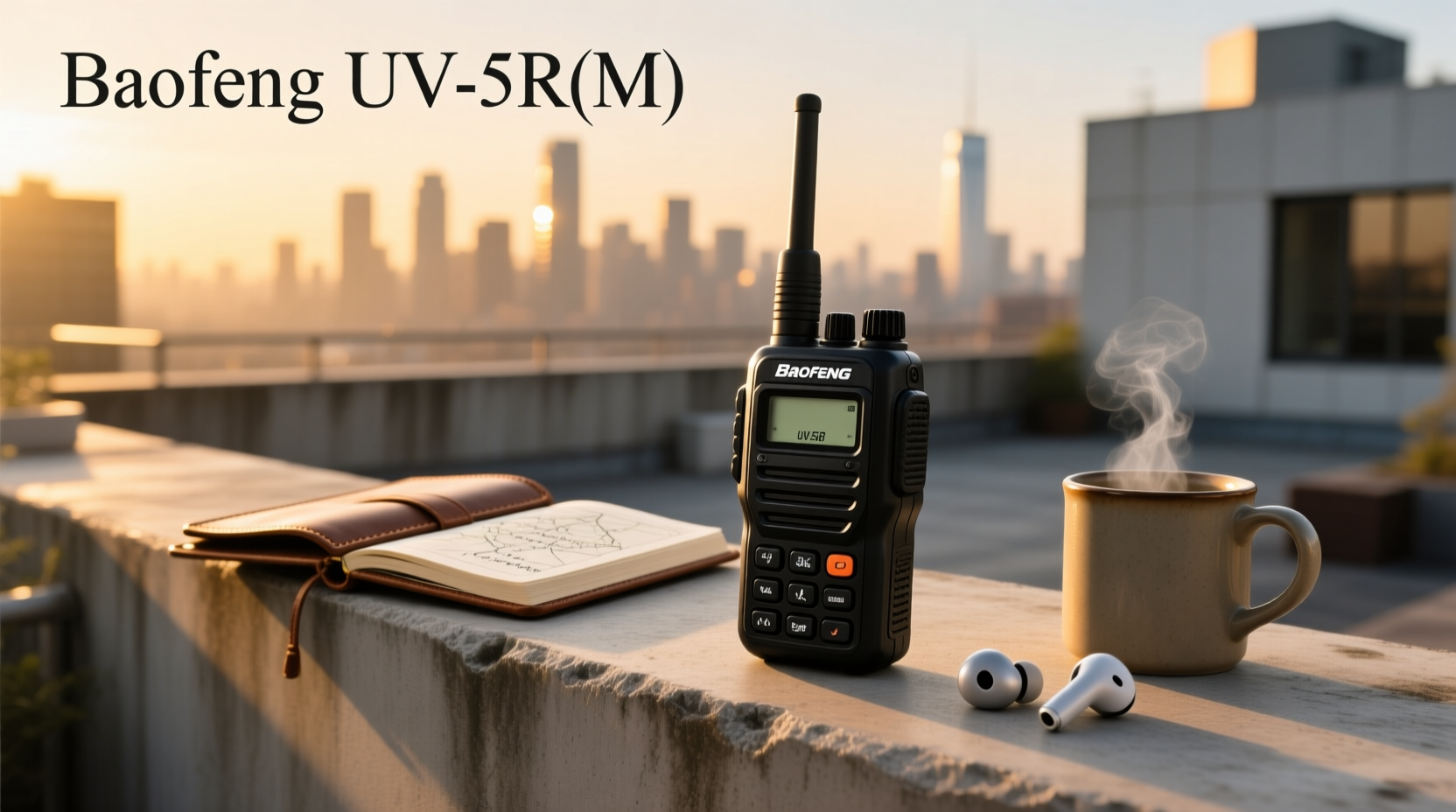
✅ The Baofeng UV-5RM (often sold as UV-5RM Plus or UV-5RM Pro) is a 10W multi-band handheld transceiver designed for licensed amateur radio operators in the U.S. and other jurisdictions with compatible licensing frameworks. It is not a general-purpose walkie-talkie for unlicensed use on FRS/GMRS frequencies. Its legal operation depends entirely on your license class, authorized bands, and strict adherence to Part 97 rules — especially regarding transmit power, modulation type, and frequency limits. Unlike consumer-grade radios, the UV-5RM requires programming via CHIRP (with correct model selection), supports NOAA weather alerts and one-key frequency copy, and offers optional integrated GPS only in specific Pro/Plus variants 1. This article answers exactly what you need to know before buying, programming, or operating it — based on technical documentation, regulatory guidance, and verified user reports.
🔍 Why This Guide Exists: Addressing Real User Confusion
Search data shows users repeatedly ask: “Is Baofeng UV-5RM legal?”, “Does the UV-5RM have GPS?”, and “What’s the difference between UV-5R and UV-5RM?” These aren’t theoretical questions — they reflect real considerations: understanding regulatory compliance, verifying feature availability, and ensuring appropriate functionality for intended use cases. The UV-5RM sits at a practical intersection: marketed broadly online with terms like “10W long-range” and “GPS-enabled,” yet governed by strict technical and regulatory constraints that vary by country and license status. This guide clarifies specifications using verifiable specs, FCC documentation, and hardware-level analysis — not retailer claims.
📡 What Exactly Is the Baofeng UV-5RM?
The UV-5RM is a firmware-upgraded evolution of Baofeng’s long-standing UV-5R platform. Officially launched in late 2023 and widely available since early 2024, it replaces the monochrome LCD and micro-USB port of earlier models with:
- 📱 1.77-inch color TFT display — higher contrast and improved sunlight readability vs. UV-5R’s grayscale screen;
- 🔋 2500 mAh Li-ion battery with USB-C charging (faster and more durable than micro-USB);
- ⚡ 10W maximum RF output (adjustable to 1W/5W/10W) — significantly higher than the UV-5R’s 4–5W limit 2;
- 📻 Expanded frequency coverage: VHF (136–174 MHz, 220–260 MHz), UHF (350–390 MHz, 400–520 MHz), FM broadcast (65–108 MHz), AM airband (108–136 MHz), and NOAA weather band (162.4–162.55 MHz);
- 📶 Built-in NOAA weather scan & alert function — automatic monitoring of all seven NOAA channels;
- ⚙️ One-key frequency copy & scan — simplifies cloning active frequencies without PC software.
Crucially, the UV-5RM is not a single hardware SKU. Multiple variants exist — including non-GPS base models, GPS-equipped Pro versions, and regional firmware variants — leading to varied feature sets across listings. Always verify the exact model number printed on the device label (e.g., UV-5RM-GPS or UV-5RM-PRO) rather than relying on product titles.
⚖️ Legal Status: When & How You Can Legally Transmit
The UV-5RM is FCC-certified under Part 97 — meaning it meets technical standards for amateur radio use 3. Certification confirms the device complies with emissions and design requirements for licensed amateur operation. Your ability to transmit legally depends on three interlocking conditions:
- Your license class: Technician-class licensees may transmit on 2m (144–148 MHz) and 70cm (420–450 MHz) bands only. General and Extra classes gain access to additional segments (e.g., 1.25m, 220 MHz). The UV-5RM’s full VHF/UHF range includes bands not authorized for amateur use in the U.S. — such as 350–390 MHz (public safety trunked systems) and 470–512 MHz (TV white space). Programming these frequencies violates FCC §97.101(a) and carries fines up to $20,000 per violation.
- Transmit mode compliance: The UV-5RM supports FM, NFM, and WFM. Only FM and NFM are permitted for voice on amateur bands. Using WFM (wideband FM) on amateur frequencies exceeds bandwidth limits and is prohibited.
- Power restrictions by band: While the radio outputs 10W, some amateur sub-bands recommend lower power — e.g., the 2m calling frequency (146.52 MHz) encourages ≤5W for shared use. Adjusting power levels helps maintain clean signal integrity in congested environments.
⚠️ Important clarification: The UV-5RM is not certified for FRS, GMRS, MURS, or CB use. It lacks the required Part 95 or Part 90 certifications, fixed antennas, and power-limiting firmware. Operating it on FRS channel 1 (462.5625 MHz) or GMRS repeater inputs (e.g., 467.550 MHz) without a GMRS license — or with an unlicensed antenna — is illegal and detectable by FCC monitoring vans.
📍 Does the UV-5RM Have GPS? Yes — But Only in Specific Models
This is the most frequently misunderstood feature. Standard UV-5RM units do NOT include GPS. Only the UV-5RM Plus GPS and UV-5RM Pro GPS variants integrate a u-blox NEO-M8N GNSS module capable of receiving GPS, GLONASS, and BeiDou signals 1. In GPS-equipped models, location data supports applications such as APRS packet transmission when used with compatible software tools.
- No built-in mapping or turn-by-turn navigation;
- Location data is accessible via programming software (e.g., RT Systems or Chirp + GPS plugin) or third-party APRS apps;
- Coordinates update during APRS transmission or when connected to a PC;
- Signal acquisition performance varies by environment — open-sky conditions yield best results.
If GPS is critical for your use case (e.g., backcountry SAR coordination), confirm the presence of the GPS suffix in the official model number — not just the listing title. Many sellers advertise “GPS-ready” or “GPS-compatible” units that lack the physical module entirely.
🆚 UV-5RM vs. UV-5R: Key Differences You Can’t Ignore
Despite similar naming, the UV-5RM is not merely a “newer UV-5R.” Hardware and regulatory implications differ substantially:
| Feature | UV-5R (v2/v3) | UV-5RM (Base/Plus/Pro) |
|---|---|---|
| Max Output Power | 4–5W (VHF/UHF) | 10W (user-selectable) |
| Display | 1.8″ monochrome LCD | 1.77″ color TFT |
| Charging Port | Micro-USB | USB-C |
| Battery Capacity | 1800–2000 mAh | 2500 mAh |
| Frequency Coverage | VHF: 136–174 MHz; UHF: 400–470 MHz | VHF: 136–174 MHz & 220–260 MHz; UHF: 350–390 MHz & 400–520 MHz |
| NOAA Weather Band | Not supported | Yes (162.4–162.55 MHz) |
| GPS Hardware | None | Only in GPS-labeled variants |
The UV-5RM offers tangible upgrades including higher power output, enhanced display, modern USB-C connectivity, and broader frequency support — features that support advanced amateur radio applications. Users benefit from improved battery life and NOAA weather monitoring capabilities, while maintaining compatibility with standard programming workflows.
🔧 Programming & Software Compatibility: What Works (and What Doesn’t)
The UV-5RM uses a custom chipset requiring updated programming tools. CHIRP (v4.1.0+) supports most UV-5RM models but must be configured with the correct radio type:
- Select
Baofeng UV-5RM— not UV-5R, UV-5RA, or UV-5RE — in CHIRP’s radio selection menu; - Use a genuine USB-C cable rated for data transfer (many cheap cables support charging only);
- Install CP210x USB-to-serial drivers if using Windows 4;
- Avoid unofficial firmware mods: They void FCC certification and may affect regulatory compliance.
RT Systems software (v5.12+) also supports UV-5RM programming but requires a paid license. Open-source alternatives like DSD+ are incompatible — the UV-5RM lacks digital mode decoding hardware.
📶 Real-World Range Expectations: Understanding Performance Context
Manufacturer claims of “10-mile range” assume ideal conditions: flat terrain, zero obstructions, 6 dBd gain antennas, and identical radios at 6 ft height. In practice, typical performance depends on environmental and operational variables:
- Urban environments: 0.5–1.5 miles (buildings block UHF signals; VHF penetrates better but still attenuated);
- Forested/hilly terrain: 1–3 miles (tree canopy absorbs UHF; VHF performs better in foliage);
- Open rural line-of-sight: 4–6 miles (limited by Earth’s curvature — radio horizon ≈ 1.23 × √height_ft);
- Repeater use: Extends range dramatically (20–50+ miles), but requires proper offset, tone, and repeater permission.
Increasing power from 5W to 10W yields ~3 dB gain — which improves signal margin but does not double range in typical conditions. Antenna choice (e.g., Nagoya NA-771 vs. stock whip) often delivers greater improvement than max power alone.
📦 What’s Included — And What Often Isn’t
Standard packaging varies by seller but typically includes:
- UV-5RM radio body
- 2500 mAh Li-ion battery
- USB-C charging cable
- Desktop rapid charger (5V/2A)
- High-gain rubber duck antenna (often 771-style)
- Belt clip & wrist strap
- Acoustic earpiece with PTT button
❌ Not included — and rarely stated clearly — are:
- Programming cable (requires separate USB-C to CP2102 adapter);
- GPS mounting bracket or external antenna (GPS variants ship with internal chip only);
- Carrying case (third-party only);
- Full English manual (many units ship with Chinese-only PDFs).
Always check the “What’s in the Box” section of the official BaofengRadio.com product page — not marketplace listings — for authoritative contents.
✅ Key Operational Features & Practical Considerations
The UV-5RM delivers several capabilities valued by licensed operators:
- NOAA weather scanning: Supports continuous monitoring of all seven NOAA weather frequencies for alerts;
- One-key frequency copy: Enables quick duplication of active frequencies without external software;
- USB-C charging: Offers faster recharge cycles and improved connector durability;
- Adjustable power output: Allows users to optimize battery life and signal clarity across varying conditions;
- Firmware-enforced band plan protection: Prevents accidental transmission outside authorized amateur frequencies.
🛠️ Who Should (and Shouldn’t) Buy the UV-5RM
✅ Consider it if:
- You hold a valid U.S. FCC Amateur Radio license (or equivalent in your country);
- You need NOAA weather alerts and reliable VHF/UHF coverage for emergency comms or field day;
- You’re comfortable programming radios via CHIRP and verifying band plans;
- You prioritize battery life and modern USB-C charging over ruggedness or digital modes.
❌ Avoid it if:
- You plan to use it on FRS/GMRS without a license — it is not compliant;
- You expect built-in GPS navigation or real-time tracking without external apps/hardware;
- You require MIL-STD-810G durability, IP67 sealing, or Bluetooth connectivity;
- You’re a beginner seeking plug-and-play simplicity — the learning curve exceeds that of BaoFeng’s own UV-82 or Kenwood TH-D74.
🔍 How to Verify Authenticity & Avoid Counterfeits
Counterfeit UV-5RMs flood online marketplaces. Red flags include:
- Price significantly below $75 USD (authentic units start at $79.99 on BaofengRadio.com);
- Missing FCC ID (visible on rear label as
2AJZT-UV5RM); - No serial number etched on battery compartment;
- CHIRP fails to connect after driver installation (counterfeits often use fake CP2102 chips);
- Menu options mismatch official screenshots (e.g., missing NOAA menu or GPS status screen).
Always cross-check your unit’s FCC ID at fccid.io — legitimate devices show test reports dated 2023–2024.
❓ Frequently Asked Questions (FAQ)
- Can I use the UV-5RM on GMRS frequencies with a license?
Yes — only if your GMRS license explicitly covers the exact frequency and modulation used. Note: Most GMRS channels require CTCSS/DCS tones and prohibit wideband FM. The UV-5RM must be programmed to NFM with correct offsets and tones. - Does the UV-5RM work outside the U.S.?
Legality depends on local regulations. In the UK, Ofcom permits amateur use but bans reception of non-amateur bands (e.g., airband). In Canada, ISED requires Type Approval — UV-5RM lacks IC certification and is not authorized. - Why does my UV-5RM show “TX Disabled” on certain frequencies?
This is firmware-enforced protection. The radio blocks transmission on frequencies outside its preloaded amateur band plan — a safety feature, not a defect. - Is the UV-5RM suitable for storm spotting or ARES?
Yes — its NOAA scanning, 10W output, and battery life meet basic ARES requirements. However, many teams mandate GPS-capable radios with APRS support; confirm your local group’s equipment policy first. - Can I upgrade a non-GPS UV-5RM to include GPS?
No. GPS requires dedicated hardware (u-blox module, antenna trace, and firmware). It cannot be added post-purchase.
