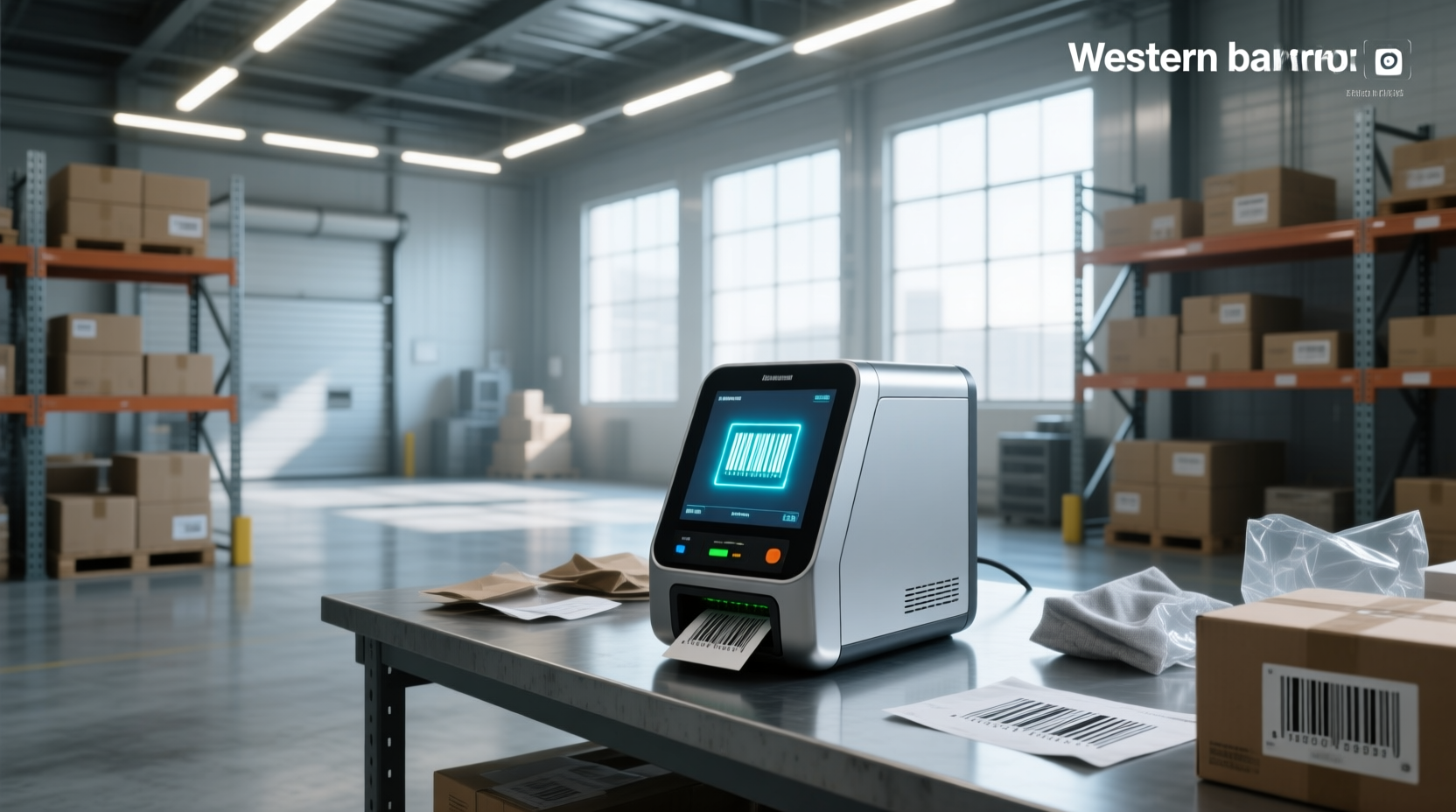
You need a barcode verifier — not just a scanner — if your business prints, labels, or ships products where scannability is mission-critical (e.g., retail distribution, pharmaceutical packaging, or FDA-regulated logistics). A true barcode verifier performs ISO/IEC-compliant grading (A–F) on symbol contrast, modulation, decodeability, and edge determination — something no smartphone app, web tool, or standard barcode reader can do reliably1. This article explains exactly what a barcode verifier is, how it differs from common lookup tools and scanners, which industries require verification, what specifications matter most, and how to avoid costly compliance failures.
Why ‘Barcode Verifier’ Searches Often Lead to Confusion
When users search for barcode verifier, Google returns a mix of consumer-grade scanning apps (like QR & Barcode Scanner on Google Play), free online lookup services (e.g., Go-UPC, Barcode Lookup), and industrial-grade hardware (e.g., Cognex DM475, Axicon PV series)2. That’s because the term is used loosely — often conflated with barcode scanners, online GTIN lookup tools, or mobile verification apps. But in supply chain, manufacturing, and regulatory contexts, a barcode verifier has one strict technical definition: a calibrated, standards-based instrument that measures and reports on the physical print quality of a barcode against internationally recognized specifications.
This distinction matters. A retailer rejecting a shipment because its UPC labels failed scan testing isn’t complaining about data accuracy — they’re citing print quality nonconformance. And only a certified verifier — not a phone camera or web decoder — can produce the auditable, repeatable grade report required by Walmart’s Retail Link, Amazon’s Seller Central, or GS1’s Global Standards Management Process (GSMP).
Barcode Verifier vs. Barcode Scanner: Not Interchangeable
The most frequent misunderstanding centers on function. Let’s clarify:
| Feature | Barcode Verifier | Barcode Scanner / Reader | Online Lookup Tool (e.g., Verified by GS1) |
|---|---|---|---|
| Purpose | Measures physical print quality and assigns an ISO/IEC grade (A–F) | Decodes symbology to retrieve encoded data (e.g., GTIN) | Looks up registered GTINs in GS1’s database to verify company prefix ownership |
| Output | Pass/fail result + detailed report: reflectance, quiet zone, symbol contrast, decodability, etc. | Raw data string (e.g., "0123456789012") | Company name, address, product description (if registered) |
| Compliance | Must conform to ISO/IEC 15415 (2D), 15416 (1D), or 15426 (verification protocols) | No formal standard — performance varies by sensor, lighting, firmware | No physical measurement — purely database matching |
| Calibration | Requires periodic calibration using certified test charts (e.g., NIST-traceable) | No calibration needed or possible | N/A — software-only |
| Use Case | Pre-shipment label validation, print process control, audit defense | Point-of-sale checkout, warehouse receiving, inventory tracking | Verifying GTIN legitimacy before listing, checking brand ownership |
A scanner answers “What does this code say?” A verifier answers “Will this code scan reliably — today, next month, and after warehouse handling — across all retail scanners?” The difference is foundational. As Cognex explains: “Scanners are designed to read; verifiers are designed to assess3.”
When Do You Actually Need a Barcode Verifier?
Not every business requires dedicated verification hardware. Here’s a decision framework:
- ✅ Required: Companies that print their own barcodes (e.g., private-label manufacturers, contract packagers, pharmaceutical labs) — especially if supplying major retailers or regulated sectors (FDA, EU MDR, ISO 13485).
- ✅ Required: Label printers and packaging converters performing pre-press or inline quality control — where repeatability and traceability are contractual obligations.
- ⚠️ Optional but recommended: E-commerce fulfillment centers printing shipping labels (e.g., UPS, FedEx, USPS barcodes) — high-volume thermal printing degrades over time; verification prevents downstream scan failures.
- ❌ Not needed: Consumers looking up product info, resellers checking authenticity via GTIN, or small businesses using pre-printed labels from certified vendors.
If your label fails a retailer’s incoming scan test, you’ll typically receive a noncompliance notice referencing ISO/IEC 15416 or 15415. Without a verifier-grade report showing root cause (e.g., low contrast due to ribbon wear), dispute resolution is nearly impossible.
Key Technical Specifications: What to Evaluate Before Buying
Industrial barcode verifiers vary significantly in capability. Focus on these five non-negotiable criteria:
1. Symbology Support & Standard Compliance
Verify explicit support for your required symbologies: UPC-A, EAN-13, Code 128, DataMatrix, QR Code, and GS1 DataBar. Confirm conformance to current versions of:
- ISO/IEC 15416 (for linear/1D symbols)
- ISO/IEC 15415 (for 2D symbols)
- ISO/IEC 15426-1 (verification protocol for 1D)
- ISO/IEC 15426-2 (for 2D)
Older models may only meet legacy standards (e.g., AIM DPM-1999), which lack modern parameters like partial decode or cell modulation analysis. Always request the manufacturer’s compliance statement — not marketing claims.
2. Illumination Geometry & Aperture
Verification depends on controlled, standardized lighting. Look for devices specifying:
- Annular illumination (for omnidirectional scanning simulation)
- Low-angle lighting (to detect specular reflection issues)
- Multiple aperture options (e.g., 10°, 30°, 45°) to match scanner field-of-view requirements
Fixed-aperture units cannot adapt to varying label sizes or material finishes (e.g., glossy vs. matte, direct thermal vs. thermal transfer).
3. Calibration & Traceability
A verifier without documented calibration is functionally useless for audits. Ensure:
- Factory calibration certificate included (NIST-traceable or equivalent national metrology institute)
- On-device self-calibration or easy recalibration procedure
- Annual recalibration service availability (and cost)
Devices sold as “ISO-compliant” without calibration documentation fail third-party validation.
4. Reporting & Data Export
Reports must be exportable in PDF or CSV, include full parameter breakdowns (not just overall grade), and retain timestamp, operator ID, and image capture. Avoid units that only display pass/fail on-screen with no audit trail.
5. Integration Capability
For production lines, look for:
- PLC-compatible I/O (discrete pass/fail signals)
- OPC UA or Modbus TCP support
- API access for automated reporting into MES or QMS systems
Can You Use Free Online Tools or Apps Instead?
No — and here’s why.
Free web-based “barcode verifiers” (e.g., ImageToText.info, Minify’s Scanner) or mobile apps claiming “verification” perform decoding only. They may tell you whether a photo contains a scannable QR code — but they cannot measure:
- Minimum reflectance ratio (Rmin/Rmax)
- Edge contrast (EC)
- Quiet zone width (measured in modules, not pixels)
- Symbol contrast (SC) per ISO/IEC 15416 Section 4.3
- Decodability (how much error correction margin remains)
Smartphone cameras lack calibrated illumination, fixed focus, and spectral response control. Lighting conditions, screen glare, lens distortion, and JPEG compression all introduce unquantifiable variables. As Omron Automation states: “Barcode verification requires objective, repeatable measurement — not subjective visual interpretation4.”
Even GS1’s official Verified by GS1 service — while authoritative for GTIN ownership and registration status — does not assess physical print quality. It confirms “who owns this number,” not “will this printed version scan at Target’s distribution center.”
Common Misconceptions About Barcode Verification
Misconception #1: “If my scanner reads it, it’s verified.”
False. Scanners are designed for best-effort reading under ideal conditions. A verifier simulates worst-case scanning environments — dirty lenses, motion blur, low battery, varying angles — and grades robustness.
Misconception #2: “All verifiers give the same result.”
No. Results vary based on calibration status, lens quality, illumination uniformity, and software algorithm implementation. Independent testing shows >15% variance between uncalibrated units on identical samples5.
Misconception #3: “One-time verification is enough.”
Print quality drifts. Ribbon degradation, printhead wear, environmental humidity, and substrate changes affect output. Best practice: verify at start-of-shift, after maintenance, and every 2–4 hours during continuous printing.
Cost Considerations and Total Cost of Ownership
Entry-level handheld verifiers start around $2,200 USD (e.g., Axicon PV series); benchtop or inline systems exceed $15,000. But consider hidden costs:
- Chargebacks: Walmart imposes $250–$500 penalties per noncompliant case; Amazon may suspend listings.
- Reprints & labor: Recreating 500 rejected labels takes ~2 hours of labor + materials.
- Lost sales: Shelf-ready packaging rejected at DC = delayed launch = lost holiday revenue.
- Recalibration: Typically $300–$600 annually; some vendors bundle 2 years.
ROI is often realized within 3–6 months for mid-volume producers.
How to Validate Your Verifier’s Output
Don’t rely solely on the device report. Cross-check using:
- GS1’s Barcode Verification Guidelines — freely available PDF outlining pass thresholds for each parameter6.
- Test charts: Purchase certified verification test charts (e.g., from Applied Image or TSC Auto ID) with known grades. Run them weekly.
- Third-party lab comparison: Send sample labels to an accredited metrology lab (e.g., UL, SGS) for independent assessment — recommended annually.
Final Recommendation: Who Should Buy What?
For brands & manufacturers printing labels in-house: Invest in a calibrated, ISO-compliant verifier (e.g., Cognex DM475, Axicon PV340, or Omron F150). Prioritize calibration support and reporting depth over speed.
For distributors or 3PLs receiving labeled goods: A verifier is rarely needed unless auditing supplier compliance. Focus instead on high-reliability scanners with wide-angle decode and ruggedized housings.
For consumers or small sellers: Use free GS1 tools (Verified by GS1) and mobile scanners for GTIN lookup — but understand these confirm registration, not print integrity.
Frequently Asked Questions
- Can a smartphone app verify barcode print quality?
No. Phone cameras lack calibrated lighting, fixed focus, and spectral control required for ISO-compliant measurement. Apps decode — they don’t verify. - Is ‘Verified by GS1’ the same as barcode verification?
No. Verified by GS1 confirms GTIN registration and company prefix ownership. It does not assess physical print quality or scannability. - Do I need separate verifiers for 1D and 2D codes?
Most modern verifiers (e.g., Cognex DM475, Axicon PV340) handle both 1D and 2D symbologies under one platform — verify model specifications before purchase. - How often should I calibrate my barcode verifier?
Annually is standard, but verify per manufacturer guidance. Also recalibrate after impact, extreme temperature exposure, or if test chart results deviate >5% from baseline. - What’s the minimum passing grade for retail compliance?
Most retailers (Walmart, Kroger, Target) require ≥ Grade C (≥2.0 on 4.0 scale) for all parameters. Some mandate Grade B (≥3.0) for healthcare or perishables.
