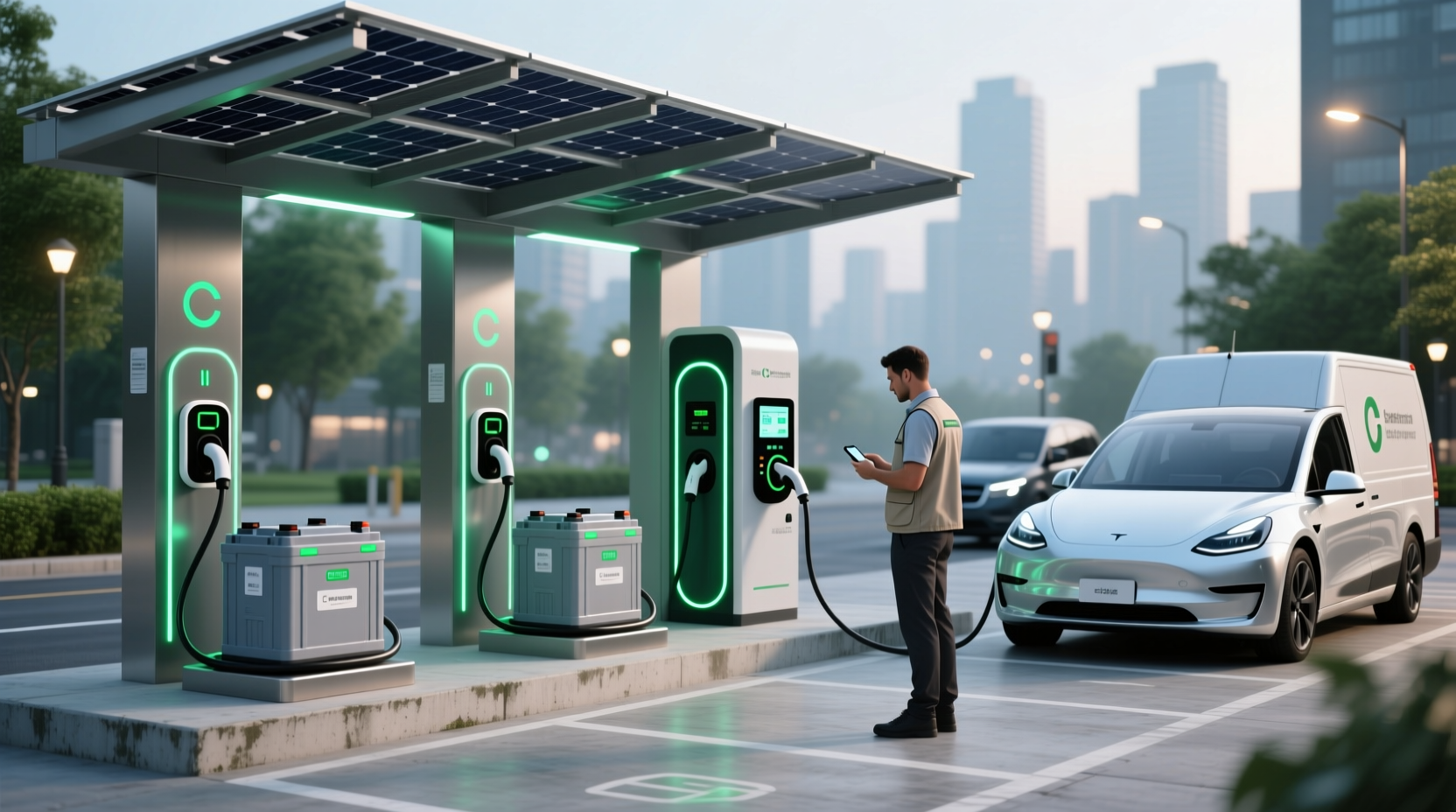
✅ Battery swapping stations are automated facilities that replace an electric vehicle’s depleted battery with a fully charged one in 2–5 minutes — offering near-instant 'refueling' for fleets, two-wheelers, and commercial EVs where downtime is costly. Unlike plug-in charging, this method decouples energy replenishment from vehicle ownership and enables centralized battery health management, grid integration, and rapid turnaround for high-utilization vehicles like taxis, delivery vans, and e-rickshaws1. While widely deployed in China (NIO operates over 3,760 stations) and growing rapidly in India (Sun Mobility, Battery Smart, Lithion Power), adoption in North America and Western Europe reflects evolving infrastructure development timelines and regional policy frameworks supporting battery-as-a-service (BaaS) models.
Why Battery Swapping Exists — And Why It’s Not Just ‘Faster Charging’
Battery swapping isn’t a replacement for home or public charging — it’s a complementary operational model designed for specific use cases where time, predictability, and battery lifecycle control matter more than consumer convenience. Consider these real-world drivers:
- Commercial fleet uptime: A delivery van losing 45–90 minutes per fast-charge session across 3–4 daily cycles loses ~3–5 hours of revenue-generating time weekly. Swapping cuts that to <5 minutes — effectively preserving 90%+ of scheduled operating hours3.
- Battery longevity management: Swapped batteries are charged under optimized voltage/temperature profiles in climate-controlled stations — avoiding the thermal stress of repeated DC fast charging, which accelerates degradation4.
- Urban space constraints: In dense cities like Bangkok or Mumbai, installing high-power charging corridors requires significant land, grid upgrades, and permitting. A single swapping station (occupying ~15–25 m²) can serve dozens of vehicles per hour without drawing >100 kW continuously5.
- Grid balancing potential: With 20–100+ swappable packs on-site, stations act as distributed energy storage — absorbing off-peak power and discharging during peak demand, supporting local grid stability6.
How Battery Swapping Actually Works — Step by Step
The process is highly standardized across leading providers (NIO, Ample, Sun Mobility), though mechanical interfaces differ. Here’s what happens during a typical swap:
- Pre-arrival authentication: The driver selects a station via app; vehicle identity, battery health status, and available inventory are verified wirelessly (via Bluetooth or cellular). Most systems require ≥20–30% remaining SOC to avoid deep-discharge damage during transit7.
- Guided positioning: Using ground markings, LED guidance, or lidar-assisted alignment, the vehicle parks precisely over the station’s robotic platform. Cameras confirm chassis geometry and battery mounting points.
- Automated lift and disconnect: Hydraulic or scissor lifts raise the vehicle ~30–50 cm. Robotic arms loosen locking mechanisms, disconnect high-voltage and data connectors, then extract the depleted pack (typically 15–300 kWh depending on vehicle class).
- Swap and reconnection: A pre-conditioned, fully charged battery is inserted, connectors re-engaged, and locks secured. Full electrical handshake confirms communication integrity before lowering.
- Exit and billing: The vehicle exits; billing is applied automatically (per swap, per kWh, or subscription-based). Average dwell time: 2 min 45 sec (NIO Gen 5 target: <120 sec)8.
Global Deployment Landscape — Who’s Doing It, Where, and Why
Adoption reflects regional priorities, urban density, fleet economics, and battery supply chain development.
🇨🇳 China: The World’s Largest & Most Mature Ecosystem
NIO leads with 3,761 stations (as of Q2 2025), including 1,025 on national expressways8. Its 5th-generation stations — launching mid-2026 — hold up to 23 battery packs and support 480 swaps/day9. CATL’s new modular swappable batteries (introduced Feb 2025) aim to enable cross-brand compatibility, supporting broader industry collaboration10. Government incentives (e.g., subsidies for BaaS leasing) and local emissions policies for last-mile delivery have accelerated uptake.
🇮🇳 India: Two- & Three-Wheeler Focus, Rapid Scaling
With over 1,200 stations deployed (Sun Mobility, Battery Smart, Lithion Power, Gravton, Hero Electric), India targets 5,000+ by 202711. The market centers on compact vehicles: e-scooters (avg. 2–4 kWh), e-rickshaws (8–15 kWh), and light commercial vehicles. Blue Energy Motors launched the country’s first heavy-duty truck swapping station in 2024 — supporting 200+ kWh packs for logistics fleets12. Key enablers include FAME-II subsidies, state-level battery-swapping initiatives for commercial fleets, and favorable station CAPEX economics (₹2.5–₹6.5 crore).
🌍 Rest of World: Emerging Pilots and Infrastructure Development
In the U.S., Ample operates pilot stations in San Francisco and Los Angeles — using modular, vehicle-agnostic ‘power packs’ installed beneath the chassis13. The EU sees growing interest: UNEP-backed trials in Bangkok (213 stations installed by late 2024) focus on shared micro-mobility infrastructure14. Ongoing efforts toward regulatory harmonization (e.g., ISO 21159 for battery interface specs) and OEM collaboration continue to support scalable deployment.
Key Technical & Operational Requirements
Swapping demands precise coordination across five interdependent layers:
| Layer | Critical Requirements | Current Industry Progress |
|---|---|---|
| Mechanical | Standardized mounting points, lock/unlock actuators, thermal interface pads, ingress protection (IP67+) | Industry consortia are advancing interoperability frameworks; NIO, Gogoro, and Ample contribute technical insights to standardization bodies |
| Electrical | Unified HV connector (e.g., GB/T 20234.3), CAN/LIN bus protocols, SOC/SOH handshaking | OEMs increasingly participate in joint testing programs to validate cross-platform communication protocols |
| Software | Real-time battery ID tracking, health analytics, OTA update capability, cybersecurity (ISO/SAE 21434) | Cloud-based battery management platforms now support multi-OEM integrations and predictive maintenance features |
| Logistics | Inventory rotation algorithms, predictive restocking, degraded pack segregation, recycling pathways | Leading operators publish annual sustainability reports detailing battery utilization rates and second-life reuse pathways |
| Business Model | Transparent pricing (swap fee vs. kWh vs. subscription), insurance coverage, liability framework for battery damage | Flexible BaaS contracts now offer tiered upgrade options, residual value guarantees, and integrated insurance packages |
Cost Structure: What a Station Actually Requires
Capital expenditure varies significantly by region, scale, and automation level. Based on disclosed figures and industry reports:
- China: $650,000–$920,000 per station (NIO Gen 4: ~$772,000; includes robotics, 21-pack inventory, grid connection, land lease)2
- India: ₹2.2–₹6.8 crore (~$265,000–$820,000), with lower land and labor costs but higher import duties on robotics11
- U.S./EU: $1.1–$1.8M (Ample’s drive-thru stations include civil works, redundant power, and UL-certified safety systems)13
Ongoing OPEX includes battery depreciation (3–5 years at ~20% annual value loss), electricity arbitrage margins, maintenance (~8–12% of CAPEX/year), and software licensing. Profitability typically requires >120 swaps/day — achievable only with captive fleets or high-density urban deployment15.
Pros and Cons — Objectively Weighed
Context determines viability — swapping offers distinct advantages for specific applications:
✅ Advantages
- Time efficiency: 2–5 min vs. 20–60+ min for 10–80% DC fast charge
- Predictable uptime: No dependency on charger availability or grid congestion
- Extended battery life: Controlled charging reduces cycle-induced wear
- Scalable energy storage: Idle batteries buffer renewable intermittency
- Lower vehicle cost: Customers lease batteries instead of buying — reducing upfront EV price by 20–40%
⚙️ Operational Characteristics
- Vehicle integration: Designed for dedicated platforms with standardized mechanical and electrical interfaces
- Infrastructure scalability: Capital investment scales with anticipated usage volume and service area requirements
- Battery lifecycle management: Centralized conditioning and monitoring supports consistent performance and long-term value retention
- Vehicle packaging: Modular design enables flexible integration strategies across vehicle classes
- Regulatory engagement: Operators collaborate with authorities to develop clear frameworks for safety, grid interaction, and service standards
Will Battery Swapping Replace Charging? The Realistic Outlook
No — and it shouldn’t try to. Data shows swapping serves ~12–18% of global EV kilometers, concentrated in three segments: (1) high-frequency urban two-wheelers (India, Southeast Asia), (2) commercial fleets with fixed routes (taxis, parcel delivery), and (3) municipal vehicles (buses, sanitation trucks)16. For private car owners, home AC charging remains optimal for overnight replenishment; public DC fast charging suffices for long-distance travel. Swapping fills the gap where both are operationally impractical.
The future lies in hybrid infrastructure: stations combining swapping bays, 150–350 kW chargers, and battery health kiosks. NIO’s Gen 5 stations already integrate all three9. As solid-state batteries mature (targeting 2028–2030), their higher energy density and thermal stability may reduce swap frequency — but won’t eliminate the need for rapid turnover in commercial applications.
Frequently Asked Questions (FAQ)
- What vehicles currently support battery swapping?
As of mid-2025: NIO ES6/ET5/ET7 (China), Gogoro Network scooters (Taiwan, Indonesia), Sun Mobility SUN ONE (India), and select Ample-powered commercial vans (U.S. pilots). These implementations reflect focused platform development and regional deployment strategies. - How much does a single battery swap cost?
Varies by market and plan: NIO charges ¥15–¥35 ($2–$5) per swap in China (subscription discounts apply); Battery Smart in India bills ₹120–₹250 (~$1.40–$3.00) per swap; Ample’s U.S. pilots use per-kWh billing (~$0.22/kWh, comparable to Level 2 charging). - Can I install a battery swapping station privately?
Not practically. Minimum viable stations require certified robotics, HV safety certification (IEC 61851, UL 2580), grid interconnection approval, and battery inventory management — all subject to local utility and fire code review. Franchise models (e.g., Sun Mobility Partner Program) exist but mandate minimum fleet commitments. - Do swapped batteries degrade faster than onboard ones?
No — evidence suggests slower degradation. Swapped packs undergo scheduled, temperature-controlled charging (often at C/2–C/3 rates) and rest periods, avoiding the heat buildup of repeated 150–250 kW DC sessions. NIO reports 93% capacity retention after 1,000 swaps (~5 years of fleet use)17. - Is battery swapping safer than fast charging?
Safety risk profiles differ. Swapping eliminates high-current plugging/unplugging (reducing arc-flash risk) but introduces mechanical handling hazards and battery transport logistics. Both require rigorous thermal runaway containment — modern stations use fire-rated cabinets and localized suppression. Neither method has recorded fatalities in peer-reviewed incident databases (NTSB, RAPEX, MSHA).
References:
1 — Grid integration of battery swapping station: A review, ScienceDirect
2 — Wikipedia: Battery swapping (CAPEX data)
3 — ifm.com: Battery swapping station for electric vehicles
4 — UNEP: The big switch: battery swapping stations speed the shift to clean mobility
5 — eletric-vehicles.com: NIO pushes 5th-gen battery swap stations
6 — tycorun.com: Best top 5 battery swapping station in India
7 — Battery Smart official website
8 — Ample: Homepage
9 — CnEVPost: NIO to start internal testing of 5th-gen swap stations
10 — YouTube: CATL unveils swappable battery tech (Feb 2025)
11 — EVreporter: List of Battery Swapping Solution Providers in India
12 — Facebook/TrucksDekho: Blue Energy Motors launch
13 — CNET: Ample’s new drive-thru stations
14 — UNEP: Bangkok deployment data
15 — Shizen Energy: Fast charging vs battery swapping analysis
16 — Transparency Market Research: Battery Swapping Market Size, Growth, Trends
17 — NIO 2024 Sustainability Report (battery health metrics)
