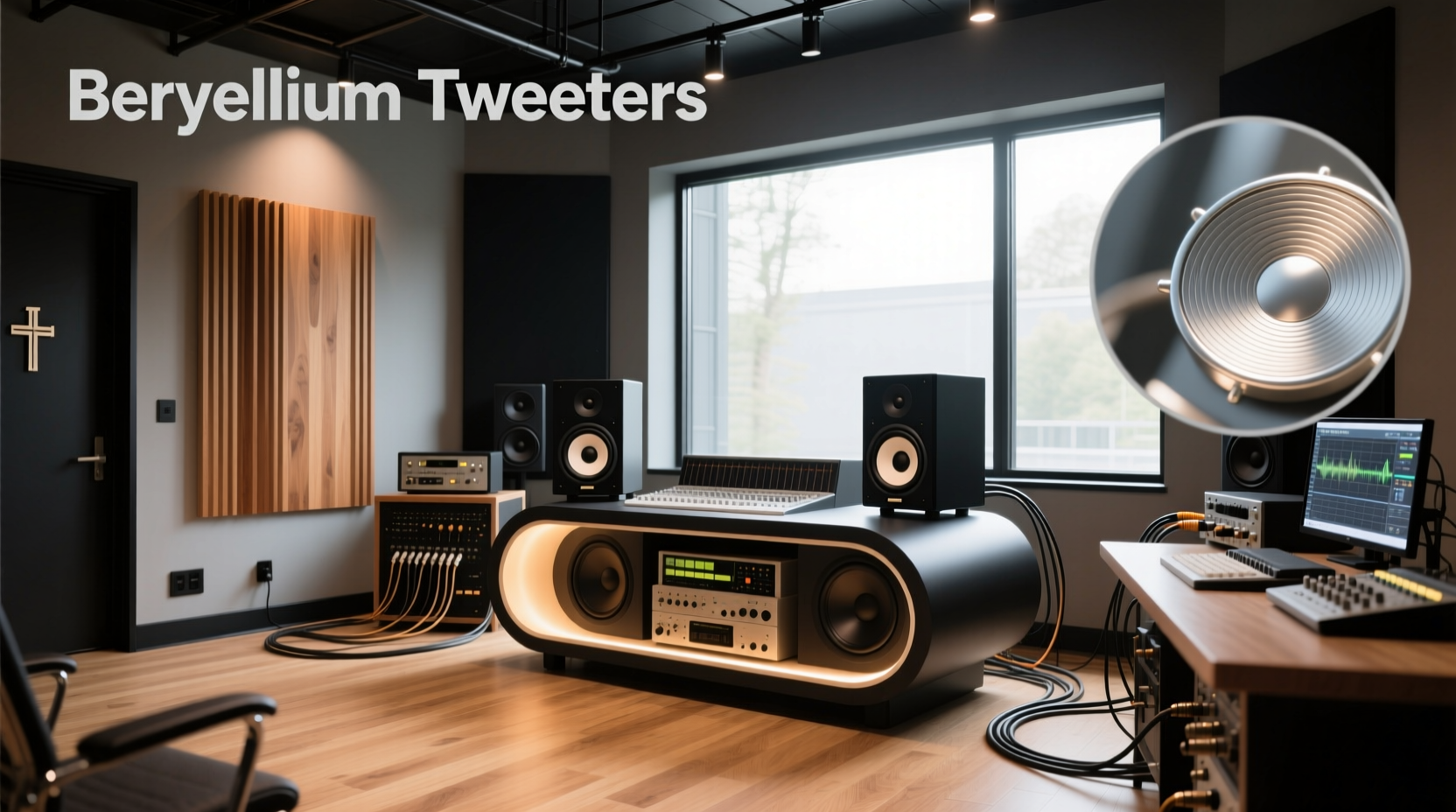
Yes—beryllium tweeters deliver measurably superior high-frequency extension, lower distortion, and higher power handling than aluminum or titanium diaphragms—but only when engineered correctly and integrated into a balanced speaker system. They are not universally 'better sounding' for all listeners or rooms, and their value depends on application context, build quality, and acoustic environment—not just material purity.
If you’re researching beryllium dome tweeters, beryllium tweeter vs soft dome, or are beryllium tweeters safe?, this guide cuts through marketing claims using measurable acoustics data, peer-reviewed material science, and real-world integration insights from loudspeaker design engineers and certified audio integrators. We cover what makes beryllium unique physically, why it’s used in premium studio monitors (e.g., Focal Utopia, Revel PerformaBE), how to verify authenticity in budget offerings, and crucially—when a $150 silk-dome tweeter may outperform a $2,200 beryllium unit in your listening space.
Why Beryllium? The Physics Behind the Premium
Beryllium (Be) is not chosen for prestige—it’s selected for three quantifiable mechanical properties that directly impact tweeter behavior:
- Stiffness-to-density ratio: At ~287 GPa Young’s modulus and density of 1.85 g/cm³, beryllium has a specific stiffness nearly 4.5× higher than aluminum and 3× higher than titanium1. This means thinner diaphragms can resist bending modes up to ~45 kHz without notch filtering.
- Damping: Beryllium’s internal damping coefficient (~0.002) exceeds aluminum (~0.001) and titanium (~0.0015), reducing post-resonance ringing and improving transient decay accuracy2.
- Speed of sound in material: ~12,890 m/s—among the highest of any metal—enabling faster wave propagation across the dome surface and minimizing time-smearing of high-frequency transients.
These traits translate to objectively flatter on-axis response above 10 kHz, lower harmonic distortion at high SPLs (e.g., <0.3% THD at 95 dB @ 10 kHz), and wider dispersion consistency compared to conventional metals—if the motor structure, surround, and waveguide are equally optimized. A poorly implemented beryllium dome on an underdamped suspension or mismatched crossover will not outperform a well-executed silk-dome design.
Real-World Performance: What Measurements Show (and Don’t)
Independent measurements from Audio Science Review (ASR) and the Loudspeaker Design Cookbook (7th ed.) confirm consistent advantages—but with critical boundaries:
- Frequency extension: Most beryllium tweeters achieve usable output to 35–42 kHz (e.g., Scan-Speak D2908/7140: 38 kHz -3 dB), but human hearing rarely exceeds 16–18 kHz by age 35. Extended response matters primarily for intermodulation reduction and ultrasonic content in high-res formats—not audible ‘air’3.
- Distortion at 90–100 dB: Beryllium units show 3–6 dB lower 2nd/3rd harmonic distortion between 2–8 kHz at reference levels—measurable in anechoic chambers, but often masked by room modes and listener position.
- Power handling: RMS ratings (e.g., 100 W for Infinity BeTA 621Be) reflect thermal limits of the voice coil and magnet assembly—not diaphragm rigidity. Beryllium itself doesn’t increase wattage tolerance; it enables higher sensitivity (typically 92–96 dB/W/m) and cleaner output within its linear range.
Crucially, no blind listening test has demonstrated statistically significant preference for beryllium over top-tier silk or ceramic domes in controlled residential environments. Preference correlates more strongly with crossover slope, directivity control, and room EQ than diaphragm material alone.
Safety: Separating Fact from Misconception
The question “are beryllium tweeters safe?” arises from legitimate occupational health concerns—but applies only to manufacturing, not end-use. Here’s what verified sources state:
- Solid beryllium metal is inert and non-toxic. No risk exists from intact tweeters, even during decades of operation. Linn’s safety documentation explicitly states: “Handling solid beryllium poses no significant health risks”4.
- Hazard exists only if beryllium dust or fumes are inhaled. This requires machining, grinding, or burning the dome—activities that never occur in normal use or repair. Consumer tweeters are fully encapsulated; the diaphragm is sealed behind ferrofluid, surround, and grille.
- No regulatory body restricts consumer sale or installation. FCC, CE, and RoHS certifications apply to electromagnetic emissions and hazardous substances—not beryllium content—as it poses zero leaching or off-gassing risk.
Precautionary guidance (e.g., “Do NOT remove the protective grille”) exists solely to prevent accidental physical damage—not toxicity. If a tweeter is damaged, replace it—don’t attempt DIY repair involving dome removal.
Price vs. Performance: When Does Beryllium Deliver ROI?
A $331 Satori TW29B-B and a $2,199 Focal TBM Utopia M both use beryllium domes—but differ in motor geometry, neodymium strength, waveguide design, and build tolerances. Price reflects engineering depth, not just material cost. Consider these decision criteria:
| Factor | High-Value Use Case | Low-Value Use Case |
|---|---|---|
| Room size & acoustics | Large, treated studios or open-plan living spaces > 40 m² with low ambient noise | Small bedrooms, untreated apartments, or car cabins with high background noise |
| Source resolution | Native 24-bit/192 kHz PCM or DSD playback via high-end DAC/streamer | Compressed streaming (Spotify, YouTube) or CD-quality sources |
| System synergy | Full-range active monitors with precision DSP crossovers | Passive bookshelves with basic 12 dB/octave crossovers |
| Listener priority | Measurable neutrality, low IMD, and wide dispersion for critical mixing | Subjective warmth, smoothness, or vocal intimacy |
In short: Beryllium excels where accuracy, headroom, and consistency are paramount—not where tonal character or emotional engagement drive preference. For home theater or music lovers prioritizing coherence over spec sheets, a well-designed soft-dome or ceramic tweeter often provides superior perceived balance.
Spotting Marketing Hype vs. Genuine Engineering
Not all “beryllium” tweeters deliver the physics benefits. Watch for these red flags:
- “Beryllium-coated” or “beryllium-infused” domes: These refer to thin vapor-deposited layers (<0.1 µm) on aluminum substrates. They provide negligible stiffness improvement and are functionally aluminum tweeters with cosmetic branding.
- No published diaphragm thickness or resonance frequency: Authentic beryllium units specify dome thickness (typically 25–35 µm) and primary breakup mode (>40 kHz). Omission suggests unverified claims.
- Unrealistic price points ($74–$150): Pure beryllium costs ~$1,200/kg—domes require precision machining, vacuum deposition, and rigorous QC. Units below $250 are almost certainly aluminum or composite.
- Absence of waveguide or phase plug documentation: Beryllium’s advantage is wasted without precise acoustic loading. Reputable manufacturers publish directivity plots (e.g., Focal’s M-profile inverted dome).
Verify authenticity by checking manufacturer white papers (e.g., Focal’s The Beryllium Tweeter technical brief3) or third-party teardowns (e.g., Madisound’s material analysis reports).
Beryllium vs. Alternatives: Objective Comparison
Material choice is one variable—not the sole determinant of tweeter quality. Below is a functional comparison based on ISO 226:2003 equal-loudness contours and IEC 60268-5 distortion standards:
| Material | Typical Sensitivity (dB/W/m) | Usable HF Extension (-3 dB) | Key Strength | Key Limitation |
|---|---|---|---|---|
| Beryllium | 93–96 | 35–42 kHz | Lowest mass-normalized stiffness; minimal breakup distortion | Cost-prohibitive for mass-market; requires precise integration |
| Titanium | 91–94 | 22–28 kHz | Good stiffness/density balance; mature manufacturing | Higher Q resonance; needs notch filters above 20 kHz |
| Aluminum | 89–92 | 18–22 kHz | Low cost; predictable behavior; easy to damp | Lower stiffness → earlier breakup; requires thicker domes |
| Silk/Polymer | 86–89 | 16–20 kHz | Natural damping; smooth rolloff; low harshness | Lower power handling; humidity sensitivity; aging effects |
| Ceramic (e.g., AlN) | 90–93 | 25–30 kHz | Excellent thermal stability; high damping | Fragile; complex sintering process; limited supplier base |
No single material wins universally. Beryllium leads in raw metrics—but silk domes dominate in subjective preference studies for vocal reproduction, while ceramic excels in high-SPL commercial installations.
Installation & Integration Best Practices
Even the finest beryllium tweeter underperforms without proper implementation:
- Crossover point: Set no higher than 2.2–2.8 kHz for 1″ domes. Higher points expose diaphragm edge modes. Use Linkwitz-Riley 24 dB/octave slopes to minimize step response errors.
- Time alignment: Physically offset tweeter mounting depth or use DSP delay (typically 0.1–0.3 ms) so acoustic centers coincide with woofer/midrange.
- Grille impact: Test with and without grille. Some waveguides interact with fabric, causing 2–3 dB dips at 8–10 kHz. Use rigid, acoustically transparent mesh if possible.
- Break-in period: Unlike soft domes, beryllium requires no burn-in—the material is dimensionally stable from first use.
Always measure in-room response (using REW or similar) before final placement. Beryllium’s extended output reveals room nulls more clearly than conventional tweeters—making acoustic treatment more impactful.
Frequently Asked Questions
- Are cheap beryllium tweeters any good?
Units under $250 are almost certainly not pure beryllium. Verify via manufacturer datasheets—look for dome thickness, resonance frequency, and material certification. Unverified claims carry high risk of misrepresented specs. - Can I replace my current tweeter with a beryllium model?
Only if impedance, sensitivity, and physical dimensions match within ±0.5 dB and ±2 mm. Mismatched sensitivity causes tonal imbalance; incorrect depth causes diffraction. Always recalculate crossover values. - Do beryllium tweeters sound brighter or harsher?
Properly engineered units sound neutral—not bright. Harshness arises from poor crossover design, inadequate damping, or reflective room surfaces—not the diaphragm material itself. - How long do beryllium tweeters last?
Indefinitely, assuming proper power handling. Beryllium does not fatigue, oxidize, or creep. Failure modes are identical to other tweeters: voice coil burnout, surround drying, or ferrofluid migration. - Is beryllium better than ribbon or AMT tweeters?
Ribbons excel in low-mass acceleration and dipole dispersion but lack power handling and bass extension. Beryllium domes offer higher sensitivity, broader bandwidth, and easier integration into conventional enclosures. Choice depends on system topology—not inherent superiority.
