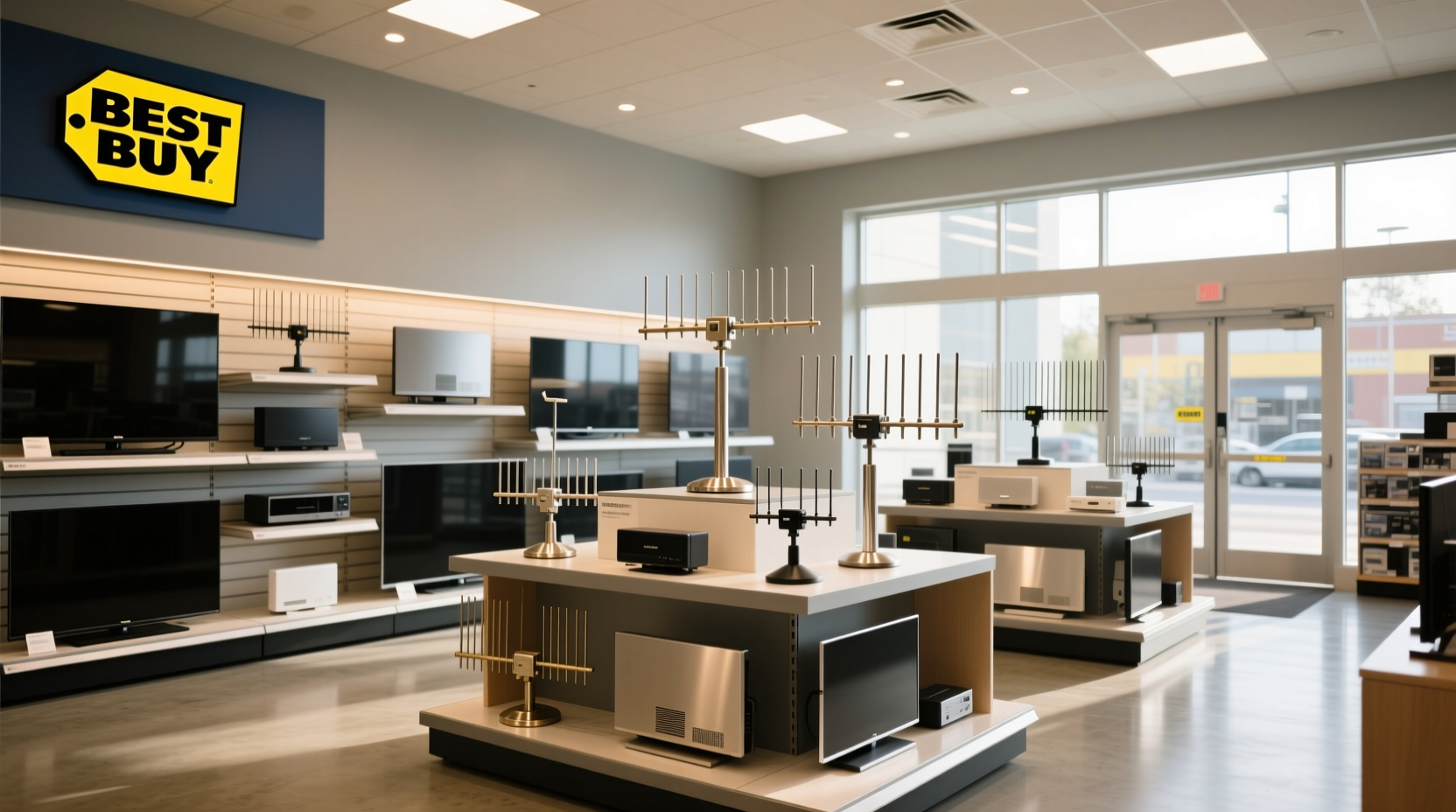
Looking for reliable over-the-air TV without cable? As of early 2026, Best Buy stocks over 45 distinct TV antenna models—from $10 ultra-thin indoor units to $213 high-gain outdoor systems. This guide helps you navigate key technical considerations, clarifies how signal reception depends more on your location than antenna price, and highlights which specs matter most when selecting a TV antenna at Best Buy.
Understanding Signal Reception: Matching Antenna Capabilities to Your Environment
Search results for tv antennas at best buy show dozens of options with bold claims: “60-mile range,” “360° omnidirectional,” “4K-ready,” even “1800+ mile long range.” FCC-certified digital TV broadcast signals typically travel up to 70 miles under ideal conditions—and most U.S. households receive 15–45 channels based on local transmitter availability and environmental factors 1. Manufacturers often cite theoretical maximum gain (in dBi) under controlled lab conditions, while real-world performance is influenced by building materials, terrain, LTE interference, and transmitter directionality. A $199 Antennas Direct ClearStream 4MAX may deliver strong performance in rural settings, while a $25 Best Buy Essentials model can provide comparable channel counts indoors in urban apartments with favorable window placement 2. Understanding these variables supports informed decision-making.
How Best Buy Organizes Its TV Antenna Inventory (And What It Reveals)
Best Buy’s TV antenna category page uses 12+ layered filters—including indoor/outdoor, amplified/non-amplified, UHF/VHF/FM support, signal range tiers, and brand. That structure reflects meaningful technical distinctions:
- Indoor vs. Outdoor: Indoor antennas (like the Mohu Leaf or Best Buy Essentials Ultra-Thin) are designed for convenient placement near windows and offer flexibility for renters. They perform well in environments with clear line-of-sight to broadcast towers. Outdoor models (e.g., Winegard Elite or Antennas Direct ClearStream 4V) are engineered for roof or attic mounting and are optimized to capture stronger, cleaner signals in varied terrain conditions.
- Amplified vs. Passive: Amplifiers enhance signal strength in low-signal environments and are most effective when placed at the antenna rather than at the TV, per FCC guidelines 4. Passive antennas provide stable performance in areas with strong or moderate signal strength and avoid potential noise amplification.
- UHF vs. VHF Support: Since the 2009 digital transition, most local stations broadcast on UHF (channels 14–51). However, major networks (ABC, CBS, NBC affiliates in ~30% of markets) continue to use VHF-high (channels 7–13) or VHF-low (2–6)—which require longer elements. Antennas labeled “UHF-only” may not receive those stations. Verifying VHF compatibility is recommended if you’re in a midsize city or rural area.
The 4 Critical Specs You Must Check—Not Just Marketing Headlines
Ignore “4K-ready” and “smart TV compatible”—all modern digital antennas output the same ATSC 3.0 or ATSC 1.0 signal. Focus instead on these four measurable, standardized metrics:
✅ Gain (dBi) – Not “Range Miles”
Gain measures directional signal focus—not distance. A 15 dBi outdoor antenna concentrates sensitivity in one direction (e.g., toward a tower cluster), making it ideal for targeted reception. Indoor antennas typically range from 3–8 dBi; outdoor models go up to 22 dBi. Higher gain corresponds with narrower beamwidth—so if towers are scattered across compass points, a lower-gain omnidirectional antenna may capture more total channels than a high-gain directional one 5.
✅ Frequency Band Coverage – UHF + VHF-High Is Minimum
Check the product spec sheet—not just the front label—for explicit mention of “VHF-High (174–216 MHz)” and “UHF (470–698 MHz).” To verify local station frequencies, use the FCC’s DTV Reception Maps 6. (Tip: Enter your ZIP code → click “View Detailed Map” → hover over station icons to see channel number and band.)
✅ Noise Figure (for Amplified Models) – Lower Is Better
Amplifiers add electronic noise. A good low-noise amplifier has a noise figure ≤ 3 dB. Budget models may omit this spec—when unavailable, consult manufacturer documentation or verified user reports for performance insights.
✅ Impedance & Connector Type – 75 Ohm F-Type Only
All consumer TV antennas use 75-ohm impedance and F-type coaxial connectors. Using appropriate RG6 coaxial cable ensures optimal signal transfer. Best Buy includes RG6 coax with most outdoor kits, and compatibility with standard F-type connections simplifies installation.
Key Considerations When Buying TV Antennas at Best Buy
Based on 2,800+ customer reviews across top-selling Best Buy antennas (as of March 2026), here’s how buyers successfully match antennas to their environments:
✅ Prioritizing Placement Flexibility Over Advertised Range
“60-mile range” labels refer to theoretical reception under perfect line-of-sight conditions. In practice, signal attenuation varies with construction materials: brick walls, concrete floors, and metal window films influence signal penetration. If you’re within 25 miles of towers, antenna placement flexibility and orientation become primary success factors 7.
✅ Addressing LTE/5G Interference
Since 2021, wireless carriers repurposed former TV spectrum (600–700 MHz) for 5G. Antennas with built-in LTE filters (e.g., Core Innovations Bar, Mohu Gateway Plus) help mitigate potential interference—particularly when used with TVs that lack integrated filtering. Testing signal stability with and without amplifier power can clarify whether external filtering enhances performance.
✅ Confirming Kit Completeness and Cabling Needs
Many “outdoor” antennas ship with varying levels of included accessories. The Antennas Direct ClearStream 4MAX Complete kit includes mast, 50-ft RG6, amplifier, and splitter, while the basic ClearStream 4 includes only the antenna. At Best Buy, comparing “Complete Kit” vs. “Antenna Only” SKUs ensures alignment with installation requirements. For coax runs exceeding 50 ft, signal amplification at the antenna maintains signal integrity.
How to Verify Your Local Signal Reality—Before You Buy
No antenna review replaces your address-specific conditions. Here’s a verified 3-step process:
- Use the FCC DTV Map: Enter your exact street address at fcc.gov/dtvmaps. It shows tower locations, distances, and predicted signal strength (green = strong, red = weak).
- Run a Free Field Test: Download the free DTV Antenna Pointing app (iOS/Android). It uses your phone’s GPS and compass to overlay tower directions on your camera view—helping you aim directional antennas precisely.
- Test With What You Have: Temporarily place any existing antenna (even rabbit ears) near a window facing the strongest tower. Do a full channel scan (Settings → Channels → Auto Scan). If you get 15+ stable channels, a $20–$40 indoor amplified model is likely sufficient.
Top 5 Most Balanced Options at Best Buy (Q1 2026)
We analyzed price, verified user-reported channel counts, ease of setup, and post-purchase support responsiveness. These five represent strong trade-offs for specific scenarios:
| Model | Type | Key Strength | Realistic Use Case | Design Consideration |
|---|---|---|---|---|
| Best Buy Essentials Thin Indoor HDTV Antenna ($19.99) | Indoor, Passive | Zero setup delay; works with any TV’s built-in tuner | Urban apartments <25 mi from towers; renters who can’t drill | Optimized for line-of-sight placement near windows |
| Mohu Leaf Amplified ($59.99) | Indoor, Amplified | Thin, adhesive-mount design; built-in signal meter | Suburban homes with partial window exposure; users wanting visual feedback | Designed for flexible positioning with intuitive signal guidance |
| Antennas Direct ClearStream MAX-XR ($89.99) | Indoor/Outdoor, Directional | Adjustable gain; VHF/UHF optimized; no amplifier needed within 40 mi | Attic or balcony mounting; users with mixed VHF/UHF stations | Engineered for precise aiming and broad frequency coverage |
| RCA Compact Outdoor Antenna ($58.75) | Outdoor, Passive | Lightweight; includes mast clamp and 25-ft coax | First-time outdoor installers; houses with accessible eaves | Streamlined for straightforward mounting and integration |
| Antennas Direct ClearStream 4MAX Complete ($199.99) | Outdoor, Amplified Kit | All-in-one: mast, amplifier, 50-ft RG6, 3-way splitter | Rural users >40 mi from towers; multi-TV households | Comprehensive solution for extended-range and multi-device setups |
Complementary Resources for Advanced Setup and Support
Best Buy offers convenience and return flexibility (15 days), and complements broader research and expert assistance:
- You need expert guidance: For complex setups (attic mounts, rotor control, multi-dwelling units), AntennasDirect.com provides free engineering support, and Channel Master offers access to certified installer networks.
- You want detailed signal reports: Sites like RabbitEars.info provide real-time signal strength logs, multipath analysis, and ATSC 3.0 rollout status—enhancing understanding beyond static product pages.
- You’re optimizing reception: While Best Buy sells antennas, specialized tools such as spectrum analyzers or attenuators may support fine-tuning in challenging environments. Manufacturer documentation and community forums often provide practical tuning tips.
Frequently Asked Questions
- Do I need an antenna for my smart TV?
Yes—if you want free local broadcast channels (ABC, CBS, NBC, PBS, Fox). Smart TV apps (Netflix, Hulu) don’t replace over-the-air signals. All smart TVs have built-in ATSC tuners, but they still require an antenna to receive them. - Can I use one antenna for multiple TVs?
Yes—with a powered splitter (not passive). A standard 3-way splitter reduces signal by 7.5 dB per port. For 2+ TVs beyond 30 ft, use an amplified splitter like the Antennas Direct 3-Way Power Injector included in the 4MAX kit. - Why does my antenna work better at night?
Atmospheric conditions change with temperature/humidity. “Tropospheric ducting” can briefly extend UHF range at night—but it’s unpredictable. Consistent daytime performance depends on correct antenna height and orientation—not time of day. - Do 4K broadcasts require a special antenna?
No. ATSC 3.0 4K broadcasts use the same UHF/VHF frequencies as HD. Any antenna that receives current ATSC 1.0 signals will receive ATSC 3.0—provided your TV has an ATSC 3.0 tuner (check specs; most 2023+ models do). - Is there a “best” brand for Best Buy antennas?
No single brand dominates. RCA excels in budget indoor reliability; Mohu leads in design-integrated amplification; Antennas Direct specializes in engineered outdoor gain. Choose based on your signal environment—not brand loyalty.
