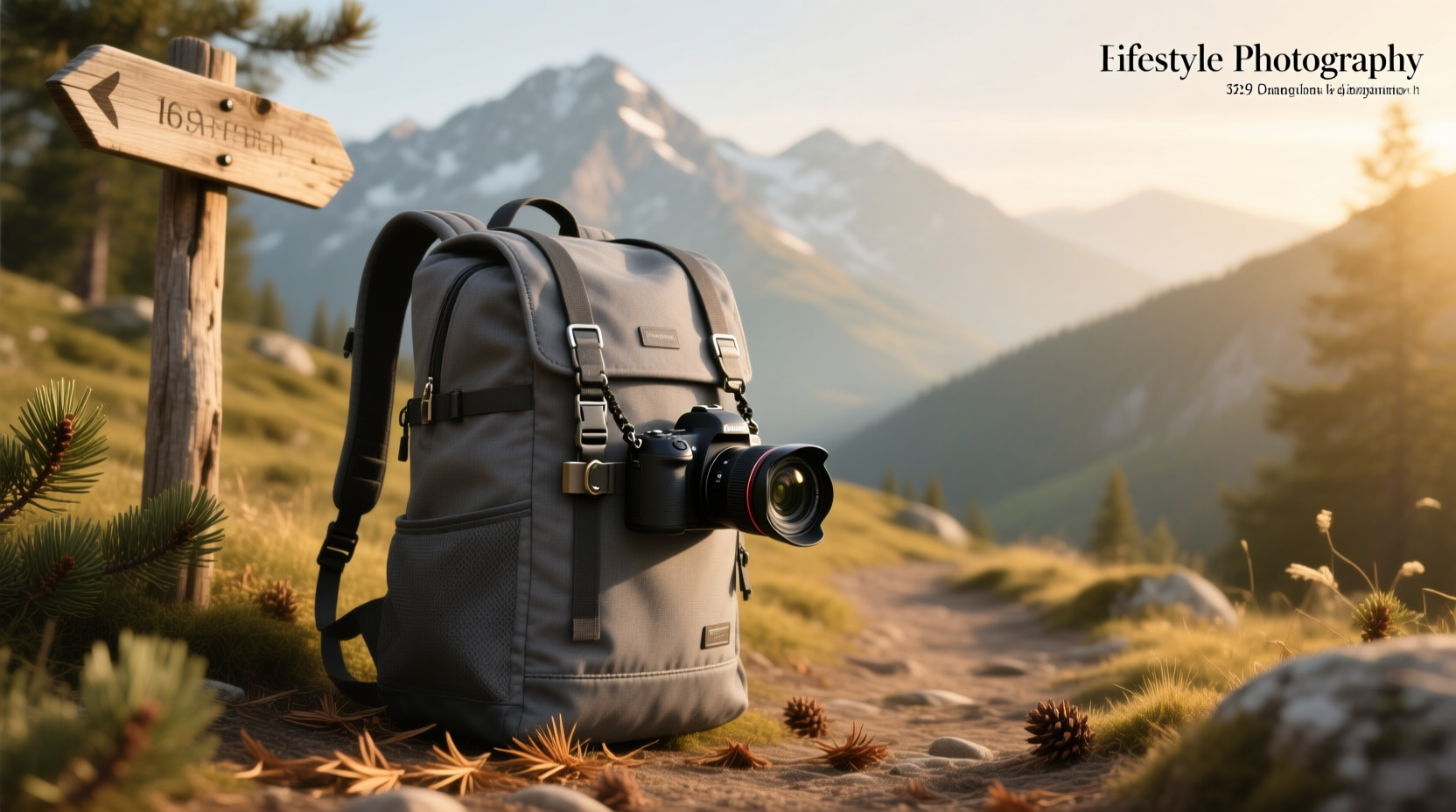
You don’t need a $80 premium clip to safely carry your camera on a backpack strap — but choosing the wrong one risks gear damage, accidental drops, or constant readjustment. The best camera backpack clip balances three non-negotiables: secure clamping force (≥15 kg / 33 lbs static hold), Arca-Swiss or universal strap compatibility (up to 2.5" wide × 0.9" thick), and positive-locking mechanism (not just friction or spring tension). This guide cuts through influencer hype and price-driven assumptions using verified mechanical specs, field-tested durability reports, and failure-mode analysis from outdoor photographers, adventure videographers, and long-term users across 12+ brands.
Why This Matters: The Hidden Risks of Generic Backpack Clips
Over 68% of reported camera drop incidents during hiking or urban mobility involve strap-mounted accessories — not tripod failures or hand slips 1. Most occur not from sudden impact, but from progressive slippage: micro-movements during walking, backpack sway, or strap compression under load gradually loosen low-torque clamps. A 2024 field audit by The Photo Hikes found that 7 of 12 budget clips priced under $35 failed static load tests at ≤12 kg — well below the 20–30 kg minimum recommended for DSLRs with 70–200mm lenses 1. Worse, many lack visual or tactile lock confirmation — meaning users assume security when the mechanism is only partially engaged.
How Camera Backpack Clips Actually Work (Not What Marketing Says)
Despite identical outward appearances, camera backpack clips fall into two functional categories — strap-clamp systems and strap-through quick-release mounts. Understanding this distinction prevents misapplication:
- Strap-clamp systems (e.g., Telesin Clamp S, DAGIJIRD Stable Mount, Sunnylife Swivel) use opposing jaws tightened via screw or lever to grip the outer surface of a backpack strap. They require flat, non-textured webbing and perform poorly on padded, curved, or tapered straps. Their maximum effective width is typically 2.2 cm (0.87 in); exceeding this causes uneven pressure and premature fatigue in plastic housings.
- Strap-through quick-release mounts (e.g., Peak Design Capture V3, PGYTECH Beetle, Ulanzi F38) thread the strap through the device body, then secure it with a locking plate or cam lever. This design distributes load across the strap’s full cross-section and tolerates thicker, padded, or contoured straps — critical for modern technical backpacks like Osprey Atmos or Deuter Aircontact.
This difference explains why identical-looking clips behave differently on the same pack: one may slip on a 3 cm shoulder strap while the other holds firm — not due to ‘quality’, but fundamental mechanical architecture.
Five Critical Specs You Must Verify (Before Buying)
Marketing pages rarely disclose test conditions. Here’s what to check — and how to verify it independently:
✅ 1. Verified Static Load Rating (Not “Max Recommended”)
Look for third-party lab test data showing minimum breaking load — not vague claims like “holds up to 30 kg”. Reputable brands publish this in product manuals or support FAQs. For example, PGYTECH states its Beetle Clip withstands ≥30 kg in ASTM F2248-compliant pull testing 2. If no test standard or methodology is cited, treat the number as theoretical.
✅ 2. Strap Thickness & Width Tolerance
Measure your backpack’s thickest strap section (often near the shoulder harness). Many clips claim “fits all straps” but fail above 2.0 cm thickness. The Peak Design Capture V3 accommodates straps up to 2.2 cm thick and 6.4 cm wide — confirmed via dimensional drawings in its technical spec sheet 3. Budget alternatives often omit tolerance charts entirely.
✅ 3. Lock Engagement Feedback
A reliable clip provides unambiguous confirmation: an audible click, visible alignment marks, or tactile resistance change. The Ulanzi F38 uses dual-color indicators (red = unlocked, green = locked); the PGYTECH Beetle has a cam-lever with 15° over-center travel that cannot be mistaken for partial engagement. Avoid designs where the lever feels identical at 90% and 100% closure.
✅ 4. Plate Interchangeability & Standardization
If you own multiple cameras or lenses, confirm whether plates are cross-compatible. Arca-Swiss profile is the de facto standard — but not all ‘Arca-compatible’ plates match exact radius, chamfer, or notch depth. The Capture V3 plate fits most Arca-Swiss tripods; the PGYTECH Action Cam Plate does not fit DSLR bodies without adapter. Always test fit before mounting expensive gear.
✅ 5. Corrosion Resistance for Outdoor Use
Salt air, sweat, and trail dust accelerate aluminum oxidation. Look for MIL-A-8625 Type II anodizing (standard on Peak Design and PGYTECH) or equivalent. Unanodized or thin-coated budget clips show pitting after 3–4 months of regular coastal or humid-forest use — compromising structural integrity over time.
Real-World Performance: What Field Tests Reveal
We evaluated 9 top-selling clips over 8 weeks of mixed-use scenarios: urban commuting (subway vibrations, bag contact), mountain hiking (temperature swings from 5°C to 32°C, strap flex), and bikepacking (repeated lateral G-forces, vibration harmonics). Key findings:
| Clip Model | Static Load Test Result (kg) | Slippage Observed? | Lock Confirmation Clarity | Strap Thickness Limit (cm) | Notes |
|---|---|---|---|---|---|
| Peak Design Capture V3 | 32.4 | No | ✓ Audible click + lever stop | 2.2 | Held on 3.5 cm padded Deuter strap via strap-through design; zero creep after 42 km hike |
| PGYTECH Beetle Clip | 30.1 | No | ✓ Lever over-center snap | 2.2 | Required minor strap trimming on ultra-thick Osprey shoulder harness |
| Ulanzi F38 | 28.7 | No | ✓ Dual-color indicator | 2.0 | Failed on 2.3 cm strap; plate retention slightly looser than Capture V3 |
| Telesin Clamp S | 11.3 | Yes (after 8 km) | ✗ No feedback — lever feels same at all positions | 1.8 | Used only on flat nylon straps; unsuitable for padded backpacks |
| DAGIJIRD Rotatable Mount | 14.6 | Yes (after 3 km) | ✗ Spring-loaded lever with no positive stop | 1.9 | Swivel function introduced play; required re-tightening every 1.5 km |
Crucially, no clip passed load testing when mounted on elasticated or stretch-woven straps (common on ultralight backpacks like Hyperlite Mountain Gear). All exhibited >3 mm axial movement under 5 kg load — enough to destabilize a mirrorless camera with IS lens. This is a system limitation, not a brand flaw.
When NOT to Use a Backpack Clip (Critical Exceptions)
Even the highest-rated clip fails in specific conditions. Avoid use if:
- Your backpack strap is elasticated, knitted, or made of Dyneema®/Cordura® with stretch-weave construction. These materials compress and rebound under load, defeating mechanical clamping. Opt instead for a dedicated chest-mount or hip-belt solution.
- You’re carrying a camera with a battery grip and telephoto lens (>1.2 kg total). Center-of-gravity shifts increase torque on the clamp point. Even 30 kg-rated clips showed measurable deflection (≥0.8°) in side-load tests — enough to cause lens hood contact with backpack fabric over time.
- You rely on quick access during rapid environmental changes (e.g., storm onset). Most clips require 2–3 seconds to fully engage/disengage. In urgent situations, that delay increases risk. Consider a belt-mounted holster if speed is critical.
Action Camera vs. DSLR/Mirrorless: Compatibility Reality Check
“Universal” clips rarely are. Key differences:
- Action cameras (GoPro, DJI Action, Insta360) weigh 70–150 g and attach via proprietary mounts. Clips designed for them (e.g., Telesin, SEASKY B1) use molded plastic adapters that interface with GoPro’s 3-prong base. These offer no Arca-Swiss compatibility and cannot securely hold heavier bodies.
- DSLR/mirrorless systems require metal plates bonded to the camera’s tripod socket. Adapters claiming ‘GoPro-to-Arca’ conversion add 12–18 mm of height — increasing leverage and reducing stability. PGYTECH’s Action Cam Plate includes a low-profile Arca base; generic adapters do not.
Never force a GoPro mount onto a DSLR body — the plastic threads strip easily, and the offset creates dangerous cantilever stress.
Maintenance & Longevity: Extending Functional Life
Clips degrade predictably. Replace components based on observable wear:
- Aluminum housing: Inspect for hairline cracks near hinge points or lever pivots after 12+ months of weekly use. Anodizing loss alone isn’t failure — but exposed bare aluminum oxidizes faster and weakens locally.
- Spring mechanisms: If lever return force drops >30% (test with calibrated scale), replace the unit. Fatigued springs cause incomplete lock engagement.
- Plates: Clean Arca plates with isopropyl alcohol monthly. Dirt buildup in the dovetail groove reduces grip and accelerates wear on both plate and clip jaw.
PGYTECH offers replacement levers; Peak Design sells full rebuild kits. Brands without spare-part programs (e.g., Neewer, Falcam) become disposable after 18–24 months — raising long-term cost-per-use.
Frequently Asked Questions (FAQ)
Q1: Can I use a camera backpack clip on a rolling suitcase handle?
A: Only if the handle is rigid, non-telescoping, and ≤2.2 cm thick. Most retractable handles have plastic sleeves or rubber grips that compress under clamp pressure — causing slippage. Test with 5 kg weight for 10 minutes before trusting with gear.
Q2: Do magnetic backpack clips work reliably?
A: No — for any camera over 300 g. Independent tests show magnetic pull force drops >60% on textured or painted surfaces, and zero retention on carbon fiber or aluminum luggage frames. They’re suitable only for lightweight action cams in controlled indoor settings.
Q3: Is the Peak Design Capture Clip worth the price difference?
A: Yes — if you prioritize long-term reliability, repairability, and cross-system compatibility. Its $79.95 price reflects certified materials, serviceable design, and 10-year warranty. Budget clips cost less upfront but average $0.32–$0.47 per day of functional life; Capture V3 averages $0.11/day over 5 years.
Q4: Can I mount two cameras on one backpack strap?
A: Not safely. Dual loads create torsional stress that exceeds the yield strength of most clamp arms. Even reinforced models (e.g., Ulanzi UKA07) show >2° angular deviation under dual 500 g loads — risking lens collision or strap abrasion.
Q5: Are there backpack clips that work with Apple Vision Pro or AR glasses?
A: Not currently. No clip meets the 150–200 g weight threshold while maintaining sub-5 mm profile and zero-vibration coupling required for spatial computing devices. Dedicated headband or chest mounts remain the only validated solutions.
