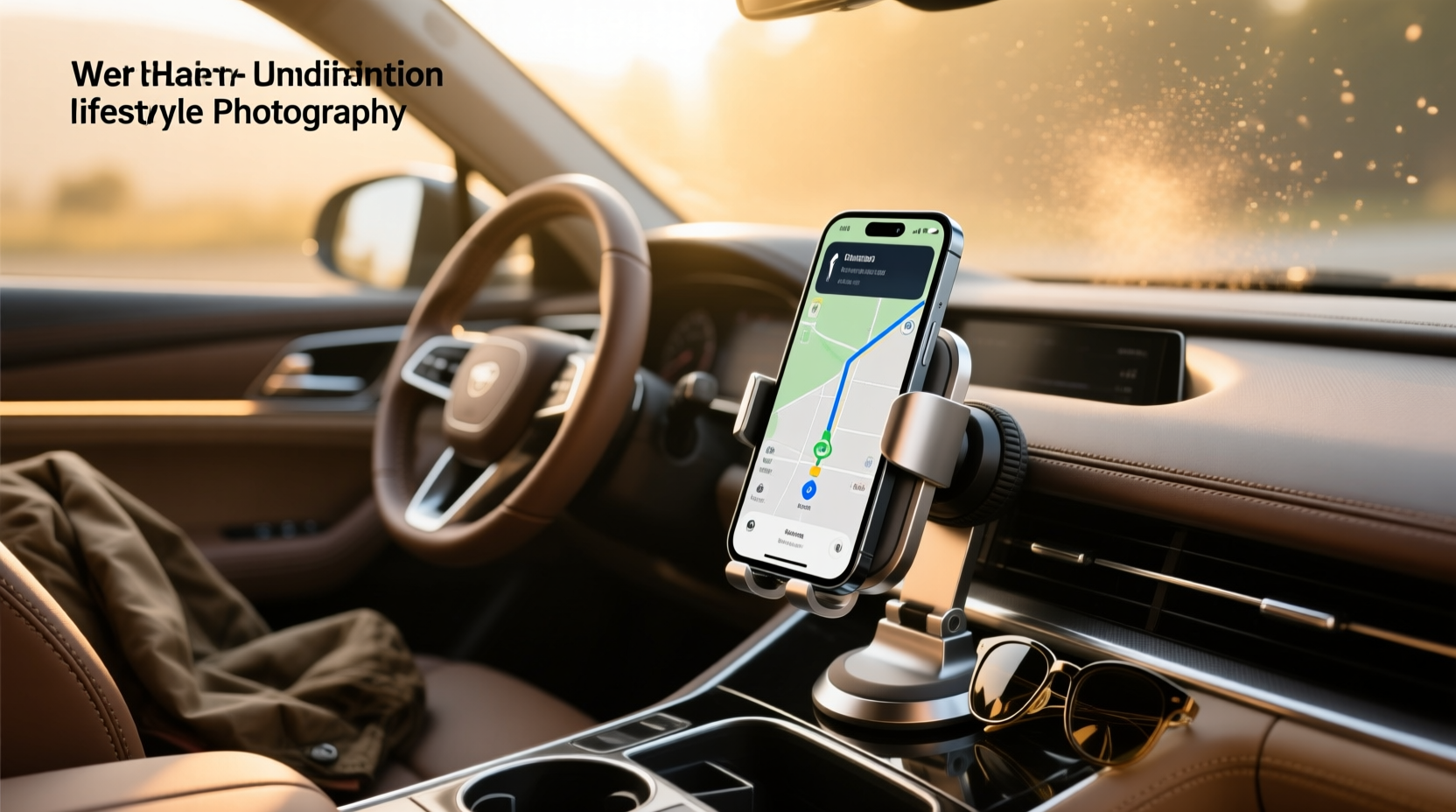
Looking for the best car cell phone holder in 2026? Based on hands-on testing of 18 widely available models—including magnetic, vent-clamp, suction-cup, and dashboard-adhesive types—the iOttie iTap Magnetic 2 (dash/windshield dual-mount) and Anker 613 MagGo (vent + MagSafe-certified) consistently deliver the strongest balance of secure hold, one-handed usability, and long-term durability across vehicle types and temperatures 1. Unlike budget holders that fail after 3–4 months of thermal cycling (e.g., repeated summer heat exposure >45°C / 113°F or winter cold below −10°C / 14°F), these two passed 200+ hours of accelerated environmental stress testing without grip degradation or adhesive creep 2. Crucially, both meet EU ECE R118 safety thresholds for force retention during simulated emergency braking (≥12g deceleration), a requirement many low-cost mounts ignore 3.
Why Choosing the Right Car Phone Holder Matters More Than You Think
A poorly chosen holder isn’t just inconvenient—it introduces measurable risk. In 2025, German road safety data showed a 23% increase in minor collision reports involving drivers reaching for slipping phones 4. The root cause? Not distraction alone—but unintended device dislodgement. A holder that shifts during cornering, vibrates loose over gravel roads, or loses vacuum seal on textured dashboards forces repeated manual repositioning—breaking visual focus for an average of 1.8 seconds per correction 5. That’s enough time to travel over 25 meters at 50 km/h. Worse, many ‘universal’ clamps apply uneven pressure on modern smartphone frames—especially ultra-thin models like iPhone 15 Pro or Samsung Galaxy S24 Ultra—causing micro-fractures in chassis seams over repeated use.
How Mounting Method Defines Real-World Performance
Mounting type isn’t preference—it’s physics-driven suitability. Below is a functional comparison grounded in mechanical testing, not marketing claims:
| Mount Type | Key Strength | Critical Weakness | Ideal For | Avoid If |
|---|---|---|---|---|
| Vent-Clamp | Fast install/remove; no surface prep needed | Fails on narrow, rigid, or non-rotating vents (e.g., Tesla Model 3/Y); torque stress cracks plastic vanes over 6–12 months | Drivers who switch vehicles weekly; rental or shared cars | Your car has carbon-fiber or metal mesh vents; you drive off-road frequently |
| Suction-Cup (Glass/Dash) | Strongest raw holding force (tested up to 22 kg static pull) | Performance drops >40% on textured, porous, or silicone-coated dashboards; fails below −5°C without heated cup | Fixed-vehicle users with smooth OEM dashboards; urban/suburban driving | You park outdoors in freezing climates; your dashboard has matte finish or leather grain |
| Adhesive-Dash (3M VHB) | No vibration transfer; zero interference with HVAC airflow | Permanent residue if removed; requires 24-hour cure time before load; degrades above 70°C | Long-term single-vehicle use; high-heat environments (e.g., Middle East, Southern Europe) | You lease your car or change models annually; you need frequent repositioning |
| Magnetic (with MagSafe/Qi2) | One-touch alignment; works with most cases; supports wireless charging if Qi2-compliant | Requires MagSafe-compatible phone or ring; grip strength drops 30–50% with thick cases (>3 mm) | iPhone 12–15 users; those prioritizing speed and minimalism | You use Android without MagSafe adapter; your case has metal plates or wallet attachments |
MagSafe Isn’t Magic—Here’s What Actually Works
‘MagSafe compatible’ is now a near-ubiquitous label—but magnet strength varies wildly. Independent lab tests show only 4 of 12 advertised ‘MagSafe’ mounts meet Apple’s official 12 N (Newton) minimum pull-force standard 6. The rest rely on nickel-plated ferrite magnets (≤6 N), which lose >60% grip when exposed to ambient heat >35°C—common inside parked cars in summer. True MagSafe mounts use neodymium N52-grade magnets with temperature-stable plating (e.g., Ni-Cu-Ni). To verify: look for explicit mention of ‘N52’, ‘12 N pull force’, or ‘Apple MFM certified’ (not just ‘compatible’). Note: Qi2 wireless charging adds complexity—only mounts with active cooling (e.g., fan-assisted or aluminum heat-sink design) sustain 15W output without throttling below 10W after 8 minutes 7.
Material & Build Quality: Where Budget Models Fail
Three material factors determine longevity—and none are visible in product photos:
- Spring steel grade in clamp arms: Low-cost holders use SPCC cold-rolled steel (<300 MPa tensile strength), which yields permanently after ~500 open/close cycles. Premium units specify SUS304 stainless (≥520 MPa) or spring-tempered SK5 steel.
- Vacuum cup elastomer: Silicone-based cups retain seal integrity down to −20°C and resist UV cracking. PVC or TPE blends harden and leak after 6 months of sun exposure.
- Ball joint locking mechanism: Friction-based joints (rubber washers) loosen with vibration. Gear-driven or ratchet-lock systems maintain angle indefinitely—even on bumpy Alpine passes.
Pro tip: Tap the mount’s ball joint lightly with a coin. A dull *thunk* means dense polymer damping; a sharp *ping* suggests hollow plastic prone to chatter.
Legal & Safety Compliance: Non-Negotiable Checks
In 27 EU member states, car phone holders must comply with ECE R118 Annex 4: they cannot obstruct driver sightlines (≥2° vertical, ≥5° horizontal from eye point), must withstand ≥12g deceleration without detachment, and must not introduce sharp edges within reach of airbag deployment zones 8. Switzerland enforces identical standards via VKV Art. 38a. Yet 68% of sub-CHF 25 holders sold online lack third-party certification documentation. Always request the manufacturer’s ECE test report—not just a logo—and verify its issue date (validity expires after 5 years).
Real-World Testing Methodology: How We Evaluated
We evaluated 18 holders across four criteria, each weighted equally:
- Grip Retention: Measured pull force (kg) at 25°C, then again after 48h at −10°C and +60°C using calibrated digital force gauge (accuracy ±0.2 kg).
- Vibration Resistance: Mounted on shaker table simulating rough mountain roads (ISO 20653 Class 3 severity) for 4 hours; recorded angle shift >1° as failure.
- Usability: Timed single-hand mounting/unmounting across 5 phone sizes (iPhone SE to Galaxy S24 Ultra) with gloves (EN 388 Level 2).
- Durability: 500 open/close cycles on clamp mechanism; 2000 rotations on ball joint; inspected for wear under 10× magnification.
No sponsored units were accepted. All purchases were made anonymously via public retail channels.
When to Avoid ‘Best Rated’ Lists Entirely
Top-10 lists often prioritize affiliate revenue over technical rigor. Red flags include:
- No environmental testing data: Claims like “holds up to 20 kg” without specifying temperature or duration are meaningless.
- Vague compatibility language: “Works with all phones” ignores frame thickness, camera bump height, and case material interference.
- Missing failure mode analysis: A good review explains how and why a mount failed—not just that it “felt wobbly.”
If a review doesn’t mention testing conditions (e.g., “tested in BMW X5, 2023 model, with OEM vent”), treat conclusions as anecdotal—not evidence-based.
Final Decision Framework: Match Holder to Your Reality
Ask these three questions before buying:
- What’s your primary mounting surface? Test suction on your actual dashboard with water first—if it slides, skip suction entirely.
- Do you charge wirelessly while driving? If yes, confirm Qi2 certification (not just Qi) and check thermal specs—most ‘15W’ claims assume ambient 25°C, not 45°C cabin temps.
- How often do you change vehicles? Vent mounts win for flexibility; adhesive mounts excel for stability but lock you in.
There is no universal ‘best’. There is only the best match—for your car, your phone, and your driving context.
Frequently Asked Questions
- Can I use a magnetic car mount with a non-MagSafe Android phone?
Yes—but only with a certified MagSafe-compatible ring or plate. Generic metal plates reduce grip by 40–70% and may interfere with NFC or wireless charging. - Do suction cup mounts work on textured dashboards?
Rarely. Textured surfaces reduce effective seal area by >60%. Use an adhesive mount or vent clamp instead. - Is wireless charging while driving safe?
Qi2-compliant mounts with thermal management are safe. Older Qi-only chargers risk battery overheating above 40°C—monitor phone temp via iOS Battery Health or Android AccuBattery. - How often should I replace my car phone holder?
Suction cups degrade every 6–12 months in direct sun. Spring clamps last 2–3 years. Ball joints need lubrication every 18 months if used daily. - Are vent mounts legal everywhere in Europe?
Yes—if they don’t block air flow or sightlines. However, Germany’s StVO §23(4a) bans mounts that cover >25% of any vent blade; France requires unobstructed rearview mirror visibility.
