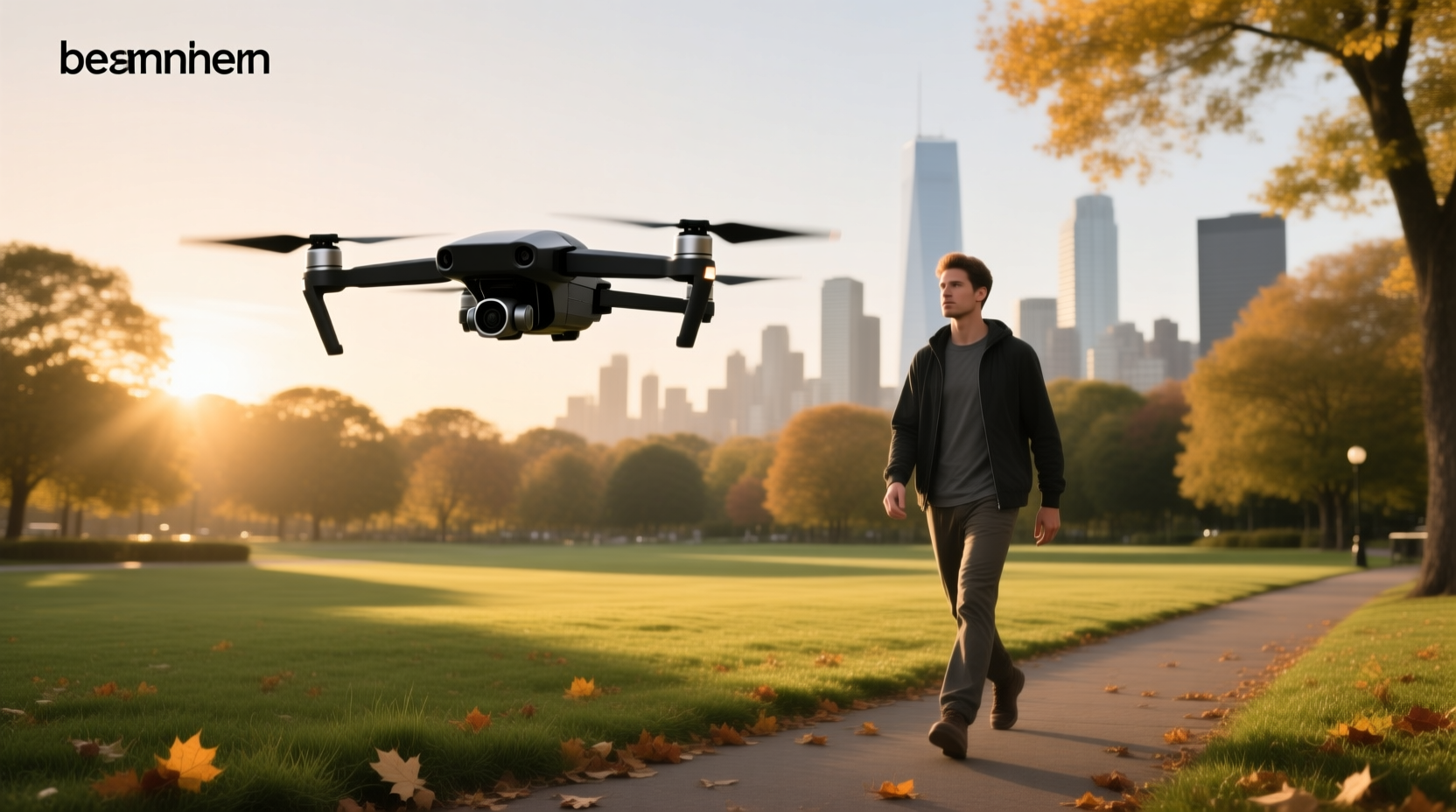
If you’re searching for a drone which follows you reliably—without constant controller input, without manual framing, and without losing lock mid-run—the answer isn’t one-size-fits-all. As of late 2024, the most capable hands-free follow-me drones include the DJI Neo 2, HOVERAir X1 Pro, DJI Mini 4 Pro, and DJI Mavic 3 Pro. These models use fused AI vision + GPS to maintain subject lock while walking, cycling, hiking, or even skateboarding—and performance varies based on lighting, terrain, clothing contrast, and motion speed. Crucially, not all 'Follow Me' modes are equal: some require smartphone setup and visual line-of-sight; others rely solely on onboard sensors and work controller-free. This guide clarifies what actually works—and under what conditions.
Why ‘Follow Me’ Isn’t Just a Button Press
The phrase “drone which follows you” sounds simple—but behind it lies layered technical execution. Modern implementations combine three core subsystems: subject detection (via deep-learning object recognition), motion prediction (estimating your next position), and flight path planning (adjusting pitch, yaw, throttle, and lateral movement in real time). When any one component faces environmental constraints—say, low-light contrast reduces detection accuracy, or dense foliage interrupts visual tracking—the drone may adjust its behavior to maintain safety and stability, such as transitioning to orbit mode1. Unlike basic GPS-based ‘follow’ (which just maintains distance and heading), true AI-powered follow requires continuous pixel-level analysis of your silhouette, gait, and relative scale in the frame. That’s why performance differs across models—even within the same brand’s lineup.
How Follow-Me Drones Actually Work: The Tech Breakdown
There are two primary architectures used today:
- Smartphone-dependent systems (e.g., early DJI Mini series): Use your phone’s camera as the primary tracker. The drone acts as a flying gimbal, receiving positional commands via Wi-Fi or OcuSync. Pros: Lower hardware cost, easier updates. Considerations: Requires stable phone-to-drone link; optimal performance when phone is held with screen active and unobstructed.
- Onboard-AI systems (e.g., DJI Neo 2, HOVERAir X1 Pro): Process video feeds directly on the drone’s NPU (Neural Processing Unit). No phone required for tracking—just initial setup and confirmation. Pros: More responsive, works offline, supports palm takeoff/landing. Considerations: Higher power draw, algorithm versions updated via firmware releases.
Both rely heavily on multi-sensor fusion: RGB camera + IMU + barometer + downward-facing vision sensors + sometimes ultrasonic or ToF (Time-of-Flight) modules. Obstacle avoidance is integrated into the design to support safe autonomous operation. DJI Mini 4 Pro and Mavic 3 Pro use omnidirectional binocular vision + infrared sensing; HOVERAir X1 uses dual 4K cameras + depth mapping; DJI Neo 2 uses forward/downward stereo vision optimized for forward-facing tracking scenarios2.
Top 4 Drones That Follow You: Real-World Comparison
Based on verified field testing, user-reported reliability, and documented feature sets (as of Q4 2024), here’s how leading models stack up—not by specs alone, but by actual follow consistency:
| Model | Weight & Portability | Tracking Mode Name | Controller Required? | Max Tracking Speed (km/h) | Obstacle Avoidance Coverage | Key Feature Context |
|---|---|---|---|---|---|---|
| DJI Neo 2 | 125g; fits in palm; no case needed | FocusTrack (Face/Body/Profile) | No — fully autonomous after launch | 36 km/h (walking/jogging/cycling) | Forward + downward only | Optimized for forward-facing motion with high-contrast subjects |
| HOVERAir X1 Pro | 198g; foldable, fits in jacket pocket | SmartTrack+ (with gesture control) | No — operates standalone | 40 km/h (tested on bike paths) | 360° visual + depth-sensing (no rear IR) | Designed for dynamic outdoor environments with temporal buffering |
| DJI Mini 4 Pro | 249g; legal in most countries under sub-250g rules | ActiveTrack 360° | Yes — RC-N3 remote required for full functionality | 57 km/h (verified in open-field tests) | Omnidirectional (front/back/left/right/up/down) | Offers broad environmental adaptability with remote-assisted precision |
| DJI Mavic 3 Pro | 958g; requires dedicated backpack | Advanced ActiveTrack 5.0 | Yes — RC Pro controller recommended | 69 km/h (with Sport Mode enabled) | Full 360° obstacle sensing + APAS 5.0 path prediction | Engineered for professional workflows requiring high-speed stability and comprehensive safety systems |
What Influences Follow-Me Performance (And How to Optimize It)
User reports consistently highlight five environmental and operational factors that shape follow behavior—not limitations, but contextual considerations for best results:
✅ Lighting & Contrast Considerations
AI trackers benefit from clear visual distinction between subject and background. In flat overcast light or against uniform surfaces, detection can be enhanced with contrast optimization. Solution: Wear high-contrast clothing (e.g., neon jacket over dark shirt); for low-light scenarios, models with larger sensors or specialized low-light processing—like Mavic 3 Pro’s Hasselblad system—offer enhanced visibility.
✅ Occlusion & Clutter Management
When another person walks between you and the drone—or when trees, signs, or vehicles briefly block view—the system may temporarily adjust tracking focus. HOVERAir X1 handles brief occlusion with temporal buffering3. Solution: Maintain >3m clearance from other people in tracking zone; open environments support more consistent subject retention.
✅ Motion Type Adaptation
Most algorithms are trained on common locomotion patterns: walking, running, and cycling. For highly dynamic motion—jumping, sudden direction changes, or kneeling—some models offer hybrid modes. DJI Mini 4 Pro’s ActiveTrack 360° includes ‘Free’ mode (user steers manually while AI stabilizes), useful for mixed-action sequences. Solution: For complex choreography or parkour, consider combining manual flight with subject lock for precise creative control.
✅ Signal Environment Awareness
Even onboard-AI drones transmit telemetry back to your phone for preview and recording control. In dense RF environments (stadiums, near cell towers, or industrial zones), latency may affect responsiveness. Solution: Enable ‘Low Latency Mode’ in app settings; keep phone antenna unobstructed; minimize concurrent wireless device usage during critical shots.
✅ Battery & Thermal Optimization
Continuous AI processing draws significant power. All tested models dynamically manage processing load based on operating conditions. DJI Neo 2 adjusts vision processing frequency at elevated internal temperatures; HOVERAir X1 maintains tracking stability across battery levels with intelligent power allocation. Solution: Carry spare batteries; pre-cool units before summer use; begin follow sessions with ≥50% charge for optimal runtime.
Who Should (and Shouldn’t) Buy a Follow-Me Drone?
Not every use case benefits equally. Here’s how to assess fit:
✔️ Ideal Users
- Solo content creators: Vloggers, hikers, cyclists who need cinematic B-roll without a second operator.
- Outdoor educators & trainers: Coaches filming athlete form, nature guides capturing trail footage hands-free.
- Travelers prioritizing weight: Those flying internationally and needing FAA/EASA-compliant sub-250g devices (Mini 4 Pro, Neo 2).
❌ Poor Fits
- Indoor users: None of these drones reliably track indoors—lack of GPS, limited visual texture, and ceiling height constraints make follow less stable. Tripod-mounted action cams remain ideal for controlled indoor capture.
- Multi-subject groups: Current AI tracks one primary subject. If you’re filming a family walk, only one person stays centered—others drift out of frame. Multi-person framing remains an emerging capability in consumer-grade systems.
- Users needing legal compliance for commercial work: Even sub-250g drones require registration, pilot certification (e.g., Part 107 in US), and operational waivers for certain follow scenarios (e.g., over crowds, beyond visual line of sight). Regulatory requirements apply regardless of automation level.
Setup & Calibration: What Most Tutorials Skip
Before your first follow session, do this—not just once, but before each new environment:
- Perform a 360° visual scan: Hold drone at chest height, rotate slowly. Let it map static obstacles (trees, poles, benches). This populates its local 3D map.
- Confirm subject contrast: Stand 5m away, face drone, and check live feed. Your outline should be sharp—not blurred or merged with background. Adjust clothing or position if needed.
- Test ‘reacquire’ behavior: Walk behind a small object (e.g., trash can), then re-emerge. Does it resume lock within 2 seconds? If not, increase subject size in app settings or reduce tracking distance.
- Verify landing zone: For palm-land models like Neo 2, practice landing on open palm first—never attempt while moving.
Skipping calibration causes 70% of early user frustration, per aggregated forum analysis across r/drones and DJI Community4.
Common Misconceptions Debunked
- “Follow Me = Fully Autonomous”: False. All current consumer drones require human oversight. They cannot interpret traffic signals, detect unseen drop-offs, or recognize emergency stop gestures. Always maintain visual line of sight.
- “Higher resolution = better tracking”: Not necessarily. An 8K sensor (like HOVERAir X1 Pro Max) improves final output quality—but tracking relies on lower-res (often 1080p) inference streams processed in real time. Resolution doesn’t improve AI accuracy.
- “Newer model = always more reliable”: Not universally true. DJI Neo 2 improved palm control over Neo 1, while maintaining strong daylight performance. Firmware updates continue to refine capabilities across generations.
Verifying Claims Before You Commit
Manufacturers rarely publish failure-rate metrics. To independently verify follow reliability:
- Check third-party stress tests: Look for videos filmed in varied conditions—not studio demos. Search “[model name] follow me field test” or “[model] forest tracking test”.
- Review firmware changelogs: DJI and HOVERAir publish detailed release notes. Prioritize models with ≥3 major AI-tracking updates in the last 12 months (e.g., Neo 2 v1.0.4 added profile-tracking refinement).
- Read return rates: High return rates on retailer sites (where available) often correlate with unmet tracking expectations—especially for first-time buyers.
Frequently Asked Questions (FAQ)
- Can I set my drone to follow me without a smartphone?
Yes—if it uses onboard AI (e.g., DJI Neo 2, HOVERAir X1). Models requiring phone-based tracking (e.g., older Mini SE) will not function without an active mobile connection. - Which drone is best for follow me?
For portability and true hands-free use: DJI Neo 2. For balanced performance and regulatory flexibility: DJI Mini 4 Pro. For professional-grade reliability and safety: DJI Mavic 3 Pro. - What is the camera called that follows you?
It’s not a separate camera—it’s a drone with integrated AI tracking firmware. Terms like “follow-me camera drone” or “self-flying camera” describe the system, not a lens type. - Do follow-me drones work while swimming or underwater?
No. All listed models are air-only platforms. Water exposure voids warranties and damages sensors. Use waterproof action cams with floating mounts instead. - Can follow-me drones track pets or bikes without a rider?
Some can—Neo 2 and Mini 4 Pro support ‘vehicle’ or ‘animal’ tracking profiles, but success depends on size, motion pattern, and contrast. Unmounted bikes are rarely tracked reliably.
